
A dental marketing agency is an outside team that runs your Google Ads, local SEO, review workflow, website, and reporting for a monthly retainer, so a single practice owner does not have to build and manage that stack in house. The question every practice above $600,000 in annual production hits sooner or later. Agency retainer or in-house team.
The answer depends on three inputs. Production tier, number of locations, and if the practice already has a marketing person carrying at least one channel well. Get the read wrong and you burn 18 to 30 months of budget on the wrong structure. This guide walks the real math side by side, tier by tier. Every number came from a client we onboarded or an in-house team we replaced.
Written from what we see on every discovery call at Redefine Web. Nothing here is theoretical. Skills gap by channel. Tool stack cost. Hiring risk. Turnover math. A decision tree that tells you which model fits today and when to switch as you scale.
Dental marketing agency vs in-house cost breakdown
The honest cost comparison is not agency retainer against salary. It is total marketing operating cost against new patients booked at year end. Salary is one line item. Tools, training, hiring cost, turnover, and channel results all move the total. Here is the real math at four practice tiers.
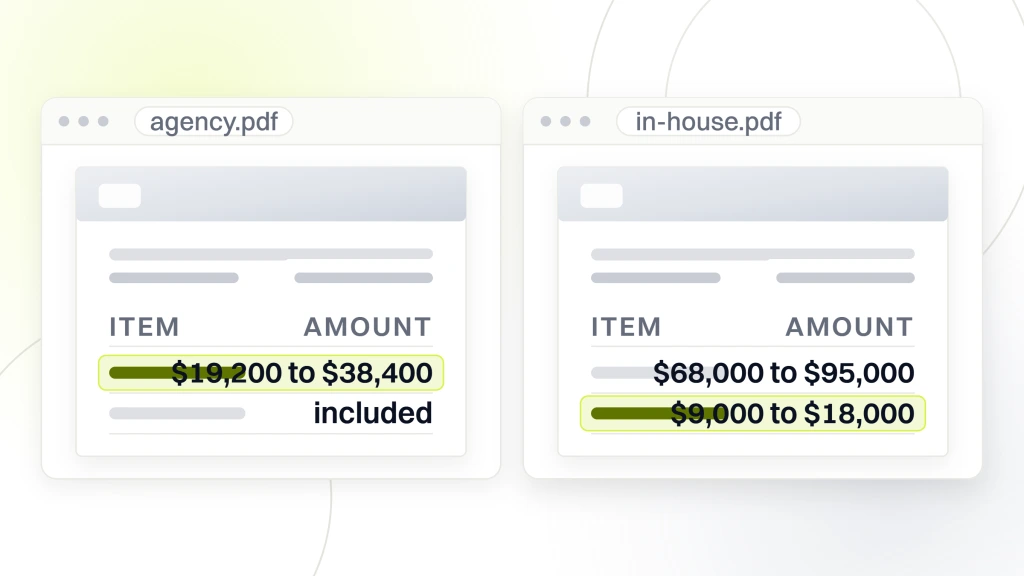
The retainer sits inside a predictable band. In-house cost has a wider variance, so it includes hiring risk, turnover replacement, and the tool stack the person needs to do the job. Practices that underestimate the tool stack usually spend $9,000 to $18,000 per year on software the agency would have absorbed. That number matters at every tier.
| Practice tier | Agency total year | In-house total year | Typical winner |
|---|---|---|---|
| $600K to $1.2M production | $19,200 to $38,400 | $68,000 to $95,000 | Agency |
| $1.2M to $2.5M production | $32,000 to $57,600 | $82,000 to $118,000 | Agency or hybrid |
| $2.5M to $5M production | $48,000 to $86,400 | $110,000 to $175,000 | Hybrid |
| $5M plus, multi-location | $96,000 to $216,000 | $220,000 to $520,000 | In-house plus agency retainer |
Tool stack the in-house team actually needs
A functioning in-house dental marketing team needs 6 to 9 tools running at all times. Call tracking runs $75 to $199 monthly. Review automation, $89 to $199. Local SEO tracking, $99 to $299. Landing page builder, $49 to $149. Email and text automation, $89 to $299. Design tools, $30 to $89. Analytics and dashboarding, $75 to $299. Total tool stack lands at $6,000 to $18,000 per year. Most practices we audit have been guessing at 3 to 5 tools and missing the rest.
The agency absorbs that stack inside the retainer. On top of that, agency access is enterprise-tier on tools like SEMrush and CallRail, which single-seat practice licenses do not touch. That gap is real. It shows up in the reporting depth and in the campaign optimization pace.
Hiring risk and turnover cost per year
Dental marketing coordinators turn over at 22 to 34 percent per year on industry hiring benchmarks. Every turnover costs the practice $8,000 to $22,000 in recruiting, onboarding, lost momentum, and account handoff. Practices that hired three marketing coordinators inside two years usually spent more on turnover than they would have spent on a competent agency for the full period. That risk is invisible on the offer letter. It shows up 14 months later.
Dental marketing company vs in-house by channel
Not every channel is a clear agency win. Some channels the in-house team runs better so they know the practice culture, the doctor voice, and the patient stories. Some the agency runs better so they have specialist depth and cross-practice data. The right split changes as the practice grows. Here is the channel-by-channel decision framework a dental marketing company usually recommends.
The framework is not a blanket rule. It is a starting point. Any practice can move a channel from agency to in-house or the other way based on who at the practice is strong in what area. What matters is that every channel has an accountable owner with the time and tooling to run it well. Our dental marketing services post lists the deliverables that each channel requires.
Paid ads is usually an agency win
Google Search, Local Services Ads, and Meta run better through a specialist agency at almost every practice tier below $5M production. The reason is bid management. A single-person in-house team cannot spend 8 to 15 focused hours per week on Google Ads. An agency specialist runs 6 to 12 dental accounts at once and applies cross-account pattern recognition that no single-practice hire can match. Cost per patient lands 20 to 45 percent lower on agency-managed paid than in-house-managed paid at that scale.
Real example. Smile Design Dentistry, a 50-plus office DSO in Central Florida, cut cost per call 30 percent over a 12-month curve and lifted paid conversion 20 percent under a coordinated in-house plus agency stack. The gains came from a specialist paid team layered under the in-house director, not from either side working alone.
Local SEO is a shared workstream
Google Business Profile management, review response, and photo uploads run better in-house so the practice manager has real-time knowledge of what happened at the practice today. Technical local SEO, citation cleanup, and cluster content strategy run better through an agency so they require specialist tooling and cross-market data. The clean split is in-house handles daily GBP and reviews, agency handles quarterly technical work and content strategy.
Content marketing is often an agency win
Dental content marketing needs 12 to 24 well-targeted posts per year, each 1,800 to 3,500 words, with dental-specific accuracy and local intent. That level of output rarely fits an in-house marketing coordinator already running paid, reviews, and reporting. Specialist agencies produce the volume at $300 to $800 per post with medical review. Practices that tried to run content in-house usually publish 3 to 5 posts per year and abandon the strategy inside 12 months.
Reviews and reputation is an in-house win
Reviews live and die at the front desk. The person who just handed the patient their post-op instructions is the person best placed to ask for a review 60 seconds later. That timing is the difference between a 12 percent request-to-review rate and a 4 percent one. An agency can build the automation, the drip flow, and the response templates, but the ask itself belongs in-house. Delicate Dental Group hit 700 plus verified reviews at launch on exactly that split, in-house asks powered by an agency-built workflow.
When an in-house dental marketing team wins
In-house wins at multi-location DSO scale and at practices with a strong existing marketing hire. Once production hits $2.5M or 3 plus locations, operational complexity crosses the threshold where a single point of contact inside the organization pays for itself. Below that threshold, agency retainers usually beat in-house.
The exception is a practice that already has a marketing coordinator delivering results. Do not fire someone competent to save $18,000 on an agency retainer. If they are running a 4.5 to 5.5 percent form-fill rate on the website, growing reviews at 15 to 30 per month, and holding cost per patient inside a tight band, they are earning their salary. Add an agency for the channels they are weak in instead of replacing them.
At DSO scale, in-house always wins
A dental service organization with 8 or more locations always needs an in-house marketing director. The operational complexity of coordinating campaigns, brand consistency, cross-location reporting, and vendor management exceeds what an outsourced agency can deliver as the single point of contact. That director usually runs a small team plus one or two agency retainers for specialist channels like technical SEO and creative production. Smile Design Dentistry with 50-plus offices runs the model successfully, and it produced a 30 percent cost per call reduction and 20 percent PPC conversion improvement under the in-house plus agency stack.
When you already have a strong marketing hire
Practices that already employ a marketing coordinator producing results have a different question. Should we replace them or supplement them. The answer is almost always supplement. Keep the coordinator on what they run well. Add an agency for the channels they are weak in. Cost is $600 to $2,400 monthly for a partial-scope retainer, cheaper than a full agency handoff, and it protects the institutional knowledge the coordinator built.
When a dental marketing agency wins
An agency wins at single-location practices below $2.5M, at practices where the current marketing hire is underperforming, and at scratch launches. The reason is depth. An agency with 20 to 100 dental clients has seen every failure pattern across markets and applies the fixes inside a quarter.
Agency wins stack fast when the practice needs to move. New location launch. Rebrand. Website rebuild. New service line entry. Those projects require 200 to 500 hours of concentrated specialist work inside a 90-day window. An in-house team of one cannot absorb that surge. An agency can staff it inside a week and hand back the ongoing operation at the end.
Single-location practices under $2.5M
At $600K to $2.5M in annual production, a dental marketing agency retainer of $1,600 to $3,200 per month books 22 to 55 new patients monthly at a blended cost per patient of $85 to $145. That is 3 to 6 times the return of a single in-house hire at the same practice tier. The math is not close. Practices at this tier almost always win with an agency, unless there is a specific reason to build in-house culture around marketing.
Scratch practices in month one
A brand-new practice with no reviews, no website, and no local presence needs a full stack running by opening day. The in-house model cannot deliver that. Even the best marketing coordinator needs 3 to 6 months to build the assets. A dental marketing agency delivers the website, GBP setup, review workflow, and initial paid campaigns inside 30 to 45 days. Delicate Dental Group launched from scratch that way and hit 700 verified reviews plus 280 percent map-driven call growth inside months. The agency model funded the launch. Once the practice hit 800 active patients, they added a coordinator.
The hybrid model most growing practices adopt
Most practices past $2.5M in production land on a hybrid model. One in-house coordinator or manager plus one agency retainer of $1,200 to $2,800 per month for specialist channels. The coordinator owns Google Business Profile, review workflow, patient content, and cross-department coordination. The agency owns paid ads, technical SEO, content production, and monthly reporting.
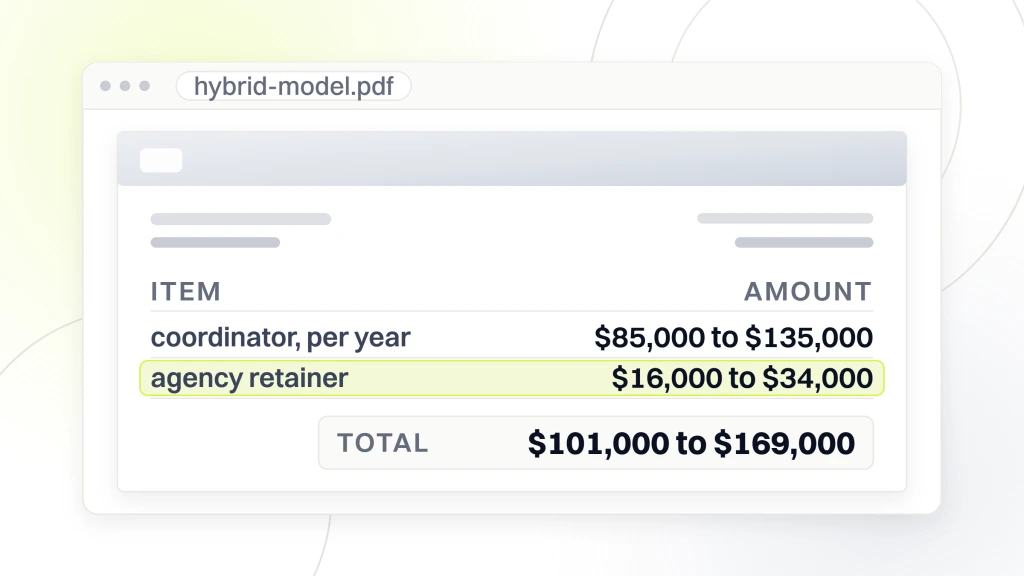
The hybrid model works so it removes single-point failure. Industry surveys on marketing team structure, including the Dental Economics guidance on hiring a marketing manager, back up this pattern across independent practices and DSOs. If the coordinator leaves, the agency covers the specialist channels until a replacement is hired. If the agency underperforms, the coordinator maintains the core workstreams until a new agency is onboarded. Practices running the hybrid for 3 or more years usually hold cost per patient inside a 15 to 20 percent band year over year and grow production 12 to 25 percent annually.
Who owns what in a hybrid split
In-house owns Google Business Profile daily activity, review responses, patient story content, event marketing, staff training, and cross-department coordination. Agency owns Google Ads, Local Services Ads, Meta Ads, technical SEO audits, content production, landing page work, and monthly reporting. Weekly 30-minute calls keep the two aligned. Monthly reporting comes from one dashboard the agency builds and the coordinator populates with practice-side data.
Hybrid model total cost
A hybrid model at a $2.5M to $5M practice runs $85,000 to $135,000 per year on coordinator salary plus benefits, plus $16,000 to $34,000 per year on the agency retainer. Total marketing operating cost lands at $101,000 to $169,000. The practice usually books 320 to 640 new patients per year on that spend, blended cost per patient of $170 to $265. Practices without the hybrid usually pay more per patient so the in-house team is stretched thin or the agency is doing work the practice could do cheaper in-house.
How to evaluate a dental marketing firm before signing
Not every dental marketing firm is worth the retainer. 40 to 55 percent of the agencies we hear about from prospective clients underdeliver on basic scope. The signals that separate a competent agency from a coasting one are specific. Ask the questions below before signing.
The core question is always the same. Show me the last three dental client results in booked patients per month, not clicks or impressions. Agencies that show cost per patient, booked patient volume, and retention numbers inside the first 20 minutes of the pitch are the ones worth the retainer. Agencies that dodge the question and pivot to reporting features are the ones you skip. See our dental marketing agency post for the full red-flag checklist.
- Show me the last three client results in booked patients per month
- Who is my day-to-day contact and how many other dental accounts do they run
- What is your monthly reporting cadence and what four numbers lead the deck
- Do you own the ad accounts or does the practice own them
- What is your contract minimum term and what is the exit process
- How do you handle attribution across Google, Meta, calls, and forms
- What does the first 90 days look like from day one to day 90
Red flags on the pitch call
Vague guarantees. Pitches that promise a specific number of leads or a first-page ranking on day 60. Refusal to name the account manager. Retainers that include a percentage of ad spend on top of the flat fee. Contract minimums beyond 12 months with no exit clause. Every one of those is a signal the agency is not confident in the value they deliver. Walk. There are 800 dental marketing agencies in the US. Half of them do not carry these red flags.
Ad account and website ownership
The practice always owns the Google Ads account, the Meta Business account, the domain, the hosting, and the Google Business Profile. Never sign an agreement where the agency owns those. Agencies that push ownership onto their own entity structure it to make offboarding painful. Legitimate agencies build accounts under the practice ownership and grant themselves manager access. If the agency is not willing to structure it that way, walk. This is a load-bearing test for how the agency plays long term.
Hiring an in-house dental marketer that works
The in-house hire is only a win if the person you hire has the specific skill set the role demands. That skill set is narrow. Local search, Google Business Profile, review workflow, basic paid ads, dental-specific content, and dental practice management system familiarity. Most marketing coordinators in the general job market have 2 to 3 of those. A dental practice needs someone with 5 to 6.
The hiring pipeline is small. Most successful in-house dental marketers came from another dental practice, from an ex-agency background, or from a healthcare-adjacent marketing role. Job posts to general marketing candidate pools produce 40 to 80 applicants with almost no dental experience. Referrals from other practice managers, dental industry LinkedIn groups, and dental conferences produce 6 to 12 qualified candidates. The referral pipeline is worth the extra effort every time.
Writing the job description
The job description names the four workstreams the person will own. Google Business Profile, review workflow, paid ad management, and reporting. Skills required are Google Ads certification, Meta Blueprint familiarity, spreadsheet fluency, and dental practice management system exposure. Bonus skills are basic HTML, landing page builders like Unbounce or Instapage, and CRM familiarity. Salary range at $58,000 to $82,000 base plus 10 to 20 percent performance bonus tied to booked patients per month.
Onboarding the first 90 days
First 30 days, shadow the front desk, learn the practice management system, meet every provider, review the last 12 months of marketing spend and results. Days 31 to 60, take over Google Business Profile, review workflow, and reporting cadence. Days 61 to 90, take over paid ad management under agency or consultant supervision. Full autonomy at day 91 with monthly benchmarks against the pre-hire baseline. Practices that skip the shadow phase usually watch the marketer leave inside 8 months so they never built a practice-side network. See our dental marketing services post for the workstream deliverables the marketer should own.
When a dental marketing consultant is the right first step
Sometimes the right answer is neither an agency nor an in-house hire. A dental marketing consultant, engaged for a 60 to 90 day audit and roadmap, costs $4,000 to $12,000 one time and answers the question of what to build before spending on either model. Practices stuck between tiers, or with a churned agency and no clear next step, get the most from this option. The consultant delivers a channel-by-channel gap map, a tool stack recommendation, and a hiring or agency shortlist. From there the decision to go agency, in-house, or hybrid is data-backed, not gut-driven.
The trap to avoid. Consultants who convert the audit into a retainer with no walk-away option first. If the consultant is pitching the agency retainer on top, the audit is a sales tool, not a diagnostic. Ask them upfront if they will take the retainer if the roadmap suggests it. A firm no, meaning they hand you off to two shortlisted agencies, is the right answer for objectivity. Ours is one of many models on the market. Test the consultant against that filter.
Dental marketing agency vs in-house decision tree
The decision is not one answer. It is a decision tree that runs on three inputs. Practice production, number of locations, and existing marketing skill on staff. Walk the tree in order. The output tells you if to hire, retain an agency, run a hybrid, or wait until the next production tier before changing anything.
Most practices we talk to have already made one of the four choices. Half of them chose wrong for their current tier. The decision tree gives them permission to switch. Switching costs 60 to 90 days of transition friction and $4,000 to $12,000 in handoff work. That cost is almost always dwarfed by the improvement in cost per patient inside the following two quarters. See our dental marketing plan guide for the annual template every model needs.
Under $1.2M production, single location
Hire a dental marketing agency at $1,600 to $2,400 monthly. Do not build in-house at this tier. The math does not work. Every dollar of coordinator salary produces a lower return than the same dollar spent on a specialist retainer. Reevaluate at $1.5M production. Practices that jumped to in-house at this tier almost always regretted the decision inside 12 months.
$1.2M to $2.5M production, single or two locations
Run a full-scope agency retainer at $2,400 to $3,600 monthly, or a small hybrid with a part-time marketing hire plus an agency for paid. The hybrid works only if the practice manager has 8 to 12 hours per week to coordinate the pieces. If not, stay with the agency. Reevaluate at $2.8M or a third location. Sources like the ADA practice management resources and the Dental Economics marketing archive back up the tier thresholds.
$2.5M plus production or 3 plus locations
Run the hybrid or transition to in-house with an agency retainer for specialist channels. Full in-house with no agency almost never wins below 8 locations so the bench depth is not there. At 8 plus locations, in-house wins and the agency retainer becomes optional. Above 20 locations, run in-house with occasional specialist consulting engagements for major initiatives like rebrand or new market entry.
Make the dental marketing agency call that fits your tier
The bottom line on this comparison. Below $2.5M production, a dental marketing agency almost always wins on cost per patient and speed to result. At $2.5M to $5M, hybrid is the model that survives coordinator turnover and covers specialist channels at the same time. Above $5M with multi-location, in-house plus an agency retainer for niche channels is the durable structure. Match the model to the tier, not to the last vendor pitch you heard.
Redefine Web has run this playbook across DSOs like Smile Design Dentistry and scratch launches like Delicate Dental Group, and the pattern holds at every tier. If the current model is not producing the cost per patient the tier demands, walk the tree in this guide and switch. Book a 30-minute call and we will map your current model against the decision tree and hand back a written recommendation, agency or not.