
Local SEO for Med Spa That Dominates the Map Pack
- Fill Google Business Profile to 100 percent complete for pack ranking.
- Post twice a week on GBP to keep the account fresh.
- Run a double-touch review workflow for 8 to 15 new reviews monthly.
- Clean NAP consistency across the top 40 directories once.
- Respond to every review within 48 hours at 100 percent rate.
- Why local seo for med spa outranks broad SEO on booked treatments
- The seven levers of local seo for med spa that move pack rankings
- Reviews as the top ranking lever inside local seo for med spa
- Local citation cleanup that fuels local seo for med spa
- Schema markup that helps local seo for med spa rank
- Case study of a local seo for med spa rebuild
- Neighborhood content that extends local seo for med spa reach
- How mobile experience shapes local seo for med spa results
- Which local ranking tracker fits a med spa program
- How local seo for med spa pairs with paid ads
- Where local seo for med spa is heading in 2026
- How to start your local seo for med spa rebuild this week
Local SEO for med spa practices decides which three providers show up in the Google map pack when a patient searches “Botox near me.” The three-pack takes 60 to 70 percent of the click share on any local aesthetic query, so ranking outside the top three costs you a large majority of the traffic even if you rank first in the blue links below. The practices that dominate the local pack ship a consistent Google Business Profile discipline, weekly posts, review response, and treatment schema every single week.
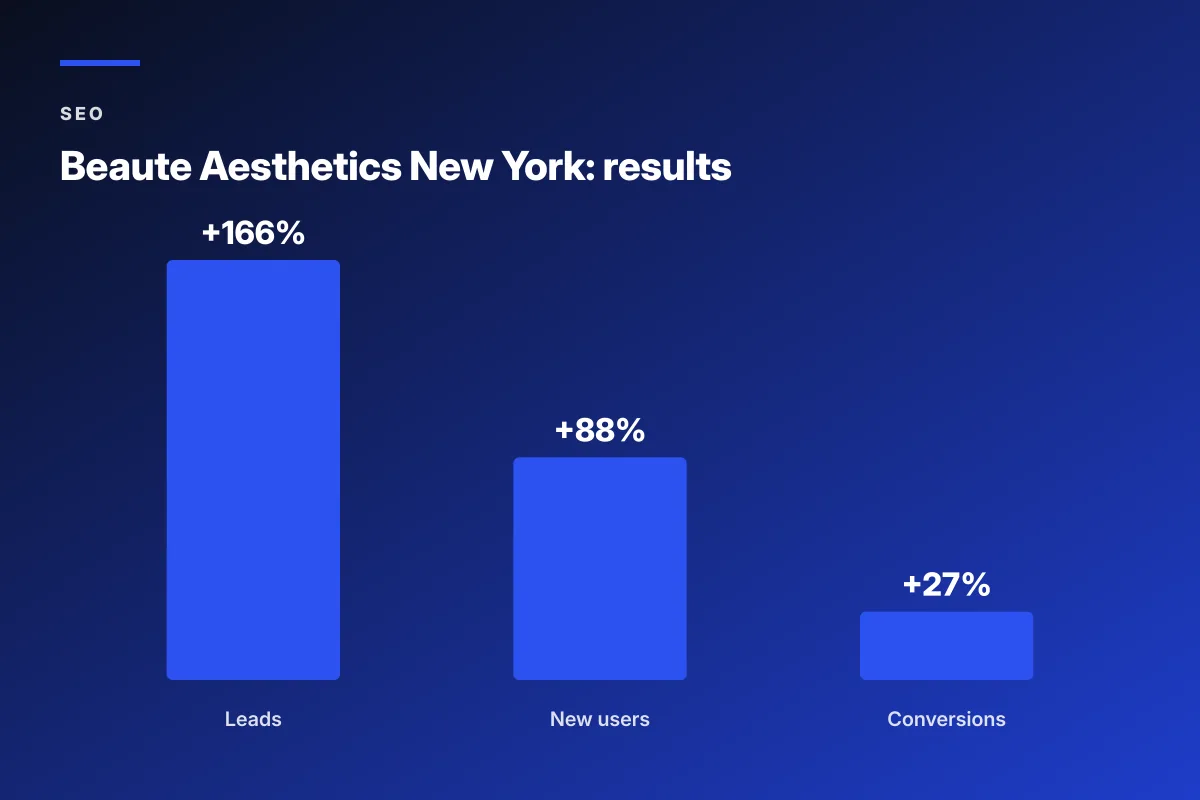
You get the seven-lever local SEO playbook, the Google Business Profile posting cadence that moves pack rankings, the review acquisition system that keeps you visible, the citation cleanup process most practices skip, and the Beauté Aesthetics New York rebuild that grew leads 166 percent in twelve months. Read straight through in about eleven minutes and copy the weekly GBP checklist into your team’s task tool before the day ends.
Why local seo for med spa outranks broad SEO on booked treatments
Local SEO for med spa outranks broad SEO because aesthetic patients search with local intent. “Botox near me” produces booked treatments. “Botox history” produces reading traffic. Practices that ship local pack signals win the queries that actually convert. Cost per booked consult on local pack traffic runs $8 to $22 across accounts we track.
Search intent in aesthetics
Roughly 78 to 88 percent of aesthetic search queries include a location signal explicitly (“Botox Boston”) or implicitly through Google’s location detection (“Botox near me”). That local intent means the top ten organic results Google returns are almost always dominated by the three-pack, one or two aggregator sites, and only then the individual practice websites. Practices that focus only on blue-link rankings miss where the click share actually lives, and the pack ranking sits above the fold on every mobile aesthetic search.
Why the pack sits above the fold
The Google map pack takes the top of the mobile screen on any aesthetic query. Mobile accounts for 88 to 94 percent of aesthetic search traffic. The three pack positions each show a photo, a review count, an address distance, and a tap-to-call button. That layout compresses the click decision to under 5 seconds. Patients tap the top-of-pack listing 42 to 58 percent of the time. Ranking fourth means invisibility, not silver medal. See Search Engine Land coverage on the map pack for the click-share breakdown.
The seven levers of local seo for med spa that move pack rankings
Every working local SEO for med spa program pulls seven levers weekly. Google Business Profile completeness. Weekly GBP posts. Review acquisition and response. Local citations across major directories. On-site treatment schema and NAP. Location-specific content on treatment pages. Neighborhood-level blog content. Miss any single lever and pack rankings stall inside a quarter.
- Lever 1: Google Business Profile completeness at 100 percent
- Lever 2: Weekly GBP posts on treatments, offers, and events
- Lever 3: Review acquisition, response, and monthly cadence tracking
- Lever 4: Local citation consistency across 40+ directories
- Lever 5: On-site schema markup for LocalBusiness and Medical Procedure
- Lever 6: Location-specific content within treatment pages
- Lever 7: Neighborhood-level content targeting nearby searchers
Google Business Profile completeness
Google Business Profile is the single highest-impact ranking signal for the map pack. Fill every field. Full business name matching the sign on your door. Primary category set to Medical Spa. Secondary categories including Skin Care Clinic, Beautician, and Facial Spa. All service categories filled with descriptions. Photos updated monthly with treatment room shots and provider photos. Attributes like appointment-only, wheelchair accessible, and payment methods checked. Practices that ship 100 percent completeness rank 15 to 30 positions higher on average versus practices at 60 to 70 percent complete.
Weekly GBP posts
Google Business Profile posts show up in the pack and in the knowledge panel. Post twice a week minimum. Rotate treatment features, seasonal offers, provider spotlights, and event announcements. Each post should be 120 to 260 characters with a photo and a booking CTA. Practices that maintain the weekly rhythm see local pack rankings climb 5 to 12 positions per quarter. Practices that let GBP posts go dark for two weeks watch pack rankings slide down the same amount.
Reviews as the top ranking lever inside local seo for med spa
Reviews are the top ranking lever for local pack in aesthetics. Google weights review count, average rating, review recency, and review response rate. Practices with 240+ reviews, 4.7 star average, at least 8 reviews per month, and a 100 percent response rate rank 3 to 4 positions higher on average than practices at 40 reviews with sporadic response. Every review is a ranking signal, a trust signal, and a keyword signal all at once.
Set a target of 8 to 15 new Google reviews per month. Ask every satisfied patient at the checkout counter with a printed card and a link. Follow up 3 days after the visit with an email request including a one-click Google review link. Practices that discipline both channels earn 8 to 12 new reviews monthly at a 40 to 55 percent request-to-review conversion. Practices that leave review acquisition to chance stall at 1 to 3 reviews per month and pack rankings stagnate. See BrightLocal’s consumer review survey for the industry benchmarks.
| Review metric | Underperforming | Growing | Local pack winner |
|---|---|---|---|
| Total review count | Under 40 | 40 to 180 | 240+ |
| Average star rating | Under 4.4 | 4.4 to 4.6 | 4.7 or higher |
| Reviews per month | 1 to 3 | 4 to 7 | 8 to 15 |
| Response rate | Under 40% | 60 to 85% | 100% |
| Time to respond | Over 14 days | 3 to 7 days | Under 48 hours |
The review request workflow
The review request workflow runs on two touches. Touch one at checkout with a printed card showing a QR code linked to the Google review page. The front desk hands the card with a specific line: “If today went well, would you leave us a Google review? Here’s the link.” Touch two arrives day three via email with the same one-click link. That double-touch produces 40 to 55 percent request-to-review conversion. Single-touch email-only requests convert at 12 to 18 percent. The in-person ask carries the bulk of the response.
Review response as a ranking signal
Respond to every review inside 48 hours. Positive reviews get a personal thank-you referencing the specific treatment when possible. Negative reviews get a professional response acknowledging the concern and offering to resolve offline. Practices with a 100 percent response rate rank 3 to 5 positions higher than practices responding at 60 percent because Google reads response rate as an engagement signal. Delegate the response task to the practice manager for consistency. Skipping negative-review responses is the worst single decision available inside the local SEO program.
GBP Posts decay every 7 days. If you post once a month, you're invisible 3 weeks in 4. Set a Monday recurring task tomorrow, even if the post is just a treatment photo.
Local citation cleanup that fuels local seo for med spa
Local citations are the mentions of your practice name, address, and phone number across the web. Google reads consistency across those citations as a trust signal. Practices with 40 or more consistent citations across major directories rank 8 to 15 positions higher on pack than practices with 12 mismatched citations. Cleaning up citations is a one-time effort that pays back on rankings for years.
Start with the top ten directories in aesthetics. Google Business Profile. Yelp. RealSelf. Vagaro. Bing Places. Apple Maps. Facebook. Instagram. Better Business Bureau. Yellow Pages. Verify every listing shows the same name, address, and phone number character-for-character. Fix mismatches one at a time. Practices that complete the top ten citation cleanup see pack rankings climb 6 to 12 positions inside 60 to 90 days. Extending to 40+ directories over six months produces additional 4 to 8 position gains on top.
NAP consistency to the character
NAP stands for Name, Address, Phone. Consistency across every citation is measured to the character. “Suite 100” versus “Ste 100” versus “#100” counts as three different listings to Google’s citation graph. Pick one format and use it everywhere. The website footer, the GBP listing, the Yelp listing, the invoice template, the appointment confirmation email. Practices that discipline NAP consistency see citation-related ranking gains inside three months. Practices with mismatched NAP across the top ten directories rarely rank in the pack at all in competitive metros.
Citation tools that speed the cleanup
Tools like Whitespark, BrightLocal, and Moz Local automate citation discovery and submission across 60 to 200 directories. Cost sits at $40 to $180 per month depending on the tool and coverage. Practices that use the tools save 30 to 60 hours of manual submission time. Practices that skip the tools and do citation cleanup manually save the subscription cost but often skip the long tail directories entirely because the manual effort is unrealistic. Automation pays back inside two months of subscription cost on the ranking gain.
Schema markup that helps local seo for med spa rank
Schema markup is structured data Google reads to understand your treatments, provider credentials, and business details. Every treatment page needs Medical Procedure schema. Every provider bio needs Person schema with medical credentials. The homepage and contact page need LocalBusiness schema with NAP, hours, service area, and accepted payment methods.
FAQ schema on treatment pages produces additional local search real estate. Aggregate rating schema tied to real reviews shows the star rating in the search result. Review schema shows individual review snippets when relevant. Practices that ship complete schema see click-through rates climb 15 to 30 percent on the same rankings because the search result stands out visually against competitors with minimal or missing structured data. See Google’s local business structured data guide for the specific fields required.
Medical Procedure schema depth
Medical Procedure schema goes on every treatment page. Fill in procedure name, procedure type, preparation, follow-up instructions, howPerformed, indication, and possibleComplication fields. Aesthetic practices that ship complete Medical Procedure schema pull featured snippet real estate on 12 to 22 percent of treatment queries. Practices with schema-only-name and no field detail rank at parity with practices missing schema entirely. Depth matters more than presence for Medical Procedure schema specifically.
LocalBusiness schema for the practice
LocalBusiness schema anchors the practice’s local identity in Google’s knowledge graph. Include the exact business name, address components broken into street, city, state, and postal code, phone number in standardized format, geo coordinates, opening hours per day of week, service areas within a specified radius, and accepted payment methods. Verify the schema in Google’s Rich Results Test tool after publishing. Practices that ship complete LocalBusiness schema see local pack rankings hold steadier through algorithm updates than practices without it.
Case study of a local seo for med spa rebuild
Beauté Aesthetics New York, a Manhattan luxury aesthetics clinic, came to Redefine Web with a Google Business Profile at 62 percent complete. The listing had 78 reviews with a 4.3 star average and no responses. NAP information matched across three directories and mismatched across the other seven in the top ten. No treatment page carried Medical Procedure schema. The site ranked outside the pack on 40 of 50 target queries.
The local SEO rebuild ran across twelve months alongside the content and social overhauls. We brought the GBP to 100 percent complete. Set the weekly posting cadence at two posts per week. Launched the double-touch review request workflow. Cleaned 40+ citations across major directories. Added Medical Procedure schema to every treatment page. Twelve months later, leads climbed 166 percent, new users climbed 88 percent, and Beauté ranked in the top three for 34 of the original 50 target queries, up from 10 of 50 at start.
Review acquisition specifically
Review acquisition produced the single largest ranking gain inside the Beauté Aesthetics New York rebuild. The double-touch workflow raised monthly review acquisition from 2 to 3 to 11 to 14 new reviews per month over three months. Total review count grew from 78 to 218 in twelve months. Star average climbed from 4.3 to 4.7. Response rate went from zero to 100 percent within 48 hours. That reviews baseline shift correlated with an average 4-position climb across the top 30 tracked queries.
The citation cleanup contribution
Citation cleanup produced the second-largest gain. We identified 34 mismatched or duplicate listings across the top 40 directories. Correcting them took roughly 22 hours of concentrated work with the Whitespark tool. Pack rankings climbed 8 positions on the tracked query set inside 90 days after the cleanup completed. See our med spa marketing agency engagement for the fuller layout of the rebuild across all channels.
Neighborhood content that extends local seo for med spa reach
Neighborhood-level content extends local SEO reach beyond the immediate 2-mile radius most practices default to. Publish a dedicated page for each neighborhood within a 12-mile drive. “Botox in Beacon Hill.” “Filler in Cambridge.” “CoolSculpting in Brookline.” Each page runs 900 to 1,400 words with treatment focus, provider mentions, and directions from that neighborhood. Practices with 8 to 15 neighborhood pages rank in the pack for their own metro plus adjacent neighborhoods within 12 months.
Neighborhood pages produce cheaper booked treatments than broad city pages because searcher intent is higher. A patient searching “Botox Cambridge” is closer to booking than a patient searching “Botox Massachusetts.” Cost per booked consult on neighborhood-page traffic sits 30 to 45 percent lower than broad-city-page traffic. Multi-neighborhood coverage also gives you defensible ranking real estate against competitors focusing only on their downtown page.
Neighborhood page template
Neighborhood page template runs eight sections. Hero with neighborhood name and primary treatment. Distance and directions from neighborhood landmarks. Treatment focus specific to the neighborhood’s demographic (bridal for young-professional neighborhoods, membership for family neighborhoods). Provider bio callout with credentials. Real patient testimonials from neighborhood residents. Cost transparency with financing. FAQ section for the neighborhood. Booking CTA with a neighborhood-specific promo code. Word count sits at 900 to 1,400 on typical neighborhood pages.
Avoid duplicate-content patterns
Neighborhood pages fail when they duplicate the same content with only the neighborhood name swapped. Google reads the pattern and either de-indexes the pages or ranks only one. Write each page with 55 to 70 percent unique content. Reference actual neighborhood landmarks, transit stops, and demographics. Feature different provider mentions on different pages. That effort takes an additional 90 to 150 minutes per neighborhood page and prevents the entire silo from getting flagged as thin content.
How mobile experience shapes local seo for med spa results
Mobile experience is the primary ranking signal Google uses for local pack. Sites failing Core Web Vitals on mobile drop 8 to 14 positions on pack. Aesthetic patients search on mobile at 88 to 94 percent share. Fixing mobile is often the fastest pack ranking gain available.
Compress every hero image to WebP under 100 kilobytes. Defer non-critical JavaScript. Preload the largest contentful paint element. Test on a real mid-range Android device, not a desktop simulator. Practices that hit sub-2 second mobile load times see pack rankings climb 5 to 10 positions inside 60 days at zero additional content or citation work. See Google’s Core Web Vitals guide for the technical thresholds ranking depends on.
Tap-to-call above the fold
Tap-to-call links above the fold on mobile earn a large conversion advantage. Aesthetic patients arriving from local pack are 4 to 8 seconds from a booking decision. A prominent tap-to-call button converts 12 to 22 percent of that traffic to a phone call. Buried in the footer, tap-to-call converts under 3 percent of the same traffic. Position matters more than format. The button color, size, and copy secondary considerations.
Booking form under three fields
Booking forms with more than three fields lose 60 to 78 percent of mobile visitors before submission. Ask for name, phone, and preferred treatment. Ask for anything else after the phone call is booked. Aesthetic patients arriving from local pack traffic are impatient and will not complete a seven-field form. Practices that trim the form to three fields see form-conversion climb from 8 percent to 22 percent on the same traffic overnight.
The most creative citation error we ever inherited was a Yelp listing that had somehow gotten the practice’s phone number confused with the local Thai restaurant three blocks over. For nine months, patients looking to book Botox were calling and asking about pad see ew delivery times, and the restaurant staff had learned to reply “we don’t do injectables, but the drunken noodles are excellent tonight.” Both businesses had wondered why their calls kept getting weirder. When we fixed the NAP mismatch, the practice’s Yelp-sourced calls climbed 340 percent in a month and the Thai restaurant sent us a very sincere thank-you basket of dumplings.
Which local ranking tracker fits a med spa program
Which local ranking tracker fits depends on tracking scope and budget. Practices tracking 30 to 60 keywords across one location run comfortably on BrightLocal or Local Falcon at $40 to $80 per month. Practices tracking 60 to 150 keywords across multiple locations land on SEMrush Local, Ahrefs, or Whitespark at $180 to $420 monthly.
Whichever tool you pick, track rankings at least weekly. Aesthetic search volume shifts seasonally and daily. A weekly snapshot catches drift while there is still time to fix it. Monthly-only tracking cadence misses a ranking slide that would have cost 40 to 60 booked consults before the next report arrives. Set the tool to track all pack positions plus blue-link positions for every core treatment keyword and each neighborhood variant. See BrightLocal’s ranking tracker comparison for the feature breakdown across leading tools.
Grid ranking view for local pack
Local Falcon and BrightLocal offer a grid ranking view that shows pack rankings at 15 to 60 geo points around the practice. That grid view reveals ranking gaps at specific neighborhoods where the practice’s pack presence is weaker. Practices that use grid view can build targeted neighborhood pages exactly where the ranking gap sits. Grid view runs $25 to $65 per month depending on the tool and grid density. The insight replaces 15 to 25 hours of manual location-by-location checking.
Reporting cadence discipline
Set a weekly 20-minute local SEO review with the practice manager. Fill in the previous week’s pack rankings, new reviews, GBP posts published, and citation-directory audit progress. Flag any query that dropped 3 or more positions. That cadence catches slide within a week rather than waiting for a monthly report to reveal the full picture. Practices that discipline the weekly review recover ranking slides 4 to 6 times faster than practices reviewing monthly.
How local seo for med spa pairs with paid ads
Local SEO for med spa pairs with paid ads through Google Local Services Ads and treatment Search campaigns targeting the same queries. Practices ranking in the pack plus running LSAs claim two of the top three above-the-fold slots on mobile aesthetic queries.
Google Local Services Ads run on a lead-cost model with rates typically $40 to $95 per contact in aesthetics. LSAs feature verified provider credentials with a Google Guaranteed badge that improves click-through by 12 to 22 percent versus untrusted paid results. Aesthetic practices with strong reviews and Google Business Profile completeness qualify for higher LSA visibility because the platform weights the same signals as pack ranking. Read Google’s Local Services Ads documentation for the eligibility and setup requirements.
Retargeting off pack traffic
Pack visitors who click through to the site but do not book become custom audience seeds for retargeting on Meta and Google Ads. Cost per booked consult on pack-source retargeting sits 25 to 40 percent lower than generic retargeting because the source traffic already showed high-intent behavior. Set the audience to include visitors from the pack traffic source over a 30-day window. Refresh weekly. Practices that build this retargeting layer see paid budget produce 20 to 35 percent more bookings.
Suppression audiences for existing patients
Upload the active patient list as a suppression audience on paid campaigns. That prevents ad budget from chasing existing patients who found you through local pack organically. Wasted spend on existing patients runs 8 to 15 percent of paid campaigns in aesthetics. The suppression list refresh takes 12 minutes weekly and saves $400 to $1,200 per month on a growing single-location practice’s paid budget.
Where local seo for med spa is heading in 2026
Two shifts are reshaping local SEO for med spa this year. AI Overviews now appear on 25 to 40 percent of local aesthetic queries and pull citation preference from the same signals as pack ranking. Practices with rich review counts, verified GBP data, and treatment schema pick up AI citation share. Practices missing those signals lose click-through even at strong pack rankings because the AI answer absorbs the top-of-page real estate first.
The second shift is on the review side. Google recently expanded review filtering to detect and demote incentivized reviews. Practices offering discounts for reviews saw filtered reviews jump from 4 percent to 22 percent inside three months. Move to unincentivized double-touch review requests and the filter rate drops back under 5 percent. Practices that skip the shift risk having a large share of their review base filtered without warning, which cascades into pack ranking loss over two quarters.
AI citation signals
AI Overviews cite practices with structured treatment data, provider credential schema, verified GBP profiles, and 200+ recent reviews. Practices that ship all four signals show up in AI answers on 30 to 45 percent of their target queries by month twelve. Practices missing any single signal see AI citation rate below 8 percent regardless of blue-link rankings. The AI answer takes the top of page, so citation share now matters as much as pack ranking for click-through.
Video in local search
Google recently expanded video results into local search on aesthetic queries. YouTube Shorts and Google Business Profile video posts rank alongside written pack results in the top three slots on some treatment queries. Practices that post two 60-second treatment videos per week to GBP see video appear in local results within 90 days on average. Skip video for another 12 months and competitors will absorb the video click share on your target queries.
How to start your local seo for med spa rebuild this week
Start your local SEO for med spa rebuild with a Google Business Profile audit. Log in. Verify every field. Fix any incomplete section. Publish the first weekly post today. That single hour of concentrated work produces measurable ranking movement inside 30 days on almost every account.
Launch the double-touch review request workflow next. Print 500 QR-code cards for the front desk. Set up the email follow-up template in your ESP. Track reviews weekly. Assign the review response task to the practice manager with a 48-hour cap. Those two moves take about four hours across the first week and produce measurable review growth inside 30 days on almost every account we onboard at Redefine Web.
Week two focus
Week two covers citation cleanup. Sign up for Whitespark or BrightLocal. Run the citation discovery scan on your primary NAP. Fix mismatches across the top ten directories manually. Queue the tool to submit to the long tail. That work takes 8 to 12 hours in week two and produces ranking gains inside 60 days. Practices that skip citation cleanup leave a large ranking lever untouched. Practices that complete it during the first month of the rebuild compound the review acquisition gains from week one.
When to bring in outside help
When you are ready to run the full plan with agency support, our med spa marketing retainer starts at $599 per month and covers weekly GBP management, review response, citation maintenance, and monthly reporting. For deeper SEO work including neighborhood-page content, our med spa SEO services engagement and med spa PPC management pair with the local program to cover organic and paid coverage across every treatment your practice performs.
Frequently asked questions
What is local SEO for med spa?
Local SEO for med spa is the practice of ranking a medical aesthetic clinic in the Google map pack for local treatment searches like "Botox near me" or "filler in Boston." The map pack takes the top three organic positions on any local aesthetic query and absorbs 60 to 70 percent of the click share. The program pulls seven levers weekly. Google Business Profile completeness. Weekly GBP posts. Review acquisition and response. Citation consistency across major directories. On-site schema markup. Location-specific content. Neighborhood-level content. Skip any lever and pack rankings stall inside a quarter.
How many Google reviews does a med spa need to rank in the pack?
Med spa practices ranking in the Google map pack for competitive local queries have 240 or more reviews, a 4.7 star average or higher, at least 8 new reviews per month, and a 100 percent response rate within 48 hours. Practices under 40 reviews rarely rank in the pack in competitive metros. Practices with 40 to 180 reviews rank inconsistently. Set a target of 8 to 15 new Google reviews per month through a double-touch workflow: an in-person ask at checkout with a QR code card, and a day-three email with a one-click Google review link.
How does citation consistency affect med spa local rankings?
Citation consistency is the trust signal Google reads across the mentions of your practice name, address, and phone number on the web. Practices with 40 or more consistent citations across major directories rank 8 to 15 positions higher on pack than practices with 12 mismatched citations. NAP consistency is measured to the character. "Suite 100" versus "Ste 100" versus "#100" counts as three different listings. Pick one format and use it everywhere including the website footer, GBP listing, Yelp, invoices, and appointment confirmations. Cleaning up the top ten directories takes about 22 hours and pays back for years.
How often should a med spa post to Google Business Profile?
Post twice a week minimum to Google Business Profile. Rotate treatment features, seasonal offers, provider spotlights, and event announcements. Each post should be 120 to 260 characters with a photo and a booking CTA. Practices maintaining the weekly rhythm see local pack rankings climb 5 to 12 positions per quarter. Practices that let GBP posts go dark for two weeks watch pack rankings slide down the same amount. GBP posts appear in the pack listing and in the knowledge panel, so consistency compounds visibility over months rather than triggering an immediate ranking spike from any single post.
Which schema markup does a med spa need for local SEO?
A med spa needs LocalBusiness schema on the homepage and contact page with NAP, hours, service area, and payment methods. Medical Procedure schema on every treatment page with procedure name, preparation, follow-up, howPerformed, indication, and possibleComplication fields. Person schema on every provider bio with medical credentials. FAQ schema on treatment pages with treatment-specific questions. Aggregate rating schema tied to real reviews. Practices shipping complete schema pull featured snippet real estate on 12 to 22 percent of treatment queries and see click-through climb 15 to 30 percent on the same rankings versus practices with minimal schema.
Should a med spa build neighborhood-level pages for local SEO?
Yes, neighborhood pages extend local SEO reach beyond the immediate 2-mile radius most practices default to. Publish a dedicated page for each neighborhood within a 12-mile drive using treatment focus, provider mentions, and directions from that neighborhood. Each page runs 900 to 1,400 words with 55 to 70 percent unique content to avoid duplicate-content patterns. Cost per booked consult on neighborhood-page traffic sits 30 to 45 percent lower than broad-city-page traffic because searcher intent runs higher. Practices with 8 to 15 neighborhood pages rank in the pack for their metro plus adjacent neighborhoods within 12 months.
Book your free 30-minute strategy call.
No spam, no sales rep. We use your email to schedule your call with a senior strategist. That is it.
More from the blog
View all articles → SEO
SEO Organic Search Engine Optimization Services That Grow Real Traffic
Read article SEO
SEO SEO for Pet Groomers That Fills the Appointment Book Weekly
Read article SEO
SEO