
Med Spa Marketing Ideas That Actually Drive Bookings
- Chain offers through funnels, membership, and referral, not standalone tactics.
- Segmented email flows produce 3 to 6 times more revenue than broadcast.
- Pre-purchase membership funnel is the single highest-return idea.
- Seattle med spa case study grew consult requests 241 percent in six months.
- Track cost per booked treatment, not cost per lead.
- Why most med spa marketing ideas fall flat
- Eleven med spa marketing ideas we rank by return on effort
- Digital channel mix behind the best med spa marketing ideas
- Offer design across the best med spa marketing ideas
- SEO and content med spa marketing ideas
- Email and SMS med spa marketing ideas
- Case study on med spa marketing ideas that worked in Seattle
- Low-cost med spa marketing ideas for practices under $5,000 monthly
- Seasonal med spa marketing ideas across the calendar year
- Web design behind the best med spa marketing ideas
- Analytics and attribution across med spa marketing ideas
- Where to start on your own med spa marketing ideas
Med spa marketing ideas fill a lot of blog posts and almost none of them move the calendar. You want the plays that book treatments this month, not a listicle of Instagram tricks copied from a 2019 blog. This guide covers the offers, the funnels, the referral loops, and the paid plays that actually pull consult requests and standing appointments into an aesthetics practice. Every idea comes from a live med spa rebuild we ran, not a hunch.
You get eleven med spa marketing ideas we rank by return on effort, a Med Spa · Pacific Northwest case study where Seattle consult requests grew 241 percent inside six months on the same $8,400 monthly ad budget, the paid channel split that beats corporate chains, the segmented email flows that produce most of the calendar volume, and a two-week implementation checklist your office can push live starting Monday. Read straight through in about twelve minutes, pick the three ideas that fit your practice size and staffing, and skip the rest for a later quarter.

Why most med spa marketing ideas fall flat
Most med spa marketing ideas fail because the practice runs them as one-off tactics instead of connected offers. A single Instagram giveaway does nothing. A single email blast does nothing. Standalone Groupon runs burn margin and attract one-time buyers who never come back. The plays that book real treatments chain together into a single funnel.
The second reason most med spa marketing ideas fall flat is targeting. A Botox promo pushed to everyone on your email list gets a 2 percent click rate and books nobody who was ready to buy. The same offer segmented to first-time consult drop-offs from the past 90 days books 8 to 15 percent of the send. Same offer, same channel, ten times the return. Segmentation is the multiplier every practice underinvests in.
Tactics without a system
You can spend $6,000 a month on Google Ads and Instagram content and see zero movement in booked treatments. The reason is almost never the ads or the reels. The reason is that the landing page asks for seven fields, the booking form redirects to a third-party scheduler, and the follow-up sequence is a single automated email fired 48 hours after form submit. Fix the system that catches the traffic and the same $6,000 books 3 to 4 times more treatments.
The segmentation gap
Med spa email lists rarely get segmented past new versus returning. You need at least six segments. New consult inquiries, first-treatment patients, membership holders, lapsed patients over 90 days, high-value patients over $2,000 lifetime, and referral sources. Every segment gets different offers, different copy, and different send frequency. Practices that segment properly see email revenue climb 3 to 6 times inside 90 days on the same list.
Eleven med spa marketing ideas we rank by return on effort
These eleven med spa marketing ideas sit in order of how quickly they book treatments per hour of staff work. Every one has been run inside a live practice we have rebuilt or advised. Every number tracks against a 90-day baseline. Pick the top three that fit your current stack and staffing and push them live inside two weeks. Skip the bottom four until the top three are producing.
- Pre-purchase membership funnel for high-margin services
- First-visit consult offer at $99 with credit toward first treatment
- Referral card program with two-sided reward
- Segmented email flow for lapsed patients past 90 days
- Google Business Profile photo refresh with weekly posts
- Landing page rebuild with three-field booking form
- Retargeting on Meta for consult form drop-offs
- Standing appointment nudge at checkout
- Before-after gallery indexed for local search
- SMS reminders 24 hours before appointment
- Local micro-influencer partnership for a $150 to $400 fee
Pre-purchase membership funnel
The single highest-return med spa marketing idea is a pre-purchase membership. A patient pays $99 to $189 per month for 12 months and gets a monthly credit toward any service plus a member discount on add-ons. You book the recurring revenue up front. The patient uses the credit whether they need a facial or a Botox touch-up. Practices that push memberships properly move 25 to 45 percent of new consult patients into a paid membership on the first visit. That single move stabilizes monthly revenue and cuts your cost-per-booked-treatment by more than half.
First-visit consult offer at $99
A $99 consult with $99 credited toward the first treatment converts colder traffic that would never book a $700 laser treatment on first contact. The friction drop takes booking rate from 3 to 5 percent on the ad to 12 to 18 percent. The $99 covers the room and provider time. The credit locks the patient into their first treatment inside 30 days. Chains that run this offer well see first-visit close rates on a paid treatment climb to 60 to 75 percent.
Two-sided referral card program
Give every patient a physical referral card at checkout worth $50 off any treatment for the friend, plus $50 credit for the referring patient when the friend books. Referral cards outperform digital referral codes by 3 to 5 times because the card lives in a wallet and gets handed off in person. Practices that push this at every checkout see referral-driven bookings climb from 5 to 8 percent of monthly volume to 18 to 25 percent inside four months.
Digital channel mix behind the best med spa marketing ideas
Every med spa marketing idea lives inside a channel mix. The wrong mix wastes budget on channels that never had a chance to book high-margin treatments. The right mix stacks Google Ads for high-intent local searches, Meta for retargeting and social proof, organic SEO for map pack rankings, and email plus SMS for owned-audience nurture. Miss one channel and paid CPL climbs while owned revenue slides. Cover all four and your cost per booked treatment settles into a predictable band.
The budget split we run for a $12,000 monthly marketing spend looks like $4,800 Google Ads, $2,400 Meta, $1,800 SEO retainer, $1,200 email and SMS platform plus content, $900 photo and video, and $900 reserve for micro-influencer buys. That mix produces 55 to 120 booked treatments per month on average across our aesthetics accounts. Chains with heavier ad budgets scale the same ratios up. Solo injectors starting at $3,600 total scale the same ratios down and add sweat equity on organic content. For an outside benchmark on paid ROAS math see the Google Ads ROAS reference.
Role of Google Ads in the mix
Google Ads catches the high-intent local searches where the patient is already looking for a specific treatment or a med spa near them. Botox near me. Dermal filler in Seattle. Laser hair removal specials. Those searches convert on a well-built landing page at 8 to 15 percent. Skip Google Ads and you cede that traffic to the corporate chain that keeps a $12,000 monthly campaign running. When we run our Med spa PPC management engagement, cost per booked treatment settles into a $28 to $65 band inside 60 days.
Meta ads for retargeting and social proof
Meta belongs in the mix for retargeting form drop-offs and cold audiences that respond to visual social proof. A patient who visited your Botox page but did not book gets served a before-after carousel and a $99 consult offer for the next seven days. Retargeted conversion rate lands at 4 to 9 percent on that audience. Cold prospecting on Meta struggles for aesthetics because interest targeting is too broad, so we cap Meta at 20 percent of paid spend and use it almost entirely for warm audiences.
One blast to your whole list books nobody. Filter for consult drop-offs in the last 90 days and send just to them today. Same offer, 10x the return.
Offer design across the best med spa marketing ideas
Offer design is where most med spa marketing ideas either book treatments or burn margin. A discount offer that costs the practice $150 in gross margin and books a $700 treatment is a win. A discount offer that costs $150 and books a $180 treatment is a loss dressed as a promo. Every offer has to protect a unit economics floor. Every offer has to path forward into a repeat booking, a membership, or a referral. Standalone offers rarely earn their keep.
The offers that consistently work in aesthetics run three shapes. Package pricing that bundles three sessions of the same treatment at a 15 percent discount. Cross-sell add-ons at 40 percent off when purchased at time of first treatment. Membership entry with a first-month waiver. Every one of these paths the patient into more visits or a recurring commitment. The offers that fail are the raw single-service discounts that attract one-time buyers who never return. Design past the first visit or skip the offer.
Package pricing math
Three-session Botox packages priced at a 15 percent bundle discount work because a single Botox treatment lasts three to four months and repeat behavior is baked into the treatment. Selling three sessions up front locks in a full year of return visits. Patients pay the total once, prepay one to three payments over three months, or split via a financing partner. Practices that price packages properly see average patient value climb from a single $700 visit to $1,850 over 12 months on the same acquisition cost.
Cross-sell add-ons at 40 percent
A patient booked for laser hair removal gets offered a $99 chemical peel add-on for their next visit. Same visit, same provider, one extra 15-minute room turn. That add-on that would normally cost $165 lands at $99 and stacks a second treatment onto a single visit. Practices that push this at the point of first-treatment booking see 22 to 35 percent take-up. Average ticket climbs from $700 to $860 to $1,050 on the same acquisition dollar.
SEO and content med spa marketing ideas
SEO is the med spa marketing idea most owners underinvest in because the return takes 90 to 180 days to show up on the calendar. That same delay is why competitors do not run it well either. Practices that commit to a $1,500 to $2,400 monthly SEO retainer for a year land in the top three organic results for their core service keywords in their city, and organic bookings climb to 30 to 45 percent of monthly volume. Once organic is producing, paid CPL drops because Google Ads no longer carries the whole load.
Content topics that book treatments follow patient intent, not blog trends. “How much does Botox cost in Seattle” books more consults than “Ten skincare tips for glowing skin” because the intent is transactional. Every content pillar we build for med spa clients lands in one of four buckets. Cost and pricing pages. Before-after gallery pages. Provider bios. Treatment guides written for a specific city or neighborhood. That editorial focus is what our Med spa SEO services engagement runs.
Google Business Profile and map pack
Ranking in the local map pack for “med spa near me” and “Botox in [city]” drives 40 to 60 percent of your organic booked treatments. The three levers are Google Business Profile completeness, review velocity, and weekly posts. Complete every field on GBP. Ask every patient at checkout for a Google review and hit 4 to 8 new reviews per week. Push weekly posts with before-after imagery and current offers. Practices that run this discipline for six months land in the local three-pack on 60 to 80 percent of their target keywords.
Before-after gallery indexed for search
Before-after galleries are the single most-visited page on almost every med spa site we have audited. Yet most galleries live behind a lightbox script that Google cannot index, so the SEO value is zero. Rebuild the gallery as static pages with descriptive alt text, one image per URL, and treatment-specific captions. Practices that do this see organic traffic to the gallery climb 5 to 12 times inside 90 days, and consult requests attributed to gallery pages climb along with it.
Email and SMS med spa marketing ideas
Email and SMS are the highest-return owned channels for aesthetics. A well-segmented list of 2,400 patients produces $18,000 to $42,000 per month in booked treatments from a $180 email platform bill plus one hour of staff copywriting per week. That math works in almost no other channel. The reason most practices see nothing from email is a single-list broadcast approach that hits every subscriber with the same offer and burns list health inside three months.
Segmented flows we set up on every med spa account cover six triggers. New consult inquiry drip. First-treatment welcome. Post-visit satisfaction and rebook nudge. Ninety-day lapsed reactivation. Membership renewal reminder. Birthday offer with $50 credit. Every flow runs on autopilot after setup. Every flow gets copy refresh every 90 days. That maintenance runs about four hours per month per account and produces the majority of email-driven revenue.
Reactivation flow for 90-day lapsed patients
The 90-day lapsed reactivation flow is the single highest-return email sequence in aesthetics. Trigger fires 91 days after last visit. Four-email sequence over 14 days. First email is a soft check-in with no offer. Second is a $50 credit on any treatment. Third is a limited-time membership entry offer. Fourth is a last-call reminder with a booking calendar link. Practices we run this on reactivate 15 to 28 percent of the audience inside 30 days, worth $600 to $1,900 per reactivated patient over the next six months.
SMS reminders and rebook nudges
SMS covers appointment reminders 24 hours out, rebook nudges 30 days after a treatment that wears off in three to four months, and last-minute openings when a same-day cancellation frees a chair. Open rates hover at 92 to 98 percent inside three minutes. Rebook take-up on Botox and filler reminders lands at 22 to 35 percent, filling calendar slots that would otherwise stay open. The compliance rule is opt-in on every form and a clear STOP option in every message.
Case study on med spa marketing ideas that worked in Seattle
A multi-room aesthetics practice in the Pacific Northwest came to us running a template WordPress site, a single combined service page, no visible pricing anywhere on the site, and $8,400 per month in Google Ads spend producing 22 to 28 booked consults per month. The practice was competing against three corporate chains inside a two-mile radius. The owner suspected the site was the bottleneck. She was right, though the site was one of four bottlenecks feeding the funnel.
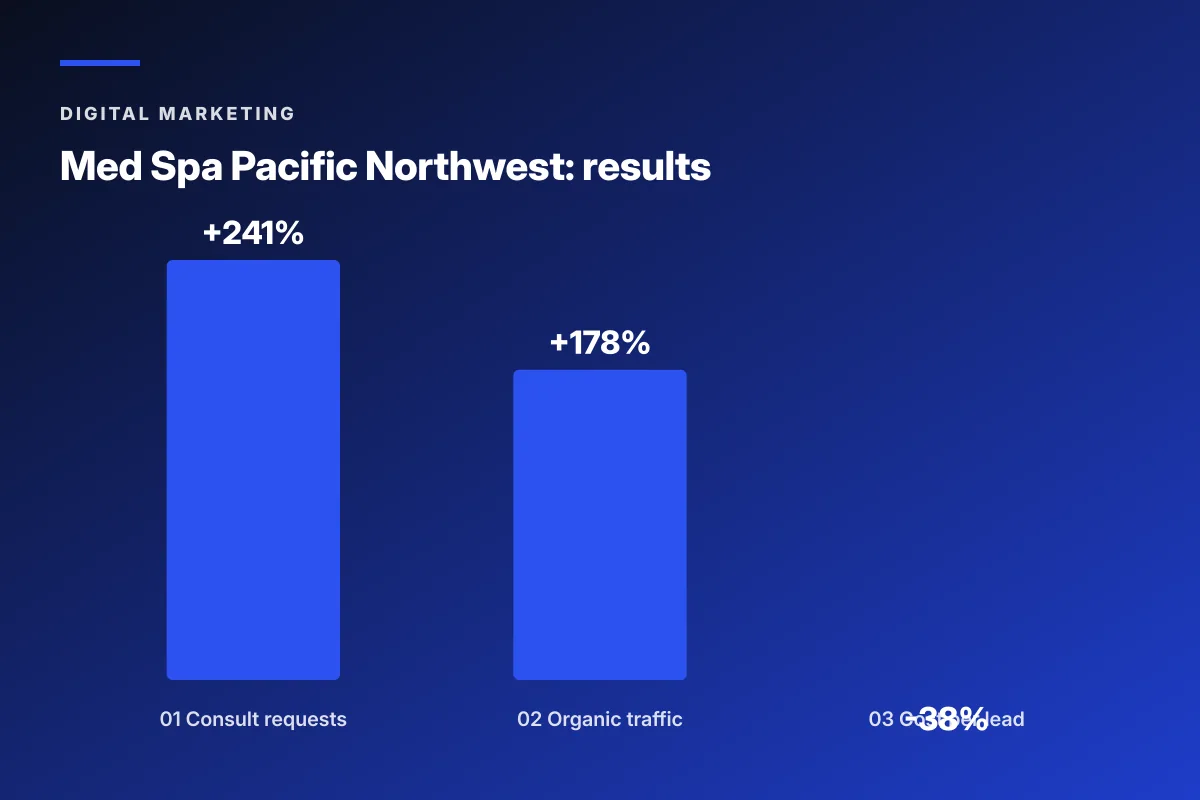
We ran a full rebuild across four workstreams over 90 days. Treatment-mapped service pages built individually for Botox, filler, laser hair removal, chemical peels, dermaplaning, and body contouring. A price simulator embedded on every treatment page so patients could estimate their visit inside 30 seconds. A rebuilt before-after gallery with 180 indexed pages and treatment-specific alt text. Segmented Google Ads campaigns and Meta retargeting rebuilt from scratch. Six months later, consult requests were up 241 percent, organic traffic up 178 percent, and paid CPL down 38 percent on the same $8,400 monthly budget.
| Metric | Baseline (month 0) | Result (month 6) |
|---|---|---|
| Monthly consult requests | 26 | 89 |
| Organic sessions per month | 4,200 | 11,676 |
| Paid cost per lead | $142 | $88 |
| Monthly ad spend | $8,400 | $8,400 |
| Booked treatments per month | 38 | 112 |
Price simulator on every treatment page
The single biggest lever in the Seattle rebuild was the price simulator. Patients pick treatment area, provider tier, and number of sessions. The simulator shows a price range and a Book Consult button. Aesthetic pricing anxiety is the number-one reason patients bounce before booking. Answering it inside 30 seconds on the treatment page moved consult conversion rate from 2.1 percent to 6.4 percent across the six treatment pages. That single feature drove roughly 40 percent of the 241 percent growth in consult requests.
Treatment-mapped service pages
The old site pushed everything through a single Services page listing all treatments in a bullet list. The rebuild split that into six dedicated treatment pages, each 1,400 to 2,200 words with pricing bands, before-after examples, provider bios, and a treatment-specific booking form. Organic sessions climbed 178 percent as those six pages each ranked for their target keyword. The bulk of that ranking growth happened between month three and month five as Google indexed and evaluated the depth of the new pages.
Low-cost med spa marketing ideas for practices under $5,000 monthly
Not every practice is running a $12,000 monthly marketing budget. Solo injectors, brand-new med spas, and providers rebuilding after a slow year need med spa marketing ideas that produce under a $5,000 monthly ceiling. The plays that work at that budget lean heavier on organic and owned channels. Paid spend gets capped at $2,000 to $2,800 on Google Ads only. SEO retainer at $1,200 to $1,500. Email plus SMS platform at $180. The rest goes to content and referral incentives.
The trade-off at that budget is time. Growth takes six to nine months instead of three months. That is fine if the practice has runway. The alternative is chasing quick paid spend on Groupon or Instagram influencers who bring one-time buyers and torch margin. Every practice we have advised at the $5,000 ceiling that stayed disciplined for six months landed in a $9,000 to $12,000 marketing budget by month nine because the referral and retention loops were producing enough revenue to reinvest.
Organic-heavy channel mix
Under a $5,000 ceiling, organic search plus email plus referral produce 55 to 70 percent of monthly booked treatments. Google Ads produces the balance at a controlled cap. Meta gets removed from the mix because retargeting volume is too low to justify the platform overhead. Weekly Instagram posts still run for social proof, but not as a paid channel. This mix takes longer to ramp but produces a lower cost per booked treatment inside 12 months because owned-audience compounding does most of the work.
Local micro-influencer partnerships
Local micro-influencers with 5,000 to 25,000 followers in your metro book treatments better than macro-influencers with 500,000. The local overlap between their audience and your service area is 20 to 45 percent versus 1 to 3 percent for a national account. Fees run $150 to $400 per post plus a comped treatment. Two to three partnerships per quarter produce 6 to 15 booked consults each on average. That math works for practices at any budget, and it produces better results than the $8,000 celebrity booking most practices reach for.
The worst med spa marketing idea we ever watched a client run was a full-page ad in a local lifestyle magazine promising “free Botox for life” as a giveaway prize. Nobody read the fine print about a lifetime maximum of three treatments spaced 12 months apart. The winner still calls the front desk every Tuesday four years later asking when her next free unit is due. The client spent $6,800 on the ad. Booked treatments attributed to the campaign: two. Total nurse time spent explaining the fine print to random people who saw the ad: 41 hours. The good news is a stack of new signs by the reception desk that read “we do not do free.”
Seasonal med spa marketing ideas across the calendar year
Aesthetic demand is not flat across the calendar. Q1 spikes for anti-aging and skincare after holiday overindulgence. Q2 loads bookings for weddings, proms, and pre-vacation prep. Q3 quiets as patients travel and skin work is out of season. Q4 spikes hard around Black Friday and holiday gifting. The med spa marketing ideas that book treatments best match the mood of each quarter. Push the wrong offer in the wrong month and you burn creative that would have converted in a different window.
Q1 works for cool skincare relaunches, laser hair removal packages ahead of summer, and membership sign-ups tied to New Year resolutions. Q2 loads bridal packages, mom-focused Mother’s Day offers, and pre-vacation body contouring. Q3 leans on hydration facials, injectable maintenance, and back-to-school mom promotions in August. Q4 sells gift cards heavily, membership as a gift, and product bundles for holiday gifting. Practices that map offers to seasons instead of pushing the same monthly Botox promo see marketing efficiency climb 25 to 40 percent inside a full calendar year.
Bridal season Q2 plays
Q2 bridal is the highest-margin window for a med spa. Brides book packages 60 to 120 days out and spend $1,800 to $4,500 across the run-up. Package the bridal offer with skincare consult, hydration facial, tox touch-ups, teeth whitening, and a lash extension bundle. Price it at a 12 to 18 percent bundle discount off individual pricing. Push it hard through Instagram partnerships with local bridal shops and photographers. Practices that own bridal in their metro run 20 to 30 bookings per month during Q2 at that ticket size.
Q4 gift cards and membership gifting
Most practices skip Q4 aesthetic gifting. A $250 gift card sold in November redeems for a $250 treatment in January when new-year skincare season peaks. That timing arbitrage smooths cash flow. Membership as a gift adds a second Q4 play. A 12-month membership sold as a holiday gift creates a locked-in patient starting January 1. Practices that push Q4 gifting hard sell 60 to 140 gift cards and 15 to 40 memberships in the six-week window between Black Friday and end of year.
Web design behind the best med spa marketing ideas
Every med spa marketing idea in this guide lives or dies on the website. A brilliant campaign pushed to a broken page still books nothing. The site has to load in under two seconds on a phone, show pricing bands within the first screen, present real before-after work, and let a patient book a consult in under 30 seconds through a three-field form. Practices that skip the site rebuild and layer paid on top of a broken foundation waste 40 to 65 percent of ad budget. Fix the site first, then scale paid.
The rebuild we ship on our Med spa web design engagement covers the seven patterns that book treatments. Sticky header with tap-to-call and Book Consult. Above-the-fold trust bar with review count and patient count. Insurance-optional payment plan callout. Six treatment tiles with one benefit line each. Live scheduler embedded on the primary landing page. Real practice photography, no stock models. Below-the-fold review carousel with real names, dates, and treatment tags. Every one of those seven patterns matters.
Mobile-first, always
Seventy to eighty percent of aesthetic traffic lands on a phone. Desktop is the secondary view. Mobile-first design puts the primary Book Consult button in the sticky footer at thumb reach, keeps forms at three fields, and compresses hero imagery to under 60 KB WebP. Practices that treat desktop as primary and mobile as an afterthought lose 45 to 65 percent of their mobile traffic to bounce inside eight seconds. The full audit method is covered in Nielsen Norman’s mobile content guide.
Copy that answers pricing anxiety
The single most-important sentence on any treatment page is the price band. “Botox in Seattle starts at $12 per unit with most consult treatments falling between $180 and $340.” That sentence removes the primary bounce trigger. Sites that hide pricing bleed 40 to 60 percent of qualified visitors who assume the practice is out of budget. Sites that publish clear price bands convert 2 to 3 times higher on the same traffic because the visitor self-qualifies before they book.
Analytics and attribution across med spa marketing ideas
Every med spa marketing idea in this guide needs tracking to prove the return. Aesthetic practices routinely spend $6,000 to $18,000 per month on marketing with no clear picture of which channel booked which treatment. That gap makes budget decisions guesswork. Fix it with three tools. Call tracking on the phone number for paid campaigns. UTM tags on every ad URL. A CRM or scheduler that logs source per patient. Together those three feed a monthly cost-per-booked-treatment number per channel.
The number you optimize against is not cost per lead. It is cost per booked treatment. A lead is a form fill. A booked treatment is revenue. Google Ads at $88 CPL that closes at 45 percent produces a $196 cost per booked treatment. Meta at $42 CPL that closes at 12 percent produces a $350 cost per booked treatment. Same-looking CPL, wildly different actual cost. Every med spa marketing idea gets tested against the booked-treatment number, not the lead number, or you optimize for the wrong outcome.
Call tracking basics
Call tracking uses dynamic phone numbers swapped on the site based on the visitor source. A paid Google Ads visitor sees one number. Organic visitor sees a different number. Direct traffic sees the main practice number. Every call routes to your front desk while the tracking platform logs the source. Tools like CallRail and CallTrackingMetrics run $45 to $180 per month depending on call volume. That spend pays back the first month it catches a channel that was invisible in scheduler-only reporting.
UTM tagging discipline
Every ad URL, email link, and social bio link gets UTM tags. Source, medium, campaign, content. Without UTMs, Google Analytics attributes half your paid traffic to “direct” and you cannot tell which campaign booked which patient. Standardize the tagging in a shared spreadsheet so every team member follows the same convention. Google’s Campaign URL Builder is the fastest way to get consistent tags across a team.
Where to start on your own med spa marketing ideas
Start with three plays this month. Rebuild the paid landing page as a three-field booking form with a clear price band. Turn on the 90-day lapsed reactivation email flow. Print physical referral cards and hand them at every checkout starting next Monday. Those three plays produce measurable movement in booked treatments inside 45 days at almost any budget. Every other med spa marketing idea in this guide stacks on top of those three.
When you are ready to run the full plan, our Med spa marketing agency engagement covers the strategy, the paid channels, the SEO retainer, and the site rebuild in one plan. The Med spa marketing retainer starts at $599 per month for practices that want a lighter touch across email, SEO, and content while running paid in-house. For a sibling read on the site side, see our optometrist website design breakdown, which covers the same seven-pattern rebuild logic across a different vertical.
Frequently asked questions
What are the highest-return med spa marketing ideas for a new practice?
The three highest-return med spa marketing ideas for a new practice are a first-visit $99 consult offer with credit toward the first treatment, a pre-purchase membership at $99 to $189 per month, and a two-sided referral card program handed out at every checkout. Those three plays produce measurable booked-treatment volume inside 45 days at almost any budget. The consult offer converts colder paid traffic that would never book a $700 laser treatment on first contact. The membership stabilizes recurring revenue. The referral cards produce 18 to 25 percent of monthly bookings inside four months. Every other idea stacks on top of those three.
How much should a med spa spend on marketing per month?
A med spa should spend 8 to 14 percent of gross revenue on marketing depending on growth stage. A new practice building brand awareness sits at the top of that range. An established practice with a returning patient base sits at the bottom. On a practice doing $80,000 in monthly revenue that math lands at $6,400 to $11,200 marketing spend. Split that budget roughly 40 percent Google Ads, 20 percent Meta ads, 15 percent SEO retainer, 10 percent email and SMS platform plus content, 8 percent photo and video, and 7 percent reserve for micro-influencer buys. That split produces 55 to 120 booked treatments per month across most aesthetic practices we advise.
Which med spa marketing ideas work with a small budget under $5,000?
Under a $5,000 monthly ceiling, focus on organic search, email, and referral. Cap Google Ads at $2,000 to $2,800. Run a $1,200 to $1,500 monthly SEO retainer to build map-pack rankings. Spend $180 on an email and SMS platform. Push referral cards at every checkout. Post weekly Instagram content for social proof without treating it as paid. Skip Meta ads at that budget because retargeting volume is too low. This mix takes six to nine months to ramp versus three months on a larger budget, but produces a lower cost per booked treatment inside 12 months because owned-audience compounding does most of the work.
How do I measure whether my med spa marketing ideas are working?
Measure cost per booked treatment, not cost per lead. A lead is a form fill. A booked treatment is revenue. Google Ads at $88 cost per lead that closes at 45 percent produces a $196 cost per booked treatment. Meta at $42 cost per lead that closes at 12 percent produces a $350 cost per booked treatment. Same-looking cost per lead, wildly different actual cost. Set up call tracking with dynamic phone numbers, UTM tag every ad and email link, and log source per patient in your scheduler or CRM. Report cost per booked treatment per channel every month and reallocate budget to the winners.
Are Groupon and daily deal sites good med spa marketing ideas?
Groupon and daily deal sites almost always lose money for med spas over 12 months. The economics look attractive on paper because a $60 Botox voucher fills the calendar next Tuesday. The reality is that Groupon buyers convert to full-price return visits at 8 to 15 percent versus 45 to 65 percent for patients acquired through paid search or referral. The one-time buyer floods your calendar, occupies room time, tips margin negative on the visit, and never comes back. Skip daily deal sites. Put the same budget into Google Ads and a well-designed landing page with a $99 consult offer, and lifetime patient value climbs 4 to 8 times.
How long does it take to see results from new med spa marketing ideas?
Paid channel ideas produce measurable booked treatments inside 14 to 30 days once the landing page and booking form are in shape. Email flow ideas produce revenue inside 7 to 14 days on an existing list because you are activating owned audiences. Referral card programs take 45 to 90 days to show up in booking data because word-of-mouth loops take time to spread. SEO and content ideas take 90 to 180 days to move organic ranking and traffic. Membership funnels start producing recurring revenue the first month they launch and compound each following month. Plan around those four timelines and set expectations with the team accordingly.
Do influencer partnerships work as med spa marketing ideas?
Local micro-influencer partnerships with 5,000 to 25,000 followers in your metro work well. Macro-influencer partnerships with 500,000 or more followers almost never pay back. The reason is audience overlap. A local micro-influencer's audience overlaps 20 to 45 percent with your service area. A macro-influencer's audience overlaps 1 to 3 percent, which means you pay a national-scale fee to reach maybe 15,000 local followers. Fees for local partnerships run $150 to $400 per post plus a comped treatment. Two to three partnerships per quarter produce 6 to 15 booked consults each on average. Cap the buys, track the results, and rotate partners every three to four quarters.
Book your free 30-minute strategy call.
No spam, no sales rep. We use your email to schedule your call with a senior strategist. That is it.
More from the blog
View all articles → Digital Marketing
 Dental Marketing Tips That Compound Into New Patients
Read article Digital Marketing
 Ecommerce Marketing Strategies That Drive Real DTC Revenue
Read article Digital Marketing