
Optometrist SEO Company Selection Guide and Red Flags
- Standard optometrist SEO retainers run $1,600 to $2,800 per month.
- Ask seven filter questions on every first call.
- Guaranteed rankings are a red flag, not a feature.
- Get content, tracking, and GBP ownership in writing.
- Vision Express hit 62 percent more booked exams in six months.
- Why an optometrist SEO company pick matters
- Real pricing for optometrist SEO services in 2026
- Seven questions to ask on the first optometrist SEO company call
- Red flags that predict a bad optometrist SEO company
- How to audit an optometrist SEO company portfolio
- What optometrist SEO services scope should include
- Case study on a real optometrist SEO company engagement
- Where to find a real seo company for optometrists
- Contract clauses that protect your optometrist SEO retainer
- When to fire your optometrist SEO company
- How to start with an optometrist SEO company
An optometrist SEO company is the single hire that decides whether your practice pulls 40 to 60 new patients a month from Google or spends the next 18 months paying an agency to send you a monthly PDF of nothing. You already sense it. Three vendors quoted three prices, three timelines, and three completely different scopes. One promises page-one rankings in 60 days. One wants to talk about content velocity. One wants to talk about backlinks. You need a way to filter, and you need it before the next sales call.
This guide is that filter. You get real pricing bands for an optometrist SEO company in 2026, the seven questions that expose a weak vendor on the first call, the portfolio red flags that predict a broken build, the contract clauses that protect your monthly cash flow, and a Vision Express case study on 62 percent more booked exams in six months. Read straight through in about ten minutes.
Why an optometrist SEO company pick matters
Your optometrist SEO company signs a 6 to 12 month engagement, owns the map pack ranking on your primary service, and writes the on-page structure the next agency inherits. Pick the wrong vendor and rebuild half in month nine. Pick right and organic covers 40 percent of new patients inside a year.
Independent practices we talk to fall into three groups. Group one has a WordPress site their web guy built in 2020, ranks for the practice name, and ranks for nothing else. Group two paid an SEO retainer at $800 per month for two years and cannot name a single keyword the vendor moved. Group three is starting fresh with a new location and needs the map pack, service pages, and Google Business Profile stood up in the first 90 days. Each group needs a different pick. The rest of this guide walks you through the filter.
The real cost of the wrong optometrist SEO company
A weak optometrist SEO company costs an independent practice $12,000 to $30,000 in retainer fees plus another $80,000 to $220,000 in missed exam revenue during the year you spend paying them. You pay the retainer. You pay for the vendor swap. You pay for the audit that tells you what the old vendor never did. Then you pay the new vendor to rebuild the technical foundation the first vendor left broken. Every independent optometrist we talk to has done this at least once.
What the right seo company for optometrists looks like
The right seo company for optometrists opens the first call with three questions about your practice, not three slides about their process. They want your average revenue per new patient, the two service lines you want to grow, and the ZIP codes inside your service radius. They quote a fixed monthly retainer, a first-90-day deliverable list, and a reporting cadence in the same document. They give you two past client references before you ask. Vendors who lead with case studies from unrelated verticals like plumbing or law are optimizing for their portfolio, not your booked exams.
Real pricing for optometrist SEO services in 2026
Real pricing for optometrist SEO services splits into four honest bands. Under $500 per month gets you a virtual assistant posting a Google Business Profile update once a week. $800 to $1,500 per month gets you basic on-page fixes and one blog post. $1,600 to $2,800 per month gets you local SEO, service page builds, technical fixes, and monthly content. $3,000 and up gets you multi-location SEO with dedicated project management and paid PR outreach. Every band is honest. The mismatch shows up when a $600 vendor promises $2,800 outcomes, or when a $3,000 vendor delivers what the $1,200 band would have produced.
For most solo and two-provider practices, the $1,600 to $2,800 band is where the math actually works. Below that you cannot afford real content plus link work. Above that you are paying for enterprise process a single-location practice does not need. See our SEO for Optometrists retainer for the scope we run in this band.
| Retainer band | Monthly range | What is included | Best fit |
|---|---|---|---|
| Bargain | Under $500 | GBP posts only | Nobody |
| Entry | $800 to $1,500 | On-page fixes, 1 blog | Rural solo practice |
| Standard | $1,600 to $2,800 | Local SEO, content, tech | Solo or two-provider |
| Enterprise | $3,000 and up | Multi-location, PR, PM | 3+ locations |
Hidden fees a weak optometrist seo company never mentions
Content beyond the included allotment runs $150 to $400 per blog post. Custom landing page builds run $600 to $2,400 each. Google Ads management on top of the SEO retainer runs 12 to 18 percent of monthly ad spend. Migration cleanup after leaving a bad vendor runs $1,500 to $4,000 as a one-time project. Any vendor whose proposal lists none of these has left them for you to discover after signing. Ask for the fully-loaded 12-month number, not just the monthly retainer.
Contract length and the exit clause
Real optometrist seo services contracts run 6 to 12 months because ranking movement takes 90 days to appear and 6 months to compound. Vendors who quote 3-month contracts are running a churn play and never get past the technical audit. Vendors who quote 24-month contracts without a fair 90-day exit clause are locking you into a bad outcome. The right shape is 6 months minimum with a written 30-day exit if published deliverables miss the calendar by more than 20 percent two months in a row. Both sides win when the exit is clear.
Seven questions to ask on the first optometrist SEO company call
The first vendor call decides the shortlist. Most practice owners burn it on the wrong questions. You ask about price. They give a range. You ask about timeline. They give a range. Ninety minutes later you know nothing useful. The seven questions below force the vendor to reveal how they actually work. If they cannot answer four of them cleanly, you are on the wrong call.
- Show me two live optometry practices you rank, and tell me what changed in their booked exams.
- Who writes the content, and how many pieces per month for my retainer band?
- What technical fixes will you do in the first 30 days?
- What is your process for Google Business Profile optimization and review generation?
- How do you track and attribute new patient calls back to organic search?
- Who owns the content, tracking, and the GBP after we part ways?
- If we do not rank inside 6 months, what is the remedy in writing?
The portfolio question filters half the market
Ask for two live optometry practices the vendor currently ranks. Not case studies. Not testimonials. Live URLs you can open, search Google for, and verify the ranking yourself. A vendor whose only optometry work sits behind a case-study PDF is a vendor who last ranked an optometry practice in 2021. Live sites plus a specific number like exams up 40 percent or organic patient calls up 3x tell you the vendor thinks in outcomes. Vendors who answer with awards or design accolades will send a pretty site that ranks for nothing.
The attribution question saves the retainer
How does the vendor attribute new patient calls back to organic search. The right answer covers call tracking on the contact page, a dedicated tracking number on Google Business Profile, form submissions tagged with source parameters, and a monthly report that ties named patients back to the organic session that started them. Any vendor whose attribution answer is “we look at rankings” is a vendor who cannot prove the retainer paid for itself in month nine when you ask. Attribution is what makes the difference between a retainer you renew and a retainer you cancel.

Before your renewal call, try to name one keyword your current vendor moved. If you can't, don't renegotiate the price. Cancel and rehire against the rubric.
Red flags that predict a bad optometrist SEO company
Red flags on an optometrist SEO company are visible on the first 20-minute discovery call. You do not need a technical audit to spot them. You need a checklist and permission to trust your gut when the sales pitch feels off. Ten minutes with the list below and a browser will teach you more about a vendor than an hour with their proposal deck.
- Guaranteed page-one rankings inside 30, 60, or 90 days
- No live optometry client references at all
- Monthly report is a screenshot of a rankings tracker and nothing else
- Content produced by non-native speakers with visible grammar errors
- Backlink strategy that mentions private blog networks or link farms
- Zero mention of Google Business Profile in their standard scope
- Refusal to name the account manager who will run your file
- Contract that keeps the domain, hosting, or GBP under the vendor login
The ranking guarantee is a lie
Google itself confirms that no SEO vendor can guarantee page-one rankings. Read Google Search Essentials and the passage is explicit. Any optometrist seo company that promises a top-3 ranking inside 60 days is either lying, gaming a low-volume long-tail keyword you do not care about, or planning to build spam links that will get your site penalized in month five. The right vendor promises specific deliverables, a specific timeline, and a probable range on results. Never a guarantee on rank.
Rankings-only reporting hides the truth
A monthly report that shows keyword rankings and nothing else is a report designed to hide bad results. Rankings tools track vanity terms nobody searches. The real report ties organic sessions to booked exams and revenue. Every real optometrist SEO company reports organic sessions, keyword rankings for your named target list, GBP impressions and calls, form submissions from organic, tracked calls from organic, and a running estimate of new patients attributed to the channel. Anything less is theater.
How to audit an optometrist SEO company portfolio
Portfolio review filters half the shortlist without a single call. Every portfolio looks good on the vendor site. Judge a portfolio by whether practices still rank three years after launch, whether sites load on mobile, and whether the businesses are still open.
Open every live client link the vendor lists. Search Google for the practice name plus their city on your phone. Note whether the map pack shows them, whether the organic result shows them, and whether the site loads fast when you tap through. Run each through Google PageSpeed Insights and record the mobile score. Anything under 60 on a portfolio piece means the vendor does not care about performance. Anything over 90 means the vendor takes technical craft seriously. See our optometrist marketing agency hub for what a real portfolio pass looks like.
Two reference calls per vendor
Pick two practices from the vendor portfolio and email one owner of each. Two sentences. Would you hire this optometrist seo services team again, and what would you change about the reporting. Most owners respond inside 48 hours. Vendors whose past clients quietly warn you off are vendors you cross off the list. Vendors whose past clients respond with a same-day yes and a specific compliment about attribution or content quality are vendors worth the follow-up scope call. Two calls per vendor saves you the year-long mistake.
Every practice site looks the same problem
Some SEO agencies build every optometry client on the same three-page WordPress template with a color swap and a logo. That works at the $800 band and fails at the $2,400 band. If ten portfolio sites all share the same hero layout, the same testimonial slider, the same three-column service block, and the same footer, you are looking at a template shop. Template shops are honest when they call themselves template shops. The problem is the ones charging retainer prices for a template deliverable. Ask which practice sites had custom research and custom copy versus the standard template.
What optometrist SEO services scope should include
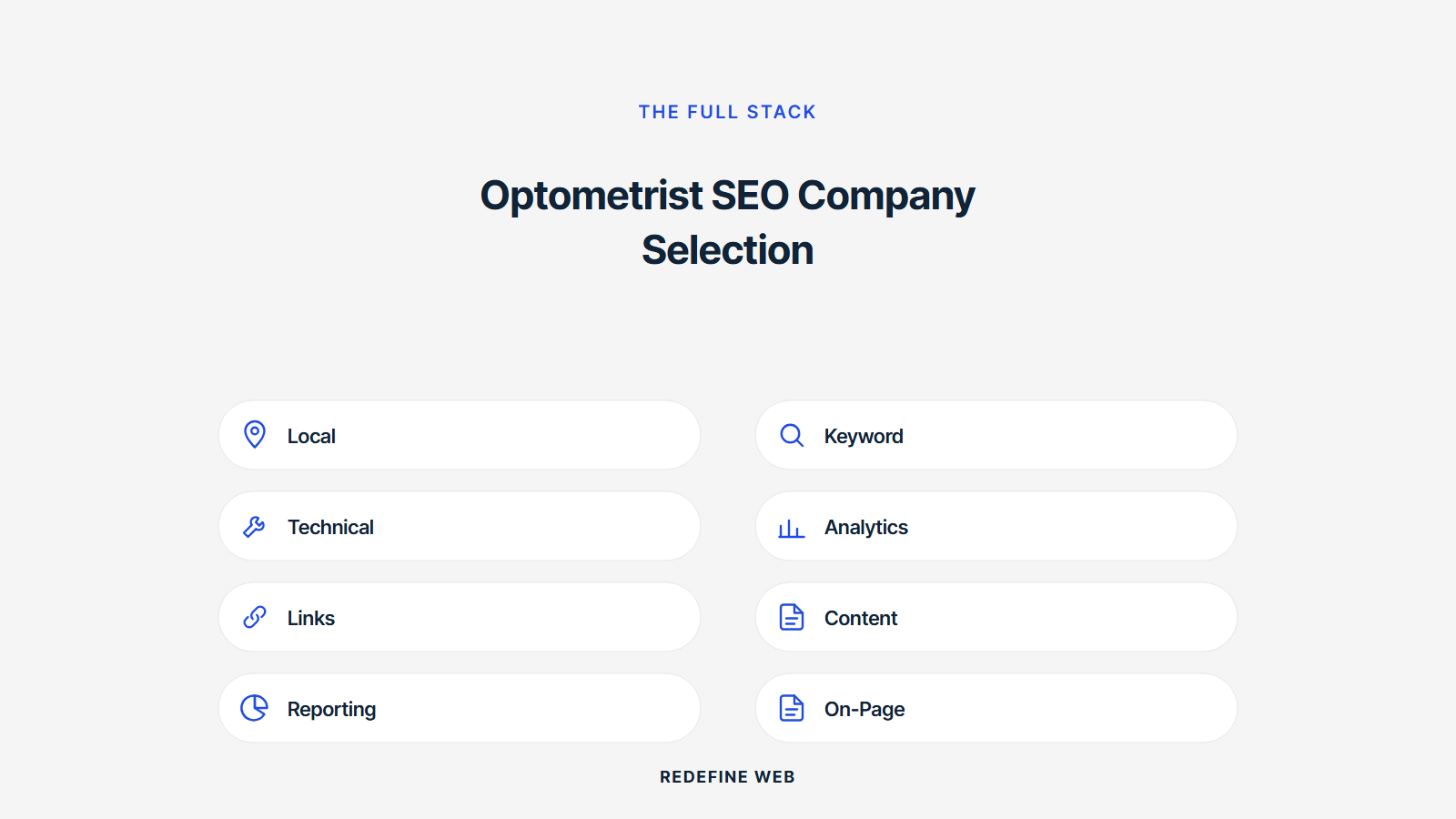
Standard optometrist SEO services scope in the $1,600 to $2,800 band covers a technical audit in month one, two long-form pages per month, Google Business Profile optimization plus weekly posts, review generation prompts, monthly citation cleanup, and one earned backlink per month from a real health publication.
The single biggest gap you will see is content velocity. Vendors will quote two pieces per month in the proposal and deliver one, blaming your slow feedback. Write the content quantity into the contract as a fixed monthly deliverable with a written remedy if the vendor misses two months in a row. That single clause prevents 80 percent of retainer disputes we see in year two.
First 90-day deliverable list
The first 90 days should list every deliverable, not the strategy. Technical audit findings addressed on the site. Google Business Profile claimed, verified, categorized, and posted to three times. Six long-form service pages published. Twelve backlinks earned or reclaimed. Full review request flow set up with automated prompts. Call tracking installed on the contact page and on the GBP number. Any vendor whose 90-day plan is vaguer than that is a vendor you will fight with in month four when nothing tangible has shipped.
Monthly cadence after day 90
Steady-state monthly cadence should run two content pieces, four GBP posts, two review requests, one earned backlink, monthly citation audit, and a written report on the second Monday of every month. That cadence keeps the site fresh, the GBP active, and the link profile growing without burning your team’s calendar. See our optometrist marketing retainer plans starting at $599 per month for the fixed-scope version of this cadence.
The classic first meeting with the wrong vendor goes like this. You describe the practice for eight minutes. They nod. They say the word alignment. They pull up their portfolio. Every client is a plumbing contractor. You are an independent optometrist. They tell you the SEO playbook works for every vertical. You ask what the ranking timeline is. They tell you 60 days. Ninety minutes later you leave with a coffee mug and a 40-page proposal that mentions the word local four times and the word optometry zero. The mug is fine. The proposal never books an exam.
Case study on a real optometrist SEO company engagement
Vision Express, an independent optometry practice competing against corporate chain locations in the same three-mile radius, came to us with hidden service pages, a weak Google Business Profile, and no tracking at all. The team had run two prior SEO retainers over the previous three years, neither of which had moved organic bookings. They were losing the map pack ranking to a chain branch that had opened 14 months earlier. Every patient inquiry was arriving via referral or a paid Google Ads click. Organic search accounted for close to zero.
Inside six months, Vision Express hit 62 percent more booked appointments, a 135.9 percent surge in organic traffic, and 71 percent overall practice growth. Every result came from a scoped optometrist SEO services engagement that started with a redesigned UX, moved through location-based SEO across six service pages, and finished with high-intent Google Ads tied back to organic landing pages. Vision Express replaced a chain-branch loss with a lead position in their local pack, and the retainer paid for itself inside quarter one on booked-exam revenue alone.
The Vision Express six-month numbers
Sixty-two percent more booked exams inside six months. A 135.9 percent surge in organic traffic on the redesigned service pages. Seventy-one percent overall practice growth measured against the six-month prior baseline. Local pack lead position on the primary service in the practice’s ZIP code. Every number came from a $1,900 per month optometrist seo services retainer with call tracking, GBP optimization, and content velocity locked into the contract. Two months of the retainer paid for itself in booked-exam revenue alone.
Lessons for your own vendor pick
Two lessons from the Vision Express engagement apply to almost every independent optometrist. First, hidden service pages are the single most common cause of a flat ranking curve. Fix the service pages first, then everything else compounds faster. Second, tracking installed on day one is what turns the retainer from a monthly bill into a monthly proof of return. Vision Express saw the first attribution-tied booked exam inside week three. Without call tracking on the GBP number, the retainer would have looked ineffective for the first 90 days.

Where to find a real seo company for optometrists
The way you find a real seo company for optometrists determines the shortlist you end up with. Google search alone surfaces the vendors who bought their way to page one, not the vendors ranking real practices. The right mix is three channels, three vendors from each, and a short 20-minute filter call with the top nine. That gives you a real cross-section of freelancer, small studio, and specialist agency options before you invite anyone to a scope conversation.
Start with vertical-specific SEO. Search Google for optometrist SEO plus your city. The vendors ranking on page one for that phrase are already running a live demo of the service they sell. Second, ask three optometry owners in your state AOA chapter or study group who they use. Third, filter Clutch and DesignRush by healthcare and by verified review count. Vendors who show up in all three channels are the shortlist that deserves a scope call. See our Optometrist marketing services for the retainer scope we publish for practices in this stage.
Filtering healthcare directory results
On Clutch, filter to at least 25 verified reviews and 4.7 stars or higher. Anything under 25 reviews is too small a sample to trust. Anything under 4.7 stars means the vendor has a real cluster of dissatisfied clients. Filter by healthcare industry so at least some client work overlaps your business shape. That filter cuts a 500-vendor result set to 15 to 30 real options for most healthcare verticals. Then narrow further by scanning each vendor page for the word optometry or eye care in past project descriptions.
Referrals from real optometry owners
A referral from an owner running an optometry practice at your revenue band gives you the highest signal in the whole vendor hunt. That owner has lived through the process. They know whether the vendor answers email in month nine. They know whether the retainer invoice matched the proposal. They can tell you the one thing the vendor did that they wish had gone differently. Two coffees with two AOA colleagues beat ten sales calls with ten vendors. Practices that trade honest vendor notes at a study group protect each other from bad hires.
Contract clauses that protect your optometrist SEO retainer
Every optometrist SEO company contract is a legal document you will read once and refer back to in month seven when something breaks. Six clauses matter more than the rest. Get these six right and the rest can be boilerplate. Get any one wrong and you are the practice owner calling a lawyer about a stalled retainer in month nine, which is a conversation nobody wants to have.
- Fixed monthly deliverables listed by quantity, not by hours
- Content ownership transferred to you on final payment
- Ownership of Google Business Profile, tracking, and analytics accounts
- Written 30-day exit clause if deliverables miss by 20 percent two months in a row
- Reporting cadence with fixed monthly delivery date
- Response-time commitment for site changes and ranking crises
Deliverables beat hour counts
A retainer defined as 20 hours of work is a retainer you will fight over in month three. A retainer defined as two blog posts, four GBP posts, one earned link, and a monthly report is a retainer you can point at. Fixed deliverable list beats fixed hour count every time. The vendor knows what to build. You know what to expect. Any change gets a change order with its own price, which protects both sides. Vendors who resist a fixed deliverable list are vendors planning to bill for the same content twice.
Content and account ownership
Content ownership on final payment is the single clause that prevents a bad exit. Vendors who keep the WordPress admin, the tracking property, and the Google Business Profile under their own login can hold your rankings hostage in year two. The right answer is your ownership from day one on the domain, hosting, WordPress admin, GBP, Google Analytics, Search Console, call tracking, and every piece of content the retainer produced. Any vendor who resists a written ownership rider is a vendor you fire before the contract signs.
When to fire your optometrist SEO company
You fire your optometrist SEO company when three consecutive months miss the deliverable count, when the monthly report is rankings-only for the third time in a row, or when organic booked exams show zero movement six months after start. Any single one of those triggers a 30-day notice conversation. Two of them together are a fire on the spot.
The exit itself is where most practices lose the most money. Rushing the exit means the domain, tracking, and content stay with the old vendor. Take 30 days. Migrate the domain to your registrar first. Move Google Business Profile ownership second. Export the content and any custom tracking dashboards third. Only then send the termination email. Vendors who fight the export are vendors who confirmed why you fired them. See Search Engine Land’s SEO agency library for the industry reference on switching vendors cleanly.
The 30-day exit plan
Day one, notify the vendor of intent to terminate on day 30 per the contract. Day three, request a full export of all content, backlinks earned, tracking dashboards, and GBP admin transfer. Day 10, verify each account is now under your login and password. Day 20, notify your incoming vendor and share the exported assets. Day 30, final payment on delivery of the export. Any deviation from that plan hands the outgoing vendor a bargaining chip you do not want them to have. Take the full 30 days and take the assets clean.
Transition costs to budget
Switching optometrist SEO services costs $2,000 to $6,000 as a one-time migration project on top of the first month of the new retainer. The new vendor rebuilds the tracking, cleans the citations the old vendor never touched, migrates any custom landing pages, and rewrites service pages the old vendor left thin. Budget this ahead of time so the switch feels planned instead of expensive. A clean transition inside 60 days is a return-positive project inside six months. A rushed transition drags on for a full year.
How to start with an optometrist SEO company
Picking an optometrist SEO company ends with a simple test. Send the seven questions above to three vendors and compare the answers. The vendor who quotes a fixed deliverable list, breaks out reporting, names an account manager, and answers ownership cleanly wins the full scope call.
Ready to scope an optometrist SEO retainer with a team that reports to booked exams instead of rankings. Our SEO for Optometrists covers the full engagement from technical audit through monthly reporting. For the retainer plan starting at $599 per month, see our Optometrist marketing services. For the paid side that pairs cleanly with organic, see our PPC services for optometrists. For an authoritative external reference on how Google evaluates local search, see the Search Engine Journal local SEO library.
Frequently asked questions
How much does an optometrist SEO company cost per month?
Real optometrist SEO company pricing splits into four bands. Under $500 per month gets you a virtual assistant posting a Google Business Profile update once a week and nothing else worth counting. $800 to $1,500 per month gets you basic on-page fixes and one blog post per month. $1,600 to $2,800 per month gets you local SEO, service page builds, technical fixes, and monthly content, which is the band most solo and two-provider practices need. $3,000 and up gets you multi-location SEO with dedicated project management and paid PR outreach, which is what a three-location practice or a regional group needs to justify. Match the band to your practice size.
How long before an optometrist SEO company shows results?
Expect the first ranking movement inside 90 days on long-tail service terms and 6 months on the primary metro terms like optometrist near me. Booked exam attribution shows up in the tracking dashboard around week 12 if call tracking was installed on day one. The Vision Express case study hit 62 percent more booked exams in six months, which is the upper end of what an independent practice sees. Any vendor promising page one on primary terms in 60 days is either lying or working a manipulation that will get penalized in month five. The honest range is 3 months for first movement and 6 to 9 months for meaningful booked exam volume.
What red flags should I watch for on the first vendor call?
Watch for eight red flags. Guaranteed page-one rankings inside a fixed timeframe. No live optometry client references at all. Monthly report that is a screenshot of a rankings tracker and nothing else. Content produced by non-native speakers with visible grammar errors. Backlink strategy that mentions private blog networks. Zero mention of Google Business Profile in the standard scope. Refusal to name the account manager who will run your file. Contract that keeps the domain, hosting, or GBP under the vendor login. Any single one of those is a fire signal. Two of them together and you leave the call before the second half of the pitch. The right vendor answers every question with specifics and never with a guarantee.
What should the first 90 days with an optometrist SEO company include?
The first 90 days should list every deliverable, not the strategy. Technical audit findings addressed on the site. Google Business Profile claimed, verified, categorized, and posted to three times. Six long-form service pages published. Twelve backlinks earned or reclaimed. Full review request flow set up with automated prompts sent to real patients after visits. Call tracking installed on the contact page and on the GBP number. Any vendor whose 90-day plan is vaguer than that is a vendor you will fight with in month four when nothing tangible has shipped. Ask for the 90-day deliverable list in writing before the retainer signs.
When should I fire my current optometrist SEO company?
Fire your current optometrist SEO company when three consecutive months miss the deliverable count, when the monthly report is rankings-only for the third time in a row, or when organic booked exams show zero movement six months after start. Any single one of those triggers a 30-day notice conversation. Two of them together are a fire on the spot. Take the full 30 days on the exit so the domain, tracking accounts, GBP admin, and content transfer cleanly to your ownership. Rushing the exit means the old vendor keeps assets you paid for. Budget $2,000 to $6,000 for the transition project on top of the first month of the new retainer.
Is a local optometrist SEO company better than a remote one?
A remote optometrist SEO company that specializes in optometry beats a local generalist SEO agency almost every time. The specialist has ranked 20 optometry practices before and knows the map pack shape, the service page structure, and the review generation cadence that works in this vertical. A local generalist has to learn all of that on your dime while ranking a plumbing company next door. Geography does not matter for SEO delivery in 2026. Vertical specialization does. Ask which vertical the vendor has ranked most often. If the answer is not healthcare or optometry specifically, keep looking regardless of the vendor's ZIP code.
Book your free 30-minute strategy call.
No spam, no sales rep. We use your email to schedule your call with a senior strategist. That is it.
More from the blog
View all articles → SEO
SEO Organic Search Engine Optimization Services That Grow Real Traffic
Read article SEO
SEO SEO for Pet Groomers That Fills the Appointment Book Weekly
Read article SEO
SEO