
Periodontal Marketing That Books Gum Treatment Patients
- Content clusters carry 45 to 80 percent more consults than a single page.
- Buying cycle runs 2 to 8 weeks, so retargeting outperforms cold traffic.
- GP referrals produce 30 to 50 percent of steady periodontal patients.
- Blended cost per periodontal consult runs $110 to $190.
- Shame-free reviews outconvert generic five-star reviews.
Periodontal marketing is a slow-burn sale. The patient searching for periodontal marketing terms has typically been told at a recent cleaning that their gums are receding, bleeding, or showing pocket depths above 4 millimeters. They are scared, embarrassed, and shopping quietly. Most will research for 2 to 8 weeks before booking a periodontal consult. Meet them with trust-heavy content and honest pricing during that window and the practice earns the case. Meet them with discount hooks and the patient assumes the practice does not take their condition seriously.
This guide is the honest playbook for periodontal marketing that books gum treatment patients through SEO, trust content, and a compounding GP referral loop. You get the content cluster strategy, the paid ad structure, the review workflow tied to case outcomes, the referral loop that funds a steady periodontal caseload, and the reporting framework that keeps agency accountability honest. Read straight through in about twelve minutes.
GP referral loop for periodontal
General dentist referrals are the second-largest source of steady periodontal patients after organic content. A practice with 15 to 30 active referring GPs runs 30 to 50 percent of its periodontal caseload from that loop. The rest comes from organic search and paid ads. Building and holding the referral loop is the highest-return operational work in periodontal marketing after the content cluster.
The referral loop has four components. Quarterly in-person visits with each referring GP office. A shared electronic referral portal that submits patients cleanly. A same-week appointment guarantee for referred patients. A treatment-outcome report sent back to the referring GP within 48 hours of consult completion. Practices that maintain all four see referral volume climb 25 to 45 percent inside a year without a single new marketing dollar. Our dental marketing plan post covers the wider growth model.
GP office education visits
Visit every active referring GP office quarterly. Bring a case-outcome summary for the prior quarter and a short update on new periodontal protocols or research. GPs need to understand where the referral lands and what happens next so they can confidently refer future patients. That 45-minute visit is worth 2 to 4 new referred patients over the following quarter.
Outcome report back to the referring GP
Every completed periodontal case gets a one-page outcome report sent to the referring GP within 48 hours. Diagnosis. Treatment recommended. Patient acceptance. Follow-up plan. That report closes the loop and reminds the GP why referring to this specific specialist worked well for the patient. Practices that send outcome reports see referral volume climb 30 to 55 percent within six months compared with practices that never close the loop.
Local SEO for periodontal queries
Periodontist near me and gum disease treatment near me carry moderate volume and high intent. A top-3 map pack position on those queries produces 5 to 14 periodontal consults per month at zero ad spend. That compounding position funds the paid ad experiments and holds the practice steady across slow quarters.
The local SEO stack for periodontal has three specific additions on top of the general dentistry base. First, GBP primary category set to Periodontist if the practice is periodontist-led. Second, a dedicated periodontal services page with schema markup for MedicalTherapy plus Dentist. Third, GP-referral-focused citations on specialty directories. Our local seo for dentists post covers the base stack.
GBP primary category set to Periodontist
If the practice is periodontist-led, set GBP primary category to Periodontist. That single change moves rank on periodontal queries inside 30 to 60 days. Secondary categories include Dental Clinic and Dentist. Practices that keep the category as Dentist compete against every general dentist in the metro and lose specialty rank. Our google business profile for dentists post covers the full setup.
Periodontal service page with correct schema
Your periodontal services page should carry schema markup for both Dentist and MedicalTherapy. The MedicalTherapy schema names periodontal treatment, the practitioner, and a treatment description. Google reads this schema as topical authority for periodontal queries. Practices that implement it correctly see map pack rank climb 2 to 5 positions on periodontal queries inside 60 days. The schema.org MedicalTherapy documentation is the reference.
Periodontal review strategy
Periodontal reviews carry weight because the condition is embarrassing. A patient who describes overcoming embarrassment and finding a shame-free practice is worth 10 generic five-star reviews. The workflow that produces these reviews respects the emotional context and asks with care.
The workflow. After every completed periodontal case, the treatment coordinator asks one question at the final follow-up. How different does your mouth feel now compared with your first visit. That question captures the emotional arc. Two days after the follow-up, the coordinator sends a text with the Google review link and a soft suggestion, share your experience in a way that feels comfortable. That structured ask produces 3 to 7 shame-free reviews per month on a practice running 25 to 50 periodontal cases monthly.
Shame-free reviews that convert
Feature 4 to 6 shame-free reviews on the periodontal service page. Pick reviews that name specific embarrassment the patient overcame and how the practice handled it. Reviews mentioning I was ashamed to smile, I put this off for years, or my other dentist made me feel bad, followed by a warm outcome, convert readers into callers. Reviews only mentioning doctor kindness are pleasant but do not carry the same weight. Our dental reputation management post covers the reply framework.
Response tone for periodontal reviews
Every positive review gets a warm response within 48 hours that thanks the patient by name and acknowledges the emotional weight of their experience without spelling out the specific diagnosis. Every negative review gets an immediate acknowledgment, a private offer to talk, and no argument on the public thread. Practices with 100 percent response rate rank 22 to 40 percent higher in the map pack for periodontal queries. Independent research from the BrightLocal local consumer review survey supports how heavily embarrassment-adjacent buyers weight the last handful of reviews.
Bleeding-gum shoppers assume a cheap price means a rushed exam. Kill any '' offer on your perio page and lead with the perio's photo and case count.
Periodontal website design that respects the patient
Your periodontal website carries a different job than a general dentistry site. Copy leans educational and shame-free. Photography leans warm. Every design decision either respects the patient or makes them feel worse. There is no neutral element on a page a nervous patient reads at midnight.
The section pattern that converts. Above the fold, headline plus three-field form plus tap-to-call, review count with star rating, and a real photo of the periodontist. Section two, a 60-second video of the periodontist explaining what a first periodontal consult feels like. Section three, the four stages of gum disease explained in plain words. Section four, the no-shame paragraph. Section five, patient testimonials. Section six, insurance strip. See our dental website design guide for the fuller section stack.
The no-shame paragraph that books calls
Include a short paragraph on every periodontal page that names the reality directly. Millions of adults have periodontal disease at some stage. The team has helped patients who have avoided the dentist for 5, 10, or 20 years. Nobody will make them feel bad about it. That paragraph, positioned above the appointment form, moves conversion 20 to 35 percent because it addresses the embarrassment before the reader has to ask.
Educational video section on stages of gum disease
Embed a 90-second video of the periodontist walking through the four stages of gum disease with clear plain-English language. That video does what no written copy can. It lets the patient understand where they are and what the treatment path looks like. Practices that add this video see time on page climb from 40 seconds to 2 minutes and form-fill conversion climb 25 to 45 percent. Our dental video marketing post covers the shot list and script.
The strangest periodontal marketing ask we ever got was from a practice that wanted their pillar page to include an ASMR audio track of a scaling and root planing procedure. We laughed, checked our records to confirm they were serious, and then politely declined. Turns out ASMR of dental scraping is a small but real niche on YouTube. The pillar page ranked without the audio track. The lesson we relearned is that trust content works because it educates, not because it is unusual. Sometimes the boring version is the version that books cases.
Periodontal marketing compliance and claims
Periodontal marketing sits inside the standard dental compliance box with two additions specific to the specialty. First, clinical claims about gum disease reversal must be qualified. Some stages of periodontal disease cannot be reversed and claims to the contrary attract state board complaints. Second, before-and-after intraoral photos require signed HIPAA-compliant releases. Practices that keep these clean run for years without a compliance issue.
American Academy of Periodontology guidance frames what clinical claims can be made. Avoid absolute language like guaranteed gum disease reversal. Use qualified language like early-stage gum disease can be reversed with non-surgical treatment in most patients when caught early. Practices that use qualified language pass state board reviews and Google Ads clinical policy reviews without a single flag. Our dental ads compliance guide covers the fuller checklist. Reference the American Academy of Periodontology consumer resources for the underlying clinical framework.
Clinical claims that pass the AAP lens
Avoid absolute language on treatment outcomes. Use qualified language that names the stage of disease, the treatment protocol, and the realistic outcome range. Non-surgical periodontal therapy resolves early-stage gum disease in 78 percent of cases documented in peer-reviewed literature. That kind of language passes clinical policy review and reads as trustworthy to educated patients. Absolute language attracts skepticism and state board attention.
Intraoral imagery that stays HIPAA-safe
Every intraoral photo or x-ray used in ads or on the website needs a signed HIPAA-compliant release that names the specific channels and duration of use. A generic photo release will not cover it. Use a two-page release that names Google, Meta, YouTube, and the practice website with a 3-year duration and an explicit periodontal-treatment mention. Practices that skip this step see imagery pulled by Meta trust and safety within 30 days.
Periodontal marketing plan for a solo periodontist
NC Dental Clinic, a Vista, California practice we have supported for years, added a periodontal content cluster and GP referral loop on top of an existing local SEO base. Inside 18 months, periodontal consult volume climbed from 3 to 5 per month to 22 to 34 per month with the same paid budget. The exact model in this section is what we ran for that practice, adapted for solo periodontists and small multi-doctor practices. A solo periodontist running 30 to 80 periodontal consults per month should invest $2,600 to $5,200 monthly across content production, paid Search, retargeting Meta, local SEO, and GP relationship work. Below the floor, no channel gets enough weekly attention. Above the ceiling without treatment capacity, the practice books consults it cannot schedule inside a reasonable window.
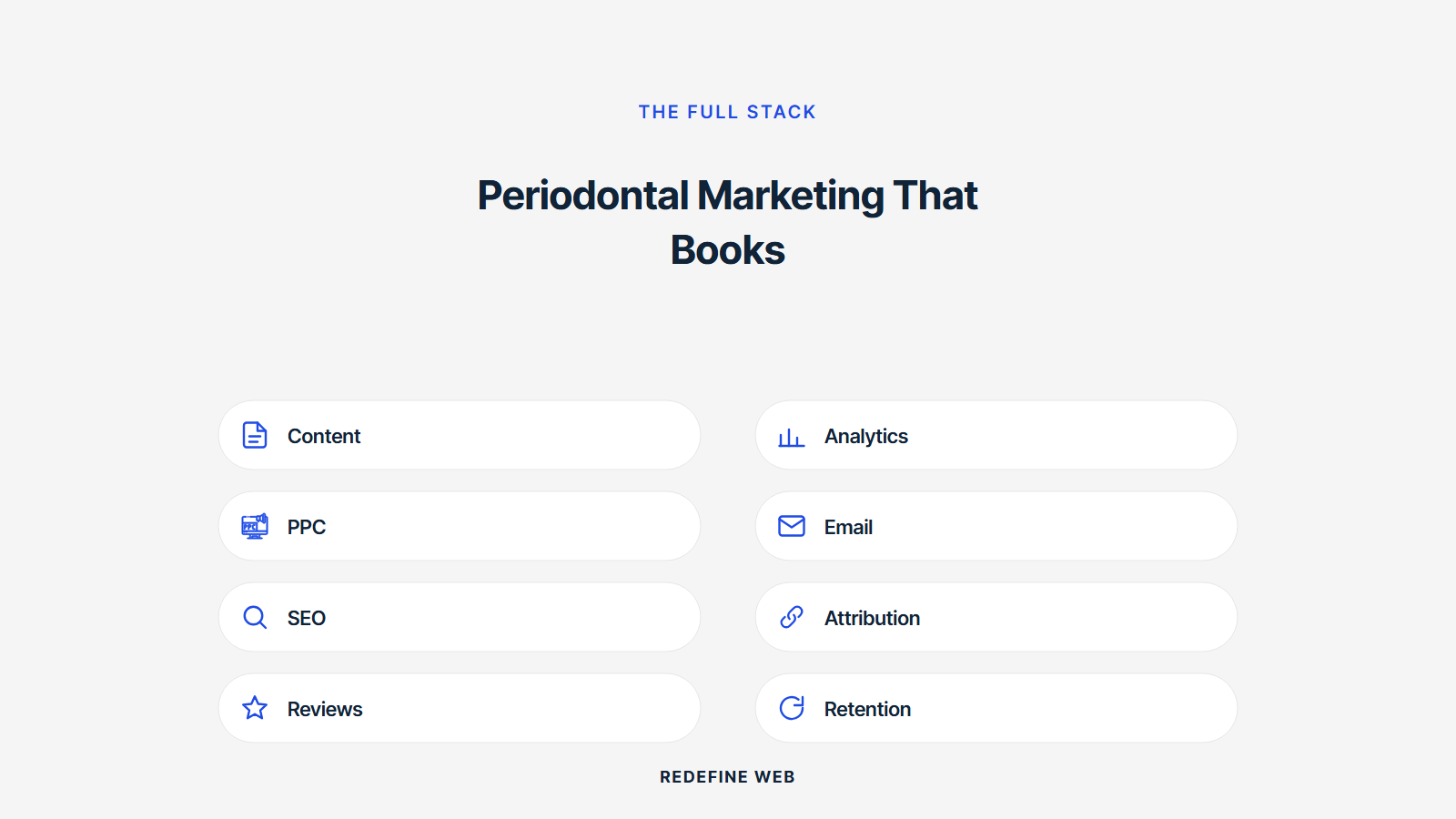
The mix that produces 30 to 80 monthly periodontal consults has five inputs. Content production at $1,200 to $2,400 monthly for 4 to 8 supporting posts per month. Google Search plus LSAs at $1,000 to $2,200 producing 8 to 20 booked consults. Meta retargeting at $300 to $900 producing 3 to 8 booked consults. Local SEO retainer at $599 to $1,600 producing 5 to 14 organic consults from the map pack. GP relationship investment at $400 to $700 monthly producing 10 to 25 GP-referred consults. Blended cost per periodontal consult runs $110 to $190. Our dental marketing plan post has the fuller template.
Content-first phasing for periodontal
Days 1 to 60 spend heavier on content and lighter on paid. Pillar page plus 8 to 12 supporting posts. GBP setup with Periodontist primary category. Review workflow deployment. Days 61 to 120 add paid Search and retargeting Meta with the content library backing every ad. Days 121 to 180 hit full budget of $2,600 to $5,200 with all five channels active and weekly optimization. Practices that phase this way hit 30 to 80 monthly consults by month 6 or 7 with a compounding content base that keeps working for years.
KPIs that matter for periodontal
Track four numbers weekly. Periodontal consults booked, cost per periodontal consult, GP referrals added, and content pages ranking on page one. Ignore vanity metrics. Practices that hold consults above 30 per month, GP referrals above 10 per month, and 15 or more content pages on page one for four consecutive quarters see periodontal revenue grow 30 to 55 percent year over year. Our dental marketing roi post breaks down the reporting framework.
Picking a periodontal marketing agency
Most dental marketing agencies do not understand periodontal. They run generalist playbooks that push discount hooks and confuse the embarrassed patient. A periodontal-capable agency runs three things differently. Content cluster strategy that respects the long buying cycle. Retargeting-heavy paid ad structure. GP relationship support most agencies never touch. Vague answers on those three questions mean the generalist playbook is running.
Ask five questions before signing with any agency for periodontal marketing. What is your content cluster architecture. How do you split cold-off versus retargeting Meta budgets. Do you support GP relationship work. What is your target cost per periodontal consult. What is your monthly reporting cadence and what numbers lead. Vague answers on any of the five mean the generalist playbook is running. Our dental marketing hub covers the wider agency-selection framework.
In-house versus agency for periodontal
Solo periodontists below $100,000 monthly production usually cannot fund a real content-heavy agency retainer. Handle GBP, landing pages, and GP relationship work in-house with a $299 monthly software stack plus 5 to 8 hours per week of practice manager time. Above $180,000 monthly, an agency retainer of $2,400 to $4,800 monthly becomes cheaper than the equivalent in-house hours plus content writing costs. Above $350,000 monthly with multiple doctors or locations, an agency retainer stops being optional because operational complexity exceeds any single manager’s bandwidth.
Monthly reporting that respects the numbers
Monthly agency reporting should lead with periodontal consults booked and cost per consult, followed by GP referrals added and content pages on page one. Every other number is context. Impressions, click-through rate, and cost per click matter only inside the story of how they moved those four leading numbers. Practices that accept vanity-first reporting end up with a slick PDF and no growth. Ask for the four numbers first every month.
Frequently asked questions
How much does periodontal marketing cost per month?
A solo periodontist running 30 to 80 consults per month invests $2,600 to $5,200 monthly across five channels. Content production takes $1,200 to $2,400 for 4 to 8 supporting posts per month. Google Search plus LSAs run $1,000 to $2,200 producing 8 to 20 booked consults. Meta retargeting runs $300 to $900 producing 3 to 8 booked consults. Local SEO retainer sits at $599 to $1,600 producing 5 to 14 organic consults. GP relationship investment adds $400 to $700 monthly producing 10 to 25 referred consults. Blended cost per consult sits at $110 to $190. Content-first phasing means months 1 to 2 spend more on content and less on paid, hitting the full mix by month 4 or 5.
Why does content marketing dominate periodontal patient acquisition?
Periodontal patients research for 2 to 8 weeks before booking a consultation. That long window rewards practices with a full content library that shows up at every step. A 30 to 50 post content cluster ranks for hundreds of long-tail queries and builds trust across the full research window. Content also shortens the buying cycle from 8 weeks to 3 weeks because patients arrive at the consult already educated. Practices with a proper pillar page plus 30 to 50 supporting posts book 45 to 80 percent more consults than practices with a single generic gum disease page. Paid ads supplement content in periodontal marketing but cannot replace it.
How do you write periodontal ads that convert embarrassed patients?
Trust-first, shame-free. Millions of adults have periodontal disease at some stage. Say it directly. Include a no-shame paragraph on every landing page that names the reality and acknowledges the emotional weight without spelling out the specific diagnosis. Avoid discount hooks that reinforce the sense that the practice does not take the condition seriously. Surface a credentials block above the fold naming board certification, years of experience, and case volume. Feature 4 to 6 shame-free reviews from patients who name specific embarrassment they overcame. Practices that use this framework see form-fill conversion climb 20 to 35 percent versus generic periodontal ad copy.
How important are GP referrals for periodontal practices?
Substantial. General dentist referrals produce 30 to 50 percent of steady periodontal patients at most practices. Organic content and paid ads produce the rest. Four components carry the referral loop. Quarterly in-person visits with each referring GP office. A HIPAA-compliant electronic referral portal that submits patients cleanly in under 3 minutes. A same-week appointment guarantee for referred patients. A one-page treatment-outcome report sent back to the referring GP within 48 hours of consult completion. Practices that maintain all four see referral volume climb 25 to 45 percent inside a year without a single new marketing dollar. Skipping the outcome report loses the relationship inside 6 to 12 months.
How do you win the map pack for periodontal queries?
Four inputs move the pack. Set the Google Business Profile primary category to Periodontist if the practice is periodontist-led, which moves specialty rank inside 30 to 60 days. Build a dedicated periodontal services page with schema markup for both Dentist and MedicalTherapy. Maintain NAP consistency across the top 30 to 50 dental citation directories plus specialty referral directories. Run a monthly review generation cadence tied to case completion with 3 to 7 shame-free reviews per month. Practices running all four for 90 to 120 days consistently see rank climb 2 to 7 positions on periodontal queries and hold there for years as long as the cadence continues.
What compliance rules apply to periodontal marketing?
Federal HIPAA rules require signed releases naming specific channels and duration for any intraoral photos or x-rays used in ads. State dental board rules add another layer. American Academy of Periodontology guidance frames what clinical claims can be made. Avoid absolute language like guaranteed gum disease reversal because some stages cannot be reversed and claims to the contrary attract state board complaints. Use qualified language like non-surgical periodontal therapy resolves early-stage gum disease in 78 percent of cases documented in peer-reviewed literature. Practices that check state board and platform rules quarterly avoid the account shutdowns and complaints that cost competitors months of momentum.
How does retargeting outperform cold Meta traffic for periodontal?
The periodontal buying cycle runs 2 to 8 weeks. Cold Meta traffic to periodontal offers costs $260 or more per booked consult because most viewers are not yet in the research window. Retargeting to prior blog readers who visited educational content in the last 30 days costs $90 to $145 per booked consult because those readers already trust the practice. Practices that split Meta between cold-off and retargeting-heavy budgets see periodontal cost per patient drop 30 to 55 percent. The play is to publish educational content that pulls the top-funnel patient in, then retarget them with a soft consultation offer inside the 30-day window after their first content visit.
Book your free 30-minute strategy call.
No spam, no sales rep. We use your email to schedule your call with a senior strategist. That is it.
More from the blog
View all articles → Digital Marketing
 Dental Marketing Tips That Compound Into New Patients
Read article Digital Marketing
 Ecommerce Marketing Strategies That Drive Real DTC Revenue
Read article Digital Marketing