
Pet Business Web Design for Subscription DTC Brands
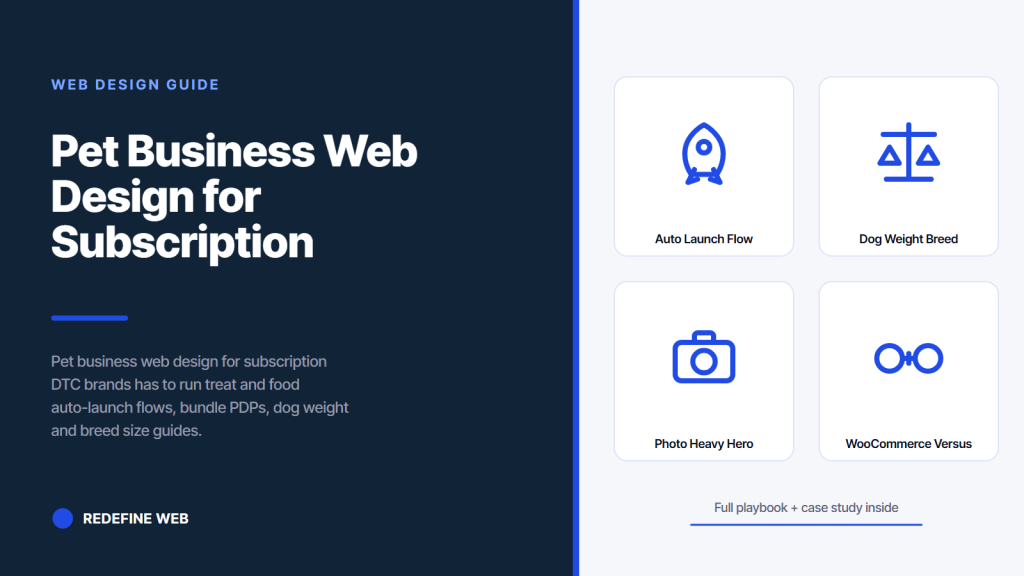
- Auto ship flow is the first CRO surface on a pet DTC site.
- Bundle PDPs outsell single SKU PDPs by 40 to 60 percent.
- Dog weight and breed size guides cut refund rates by 22 percent.
- Photo heavy hero blocks lift add to cart by 18 percent on mobile.
- Retainer starts at 599 dollars monthly across a 6 month term.
- What pet business web design actually covers
- Auto ship flow inside pet business web design
- Bundle PDPs for treats and food
- Dog weight and breed size guides
- Photo heavy hero blocks in pet business web design
- Account portal scope for pet DTC
- WooCommerce versus Shopify for pet business web design
- Lifecycle stack that pairs with pet business web design
- Performance and mobile load scope
- Dino Decking pattern applied to pet business web design
- Pricing tiers for pet business web design
- Where pet business web design fits the stack
Pet business web design for subscription DTC brands sits alongside our reference on pet shop web design for local retailers for independent neighborhood shops. Pet business web design lives or dies on the auto ship flow. A DTC treat brand doing 4200 dollars monthly on one time carts came to our team with a Shopify storefront that treated subscribe and save as a checkbox at the bottom of the PDP. The subscribe rate ran at 6 percent because the toggle sat below the fold, the frequency picker only showed a single 30 day default that did not match how a small dog burns through a 12 ounce treat bag, and the account portal buried skip and pause behind a support ticket. Refund tickets ran at 14 percent because puppy parents were ordering the wrong bag size on the first cart. Cart abandonment on the bundle builder sat at 78 percent because the interface reset every time the shopper added a new flavor.
This guide covers what pet business web design looks like for a subscription DTC brand across the auto ship flow, bundle PDPs, dog weight size guides, and photo heavy hero blocks. Every recommendation runs on real DTC accounts our team has carried through 2024 and 2025.
What pet business web design actually covers
Pet business web design is the storefront plus subscription rhythm plus account portal plus lifecycle stack that carries a treat or food brand from first cart through 24 month retention. It runs on WooCommerce or Shopify with a subscription plugin, integrates with Klaviyo, and prices at 8000 to 45000 dollars on the first build.
Our pet products web design service page runs the pricing math for founders sizing the tier against a specific catalog and subscription pattern. The scope splits cleanly across five pillars listed below.
The five design pillars
Five pillars carry a pet DTC storefront. Auto ship flow that defaults the PDP to subscribe rather than one time, with a frequency picker tied to weight math. Bundle PDPs that group 30 or 60 day supply packs across flavors or protein types without breaking recurring billing. Dog weight and breed size guides that live inside the PDP as an interactive tool. Photo heavy hero blocks that carry the brand voice and show the treat or food alongside the dog. Account portal that handles skip, swap, pause, and cancel inside 30 seconds without a support ticket. A storefront holding all five wins on retention. A storefront missing one or two falls back into a one time cart pattern that caps revenue at 40 to 50 percent below the subscription first pattern.
Where the storefront sits in the stack
The storefront sits above hosting and below the marketing team. Hosting handles compute, image CDN, and edge cache at the infrastructure layer. The storefront runs the merchandising, PDP layout, subscription rules, and account portal on top. Marketing runs the ad spend, email, SMS, and content calendar against the storefront output. A pet DTC brand doing 800000 dollars in annual revenue with a broken storefront burns 25 to 35 percent of the paid media budget on carts that abandon at the subscription toggle. Fixing the storefront pays back inside the first quarter of a 6 month starter term because the fix compounds through every ad dollar and every email send from that point forward.
Auto ship flow inside pet business web design
Auto ship flow is the first pillar because subscribe drives 55 to 70 percent of revenue on a healthy pet DTC brand. The flow decides how the PDP handles the subscribe versus one time choice, how the frequency picker maps to portion math, and how the checkout confirms the recurring billing terms without spooking the pet parent.
PDP subscribe default
PDP subscribe default puts subscribe and save at the top of the buy box at a 10 to 15 percent discount rather than a one time checkbox at the bottom that the shopper has to switch. The frequency picker offers 30 day, 45 day, and 60 day defaults tied to pet weight and portion size math right next to the subscribe toggle. Brands defaulting the PDP to subscribe see subscribe rates jump from 6 to 12 percent up to 28 to 42 percent on the same traffic. The average customer value climbs 3 to 5 times inside the first 12 months because the pet parent stays inside the subscription rather than churning after the first cart. Our mobile friendly ecommerce web design patterns guide covers the buy box hierarchy that pairs with the subscribe default on the mobile PDP where 74 percent of pet DTC traffic lands.
Checkout confirmation and recurring billing terms
Checkout confirmation on a subscription flow has to state the recurring billing terms in plain English without hiding them behind fine print. The receipt page confirms the next ship date, the amount that will bill, the payment method on file, and a one click link to the account portal for changes. Brands hiding the recurring terms behind a legal footer see chargeback rates climb to 2 to 4 percent because pet parents forget they signed up and dispute the second charge. Brands confirming the terms in plain English on the receipt page and inside a 7 day post first order email keep chargeback rates under 0.5 percent. The clarity discipline is the single change that saves the brand more revenue than any front end optimization on the PDP.
Bundle PDPs for treats and food
Bundle PDPs are the second pillar because a bundle outsells a single SKU PDP by 40 to 60 percent on average order value while pushing the pet parent deeper into the catalog on the first cart. The bundle logic has to hold across flavors, protein types, and bag sizes without breaking the recurring billing rules.
Mix and match bundle builder
Mix and match bundle builder lets the pet parent pick 3 or 6 flavors across a single subscription without breaking recurring billing. The builder holds a running total, shows a bundle price against a la carte pricing so the shopper sees the 15 to 25 percent bundle discount, and previews the delivery schedule on the right rail. Brands running a bundle builder see average order value climb from 34 dollars to 58 dollars on a first cart. Bundle attach rate settles at 42 to 55 percent of subscription starts on treat brands. Our ecommerce PDP and checkout guide walks through the technical pattern for the bundle builder that pairs with a Recharge subscription plugin on WooCommerce or a native Shopify subscription build.
30 versus 60 day supply packs
30 versus 60 day supply packs give the pet parent a clean choice on how much treat or food to hold at home rather than forcing a per bag purchase. The 30 day pack ties to the standard subscription frequency for small and medium dogs. The 60 day pack ties to bulk orders for large breeds or multi dog households at a 20 percent volume discount. Brands offering both packs on every SKU see the 60 day pack take 22 to 34 percent of subscription starts and grow customer lifetime value 45 percent over 18 months because the pet parent commits to a longer horizon. Supply pack math also cuts fulfillment cost per shipment by 30 to 40 percent on the 60 day pack because the brand ships once instead of twice.
6 percent subscribe rate means the toggle is below the fold. Move subscribe-and-save above add-to-cart today. Default the frequency. Test in a week.
Dog weight and breed size guides
Dog weight and breed size guides are the third pillar because return rates on pet food SKUs run 12 to 18 percent versus 6 to 10 percent on general DTC. Most returns come from pet parents ordering the wrong bag size on the first cart. A size guide inside the PDP cuts that friction before the order lands.
| Guide element | Input fields | Output | Impact on refund rate | Impact on subscribe rate |
|---|---|---|---|---|
| Weight range picker | Weight in pounds, age in months | Recommended bag size and subscription frequency | Down 18 percent | Up 14 percent |
| Breed selector | Breed dropdown, activity level | Recommended formula and portion math | Down 12 percent | Up 9 percent |
| Age based portion adjuster | Puppy, adult, senior toggle | Formula switch and portion calculator | Down 8 percent | Up 6 percent |
| Allergy and sensitivity filter | Grain free, protein type, allergen list | Filtered SKU list | Down 22 percent | Up 11 percent |
| Multi dog household toggle | Number of dogs and combined weight | 60 day supply pack recommendation | Down 6 percent | Up 18 percent |
The table above assumes a mid size pet DTC brand with 40 to 100 SKUs across food, treats, and supplements. Every size guide feeds structured pet data into the Klaviyo profile so lifecycle emails can send breed specific care tips, portion adjustments as the dog ages, and cross sell recommendations aligned with the specific pet in the household. Brands running the size guide without feeding Klaviyo miss the compounding gain because the guide only helps on the first cart rather than every subsequent renewal. The Nielsen Norman Group ecommerce PDP research is a useful outside read on the buy box hierarchy that pairs with the size guide on the mobile PDP.
Photo heavy hero blocks in pet business web design
Photo heavy hero blocks are the fourth pillar because pet parents shop on emotion as much as on ingredient list. A hero block showing a golden retriever mid catch with a treat carries 3 to 5 times the add to cart rate of a plain product shot on a white background. Photography scope has to run against a documented shot list rather than whatever the founder captured on the iPhone last weekend.
Shot list scope for the hero block
Shot list scope covers 8 to 14 hero shots per major SKU category rotating across breeds, environments, and interaction moments. Golden retriever on a hiking trail with a training treat. French bulldog on a hardwood floor with a chew. Mixed breed rescue on a beach with a bag of kibble. Every shot runs at 3200 by 2000 pixels minimum for the desktop hero and gets responsive srcset variants for 8 pixel widths down to the mobile viewport. Brands running a photo scope on a single dog breed cap the emotional reach because 68 percent of DTC pet shoppers own mixed breeds or lesser represented breeds. A rotating photo scope grows homepage add to cart by 18 percent on mobile and 24 percent on desktop against a single breed baseline.
Video and motion in the hero rail
Video and motion in the hero rail carry the interaction moment that a still photo cannot show. A 4 to 6 second loop of a puppy chewing a bully stick tells the story that a static shot approximates. Video weight has to stay under 800 kilobytes per loop with proper srcset for mobile versus desktop because pet DTC traffic runs 74 percent mobile with 32 percent of sessions on 4G. Brands loading a 6 megabyte hero video on mobile drop bounce by nothing because the video never plays before the shopper scrolls past. The web.dev video performance guide covers the responsive video pattern our team runs across every pet DTC hero rail.
Account portal scope for pet DTC
Account portal scope is the fifth pillar because retention on a pet DTC brand runs on how quickly the pet parent can adjust the subscription without opening a support ticket. A portal that handles skip, swap, pause, and cancel inside 30 seconds keeps churn under 4 percent monthly. A portal that routes every change through a support ticket sends churn to 8 to 12 percent monthly and burns the customer service team on the same tickets every renewal cycle.
Skip swap pause and cancel patterns
Skip and swap live on the subscription dashboard as one click actions that adjust the next ship date or the next SKU without confirmation friction. Pause runs for 30, 60, or 90 days with an automatic restart date and a reminder email 5 days before the restart. Cancel routes through a 3 step retention flow offering a pause, a frequency change, or a smaller supply pack before the cancel confirmation. Brands running the 3 step cancel retention flow save 22 to 34 percent of cancel intents because the pet parent finds a smaller adjustment that keeps the subscription going. Our ecommerce web design and development services guide walks through the account portal patterns that pair with a Recharge or native subscription plugin build.
Pet profile inside the portal
Pet profile inside the portal stores the dog name, breed, weight, age, and any allergies or sensitivities. The profile feeds the recommendation engine on the PDP for cross sell, the Klaviyo lifecycle flows for breed specific care emails, and the customer service team when a support ticket does open. Pet parents adjusting the profile as the dog grows from puppy to adult trigger automatic formula suggestions and portion math updates. Brands running a rich pet profile see cross sell attach rates on supplements and treats climb 28 percent because the recommendation matches the dog rather than a generic best seller list. The profile also builds a moat because switching to a competitor means rebuilding the pet data from scratch.
WooCommerce versus Shopify for pet business web design
Platform choice for pet business web design comes down to how custom the subscription logic gets, how many integrations the brand runs, and what the operating team is comfortable maintaining. Both platforms carry a healthy pet DTC brand. The decision changes the build cost, the ongoing plugin scope, and the ceiling on custom subscription rules.
When WooCommerce wins
WooCommerce wins on brands that need custom subscription rule engines, own the WordPress stack for content and blog, and want native control over the checkout flow without app fees on every transaction. A mid size pet brand doing 2 million dollars in annual revenue on WooCommerce pays 599 to 2200 dollars monthly on a maintenance retainer versus 3 percent app fees on every Shopify Plus subscription transaction which lands at 60000 dollars annually on the same revenue. WooCommerce also plays well with WordPress content clusters that carry SEO traffic to the storefront. Our custom ecommerce web design services guide walks through the WooCommerce build pattern for a subscription DTC brand.
When Shopify wins
Shopify wins on brands that want a hands off platform, a lean operating team, and a plug and play subscription app like Recharge or Skio without touching code. Shopify Plus checkout runs faster out of the box than a WooCommerce checkout without heavy caching and CDN configuration. The theme ecosystem carries a bigger pool of subscription native themes than the WooCommerce marketplace. Brands doing 500000 to 3 million dollars annually with a solo founder or a 2 to 4 person team often ship faster on Shopify even at the higher transaction fee tier. The tradeoff is less control on custom subscription logic and higher operating cost past 8 million dollars in revenue where the app fees compound.
Lifecycle stack that pairs with pet business web design
Lifecycle stack is the layer above the storefront that keeps pet parents engaged between renewal cycles. Every pet DTC brand past 300000 dollars in annual revenue runs Klaviyo or Attentive or both. The stack has to tie the storefront pet profile to the email and SMS flows so the messaging matches the specific dog rather than a generic best seller broadcast.
Every pet DTC founder review meeting eventually reaches the moment where somebody points at the Klaviyo dashboard and asks why the welcome flow is sending a French bulldog owner a picture of a golden retriever on a mountain trail. Nobody remembers writing the flow. The intern who set it up moved to a data science bootcamp two years ago. Its all time open rate on the misfired French bulldog send is 8 percent because the shoppers know the picture does not match their dog. Somewhere in the archive of every pet subscription brand, a 2022 welcome flow is quietly sending generic golden retriever hero shots to owners of every other breed.
The lifecycle stack runs 8 to 14 core flows on a healthy pet DTC brand. Welcome series with pet profile capture in the first 5 days. Post first order confirmation with delivery expectation setting on day 3. Pre renewal reminder 5 days before the second charge. Puppy to adult formula transition flow at 12 months. Senior dog formula transition flow at 84 months. Win back flow at 45 days of cancel. Cross sell flow on treats after 3 food orders. Referral flow at 90 days of subscription. Reactivation flow at 180 days of pause. Brands running all 14 flows tied to structured pet data see email attributed revenue climb to 22 to 34 percent of total revenue on the brand. Brands running 3 or 4 generic flows sit at 6 to 9 percent email attribution and blame the platform when the numbers stay flat.
Performance and mobile load scope
Performance scope on a pet DTC storefront runs against Core Web Vitals plus a mobile first budget because 74 percent of traffic lands on mobile and 32 percent of sessions run on 4G or slower. A slow storefront burns paid media budget on bounces before the shopper sees the subscribe toggle.
Core Web Vitals against the pet DTC baseline
Core Web Vitals baseline on a healthy pet DTC storefront holds Largest Contentful Paint under 2 seconds on mobile 4G, Cumulative Layout Shift under 0.05, and Interaction to Next Paint under 200 milliseconds. Photo heavy hero blocks push against the LCP target so image optimization has to run responsive srcset with AVIF and WebP variants at 8 pixel widths. Brands loading a single 6 megabyte hero image on mobile see LCP land at 5 to 8 seconds and bounce rate at 62 percent. Optimized hero rails drop LCP to under 2 seconds and cut bounce to 34 percent on the same traffic. The gain compounds through every ad dollar because paid media lands on a storefront that shows the buy box before the shopper decides to leave.
CDN and image pipeline
CDN and image pipeline scope routes product photography through Cloudflare Images or a similar service that generates responsive variants on demand. Every hero shot gets AVIF and WebP fallbacks with lazy loading below the fold. Video hero rails run under 800 kilobytes per loop with poster images that carry the same LCP behavior as a still hero. Brands running an image pipeline without a CDN pay 3 to 6 times more on hosting bandwidth and get worse Core Web Vitals scores. Our ecommerce web design trends guide covers the image pipeline pattern our team runs across every pet DTC build for 2026.
Dino Decking pattern applied to pet business web design
Dino Decking Ltd came to our team as a family run UK DTC brand competing with larger national retailers on eco friendly composite decking. The pattern we ran for Dino Decking on organic clicks, referring domains, and conversion rate translates directly to pet DTC brands sizing a subscription first storefront against larger national pet chains. The same 3 pillar audit, commercial URL prioritization, and pillar cluster content pattern applies without change on the pet vertical.
On Dino Decking the audit removed crawl and index blockers, fixed analytics inaccuracies masking performance for months, prioritized the top 20 commercial URLs on the decking catalog, and built pillar cluster content around composite decking topics. Organic clicks grew 206 percent year over year at peak season. Conversion rate climbed 74 percent. Referring domains grew 101 percent through digital PR on home improvement publications. The pattern applied to a pet DTC brand runs the same audit on the subscription checkout flow, prioritizes the top 20 SKU pages by revenue contribution, and builds a content pillar around treat and food subscription topics that carry the SEO traffic to the storefront.
A pet DTC treat brand running the Dino Decking pattern with a working subscribe default, size guide, bundle builder, and lifecycle stack typically sees subscribe rate climb from 6 to 8 percent up to 28 to 42 percent inside 90 days, refund rate drop from 14 to 18 percent down to 6 to 9 percent inside 120 days, and email attributed revenue climb from 6 to 9 percent up to 22 to 34 percent inside 180 days as the lifecycle flows compound against the pet profile data. The pattern that works is the scope discipline across the five pillars paired with a documented cadence, not any single heroic fix on any single PDP.
Pricing tiers for pet business web design
Pricing tiers on pet business web design scale with catalog size, subscription complexity, and integration depth. Every tier runs on a 6 month starter term because two full subscription renewal cycles are needed for the operating pattern to settle. Below the 8000 dollar first build tier, pet DTC brands are better served by a Shopify theme customization or a WooCommerce starter template.
- Starter build (8000 to 14000 dollars): solo DTC brand, 6 to 12 SKUs, Recharge or native subscription plugin, standard Klaviyo integration, subscribe default PDP, basic size guide.
- Growth build (18000 to 28000 dollars): mid size brand, 40 to 100 SKUs, custom bundle logic, full Klaviyo lifecycle stack, interactive size guide, photo heavy hero rail.
- Scale build (32000 to 45000 dollars): brand past 4 million dollars in annual revenue, proprietary subscription rule engine, custom account portal, ERP and 3PL integration, Attentive plus Klaviyo dual stack.
- Ongoing retainer (599 dollars monthly starter): 6 month term, weekly plugin patching, monthly reporting call, quarterly plugin audit, incident SLA at business hours.
- Growth retainer (1200 to 2200 dollars monthly): 8 to 12 subscription drops per quarter, drop weekend critical SLA, custom feature backlog against the roadmap.
- All tiers: signed statement of work, monthly reporting, quarterly business review, incident post mortems inside 48 hours, change orders scoped in writing.
Brands sizing the build against a specific catalog and subscription pattern often land between two tiers, at which point our team runs a discovery call to walk through the operating rhythm and price against the specific scope. Sizing math for the three build tiers above runs on a 24 month total cost of ownership lens including the ongoing retainer, the Klaviyo or Attentive fees, and the platform transaction fees. Founders typically pick the tier that carries the brand for the next 18 months rather than the current month because migrating between tiers mid engagement resets the operating rhythm the storefront team spent the first two renewal cycles calibrating.
Where pet business web design fits the stack
Pet business web design sits at the operating floor of the pet DTC growth stack. Every SEO investment, every paid media dollar, every email flow, and every subscription renewal either compounds through a working storefront or fights against a broken one. A brand paying 18000 dollars monthly for paid media against a storefront that treats subscribe as a checkbox burns 25 to 35 percent of that budget on carts that abandon at the buy box. Fixing the storefront pays back inside the first quarter of a 6 month starter term.
The 8000 dollar starter build gives a solo pet DTC brand a documented storefront across subscribe default, size guide, bundle PDP, photo hero, and account portal. Higher tiers scale the same discipline against larger catalogs and heavier subscription volumes without changing the underlying pattern. Our pet products marketing hub ties the storefront to the broader pet DTC growth stack for founders sizing the whole picture rather than the web design line in isolation.
The Smashing Magazine ecommerce UX design patterns guide and the web.dev Core Web Vitals guide are two outside reads every founder should keep on hand while sizing storefront scope against a template starter. Pet business web design is the operating layer that decides which growth investments compound through a subscription first storefront that holds together across every renewal cycle and which ones stay stuck behind a one time cart pattern that caps revenue at 40 to 50 percent below what the same brand could earn on a subscription first build.
Frequently asked questions
What does pet business web design for subscription DTC brands actually include?
Pet business web design for subscription DTC brands covers a WooCommerce or Shopify storefront built around the auto ship flow, bundle PDPs that group treats and food into 30 or 60 day supply packs, dog weight and breed size guides that cut return rates, photo heavy hero blocks that carry brand voice, and a subscription management portal that lets the pet parent skip, swap, or pause a shipment inside 30 seconds. A working build ties the storefront to Recharge or a native subscription plugin, integrates with Klaviyo for lifecycle flows, and prices at 599 dollars monthly for a starter retainer across a 6 month term. Scope is documented in a signed statement of work before the build kicks off.
How does pet business web design differ from a generic ecommerce build?
Pet business web design runs on a subscription first purchase pattern rather than a one time cart. Around 55 to 70 percent of revenue on a healthy pet DTC brand lives inside auto ship, which pushes the PDP layout, the checkout flow, and the account portal to prioritize subscribe over one time. Product photography carries huge weight because pet parents want to see the treat and the dog together in a lifestyle shot. Size and breed guides absorb the sizing friction that generic ecommerce sites skip. Return rates run 12 to 18 percent versus 6 to 10 percent on general DTC, so refund workflow gets built into the account portal rather than routed through a support ticket.
How much does pet business web design cost for a subscription DTC brand?
Pet business web design runs 8000 to 45000 dollars on a first build depending on catalog size, custom subscription logic, and integrations. A solo DTC brand with 6 to 12 SKUs and a Recharge integration on WooCommerce sits at the 8000 to 14000 dollar range. A mid size brand with 40 to 100 SKUs, custom bundle logic, and a Klaviyo lifecycle stack runs 18000 to 28000 dollars. A brand past 4 million dollars in annual revenue with a proprietary subscription rule engine runs 32000 to 45000 dollars. Ongoing retainer starts at 599 dollars monthly across a 6 month starter term because two full subscription renewal cycles are needed for the operating rhythm to settle.
What subscription flow patterns work best for pet DTC brands?
Subscription flow patterns that work best for pet DTC brands start with a subscribe and save default on the PDP at a 10 to 15 percent discount rather than a one time toggle that reader has to switch. The frequency picker offers 30 day, 45 day, and 60 day defaults tied to pet weight and portion size math. Bundle builders let the pet parent mix flavors or protein types across a single subscription without breaking the recurring billing. The account portal handles skip, swap, pause, and cancel inside 30 seconds without a support ticket. Post first order emails set expectation on delivery cadence, portion math, and how to adjust when the pet changes weight.
How do dog weight and breed size guides fit into pet business web design?
Dog weight and breed size guides sit inside the PDP as an interactive tool that maps breed to weight range to daily portion to monthly bag size. The guide runs a 4 or 5 field form covering breed, weight, age, and activity level, then recommends a specific SKU and subscription frequency. Brands running the size guide see 22 percent lower refund rates on food SKUs because pet parents pick the right bag on the first order rather than discovering the puppy formula is too rich after two weeks. The guide also feeds the Klaviyo profile with structured pet data that powers lifecycle emails on breed specific care and portion adjustments as the dog ages.
Book your free 30-minute strategy call.
No spam, no sales rep. We use your email to schedule your call with a senior strategist. That is it.
More from the blog
View all articles → Web Design
 Core Web Vitals Healthcare Websites Actually Need to Book Patients
Read article Web Design
 Professional Services Website Design Best Practices for 2026
Read article Web Design