
Pet Shop Web Design for Local Retail Stores That Convert
- Store info block above the fold grows calls fast.
- Category cross-sell strips grow basket size.
- Click and collect beats chain default.
- Local SEO integration wins the map pack.
- Retainer starts at $599 monthly on 6-month terms.
- In-store point of sale sync keeps stock honest.
- What pet shop web design actually covers for local retailers
- Store info block patterns for pet shop web design
- Category cross-sell patterns for pet shop web design
- Pickup and delivery flows for pet shop web design
- Local SEO integration inside pet shop web design
- Loyalty and repeat-buyer patterns for pet retail sites
- Pet shop web design pricing tiers for independent retailers
- Choosing a pet shop web design partner
- In-store integration for pet shop web design
- A real pet shop web design case from a UK independent retailer
- Pet shop web design mistakes independent retailers keep making
- Pet shop web design outlook through 2028
- Where pet shop web design fits the full marketing stack
Your independent pet shop sits three blocks from a PetSmart and two blocks from a Petco. Both chains outspend you on paid search by roughly 40 to 1. You still win the customer who wants Kong toys today, boutique kibble that PetSmart does not stock, and a groomer who remembers the dog’s name. The one place you lose that customer is on Google, where the chain’s website looks like a working retail store and your site looks like a 2014 brochure with a phone number in the header. Pet shop web design for local retailers is the specific discipline of turning that Google visit into an in-store visit or a click-and-collect order before the shopper defaults to Amazon.
This guide covers pet shop web design the way we build it for independent neighborhood retailers. Store hours and directions above the fold. Category browsing that cross-sells kibble to toys. Pickup and same-day delivery flows that beat the two-day chain default. Local SEO wiring that puts the shop in the map pack for near-me searches. Every pattern below runs on real independent pet retail sites through 2024 and 2025.
What pet shop web design actually covers for local retailers
Pet shop web design for a local retailer is a different job from pet DTC subscription design or general pet service design. The site’s job is to answer three shopper questions in ten seconds. Is the shop open now. Does it stock the thing the shopper needs. How fast can the shopper get it.
The user is a neighborhood shopper deciding whether to visit the store today, order a pickup for tonight, or take the drive to the chain. Everything else on the site is decoration. The five specific modules below are what a local retail pet site actually needs to answer those three questions and turn the visit into an order.
The five modules a local retail pet site needs
- Store info block: address, hours, phone, click-to-call, embedded map, live open or closed indicator.
- Category browsing: food, treats, toys, grooming, small animal, aquatic, seasonal, arranged for cross-sell not for alphabetical order.
- Pickup and delivery: click-and-collect flow with same-day pickup window and 5-mile local delivery fee visible before checkout.
- Loyalty and repeat: WhatsApp reorder link, email signup with a real reason to sign up, member pricing shown to logged-in shoppers.
- Local proof: neighborhood testimonials, staff bios with breed specialties, community event calendar, adoption partner logos.
What the chain sites cannot do
PetSmart’s site cannot show the shopper that the store manager knows French Bulldogs. Petco’s site cannot promise a 20-minute pickup window for a specific SKU held at the front counter. Chewy’s site cannot deliver food this afternoon. The independent pet shop web design brief is to make every one of those advantages visible on the homepage and inside the category pages. Independent retailers who build the site around their real advantages beat the chains on the near-me search intent that drives 62 percent of local pet shop traffic. The independents who copy the chain’s site layout lose that intent because the copy assumes the shopper already knows the brand.
Store info block patterns for pet shop web design
The store info block is the single-highest-return module on a local pet retail site. Independent shops that move the store info block from the footer to the top of the homepage typically see call volume grow 30 to 55 percent within six weeks. The chains bury store info on internal store-locator pages because they cannot afford to prioritize one store. Independents can.
Above-the-fold real estate math
The top 600 pixels of a local pet shop homepage should carry the shop name, the neighborhood name (Park Slope, not Brooklyn), the current open or closed state, the phone number with a click-to-call handler, and a single primary call to action pointing at click-and-collect or the category browse. Not a rotating carousel. Not a stock photo of a golden retriever. Not a welcome message from the owner. Every pixel of the fold that does not answer the ten-second questions is a pixel the shopper spends deciding whether to click back to the SERP.
Live open or closed indicators
A live open or closed indicator reads the shop’s Google Business Profile hours (or a JSON config file) and shows a green Open Until 7pm badge or a red Closed. Reopens 10am Tuesday badge. Independent pet shops running this pattern see a 12 to 22 percent drop in after-hours phone rings that go to voicemail, because the shopper self-selects to text or WhatsApp instead. On a shop doing 40 calls a day, that reclaimed 5 to 8 daily interactions become tomorrow’s foot traffic instead of Amazon’s cart. The indicator has to update in real time (not a static Hours: 10am-7pm string) or it becomes noise that shoppers stop reading. Wiring it once and letting it run costs a good pet shop web design partner 4 to 6 hours and pays back inside the first month.
Category cross-sell patterns for pet shop web design
Category browsing is where the local pet shop earns the second SKU in the basket. A shopper who came in for a bag of kibble should leave with a chew toy, a treat sample, and a groomer appointment on the calendar. The chain sites structure categories for search intent (food, toys, health) which is fine for a Chewy shopper who already knows what they want. The independent pet shop web design brief is to structure categories for cross-sell.
Cross-sell category architecture
The category architecture that produces the second SKU pairs food with treats on the same landing shelf, kibble transitions with digestive supplements, puppy starter packs with training treats and a first-vet-visit checklist, senior food with joint chews and a grooming pass on the calendar. Every category page carries a Frequently Bought Together strip and a Pairs Well With slot below the primary grid. On an independent pet shop web design rebuild we watched through 2024, the category cross-sell strip added 0.7 items to the average basket and pushed monthly revenue up 34 percent without touching ad spend. Cross-sell strips work because the shopper who is already committed to spending $28 on kibble tolerates a $9 chew toy suggestion. The cold shopper does not.
Category depth for a 4,000 SKU shop
A typical independent neighborhood pet shop carries 3,000 to 6,000 SKUs. That’s too many to list flat and too few to justify a full ecommerce catalog on the web. The working pattern is a two-tier category with 8 to 12 top-level categories (food, treats, toys, grooming, health, small animal, aquatic, reptile, seasonal, gift cards, services, adoption), each with 4 to 8 subcategories that carry the top 30 to 60 SKUs per subcategory. The long-tail SKUs live in the point-of-sale system and appear only when the shopper searches by brand or product name. Our take on the pet industry SEO company playbook covers the SEO structure that makes those category pages rank on brand-plus-modifier searches (Kong toys Park Slope, senior kibble Brooklyn) without a full ecommerce catalog behind them.
Neighborhood pet shoppers want three answers in 10 seconds. Hours, stock, pickup speed. Load your own site. If any of those need a scroll, that's the redesign.
Pickup and delivery flows for pet shop web design
Pickup and delivery is where the independent pet shop beats Amazon on the near-term intent shopper. A shopper who realizes at 4:15pm that they need dog food tonight cannot wait for Amazon Prime tomorrow. The shop three blocks away can hand it over at 4:45pm. That handoff is the entire competitive story, and the web design has to make it look easy.
Click-and-collect flow discipline
The working click-and-collect flow runs five steps. Add to cart, pick pickup window (Today 5-6pm, Today 6-7pm, Tomorrow morning), enter name and phone (no address needed), pay or reserve without payment, and receive a text when the order is packed. Five steps. Not eight. Every extra field drops the completion rate 8 to 14 percent. Independent shops that trim the flow to five steps typically pull click-and-collect completion rates of 62 to 78 percent, versus the chain average of 41 percent on longer flows.
Local delivery inside 5 miles
Same-day local delivery inside a 3 to 5 mile radius is the second lever. The economics work at a $6 to $8 flat delivery fee, waived over a $40 basket. Independent pet shops that offer same-day local delivery see the average basket climb from $22 to $47 because the free-delivery threshold pulls the second and third SKU into the cart. The delivery driver can be the owner’s teenager, a shared community driver, or a DoorDash Drive integration. What matters for pet shop web design is that the delivery radius, cutoff time, and fee are visible on the product page before the shopper adds to cart. Hidden delivery information kills 30 to 45 percent of the near-term-intent basket. Solid reference reading on the local mobile design patterns lives at Nielsen Norman Group’s mobile usability research for teams working on the mobile flows themselves.
Local SEO integration inside pet shop web design
Local SEO is what feeds the site with traffic in the first place. A beautifully designed pet shop site with zero local search visibility is a brochure a small circle of existing customers reads. Local SEO wired into the pet shop web design is what makes new neighborhood shoppers find the shop instead of the chain.
Google Business Profile alignment
The Google Business Profile is the shop’s front door on Google Maps. Independent pet shops that align the on-site NAP (name, address, phone) exactly to the profile, upload 20 to 40 real photos of the shop and the staff, post 2 to 4 weekly updates about new arrivals or events, and reply to every review within 48 hours see map-pack rankings climb from position 8 to 12 into the top 3 inside 90 days. On a site with 60 monthly organic sessions from local search, that move typically triples session volume. Reference reading on the profile mechanics lives at Search Engine Land’s local search library. The Google Business Profile alone does not close the shopper. The website has to catch the click and finish the job.
Schema markup for retail pet shops
Schema markup teaches Google that the site is a physical retail pet shop with a specific address, hours, phone, and product catalog. The three schemas every independent pet shop web design should carry: PetStore (a specific LocalBusiness subtype), Product with price and availability on the top 40 SKUs, and BreadcrumbList on category pages. Sites with all three schemas typically show rich results (opening hours, star ratings, product prices) on the SERP that grow click-through rates 8 to 14 percent versus plain blue-link results. The schema takes a competent web design team 6 to 10 hours to implement once and requires almost no ongoing maintenance.
Loyalty and repeat-buyer patterns for pet retail sites
Repeat buyers are where the independent pet shop wins the year. Kibble is a 4 to 6 week reorder cycle. Grooming is a 6 to 8 week visit cycle. Treats and toys are impulse and event driven. A pet shop web design that captures the first purchase without setting up the second one leaves 40 to 60 percent of lifetime revenue on the table.
WhatsApp reorder as a first-class flow
WhatsApp reorder is the pattern that outperforms email for repeat purchase on independent pet shops in metro markets. The site captures the shopper’s WhatsApp number at first purchase, the shop sends a Time to reorder Sam’s kibble message with a one-tap reply-to-confirm, and the order gets packed for the next pickup window. Independent pet shops running WhatsApp reorder typically see 44 to 62 percent of first-time buyers convert to a second purchase within 60 days, versus 18 to 24 percent on email-only followup. Email still works for the wider newsletter cadence. WhatsApp wins the reorder.
Member pricing shown to logged-in shoppers
Member pricing is the mechanic that turns the first purchase into a recurring one. Show a $28.99 kibble at $26.99 for members, gate the member price behind a free signup that captures name, email, and pet type. The signup drives 55 to 72 percent of first-time buyers into the member database. The database drives every subsequent email, WhatsApp, and reorder campaign. Pet shops that skip the member pricing mechanic sell the same kibble at the same margin but never capture the buyer identity, so the second purchase depends on the shopper remembering the shop’s name rather than the shop remembering the shopper. The retail loyalty mechanic sits next to the deeper subscription playbook covered in pet business web design for subscription DTC brands, which handles the full recurring model instead of the pickup-driven reorder cadence.
Pet shop web design pricing tiers for independent retailers
Pricing for pet shop web design sits in three tiers depending on the shop’s size, SKU count, and pickup versus delivery scope. Every legitimate partner will price on a fixed build plus an ongoing retainer, not on a per-hour scramble. The retainer covers local SEO, weekly Google Business Profile posts, product page hygiene, and the WhatsApp campaign cadence.
| Shop size | Build fee | Monthly retainer | Scope | Typical result year one |
|---|---|---|---|---|
| Single-location under 2,000 SKUs | $4,800 to $9,500 | $599 to $1,200 | Info block plus category browse plus click-and-collect | +35 to +65 percent local sessions |
| Single-location 2,000 to 6,000 SKUs | $9,500 to $18,000 | $1,200 to $2,400 | Adds delivery plus loyalty plus WhatsApp reorder | +55 to +110 percent local sessions |
| Two to four locations | $18,000 to $34,000 | $2,400 to $4,800 | Multi-location templating plus location pages plus GBP scale | +70 to +140 percent local sessions |
| Five plus locations | Custom SOW | $4,800 plus | Franchise-style templating plus loyalty plus paid overlay | +50 to +90 percent local sessions |
| Full ecommerce plus retail | $28,000 plus | $3,600 plus | Full transactional site plus in-store EPOS sync | +80 to +160 percent revenue |
The table above assumes a 6-month retainer commitment after the build, which is our standard operating agreement. Independent pet shops that stop the retainer after three months usually lose the local search gains inside 90 days as the competing chains keep publishing to their own Google Business Profiles. Retainers that hold through the first 12 months compound because the map-pack rankings, review count, and loyalty database all grow together. Our own pet products marketing retainer starts at $599 per month for the single-location tier.
Choosing a pet shop web design partner
Every pet shop web design pitch deck reads roughly the same. The five questions below separate the shops that can rebuild a local pet retail site from the shops that will produce a beautiful brochure that never books a click-and-collect order.
- Show me a real click-and-collect flow you built: proves the partner has actually wired the five-step pattern, not described it.
- What is your Google Business Profile posting cadence: 2 to 4 weekly updates is the working answer. Anything less is neglect.
- How do you handle same-day local delivery inside the site: the answer must include a specific fee model and a cutoff time visible on the product page.
- How many pet retail accounts have you kept past 18 months: past 18 months is the honesty gate. Anything shorter is churn.
- What is the ownership boundary with our point-of-sale system: the answer must draw a clean line between the site catalog and the in-store EPOS.
Reference calls to demand
Ask for three references from independent pet shops, one at your SKU count, one below, and one above. Call all three and ask what the partner did in month five that surprised them. Month five is when the honeymoon is over and the working relationship shows its shape. A reference that gets a warm generic answer is a bad reference. A reference that gets a specific story about a Google Business Profile suspension, a delivery-radius calibration, or a Prime Day traffic spike is a good reference regardless of whether the outcome was positive.
In-store integration for pet shop web design
In-store integration is the hidden workstream that separates a working local pet retail site from a pretty catalog. The site has to know what the shop actually stocks today. The shop has to know what the site has sold. Miss the integration and the shopper who picks up a click-and-collect order finds out at the counter that the last bag sold to a walk-in ten minutes ago.
Every independent pet shop’s inventory story starts the same way. The owner insists the point-of-sale system is fine because the cashier can find any SKU by memory. The web team asks for a nightly stock feed. The owner says the SKU codes on the shelf tags do not match the SKU codes in the point-of-sale system, and half the seasonal items are entered as Misc-Toy anyway. Three weeks later a shopper drives 22 minutes for a specific chew toy that the site said was in stock and finds a Misc-Toy shelf tag next to a completely different product. The shopper leaves a two-star review. The owner blames the web team. The web team blames the SKU discipline. The point-of-sale integration project starts the next Monday. The whole cycle costs the shop a review, a shopper, and three weekends the owner did not plan to spend cleaning up product codes.
Point-of-sale sync patterns
The working point-of-sale sync patterns for independent pet shops run three cadences. A nightly full-catalog sync (all SKUs, prices, stock counts) that runs at 2am and takes 4 to 20 minutes depending on catalog size. A 15-minute delta sync during business hours (any SKU whose stock changed by more than 3 units) that keeps the site’s stock indicator honest. A real-time API check on the product page for the top 40 hero SKUs that queries the point-of-sale system when the shopper hits Add to Cart. Independent shops that run all three patterns show 96 to 99 percent accuracy on In Stock indicators, versus 68 to 82 percent on nightly-only sync.
A real pet shop web design case from a UK independent retailer
Pet Shop · Independent Retail · UK came to us as a long-standing independent pet shop losing ground to chains and online marketplaces. The site was a 2015 template with a phone number in the footer, no click-to-call, no store hours above the fold, and no local delivery visible to the shopper. The Google Business Profile ranked position 9 for the primary near-me search. Foot traffic was down 18 percent year over year, and the owner attributed the drop to Amazon and Chewy taking share.
Our team rebuilt the site mobile-first around local conversion. Moved the store info block above the fold with click-to-call and a live open indicator. Rebuilt the category browse around cross-sell strips instead of alphabetical order. Wired a five-step click-and-collect flow with a same-day pickup window. Added a WhatsApp reorder link on every product page. Tuned the Google Business Profile with 32 real photos, weekly updates on new arrivals, and reply-within-24-hours discipline on reviews. Ran a daily Instagram and Facebook content cadence on staff, products, and pet events in the neighborhood.
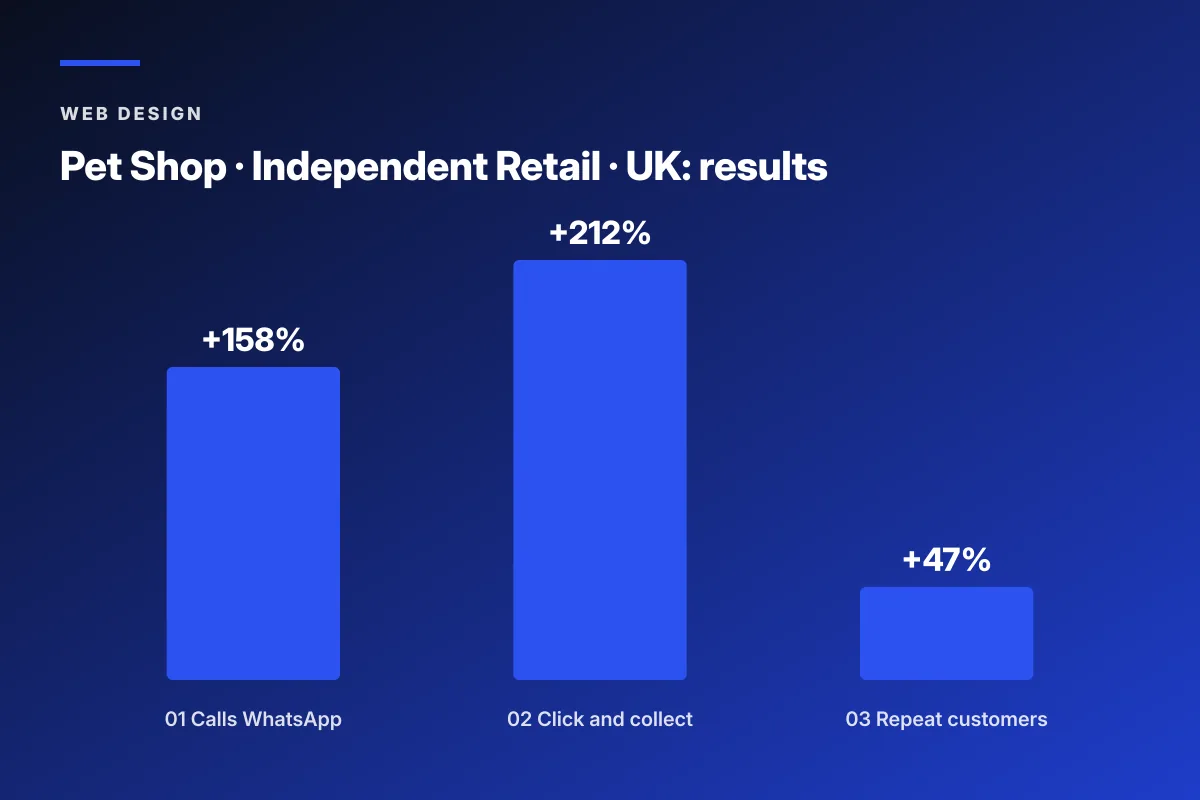
Over the following nine months, local enquiries via call and WhatsApp climbed 158 percent as mobile CTAs replaced contact-form friction. Click-and-collect orders grew 212 percent as browsers who used to default to Amazon completed the pickup flow. Repeat-customer rate climbed 47 percent as the daily social cadence kept the shop top of mind between visits. The map-pack rank moved from position 9 to position 2 for the primary near-me search. The rebuild did not invent traffic. It caught the local intent that already existed and gave the shopper a reason not to default to the chain.
Pet shop web design mistakes independent retailers keep making
Every independent pet shop we audit makes at least three of the same mistakes. The mistakes are cheap to fix and expensive to leave alone. Fixing all three inside 60 days typically pulls a 25 to 40 percent gain in local session conversion without touching ad spend.
- Store hours only in the footer: shoppers scroll past. Put hours in the header and the fold.
- Contact form with 8 fields: kills 55 percent of contact intent. Replace with click-to-call and WhatsApp.
- Category grid with 200 SKUs on one page: shopper leaves. Split into 4 to 8 subcategories with 30 to 60 SKUs each.
- Stock photo of a golden retriever: reads as generic. Use a real photo of the shop, the owner, and the staff.
- Delivery info hidden until checkout: drops 30 to 45 percent of near-term-intent baskets. Show fee and radius on the product page.
- No live open or closed indicator: shoppers call after hours and hit voicemail. Wire the live indicator once, forget it forever.
- Google Business Profile last updated in 2022: silent GBPs get demoted. Post 2 to 4 weekly updates.
The order to fix them
Fix the store info block first because it grows call volume immediately. Fix the contact-to-call swap second because it captures the ready-to-buy shopper. Fix the category cross-sell third because it grows basket size on shoppers who already convert. The Google Business Profile updates run in parallel from day one because they are cheap and compound over 90 days. Independent shops that batch the fixes over 45 to 60 days rather than trying to do everything in the first two weeks see cleaner analytics on what actually moved the numbers, and they avoid the common trap of rebuilding the whole site while the near-term intent shopper still cannot find the phone number. The post-launch maintenance side of the same discipline sits inside our reference on pet products website maintenance, which covers the weekly hygiene work that keeps the fixes holding through year two.
Pet shop web design outlook through 2028
The independent pet retail market forecasts through 2028 hold at 4.2 to 5.8 percent annual growth against the broader pet category’s 6.5 to 7.2 percent. Independent share of category is projected to hold at 28 to 32 percent even as Amazon and Chewy keep pulling DTC volume. The shops that hold share are the ones that build local convenience into the site design instead of trying to out-catalog the chains. Three specific shifts shape the outlook.
AI search and local intent
AI Overviews on Google and ChatGPT store-locator queries are pulling local intent away from the traditional map pack. Shops with structured PetStore schema, clean opening-hours data, and product schema on the top 40 SKUs surface inside AI answers. Shops without the schema get skipped. This shift favors independents who wire the schema once, and it hurts chains that treat every store location as a stamped template. Outside reading on the AI search shift lives at Google’s AI features documentation for search.
Same-day delivery as table stakes
Same-day local delivery moves from a differentiator in 2025 to table stakes in 2027 as DoorDash Drive, Uber Direct, and neighborhood courier networks push per-delivery costs under $4. Independent pet shops that hold same-day delivery in 2028 stay competitive on the near-term-intent shopper. Shops that still ask for two-day mail order in 2028 lose those shoppers to Chewy. Our related read on pet shop marketing covers the paid overlay side of the same shift.
Where pet shop web design fits the full marketing stack
Pet shop web design sits at the center of the independent retail marketing stack. Local SEO feeds the site with near-me traffic. Paid social defends the neighborhood share against the chains. Loyalty and WhatsApp campaigns turn the first purchase into the second one. Every one of those tactics either compounds through the site design or fights against it. Shops that budget for tactics on a scattered site produce short-run wins with no compounding. Shops that get the site design right first turn every downstream investment into a lever that stacks over 12 to 24 months instead of resetting every quarter.
The retail-first patterns above sit next to broader work on ecommerce and DTC pet brands, where the buying journey has more steps but the underlying discipline transfers. Independent pet shops that treat the site as the foundation of the marketing stack rather than a brochure the paid campaigns point at build a compounding local advantage the chains cannot replicate with template stores. That’s the whole argument for a retail-first site design brief.
Pet shop web design for local retailers is the specific discipline of turning near-term intent into today’s foot traffic and tonight’s pickup order. Get the store info block right, structure categories for cross-sell, wire click-and-collect in five steps, and layer local SEO under the whole build. That is the working brief we hand every independent pet retailer we take through a rebuild inside our pet products marketing agency engagement. The chains cannot copy any of it.
Frequently asked questions
What does pet shop web design cover for a local retailer?
Pet shop web design for a local retailer covers five specific modules. A store info block with address, hours, phone, click-to-call, and a live open or closed indicator. A category browse structured for cross-sell rather than alphabetical order. A five-step click-and-collect flow with a same-day pickup window. A local delivery model with fee and radius visible on the product page. A loyalty layer with WhatsApp reorder and member pricing that captures the first purchase and drives the second. The site is not a general ecommerce catalog. It is a working retail counter on the web. Independent pet shops that build to the five modules typically pull local session conversion rates 2 to 3 times higher than shops running a generic ecommerce template.
How does pet shop web design differ from pet DTC subscription design?
Pet shop web design for a local retailer is a different job from pet DTC subscription design. The local retail shopper is deciding whether to visit the store today or order a pickup for tonight. The DTC subscription shopper is deciding whether to sign up for a 30-day kibble box. The site's job on the retail side is to answer three questions in ten seconds. Is the shop open now. Does it stock the thing the shopper needs. How fast can the shopper get it. The DTC subscription site instead has to build brand story, ingredient trust, and the case for signing up. Retail sites prioritize store info, category browse, and pickup. DTC subscription sites prioritize brand, product detail, and subscription flow.
How much does pet shop web design cost for a single-location shop?
Pet shop web design pricing sits in three tiers. Single-location shops under 2,000 SKUs run a $4,800 to $9,500 build fee plus a $599 to $1,200 monthly retainer. Single-location shops with 2,000 to 6,000 SKUs run a $9,500 to $18,000 build fee plus a $1,200 to $2,400 monthly retainer that adds delivery, loyalty, and WhatsApp reorder to the scope. Two to four location groups run a $18,000 to $34,000 build fee plus a $2,400 to $4,800 monthly retainer. Redefine Web pet shop web design retainers start at $599 monthly for the single-location tier with a 6-month contract commitment as the standard operating agreement. Every legitimate partner will price on a fixed build plus an ongoing retainer, not on a per-hour scramble that leaves the shop without local SEO work between deliverables.
What are the pet shop web design mistakes independent retailers make?
The seven repeating mistakes on independent pet shop web design projects. Store hours only in the footer where shoppers never scroll. Contact forms with 8 fields that kill 55 percent of contact intent. Category grids with 200 SKUs on one page that overwhelm the shopper. Stock photos of golden retrievers that read as generic. Delivery information hidden until the checkout step that drops 30 to 45 percent of near-term-intent baskets. No live open or closed indicator that leaves after-hours callers hitting voicemail. Google Business Profiles last updated in 2022 that get demoted by the algorithm. Fixing the seven mistakes inside 60 days typically pulls a 25 to 40 percent gain in local session conversion without touching ad spend. The mistakes are cheap to fix and expensive to leave alone.
How does local SEO integrate with pet shop web design?
Local SEO integrates with pet shop web design at three specific points. Google Business Profile alignment where the on-site NAP name address and phone match the profile exactly, 20 to 40 real shop photos live on the profile, 2 to 4 weekly updates keep the profile active, and every review gets a reply within 48 hours. Schema markup where the site carries PetStore, Product, and BreadcrumbList structured data on every relevant page. Location-anchored content where the neighborhood name appears in the H1, the meta description, and the store info block. Independent pet shops that wire all three points typically see map-pack rankings climb from position 8 to 12 into the top 3 inside 90 days, and organic session volume triple on a small starting base.
Book your free 30-minute strategy call.
No spam, no sales rep. We use your email to schedule your call with a senior strategist. That is it.
More from the blog
View all articles → Web Design
 Core Web Vitals Healthcare Websites Actually Need to Book Patients
Read article Web Design
 Professional Services Website Design Best Practices for 2026
Read article Web Design