
PPC Management for Fashion Brands Monthly Scope Playbook
- Weekly negative keyword pass is the non-negotiable core.
- Creative refresh clock is 10 to 14 days on Meta, 21 on Google.
- Feed audits run monthly, seasonal audits run bi-weekly.
- Budget shifts by drop week, not by calendar month.
- Cross-channel decisions read ROAS by margin, not by revenue.
- What monthly PPC management for fashion brands includes
- Weekly cadence inside PPC management for fashion brands
- Seasonal budget shifts in fashion PPC
- Creative refresh cadence per channel
- Product feed audits for fashion PPC
- Cross-channel optimization for fashion PPC
- Landing page and conversion work
- Tracking and reporting inside the retainer
- Team and cadence for a real retainer
- A real fashion PPC management engagement in production
- Where fashion PPC management fits the stack
A DTC apparel brand doing $80,000 in monthly ad spend hired a PPC agency in March, shipped a spring drop in April, and watched cost per acquisition climb 38 percent by June. The account had no negative keyword work since kickoff, no creative refresh past the launch batch, and a product feed still pointing at three summer SKUs that stopped shipping in May. Every one of those failures traces back to the same thing. Weak PPC management for fashion brands, on autopilot after the setup month, running the same account structure a plumber’s Google Ads campaign runs. Fashion moves faster than that.
This playbook covers what PPC management for fashion brands actually includes each month. Weekly negative keyword sweeps. Seasonal budget shifts by drop week. Creative refresh cadence per channel. Product feed audits with a 12-point checklist. Cross-channel budget calls read on margin, not revenue. Every recommendation below runs on real fashion accounts our apparel fashion PPC team has held through 2024 and 2025. Beginners newer to the space should read the fashion PPC fundamentals guide for the channel and category-benchmark basics before scaling.

What monthly PPC management for fashion brands includes
PPC management for fashion brands runs on a weekly clock, not a monthly one. The core monthly scope covers a weekly negative keyword pass, a 10 to 14 day creative refresh, a monthly feed audit, bi-weekly seasonal budget shifts, and cross-channel margin reads that decide where each incremental dollar goes.
The four weekly tasks that run every account
Four tasks run every week on a healthy fashion PPC account. Negative keyword harvest from Search and Shopping search terms reports (usually 40 to 120 new negatives per week for a $30,000-per-month account). Creative fatigue check across Meta and TikTok ad sets, with fatigued assets swapped inside 48 hours. Budget pacing check against the drop calendar, with over-pacing accounts throttled by 15 percent and under-pacing accounts accelerated by the same margin. Bid strategy review on Performance Max asset groups against target ROAS floors. The four together take 6 to 10 hours per week for an account under $50,000 in spend. Skipping any one produces the account-drift pattern that shows up as a 20 to 40 percent cost per acquisition climb within 60 days.
The three monthly tasks that hold the account
Three monthly tasks hold the account together across drop cycles. Product feed audit against the 12-point checklist (covered later in this guide). Account structure review that decides whether campaigns should split, merge, or retire based on drop-cycle data. Reporting build that shows blended cost per acquisition, per-channel contribution margin, and product-cluster ROAS. Fashion accounts skipping the structure review month over month accumulate 30 to 50 percent redundant campaigns by month six, wasting 10 to 15 percent of spend on internal auction competition. A working retainer for a fashion account budgets 4 to 6 hours per month for these three tasks combined.
Weekly cadence inside PPC management for fashion brands
The weekly cadence sits at the center of PPC management for fashion brands because fashion demand moves in 6 to 14 day drop cycles. A monthly cadence misses the second drop of the cycle. A quarterly cadence misses the whole season. Locking the weekly clock and holding it for 12 weeks minimum is what separates managed accounts from expensive autopilot ones.
Monday to Wednesday work
Monday opens with the search terms report pull from Google Ads and Meta, followed by the negative keyword harvest. Tuesday runs the creative fatigue check on ad sets past day 8 of prospecting, with fresh creative queued in staging for approval. Wednesday runs the budget pacing check against the drop calendar and the ROAS floor review on Performance Max. All three days together run 3 to 5 hours for an account under $30,000 in monthly spend. Splitting the work across Monday, Tuesday, Wednesday matters because it lets Thursday and Friday handle exceptions, launches, and creative production without cramming everything into one weekly work block that misses the drop window. Our fashion PPC agency selection guide covers how to vet an agency against this exact weekly cadence.
Thursday to Sunday work
Thursday runs the mid-week reporting pull for the drop-in-progress and the mid-flight bid adjustments on the sale windows. Friday handles new drop launches for accounts that push new SKUs live on Fridays (roughly 40 percent of DTC fashion brands run Friday drops). Saturday and Sunday sit on a weekend watch protocol, with account managers checking spend pacing every 8 hours during peak drop weekends and running budget rescues if the account over-paces before 6 PM Saturday. Weekend watch matters because Meta’s algorithm punishes accounts that hit daily budget cap early on Saturday, and the recovery cycle takes 72 hours to clear.
Seasonal budget shifts in fashion PPC
Budget shifts by drop week, not by calendar month. A generic ecommerce account rebalances budget quarterly. A fashion account rebalances weekly around the drop calendar and daily around Black Friday, Boxing Day, and the two swing weeks in July and January. The math looks aggressive on paper and produces steady contribution margin in practice.
| Drop window | Prospecting share | Retargeting share | Brand Search share | Total budget vs baseline |
|---|---|---|---|---|
| Pre-drop tease (day -10 to -1) | 60 percent | 25 percent | 15 percent | 1.2x |
| Drop week (day 0 to 7) | 35 percent | 50 percent | 15 percent | 1.8x |
| Sell-through (day 8 to 21) | 25 percent | 40 percent | 35 percent | 1.0x |
| Off-cycle (day 22+) | 20 percent | 30 percent | 50 percent | 0.6x |
| Black Friday window (10 days) | 50 percent | 35 percent | 15 percent | 3.0x |
| January clearance (14 days) | 15 percent | 60 percent | 25 percent | 1.5x |
The table assumes an account with baseline spend of $20,000 per month across four channels. A brand running a summer drop in May followed by a mid-June sale would push spend to $36,000 in drop week (1.8x) and pull back to $12,000 in the last week of June (0.6x). Fashion brands treating budget as a flat monthly line miss 25 to 40 percent of drop-week volume because Meta and TikTok reward accounts that push aggressively during peak demand and starve the ones running flat. The Google Ads guide to campaign budgets covers the mechanics for daily budget shifts. The seasonal rhythm holds across women’s apparel, menswear, and accessories, with jewelry running a lighter pre-drop tease and heavier sell-through window. The broader ecommerce PPC management for DTC brands guide covers how these budget-shift patterns work outside the fashion-specific drop cycle.
Fashion PPC breaks on stale SKUs, not bids. Set a Monday feed audit before the account manager touches negatives or creative. Dead SKUs kill margin fastest.
Creative refresh cadence per channel
Creative refresh cadence is the second lever after budget. Fashion audiences pattern-match on ad creative in 5 to 12 days depending on channel, which is 2 to 3 times faster than generic ecommerce audiences. Running creative past the fatigue window costs 15 to 30 percent of ROAS on prospecting and 8 to 15 percent on retargeting.
Meta and TikTok refresh clock
Meta prospecting creative refreshes every 10 to 12 days for cold audiences, every 14 to 21 days for warm audiences. TikTok prospecting creative refreshes every 5 to 7 days for cold, every 10 to 14 days for warm. The gap between Meta and TikTok reflects platform velocity and audience behavior, with TikTok viewers scrolling 3 to 5 times more content per session than Meta viewers. Fashion brands running the same creative on both channels for 30 days will see TikTok cost per acquisition climb 40 to 60 percent before Meta shows any decline, which produces the false diagnosis that TikTok is broken when the real problem is creative fatigue. A monthly retainer running a fashion PPC account budgets 3 to 6 fresh creative variants per week for Meta and 6 to 10 for TikTok.
Google and Performance Max clock
Google Discovery, YouTube Shorts, and Performance Max asset groups run on a longer 21 to 28 day refresh clock. Performance Max in particular rewards asset stability because the algorithm learns audience-asset pairings across 14 to 21 days, and thrashing assets weekly resets the learning window. A working Performance Max asset group for fashion holds 5 headline variants, 5 long headlines, 5 descriptions, 15 lifestyle images, 5 product-only images, and 3 video assets, refreshed on a rolling basis where 20 percent of assets rotate every 7 days rather than a full swap monthly. That rolling refresh pattern shows 15 to 25 percent lower cost per acquisition versus batch refreshes on the fashion accounts our team has held through 2024.
Product feed audits for fashion PPC
Product feed audits are the third pillar of PPC management for fashion brands and the one most accounts skip. Fashion feeds carry 4 to 8 times more attribute complexity than generic ecommerce feeds because size, color, material, fit, and season all matter to Google’s Shopping algorithm and to the Meta catalog match rate. A feed with 20 percent of SKUs missing size attributes loses 15 to 25 percent of Shopping impressions on those SKUs.
- Title formula alignment: brand + product type + material + color + fit + size, in that order, across every SKU.
- Taxonomy accuracy: Google product category assigned to the deepest applicable node, not the parent category.
- Size, color, material attributes: complete for every SKU, no null values, no free-text answers where enums are required.
- Image discipline: 1200 by 1200 minimum, lifestyle plus product-only pair for every SKU, alpha channels stripped.
- Availability sync: feed availability matches site inventory within a 30-minute window.
- GTIN and MPN presence: every SKU carries valid GTIN or is flagged for the identifier_exists override.
- Custom labels: 5 label slots used for margin tier, seasonal window, drop bucket, sell-through stage, and return-rate bucket.
- Exclusion rules: out-of-stock and size-limited SKUs excluded from campaigns automatically inside 4 hours.
An audit that catches more than 15 percent of SKUs with feed issues triggers a mid-month re-audit and a Merchant Center resubmission. Audits catching under 5 percent are treated as clean and roll into the next monthly cycle. Fashion brands running Shopify with the native Google channel app usually run 8 to 12 percent SKU issue rates before any feed management app enters the picture. Layered feed managers like Feedonomics or DataFeedWatch pull the issue rate to 2 to 4 percent, which pays for itself in the first drop cycle at spend above $15,000 per month. Our Shopify PPC agency tracking guide covers the Shopify-specific feed hygiene work that pairs with this monthly audit.
Cross-channel optimization for fashion PPC
Cross-channel optimization is the monthly decision layer that sits above the weekly cadence and the feed audits. Each channel plays a specific role in the fashion PPC stack, and the monthly reallocation moves incremental dollars to the channel producing the best contribution margin per acquisition, not the best ROAS on paper.
The five-channel default stack
The default channel stack for a fashion brand over $20,000 in monthly spend runs Meta prospecting and retargeting, Google Shopping plus Performance Max, TikTok Shop plus TikTok Ads, Pinterest for wedding and seasonal moments, and Reddit for subculture niches. Meta handles 35 to 45 percent of spend. Google handles 25 to 35 percent. TikTok handles 15 to 25 percent depending on Gen Z share. Pinterest and Reddit split the remaining 10 to 15 percent. Brands trying to run one channel usually saturate the audience by month six and see cost per acquisition climb 30 percent. Brands trying to run seven or eight channels usually spread too thin to earn algorithmic learning on any single one, which produces the same climb from the opposite direction.
Margin-based reallocation math
Monthly reallocation reads contribution margin per acquisition, not revenue ROAS. A channel showing 3.2x ROAS on high-margin new-collection SKUs beats a channel showing 4.8x ROAS on clearance SKUs because the second channel earns half the contribution margin per dollar spent. Fashion accounts running blended-ROAS optimization miss this pattern and shift budget toward the wrong channels every month. Our team pulls contribution margin per SKU from the Shopify or NetSuite ledger, joins it to the ad platform revenue on order ID, and rebalances channel budget monthly on the joined margin number. The reallocation math changes 8 to 15 percent of monthly spend on a mature account, which grows contribution margin 12 to 20 percent on the same total budget. The PPC strategy for ecommerce budget allocation read covers the underlying testing framework this reallocation math sits on.
Landing page and conversion work
PPC management for fashion brands stops at the ad click for a lot of accounts and treats landing page performance as somebody else’s problem. That handoff kills 20 to 35 percent of the ROAS opportunity because a fashion account with a 2.1 percent site conversion rate and a great ad account earns half the revenue of the same ad account paired with a 3.8 percent site conversion rate.
PDP and collection page audits
The PPC management scope includes a monthly product detail page and collection page audit. Load speed under 2.5 seconds on 4G. Above-the-fold price plus size selector plus add-to-cart on mobile. At least 4 lifestyle images in the gallery. Size guide accessible in one tap. Reviews block above the fold below the buy box. Sticky add-to-cart on mobile. Fashion brands running Shopify’s default themes usually miss 3 or 4 of those on any given PDP, which caps mobile conversion at 2 to 3 percent versus the 4 to 6 percent range custom themes routinely hit. The web.dev guide to ecommerce performance covers the technical side of PDP performance work.
Checkout and post-click hygiene
The checkout audit runs quarterly and covers guest checkout availability, express payment buttons (Shop Pay, Apple Pay, PayPal) above the manual form, address auto-complete, discount code visibility during the drop window, and mobile checkout latency. Fashion brands that turn on Shop Pay for accounts synced to Meta CAPI usually see 8 to 12 percent higher checkout completion within 30 days because Shop Pay pre-fills shipping and payment data for the 100 million Shop Pay-enabled shoppers Shopify reports. Checkout audits catching more than 2 friction issues get a mid-quarter re-audit rather than waiting the full three months.
Tracking and reporting inside the retainer
Tracking work sits under the ad campaigns and stays invisible until it breaks. Broken tracking usually shows up as a 20 to 40 percent gap between platform-reported revenue and Shopify order revenue, at which point the account has been running blind for two weeks and Performance Max has learned on garbage signal.
Every drop-week reporting meeting eventually reaches the moment where the founder points at a Meta ROAS of 6.8x, then points at the Shopify dashboard showing $14,000 in the same window, then asks where the missing $22,000 in Meta-attributed revenue went. Nobody has updated the pixel since the theme swap in April. The Enhanced Conversions flag is off. iOS 14 privacy prompt opt-in rate is 18 percent. The polite thing is to admit the numbers. Somewhere in the Meta account of every fashion brand, a 6.8x ROAS is quietly earning the marketing team a bonus for revenue that never actually shipped to a real customer.
Monthly tracking hygiene covers Meta Pixel plus Conversions API deduplication check, Google Ads Enhanced Conversions match rate above 65 percent, GA4 to Shopify order reconciliation within 5 percent, UTM discipline across every ad set, and consent mode implementation for EU and UK traffic. Reporting builds a single Looker Studio dashboard showing blended cost per acquisition, per-channel contribution margin, product-cluster ROAS, and drop-week revenue by day. Accounts that skip the Looker Studio build usually pull data from 4 different platforms every month and read numbers that quietly disagree with each other by 15 to 30 percent. The dashboard costs 6 to 10 hours to build once and 30 minutes per month to maintain.
Team and cadence for a real retainer
The team behind the retainer matters as much as the scope. A fashion PPC account under $50,000 in monthly spend needs three roles across the week. A paid media manager who owns the account structure and the strategic calls. A campaign operator who runs the weekly harvest, refresh, and pacing work. A creative producer who ships 6 to 12 fresh assets per week and holds the drop-calendar handoff with the brand’s in-house team.
- Weekly account manager call: 30 minutes on Monday reviewing last week’s numbers and the coming week’s plan.
- Bi-weekly creative review: 45 minutes reviewing tested creative and briefing the next batch against drop-calendar priorities.
- Monthly strategy review: 60 minutes covering channel reallocation, feed audit findings, and structural account decisions.
- Quarterly business review: 90 minutes covering contribution margin trends, seasonal planning, and next-quarter budget.
- Ad-hoc drop-week war room: paid media manager on call from Thursday 6 PM through Sunday midnight during major drop weekends and Black Friday.
- Shared Slack channel: paid media manager and brand founder in the same channel for real-time drop coordination.
Fashion brands that treat the PPC agency as a monthly vendor rather than a weekly partner usually see 25 to 40 percent lower drop-week revenue than brands running the shared-Slack cadence. The WordStream guide to working with PPC agencies covers the client side of the same handoff. A working retainer treats the fashion brand’s marketing lead and the agency’s paid media manager as the same operational unit for the drop window, not as vendor and client.
A real fashion PPC management engagement in production
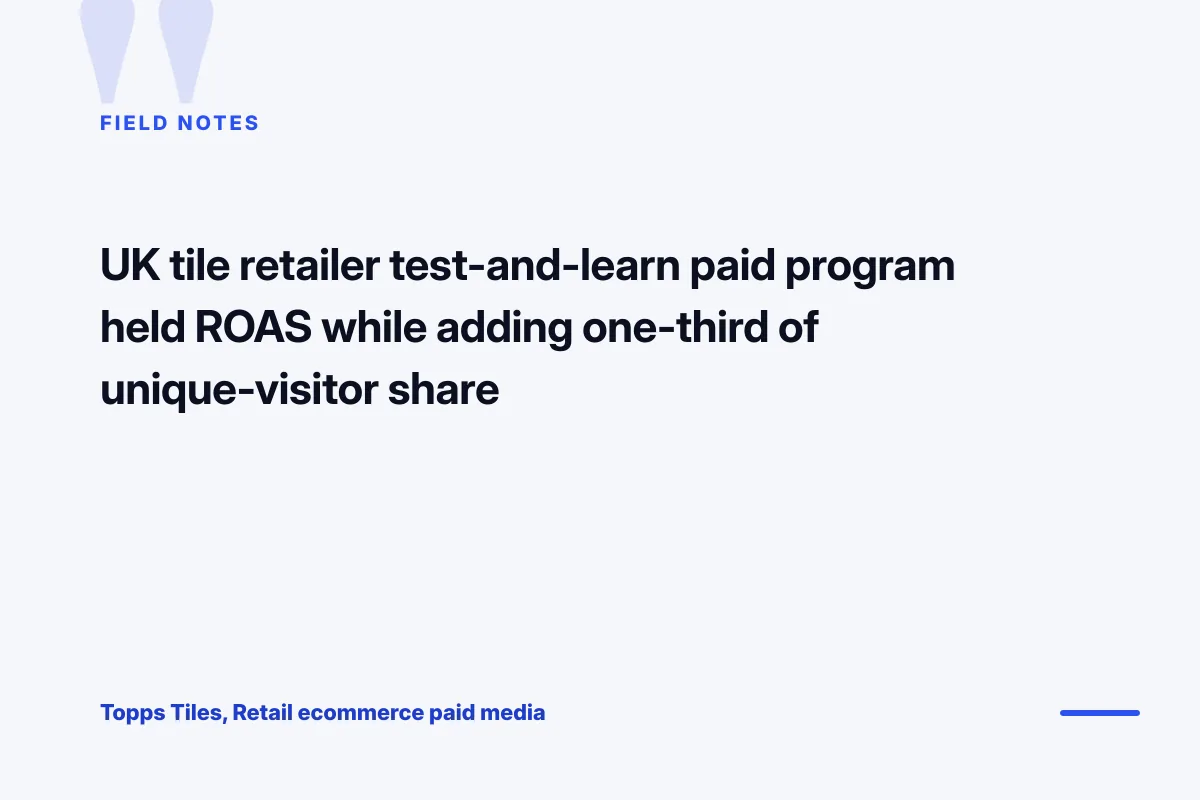
Topps Tiles came to our team with a paid media program that was holding a ROAS target but capping unique-visitor share at 8 percent in a market where the top three competitors were pulling 34 percent combined. The brand needed to test aggressive prospecting without breaking the ROAS floor, and the internal team had no bandwidth to run the weekly cadence at a drop-week clock across Google, Meta, and Reddit.
Our team built a structured test-and-learn program covering Google Shopping, Google Search, Meta prospecting and retargeting, and a Reddit test on r/HomeImprovement and r/InteriorDesign. Weekly negative keyword pass across every account. 10-day creative refresh clock on Meta with 4 to 6 fresh variants per week. Monthly feed audits catching a 12 percent SKU issue rate that pulled to 3 percent by month two. Bi-weekly seasonal budget shifts around the tile-buying peak windows (kitchen remodels in April to June, bathroom remodels in September to November). Shared Slack channel with the Topps Tiles ecommerce lead for real-time drop coordination.
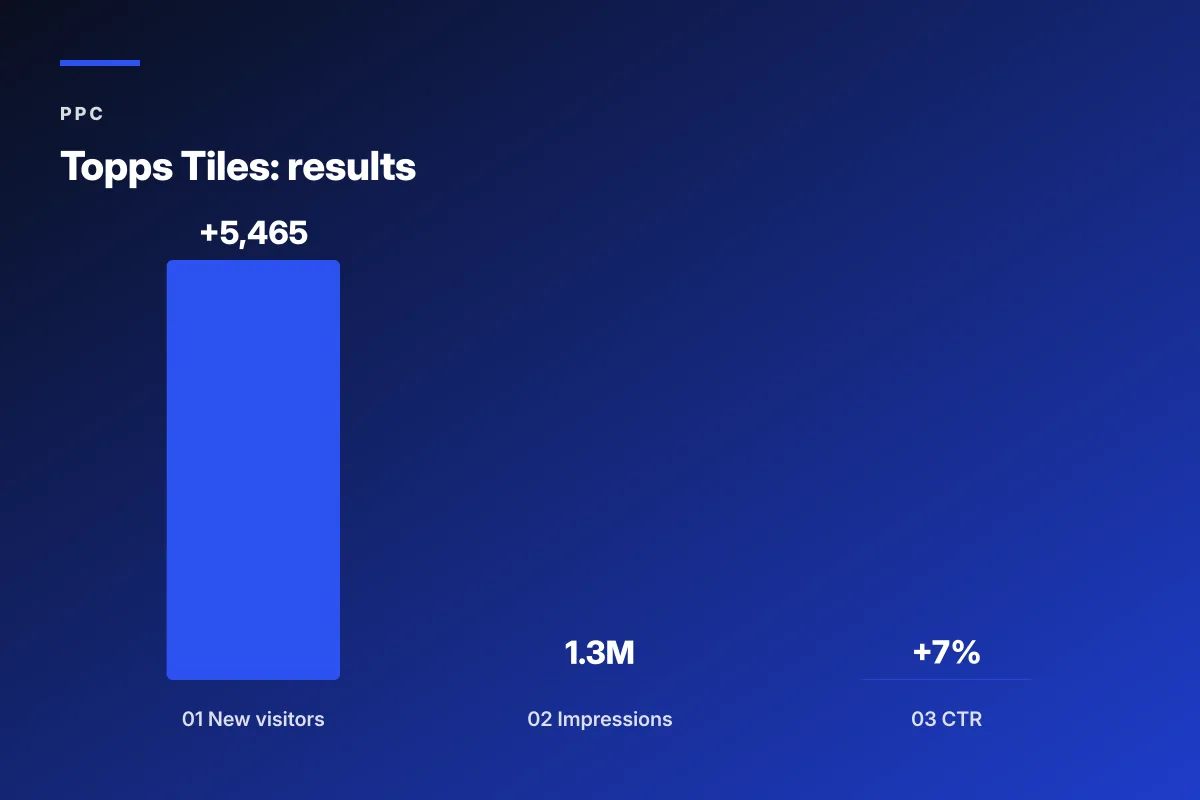
Over the test window, the program delivered 5,465 new buyer visits, 1.3 million impressions across paid channels, a 7 percent click-through rate against a 2 percent baseline, and one-third of the unique-visitor share in the tile category. ROAS held above the target floor across every drop window. The pattern that worked was the weekly-clock cadence paired with the margin-based cross-channel reallocation, not any single tactical win. That same operating pattern rolls onto fashion accounts our team holds today.
Where fashion PPC management fits the stack
PPC management for fashion brands sits at the acquisition layer of the marketing stack. Every retention channel, every organic content investment, every influencer program either compounds off healthy paid acquisition or fights against a broken one. Fashion brands that treat PPC as a standalone line item miss the compounding gains that come from paid, organic, and retention feeding the same customer file.
The pricing bands sit inside a $599 to $6,000 monthly retainer range depending on ad spend and channel count, with 6-month starter terms because fashion PPC accounts need two full drop cycles to prove cost per acquisition ceilings. The Search Engine Land paid search library is a useful outside read for founders doing budget work in-house between agency reviews.
Every read runs on the same weekly-cadence operating pattern this playbook describes. The apparel fashion marketing retainer page covers the pricing math and the drop-cycle calendar the team runs against for accounts across women’s apparel, menswear, jewelry, footwear, and accessories. PPC management for fashion brands is the operating layer that decides which tactical investments compound and which ones stay stuck on autopilot.
The monthly scope in this guide runs on the same variant coverage and retargeting split covered in our catalog ads and retargeting playbook for fashion ecommerce, which drills into the Shopify plus Meta feed integration side.
Retainer scope shifts on ethical DTC accounts because the shopper consideration window runs 21 to 45 days rather than 4 to 12 on fast fashion. Our PPC for sustainable fashion brands messaging and keywords guide covers the extended retargeting flows and cohort reporting cadence sustainable brands need.
Frequently asked questions
What does PPC management for fashion brands include each month?
PPC management for fashion brands each month includes a weekly negative keyword pass across Search and Shopping, a 10 to 14 day creative refresh cycle on Meta and TikTok, a monthly product feed audit, bi-weekly seasonal budget shifts around drop weeks and sale windows, weekly bid strategy checks on Performance Max, cross-channel ROAS reads by margin category, and a monthly account restructure review. The scope also covers landing page conversion checks, pixel and Enhanced Conversions hygiene, catalog exclusion rules for out-of-stock SKUs, and reporting that shows blended cost per acquisition alongside product-level contribution margin. All of that happens inside a 20 to 30 hour monthly retainer for most DTC apparel accounts under $50,000 in monthly spend.
How is PPC management for fashion brands different from generic ecommerce PPC?
PPC management for fashion brands runs on a faster clock than generic ecommerce. Fashion drops in cycles of 6 to 14 days, not monthly or quarterly, so the creative rotation, feed refresh, and budget shift happen on the drop calendar, not the marketing calendar. Sizing runs are unforgiving on Shopping feeds because a size-24 dress selling out breaks the ad the moment inventory hits zero. Return rates on apparel run 20 to 30 percent, which forces net-margin reporting instead of gross-revenue ROAS. Seasonal sensitivity is higher, with July and December swings of 3 to 5 times baseline demand. Generic ecommerce PPC accounts run monthly cadences and miss all of that.
What budget shifts should a fashion PPC account make by season?
A fashion PPC account should shift budget by three seasonal beats. The pre-drop tease window (7 to 10 days before a launch) pulls 15 to 25 percent of budget into brand-heavy prospecting on Meta and Reddit. The drop week itself pulls 40 to 60 percent of budget into retargeting and Performance Max with tight ROAS floors. The steady sell-through window (10 to 21 days after drop) rebalances to Search brand plus non-brand Shopping. Around Black Friday and Boxing Day, prospecting spend can triple for a 10-day window if margin per unit supports it. Off-season months (January for winter brands, July for outerwear) run at 40 percent of peak.
How often should ad creative refresh in fashion PPC?
Ad creative in fashion PPC refreshes on a 10 to 14 day clock for Meta and TikTok, a 21-day clock for Google Discovery and YouTube, and a per-drop clock for Performance Max asset groups. Meta creative fatigue on fashion audiences hits between day 8 and day 12 for cold prospecting, faster than most ecommerce verticals because the audience scrolls harder and pattern-matches faster. TikTok fashion creative fatigues by day 5 to 7 on the same audience, so brands with a TikTok Shop presence run new creative every week minimum. Retargeting creative can hold for 21 to 28 days if the offer changes at day 14.
What does a product feed audit cover for a fashion PPC account?
A monthly product feed audit for a fashion PPC account covers 12 checks. Title formula alignment across every SKU. Google product taxonomy assignments per category. Size, color, and material attribute completeness. Image dimensions and lifestyle versus product shot ratio. Availability and price consistency between the feed and the site. GTIN and MPN presence. Custom label buildout for margin tier, seasonal window, and drop bucket. Exclusion rules for out-of-stock or size-limited SKUs. Promotional feed submissions for sale events. Merchant Center diagnostics for policy warnings. Country of origin data. Return policy field. Audits catching more than 15 percent of SKUs with issues get a mid-month re-audit.
Which cross-channel calls does fashion PPC management make?
Cross-channel calls in fashion PPC management run on margin, not revenue. Meta prospecting handles cold acquisition against brand-adjacent audiences and lookalikes of high-margin buyers. Google Shopping and Performance Max handle high-intent purchase moments and always-on brand defense. TikTok handles drop-week acceleration and Gen Z acquisition. Reddit handles subculture-specific niches like techwear, workwear, or Y2K resale. Pinterest handles wedding, seasonal, and gift-guide moments. The monthly decision is where each incremental dollar earns the most contribution margin, not where ROAS looks best. Fashion brands running one channel usually cap growth by month six because the audience saturates and cost per acquisition climbs 30 percent.
How much does PPC management for fashion brands cost per month?
PPC management for fashion brands runs $599 to $6,000 per month depending on ad spend and channel count. The Redefine Web fashion retainer starts at $599 monthly for accounts under $10,000 in ad spend and covers weekly negative keyword pass, monthly feed audits, and one channel management. Accounts spending $10,000 to $50,000 monthly run $2,500 to $4,500 in management and cover two or three channels. Accounts over $50,000 monthly run $4,500 to $6,000 and cover four or five channels with dedicated creative refresh support. Every retainer commits to a 6-month starter term because fashion PPC accounts need two full drop cycles to prove cost per acquisition ceilings.
Book your free 30-minute strategy call.
No spam, no sales rep. We use your email to schedule your call with a senior strategist. That is it.
More from the blog
View all articles → PPC
PPC Healthcare PPC Advertising Channels Compliance and Targeting
Read article PPC
PPC Dental Facebook Ads Guide for Practices That Book Patients
Read article PPC
PPC