
A beauty content marketing agency earns its retainer on 4 moving parts a generalist shop rarely runs at once. An ingredient citation library that lets writers pull peer-reviewed studies in under 20 minutes. A medical review workflow that clears health-adjacent claims through board-certified reviewers inside 5 business days. An editorial calendar mapped against the buyer’s 90-day skincare decision cycle. And a conversion writing bench that carries visitors from a top-of-funnel query into product-page checkout without a voice break. Every brand shopping this space wants speed, category depth, and clean YMYL posture. Not every shop delivers all three.
The next 12 minutes cover the deliverables a beauty content marketing agency owns for a growing DTC brand or a multi-location clinic, the retainer bands that fit each scope shape, the editorial rhythm that produces steady rank gains without burning writers out, a Manhattan clinic teardown that hit 166% lead growth on this exact model, and the shortlist questions that separate a category specialist from a generalist chasing a beauty logo. Read it end to end and you’ll have a working framework for every content-agency proposal sitting in your inbox this quarter. See our beauty and skincare marketing agency page for the full retainer stack Redefine Web operates under.
The 4-pillar scope a beauty content marketing agency owns
Every beauty content marketing agency running the full stack works 4 pillars in parallel. Ingredient education content at the top of the funnel. Treatment and product explainer content in the middle. Comparison and buying-guide content near the bottom. And conversion-focused product-page and category-page copy at the checkout layer. Each pillar pulls a specific kind of traffic and a specific kind of buyer response. Skip a pillar and the funnel breaks. Overweight one and the retainer bleeds dollars on content that never touches revenue.
Most retainers put roughly 40% of monthly output into ingredient and treatment education, 30% into comparison and buying-guide content, 20% into product and category copy, and 10% into conversion-rate-optimization writes. Shift the mix based on where the brand’s funnel is losing revenue. A brand with strong ad traffic but weak on-site conversion needs more product-page rewrites. A brand with soft organic needs more top-of-funnel ingredient work. See our beauty and skincare digital marketing agency scoping guide for the funnel-diagnostic questions that steer the mix.
Ingredient education as the top-of-funnel engine
Ingredient articles rank fastest and convert best inside beauty search. A well-scoped niacinamide article that cites 4 peer-reviewed studies, walks concentration bands, and links to 3 product SKUs pulls 3,200 to 7,800 monthly sessions after month 9 and converts at 2.1% to 3.4% to email signup. A beauty content marketing agency with an ingredient citation database can produce these in 5 to 7 hours per article. A generalist researches from scratch and produces the same article in 12 to 16 hours, then bills the extra time to the retainer. That math is why category specialization pays back on a mid-size retainer.
Deliverables list for a beauty branding and marketing agency retainer
A serious beauty branding and marketing agency retainer lists specific deliverables with volume and cadence written in. 8 to 12 long-form articles monthly at 1,800 to 2,600 words each. 2 to 4 product-page rewrites monthly. 1 category-page rebuild per quarter. Medical review on every health-adjacent piece inside 5 business days. Ingredient citation database maintained and refreshed quarterly. Monthly editorial calendar tied to the quarterly search-trend forecast. And a monthly performance report with organic-attributed revenue broken out by pillar cluster. That list fits on 1 page and holds honest across the full 12 months.
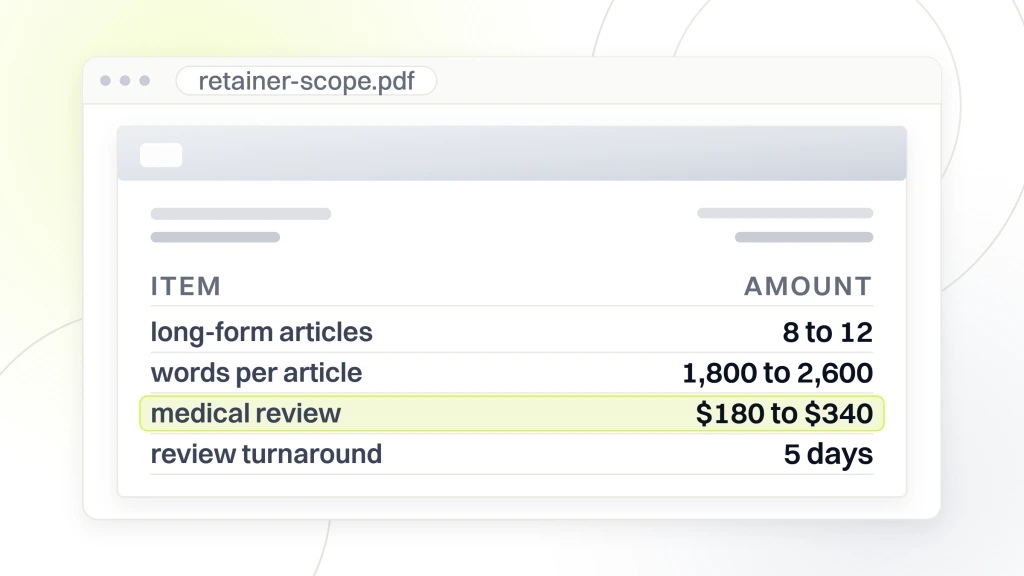
What doesn’t belong on that list is anything the shop hedges on. Approximately 8 articles hides a shop that plans to deliver 6. Medical review as needed hides a shop that plans to skip review on borderline pieces. Editorial calendar in month 2 hides a shop that doesn’t have one ready by kickoff. A beauty branding and marketing agency worth signing quotes specific numbers on every line and holds them across the term. If the proposal reads like a suggestion, the retainer will run like one too.
| Retainer band | Monthly cost | Article volume | Best fit brand stage |
|---|---|---|---|
| Foundation content | $1,499 per month | 3 to 4 articles | Single-location clinic or under $1M DTC |
| Growth content | $2,499 per month | 6 to 8 articles | $1M to $3M DTC skincare |
| Scale content | $3,999 per month | 10 to 12 articles plus product rewrites | $3M to $8M multi-SKU brand |
| Enterprise content | Starts at $6,000 per month | 14 plus articles plus category rebuilds and PR | $8M plus multi-country |
What the retainer covers versus what stays outside
Writing, editing, medical review, publishing, and reporting sit inside the retainer. Photography, video production, paid promotion, and influencer relationships sit outside as separately quoted line items. A beauty content marketing agency that bundles everything into 1 number is either padding margin or planning to underdeliver on a piece the founder cares about. Break the scope out on paper before signing. Ask which pieces move to project pricing if scope shifts. Watch how the account executive answers. See our SEO services page for the retainer scope Redefine Web offers to beauty brands.
Medical review workflow inside a content marketing for beauty brands engagement
Medical review is the workflow that decides whether health-adjacent content marketing for beauty brands ranks or stalls. A category shop keeps 8 to 20 board-certified dermatologists on retainer for client work and clears reviews inside 5 business days. The cost sits inside the retainer at $180 to $340 per article for reviewer time. Generalist shops source reviewers piece by piece, which stretches turnaround to 15 to 20 days and inflates the per-article cost past $520. That gap is the difference between a monthly cadence that compounds and one that stalls out by month 4.
The reviewer bench also feeds citation quality. Reviewers point writers at the studies that matter for a claim rather than the top Google result, which changes the citation depth on any article involving ingredients, procedures, or contraindications. On a monthly cadence of 8 to 12 articles, that quality gap is what separates content that ranks for competitive queries versus content that ranks only for long-tail. See Google’s helpful content guidance for the framing this reviewer workflow feeds.
Reviewer scheduling is where most agencies drop the ball. A shop with a bench uses shared calendars and a rotating primary reviewer per topic pillar (skincare ingredients, injectable procedures, laser treatments, retail cosmetics) so no single reviewer becomes a bottleneck. A shop without a bench routes every article to whichever freelancer replies first, which produces uneven turnaround and inconsistent voice across the calendar. The scheduling system inside the workflow matters as much as the reviewer credentials themselves, and it’s the piece most founders forget to ask about during scoping.
Editorial planning rhythm a beauty industry content agency runs
Editorial planning inside a beauty industry content agency runs on 3 cadences stacked together. Quarterly, monthly, and weekly. The quarterly plan sets the pillar clusters, the search-trend forecast, and the seasonal calendar. The monthly plan sets specific article assignments, medical review targets, and product-page rewrites. The weekly plan sets writer briefs, editor reviews, and publishing dates. That 3-layer rhythm keeps a 12-article month from turning into a scramble on the last 5 business days. Shops without the 3 layers publish in bursts and miss deadlines around month 4.
The quarterly plan takes about 8 working hours to build and it should be a real document. Cover the seasonal trend forecast, the pillar-cluster assignments for the next 13 weeks, the medical reviewer bench availability, and the priority queue for product-page rewrites. A shop that hands over this document at kickoff earns the founder’s trust. A shop that improvises the plan month by month burns that trust by month 3. See the Content Marketing Institute strategy guide for the underlying planning cadence.
Weekly brief cadence writers use
Weekly briefs run 1 page each. Target query, primary and secondary keywords, target word count, 3 internal links, 3 outbound citation targets, product mentions to weave in, and the buyer intent. A category shop pushes these on Monday morning so writers have 3 business days to draft, 1 day for editing, and 2 days for medical review before Friday publish. A generalist shop pushes briefs on Wednesday and asks writers to deliver by Friday, which produces thin content that misses the internal-linking targets. The rhythm is the retainer.
Monthly report a beauty content marketing agency delivers
The monthly report runs 6 to 9 pages. Organic sessions and revenue by pillar cluster. New indexed pages and their velocity to first rank. Medical review turnaround times. Product-page conversion rate deltas since publish. And a 1-page narrative from the account lead tying the numbers to the roadmap. Anything longer buries the signal. Anything shorter reads like an activity log. Founders who read the report cover to cover in 15 minutes stay bought in. Founders who feel lost drop out of monthly reviews by month 6.
The report should also include a 2-quarter forward look so the founder sees where the roadmap is heading. Content queued for the next 13 weeks. Product-page rewrites lined up. Category rebuilds scheduled. That forward view keeps the retainer feeling like a plan rather than a monthly output invoice.
The reporting cadence itself matters. Weekly Slack updates for indexing progress. Monthly written report for revenue attribution. Quarterly business review with the founder or CMO for roadmap adjustments. A category shop runs all 3 cadences without prompting. A generalist shop runs 1 and lets the other 2 lapse, which usually shows up as a founder feeling out of the loop by month 5. The reporting rhythm decides whether the retainer feels like a partnership or a delivery contract.
Case study on Beauté Aesthetics New York content build
Beauté Aesthetics New York, a Manhattan luxury clinic, ran a 12-month content-forward SEO retainer that produced 166% lead growth, 88% new user growth, and a 27% conversion rate gain over the term. The content scope covered 8 ingredient and treatment articles per month with board-certified physician review, quarterly category-page rebuilds for the 4 highest-margin services, and a monthly product-page rewrite queue against the retail skincare shelf. That mix put roughly 55% of retainer output into education, 25% into category rebuilds, and 20% into conversion writing.
The specific editorial decisions that mattered. The ingredient articles cited peer-reviewed studies on every clinical claim, ran through a physician-review workflow that cleared inside 4 business days, and pulled internal links to service pages and retail SKUs. The category-page rebuilds added treatment-comparison tables, before-and-after photo carousels with alt text that read as image-search SEO, and FTC-safe outcome language. The lead growth compounded from month 5 as the ingredient articles matured in the index and pulled the whole cluster up together.
| Beauté Aesthetics New York metric | Baseline | After 12 months |
|---|---|---|
| Website leads | Flat | Plus 166% |
| New user growth | Below baseline | Plus 88% |
| Conversion rate | Weak funnel | Plus 27% |
| Article publish cadence | 2 per month | 8 per month with medical review |
Ingredient library that fed every write
The Beauté content build started with a 640-study ingredient citation library indexed by molecule and concentration band. Writers pulled 3 verified citations per article inside 20 minutes, which cut research time by 7 hours per piece over the 12 months. That library also fed the retail product-page rewrites, which meant every SKU description carried study-backed claims that survived FTC review. The library sat inside the client account, not the agency’s private files, which meant Beauté Aesthetics New York owned the citation trail after the retainer wound down.
Category-page rebuild that grew product-page conversion
The 4 category-page rebuilds carried the conversion-rate gain. Each rebuild replaced marketing copy with treatment-comparison tables that let visitors filter by concern, price band, and recovery time. The tables linked directly to booking flows for treatments and to product pages for retail skincare. Time on category page climbed from 47 seconds to 2 minutes 18 seconds. Category-to-product click-through jumped 61%. That work looks small on a scope list and moves revenue like a wholesale rebuild.
DTC results a beauty marketing agency should show on the sales call
A serious beauty marketing agency shows real client outcomes on the first call, with client names and numbers. Abigail Ahern, the luxury home decor DTC brand, drove a 179% revenue increase and 3,000% paid-social ROAS working with our team, and did it without a single discount banner. That result came from content-led product-page rebuilds paired with paid social that pulled traffic to the strongest converting pages, not to broad category landing pages that leaked visitors before checkout. Content and paid worked in the same lane every month.
Boogie Board, the reusable writing tablet brand, hit a $31 cost per conversion at scale on paid media backed by content that primed cold audiences on the product’s use cases before the retargeting ads fired. That $31 number is the kind of proof point a beauty content marketing agency should be able to name on the second call. Any shop that can’t name a specific client cost per conversion, revenue lift, or organic session growth is asking the founder to sign on trust alone. Trust follows numbers, not the other way around.
Beauty content marketing agency versus in-house team
The math on in-house content versus a beauty content marketing agency turns on volume and category depth. One in-house lead writer plus one editor plus fractional medical review runs roughly $18k to $24k monthly all-in and produces 6 to 8 articles per month. A category-specialist retainer at the $3,999 per month Scale band produces 10 to 12 articles with the ingredient library, editorial planning, and medical review workflow already wired up. In-house wins on brand voice consistency after month 12. Retainer wins on speed to steady-state output and lower per-article cost across months 1 through 24.
The mature move for a growing DTC brand is retainer through year 1, hybrid model in year 2 (in-house editor plus agency writers plus in-house medical review), full in-house team by year 3 once volume justifies the fixed overhead. Skipping straight to in-house at the $3M revenue mark usually burns 8 to 11 months of ramp before the team produces at a category-shop level. See our beauty and skincare SEO service page and our PPC services page for the ad-side scope options that pair with content.
When the hybrid model earns its keep
The hybrid model earns its keep between $8M and $20M in revenue. In-house owns the editorial calendar and the brand-voice guardrails. The beauty content marketing agency delivers the writing capacity, the medical review workflow, and the citation library. Costs sit at $12k to $18k monthly combined, which is roughly 30% below full in-house at the same output level. Most brands overshoot the hybrid window and either stay retainer too long or hire in-house too early. The window is 2 years wide.
Shortlist questions for a beauty content marketing agency
5 questions on the first sales call separate a beauty content marketing agency from a generalist chasing the beauty logo. What is the medical review workflow and turnaround target. What is the ingredient citation database size and update cadence. Who is the account lead by name and how many months at the shop. What is the retainer band for the scope we just described. What does a redacted monthly report from a comparable client look like. Category shops answer with numbers inside 10 minutes on the same call. Generalists reach for slides and a promise to send an example next week.
2 more questions worth asking on the second call. What percentage of your client roster is beauty and skincare in particular. What percentage of your writers have written for beauty for 3-plus years. A category shop lands at 70% plus on both. A generalist lands under 30% on both. That gap predicts editorial quality and turnaround more reliably than any credential on the shop’s homepage.
Reference call questions worth asking
Reference calls surface the honest read on any beauty content marketing agency. Ask each reference how the account lead handles urgent scope changes. Ask whether the shop has turned over writers or medical reviewers during the engagement. Ask whether monthly targets get hit more or less than half the time. Ask whether the reference would resign the retainer today. 2 we’d resign tomorrow responses and the shop earns the finalist slot. Any hedging and the shop drops. Reference calls take 30 minutes each and predict outcomes more reliably than any deck.
Contract terms a beauty content marketing agency proposes
6-month first term with mutual continuation option, then rolling 6-month terms with 60-day cancellation notice. That structure gives the shop time to ramp editorial voice, build the ingredient library, and clear the first medical review pipeline. It also gives the founder an honest exit if outputs don’t match the proposal. Shops pushing 12-month or 24-month first terms are signaling they need the revenue certainty. Shops offering shorter terms at kickoff are signaling they don’t invest in ramp. 6 months is the honest middle.
The exit clause matters as much as the term length. Content ownership transfer (all articles remain the client’s), citation library handoff (the client’s Notion or Airtable), medical reviewer introductions (so the client can continue the workflow in-house), and a 2-month knowledge-transfer period at 50% retainer rate. Any shop that resists an exit clause is signaling they don’t want the retainer to end, which usually means the retainer economics work better for them than for the client after year 2.
The pause clause is a smaller detail that shows up when scope shifts unexpectedly. A funding round pushes launch dates. A product recall shifts editorial priorities. A rebrand pauses category-page rebuilds. A category shop names a pause clause in the first draft of the contract (usually 30-day notice, 30% retainer during pause, 3-month cap). A generalist shop treats every pause as a scope negotiation. Founders on their second or third retainer read the pause clause first because they know how often it comes into play.
Pricing transparency inside a beauty content marketing agency
Pricing transparency in the first meeting separates category shops from generalists. A category shop quotes retainer bands immediately (Foundation $1,499, Growth $2,499, Scale $3,999, Enterprise starting at $6,000 per month), breaks out writing versus medical review versus reporting on the proposal, and names the per-article rate implied by the retainer math. A generalist quotes a bundled monthly number and won’t break it out. Ask for the breakout in writing. Any shop that resists is either padding margin on 1 line or planning to underdeliver on another. Both problems show up in month 3 when scope pinches.
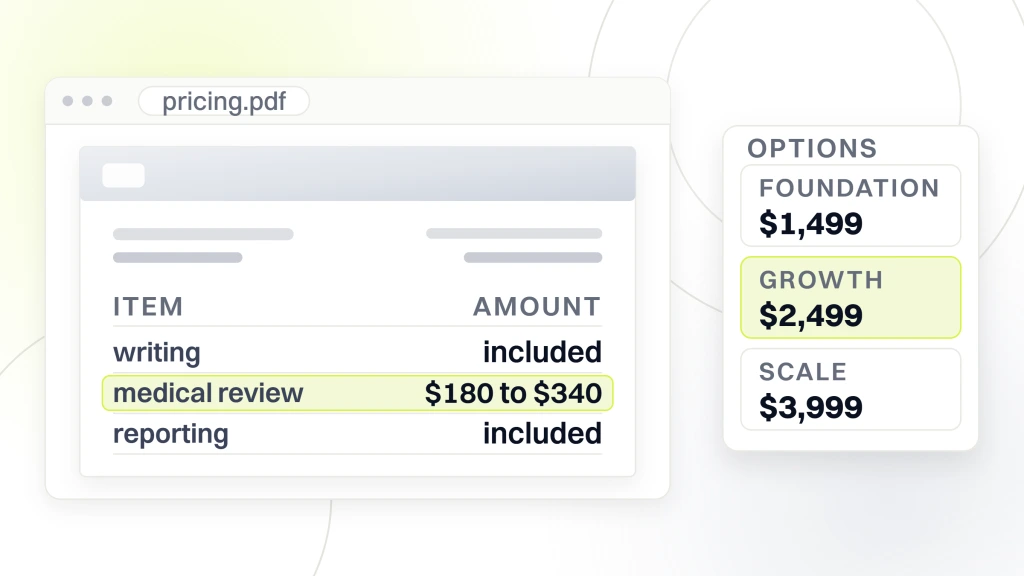
The other transparency signal is what the shop charges for scope creep. A category shop names the hourly rate for out-of-scope work in the contract ($180 to $340 depending on role) and holds it. A generalist bills out-of-scope work at whatever the account manager decides, which usually means the founder gets a surprise invoice in month 6. Read the scope-creep clause carefully before signing. It matters more than the sticker retainer number.
Payment terms also signal maturity. A category shop invoices monthly on the first business day, expects payment inside net-15, and offers a small discount for quarterly prepay (usually 3% off the retainer for 3 months paid upfront). A generalist invoices whenever the account manager remembers, accepts net-45 payment, and never offers prepay discounts because their own cashflow is stretched. Payment terms are a proxy for the shop’s own business health, and a shop struggling on cashflow usually delivers uneven output when they hit a rough month.
Making the pick on a beauty content marketing agency
The right beauty content marketing agency for your brand is the one that quotes a specific deliverables list on a specific retainer band, names a medical review workflow with a turnaround target, shows a citation library that already exists, and demos a monthly report from a comparable client with real revenue numbers like Beauté Aesthetics New York, Abigail Ahern, or Boogie Board. Every other proposal in the inbox is worth passing on. The screen takes 2 calls per shop and 2 reference calls per finalist. Total time is about 8 hours across 4 candidates. That 8 hours saves the retainer from a shop that would have delivered thin volume for the next 12 months.
Patience with the timeline is the last piece worth naming. Beauty content SEO compounds over quarters, not weeks. Signing the retainer 90 days before you want traffic gains to show up is the honest read on the calendar. Brands expecting month-2 return on investment hire the wrong shop and quit around month 5. Brands planning for month-10 payback pick shops that operate on the right time horizon and win the vertical over 24 months. See our top beauty marketing agencies roundup and our beauty marketing retainer plan for the shortlist Redefine Web works alongside in this space.
How to start a content marketing agency?+
Starting a content marketing agency runs on 4 setup moves before the first client signs. Pick 1 vertical (beauty, dental, SaaS) and go deep. Build a citation and swipe file of 200 plus reference pieces in that vertical. Recruit 3 to 5 subject-matter reviewers on retainer. Build a simple retainer proposal with 3 pricing bands and specific monthly deliverables. Then run 20 outbound calls per week to founders in your vertical. Most agencies fail because they stay generalist and compete on price. Category shops win because they compete on speed and depth. Skip the fancy website and the branding until the first 3 clients sign, then invest in the shop’s public face.
How much money do beauty marketers make?+
Beauty marketing roles pay across a wide band based on level and function. Coordinators earn $50k to $65k. Managers earn $75k to $110k. Directors earn $120k to $180k. VP roles at DTC skincare brands with $30M plus in revenue hit $200k to $280k base plus equity. Agency-side pay lands slightly lower than in-house at the same title, offset by faster promotion cycles and broader account exposure. Freelance beauty content writers with 3 plus years of category experience bill $150 to $340 per hour or $0.60 to $1.20 per word on retainer engagements. The pay premium for category depth over general marketing runs 20% to 40% at every level.
Will AI replace creative agencies?+
AI will replace parts of what creative agencies do without replacing the agencies themselves. First-draft writing, keyword research, image generation, and campaign reporting all move to AI-assisted workflows over the next 24 months. Strategy, category expertise, medical review, brand-voice guardianship, and client relationship management stay human. Agencies that treat AI as a productivity multiplier ship more work at higher quality on the same headcount. Agencies that try to hide AI use from clients lose to shops that show the workflow and price transparently against it. The winning agency model in 2027 is human strategy plus AI-assisted execution priced against the value delivered, not the hours worked.
What do beauty marketers do?+
Beauty marketers plan and run the campaigns that pull cold audiences into a brand’s funnel and convert them into repeat buyers. On a DTC skincare brand, that covers paid social buying (Meta, TikTok, Pinterest), SEO and content, email flow design in Klaviyo, influencer partnerships, retail marketing at Ulta and Sephora if the brand is there, and lifecycle campaigns for post-purchase upsell and win-back. On a multi-location clinic, the mix shifts toward local SEO, Google Business Profile management, patient reactivation campaigns, and treatment-specific landing pages. In both settings, the marketer owns the numbers (cost per acquisition, revenue per session, retention) not just the creative output.
How are influencers making over beauty marketing?+
Influencers reshaped beauty marketing across 3 waves. First, mega-influencers on Instagram (2015 to 2020) turned product launches into event marketing. Second, TikTok creators (2020 to 2023) collapsed the discovery-to-purchase window to hours instead of weeks, forcing brands to run always-on creator programs. Third, micro-influencer whitelisting and creator-led paid social (2024 to now) let brands buy media through creators’ handles at 2x to 4x the return of brand-handle ads. The result is a beauty marketing budget that spends 30% to 45% on creator payments plus paid amplification versus 15% to 20% five years ago. Brands without a creator strategy in 2026 pay a real cost per acquisition penalty against creator-native competitors.
What is a content marketing agency?+
A content marketing agency plans, writes, edits, publishes, and reports on the content programs that drive organic traffic and pipeline for a brand. Deliverables usually include long-form articles, product-page copy, category-page rebuilds, buyer guides, email nurture flows, and monthly performance reports. The best agencies work in 1 vertical (beauty, SaaS, healthcare) so writers carry deep category knowledge into every piece and citation libraries compound over time. Retainer bands typically run $1,499 to $6,000 plus per month depending on volume, review workflow complexity, and reporting depth. A specialist beauty content marketing agency at $3,999 per month usually delivers 10 to 12 articles with medical review, category-page rebuilds, and quarterly search-trend forecasts baked in.
What is beauty content marketing agency legit+
A legit beauty content marketing agency proves itself through 4 signals. Named client outcomes with specific numbers (Beauté Aesthetics New York at 166% lead growth, Abigail Ahern at 179% revenue increase and 3,000% paid-social return, Boogie Board at $31 cost per conversion). A medical review workflow with a stated turnaround (5 business days is standard). A citation library with a specific study count (600 plus is category depth). A retainer proposal that breaks writing, review, and reporting into separate line items with specific dollar amounts. Any shop that resists sharing these 4 pieces on the first 2 calls is either padding margin or planning to underdeliver. Legit shops answer inside 10 minutes on the same call with numbers, not slides.
How to get started in beauty marketing?+
Getting started in beauty marketing follows 1 of 3 paths. Path 1 is agency side, joining a beauty-specialist shop as a coordinator or junior strategist and learning the category through client work. Path 2 is brand side, joining a DTC skincare or cosmetics brand in a marketing coordinator role and building depth on 1 P and L. Path 3 is freelance, starting with 2 or 3 small clients as a content writer or paid social freelancer at $75 to $120 per hour and scaling to a retainer book inside 18 months. Every path benefits from category-specific knowledge (ingredients, clinical claims, FTC rules, key retailers) that generalists never build. Read our top beauty marketing agencies roundup for the shops worth following in this space.