A beauty and skincare digital marketing agency runs the exact funnel a general shop skips. Category seasonality, ingredient claim compliance, product page conversion patterns for a $58 serum versus a $12 lip balm, and retention math on a 45-day repurchase cycle. A generalist hands a skincare founder the same media plan they wrote for a mattress brand. It looks tidy, spends the budget, and lands a return on ad spend (ROAS) of 1.4 by month 4 when a category specialist would have hit 2.8. This guide walks the real operational gaps and the questions that split the two shops in one sales call.
You get 10 differences that show up in the first 60 days of a retainer, a Manhattan aesthetics clinic teardown with real numbers, retainer bands per beauty vertical, an honest look at Klaviyo revenue share on skincare accounts, and 8 FAQs that answer what founders actually ask a category agency. Read straight through in about 12 minutes and you’ll know which shop your brand needs by the last section. If you’re already scoping vendors, jump to the comparison table.
What a beauty and skincare digital marketing agency actually does
A beauty and skincare digital marketing agency runs paid acquisition, retention flows, product page conversion work, and content built for shoppers who Google ingredient names before they buy. That last part is the operational tell most brands miss when comparing a category shop with a generalist option. A shopper reading about niacinamide at 10 percent versus 5 percent isn’t going to convert on generic beauty ad copy.
A skincare specialist writes copy that names the concentration, the pH, and the finish. General shops write “glowing skin” and wonder why cost per acquisition (CAC) sits at $84. On paper the channel mix looks like any direct-to-consumer brand. Meta paid social, Google Ads, TikTok organic and paid, Klaviyo email and SMS, creator seeding, and public relations for editorial pickups. The difference is depth in each channel.
A category operator knows the 6 creators who move $10k of skincare in a Reel, since they’ve placed products with them for other clients. A generalist is running a $2,400 discovery call to figure out which platform matters. That $2,400 comes out of your budget, not theirs.
Channel specialization inside beauty verticals
Skincare Meta paid runs different creative than color cosmetics campaigns. Skincare converts on before-and-after with a 30-second explanation of the actives. Color converts on wear-testing with a swatch on multiple skin tones. Fragrance almost never converts on paid social at all and shifts budget to sampling programs, gifted press, and retail placement. A beauty digital marketing agency slots your brand into the right sub-playbook on the first strategy call. A generalist treats all 3 the same and burns budget for 90 days learning.
Ingredient claim compliance without the FTC letter
The FTC and FDA have taken notice of skincare claim language. “Anti-aging”, “cures acne”, and “heals scars” all cross a line most general agency copywriters don’t know exists. A category specialist writes “reduces the look of”, “visibly smooths”, or “supports” so the copy stays on the right side of substantiation rules. See the FTC guidance on health-related claims for the specific language rules. A generalist gets a warning letter, and your brand pulls a campaign at week 6.
Beauty and skincare digital marketing agency versus general agency
The comparison isn’t whether one team is smarter than the other. It’s pattern library. A category specialist has run 40 skincare accounts in the last 3 years and knows what a $32 CAC looks like on a serum brand at $58 average order value (AOV). A generalist is learning your category on your budget for the first 6 months, and the ramp shows in the numbers. For a $400k annual revenue brand, that 6-month ramp is a quarter of your yearly spend evaporated. At $8M, it’s cheaper to test the general shop, but the opportunity cost still bites.
The right answer isn’t always specialist. A prestige brand with $40M in revenue and an in-house team of 8 often runs project work with a general shop for a website redesign or a rebrand and keeping the category specialist on the retainer for performance. Splitting scope by capability rather than category is the mature play at scale. Below the $8M mark, a retainer with a specialist beats every combination we’ve measured.
Under $500k in annual revenue, skip both shops and grow direct-to-consumer channels yourself. Retainer math starts paying back at $80k monthly revenue, not before.
| Category | Beauty specialist agency | General digital agency |
|---|---|---|
| Ingredient claim copy | Substantiated by default | Legal review needed post-write |
| Creator relationships | Named list under $20k GMV | Cold outreach from scratch |
| Klaviyo revenue share | 28 to 42 percent target | 15 to 22 percent typical |
| Product page conversion baseline | 3.4 to 5.8 percent | 1.8 to 2.6 percent |
| Retention flow depth | Winback + replenishment + VIP | Welcome + abandoned cart |
| Retainer ramp time | 30 to 45 days | 90 to 120 days |
| Category benchmarks | Prior client data on file | Public reports only |
Why ramp time is the biggest hidden cost
Every retainer month during ramp is money spent when the account still misunderstands your brand. A specialist reaches steady-state performance in 30 to 45 days, since the operator has seen your exact model 15 times. A generalist needs 90 to 120 days to test creative, learn your customer, and dial the audience. At $12k per month on retainer, that’s a $60k gap in wasted spend on the general path. Founders who calculate this once never test the general option again.
The value of a named creator list
A beauty digital marketing agency’s creator list is worth more than the retainer itself in the first 90 days. 20 vetted skincare creators with average post gross merchandise value (GMV) under $20k means 20 partnerships that convert instead of 20 that don’t. Generalists pull creators from Aspire or a spreadsheet. Category shops have relationships built across prior client accounts and know which creator ships within 14 days versus 90. That difference alone is worth the price gap. See the Influencer Marketing Benchmark Report for the wider platform data.
Channel mix a beauty specialist agency runs
7 channels do the work for a beauty brand under $20M in revenue. Meta paid social, TikTok organic plus paid, Google shopping and search, Klaviyo email and SMS, creator seeding, public relations for earned editorial, and retail marketing to support wholesale channels. Every channel has a specific role and a specific key performance indicator (KPI), and the retainer scopes exactly which channels the agency owns end-to-end versus which you co-own with an in-house owner.
The mix shifts by product type. Skincare leans heavier on Meta paid and Klaviyo retention. Color cosmetics leans heavier on TikTok organic and creator seeding. Fragrance leans heavier on retail marketing and public relations. Wellness supplements lean heavier on Google search intent and podcast advertising. A category shop asks about product type on the first call, since the mix defaults are that different. A generalist hands you the same 8-channel plan they gave the last client, from a different vertical.
Meta paid for skincare brands
Skincare Meta paid runs on before-and-after creative, ingredient explainer video, and user-generated content testimonials. Target CPA sits at $28 to $52 for a $58 AOV serum brand. Below $28 and you’re likely bidding into remarketing that would have converted organically. Above $52 and the creative or audience needs a rebuild. A specialist knows those bands cold. A generalist treats the CPA as a starting number and doesn’t recognize when the account has drifted 20 percent above healthy.
TikTok strategy for color and skincare
TikTok skincare content works on demonstrable results and ingredient education. Wear tests, 7-day challenges, and ingredient comparison videos. TikTok color content works on transformation reveals and product application in real time. The 2 sub-formats need different creator lists. A category agency has both lists ready. A generalist asks for 2 weeks to “research the space” and delivers a moodboard nobody uses. TikTok changes the algorithm every quarter, and category shops read the platform every day.
Retention math a beauty digital marketing agency owns
Beauty retention math is where category specialists show their edge fastest. A well-run Klaviyo account on a skincare brand should deliver 28 to 42 percent of total revenue by month 6. A general agency lands at 15 to 22 percent, since they run the default welcome-plus-abandoned-cart pair and stop. Category specialists add winback flows keyed to 45 and 90 day repurchase gaps, replenishment reminders that count product usage from cart size, and VIP tiers tied to lifetime spend bands. The extra flows drive the delta.
SMS is the second retention lever. SMS list revenue share for beauty sits at 8 to 14 percent when run right. Generalists underinvest in SMS, since they don’t know the compliance rules or the creative pattern that keeps opt-out rates under 1 percent. Category specialists send 2 campaigns a week during launch windows and 1 campaign a week in steady state, with segmentation on last purchase category. Opt-outs stay under 0.6 percent and revenue per send lands at $0.28 to $0.48.
If your Klaviyo revenue share sits below 20 percent at month 6, the retention flow map is broken. Fix flows before scaling paid, or you’ll acquire customers who never come back.
Replenishment flow keyed to product usage
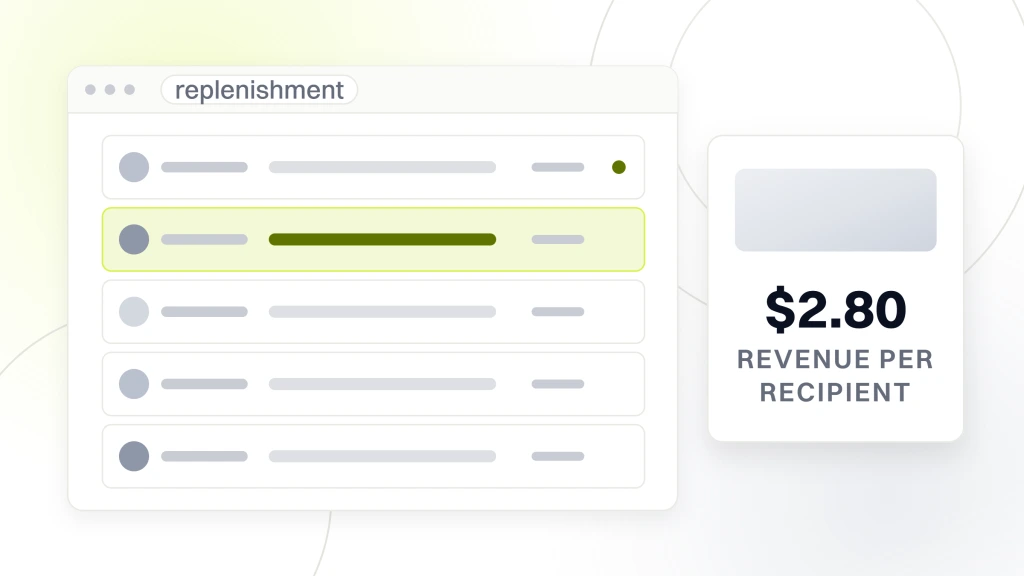
A 30ml serum bottle lasts a customer 28 to 35 days at nightly use. A replenishment flow that triggers at day 21 catches the customer before they run out and switch. Open rate on that flow lands at 46 percent, click rate at 12 percent, and revenue per recipient at $2.80. Category agencies calculate the usage window per SKU and time flows accordingly. Generalists send a generic “time to reorder” email at day 45 and wonder why revenue per recipient is $0.40.
Winback flow with a real hook
Winback flows for beauty work when the hook is a new SKU or a formulation improvement, not a discount. Customers who left after a product finished and never came back respond to “we reformulated with a higher niacinamide concentration” better than “here’s 15 percent off”. Discount winbacks train customers to wait for discounts. Formulation winbacks train customers that the brand is investing. Category agencies know the difference. Generalists default to discount every time. See our take on beauty social media marketing agency scoping for adjacent channel patterns.
Retainer bands for a beauty specialist agency
Retainer pricing depends on scope, not category. A single-channel retainer running only paid social sits at $4,800 to $8,200 per month at niche shops. A three-channel retainer running paid social plus Google plus Klaviyo sits at $9,400 to $14,800 per month. A full-service retainer covering all 7 channels sits at $18k to $32k per month at premium shops. Ad spend is separate. At $10k in monthly Meta spend, budget $1,600 to $2,400 in creative production on top of the retainer. Nobody prices this transparently in a first meeting, and that’s a red flag on its own.
Redefine Web publishes its own retainer bands upfront. Our SEO retainers run $999, $1,499, $2,499, and from $4,500 per month. Our pay-per-click (PPC) retainers match the same 4 bands. That’s the entry point for aesthetic clinics and single-location beauty studios that need consistent inbound without a massive paid budget. For direct-to-consumer skincare brands running heavier paid, the three-channel band above lines up with our top tier. A category retainer with a specialist looks nothing like a generalist proposal.
Ad spend versus retainer ratio
Healthy retainer to ad spend ratio for a growing beauty brand sits at 1:2 to 1:4. A $2k retainer on $4k to $8k in monthly ad spend keeps the math sensible. Retainers above 1:1 with ad spend usually mean the agency is padding fees to survive slow client acquisition. Retainers below 1:5 usually mean the agency is understaffed and the account isn’t getting attention. Ask the ratio question in the sales call and watch the response. Category specialists answer immediately.
Scope creep guard in the contract
The retainer contract should name the channels, name the deliverables per channel per month, and name the escalation path when scope shifts. Any “as needed” language means scope creep on your dime. 2 revisions per creative asset is normal. Endless revisions on paid ads is a red flag, and usually it means the account team isn’t confident in the first draft. 6-month terms are standard for beauty retainers. Anything shorter is an agency hedging against poor results.
Case study on Beauté Aesthetics New York
Beauté Aesthetics New York is a luxury beauty and aesthetics clinic in Manhattan specializing in medical-grade treatments, cosmetic procedures, and wellness services. Traffic was flat, landing pages lacked structure, metadata was incorrect, and lead volume from the website didn’t match the caliber of the clinical work. A general marketing shop would have suggested a paid boost. Redefine Web rebuilt the site and rebuilt the search architecture around the treatments that actually book.
The 12-month program delivered 166 percent lead growth, 88 percent new user growth, and a 27 percent conversion rate gain. The redesign leaned into gender-neutral luxury with sub-second load times. The SEO team built treatment-specific landing pages with structured data and schema markup so search engines indexed the right pages for the right terms. Analytics and behavior tracking closed the loop on ongoing optimization. The clinic’s calendar filled from the site rather than from repeat referrals alone.
Treatment-specific landing pages with schema outperform a homepage-heavy site by 3 to 5 times on lead volume. Build 1 page per procedure, then link them up.
| Beauté Aesthetics metric | Baseline | After 12 months |
|---|---|---|
| Website leads | Flat month over month | +166 percent |
| New user growth | Below industry average | +88 percent |
| Conversion rate | Weak funnel | +27 percent |
| Landing page structure | Weak metadata | Treatment-specific + schema |
Lead quality gains from treatment-specific pages
The 166 percent lead gain wasn’t a volume trick. Treatment-specific landing pages qualified inbound leads before the consult by educating on procedure, downtime, and pricing bands. Consult-to-book rate climbed alongside the raw lead count, since the leads arriving already knew what they wanted. That’s the specific gap between a category specialist agency and a generalist. A generalist drives traffic. A specialist qualifies before the phone rings.
Schema markup as a search visibility gain
Structured data on medical aesthetic procedures earned rich results in Google for treatment-plus-location queries. The clinic started appearing in the local pack for procedures that map to buyer intent (“microneedling near me”, “CoolSculpting Manhattan”) rather than only for brand-name searches. Schema is a compounding gain. The more procedures indexed correctly, the more the domain authority for the category strengthens. See the Google structured data documentation for the current spec.
Cross-vertical proof from Abigail Ahern and Boogie Board
Direct-to-consumer patterns transfer across ecommerce verticals when the operator knows the mechanics. Luxury home décor brand Abigail Ahern restructured SEO and paid media around intent-driven traffic and premium creative. Result: 179 percent revenue gain and doubled conversion rates. Boogie Board, the reusable writing tablet brand, cut acquisition costs to $31 per conversion and boosted conversions 11 percent on $650k in ads. Same operator mindset a category specialist brings to a serum brand or an aesthetics clinic. Premium positioning, intent-driven media, and disciplined creative rotation deliver in every ecommerce category we’ve run.
Red flags in a beauty digital marketing agency sales call
Category agencies answer specific questions with specific numbers. Generalists answer specific questions with slide decks. The screening happens in the first 45-minute call, and 6 questions separate the two. Ask them and you’ll know before the proposal arrives whether the shop is worth an intro to your chief financial officer.
- Name 3 beauty accounts you’ve run for more than 18 months and the retention flow revenue share you delivered.
- What’s your target CPA for a $58 AOV skincare brand on cold Meta traffic in month 3?
- Which Klaviyo flows do you build in the first 60 days, in what order, and why?
- Name 5 skincare creators under $20k GMV per post you’ve worked with in the last 6 months.
- How do you write ingredient claims that stay inside FTC substantiation without killing conversion?
- Show a real client dashboard from last month with names redacted but numbers intact.
Reviewing the redacted dashboard
The dashboard tells the truth. If the top metrics are CPC, CPM, and impressions, the agency is reporting activity, not revenue. If the top metrics are revenue, ROAS, CAC, and Klaviyo attributed revenue share, the agency reports outcomes. If the dashboard doesn’t exist, they build one during the retainer, and you’re funding the framework. Category shops have a dashboard template ready to modify for your brand on day 1.
Account lead tenure over 18 months
The person running your account matters more than the agency brand. Ask who your account lead will be and how long they’ve been at the agency. Under 12 months and there’s a churn risk mid-retainer. Under 24 months and there’s a competence risk on complex flows. Category specialists retain their strongest leads, since the category work is fun. Generalists burn junior labor on beauty accounts, since the category feels adjacent to whatever they specialize in.
Measuring a category agency retainer
3 dashboards keep a beauty retainer honest. A weekly acquisition dashboard for paid channels with ROAS by campaign, CAC, and creative fatigue signal. A monthly retention dashboard for Klaviyo and SMS with revenue share, list growth, and flow performance. A quarterly brand dashboard for organic content, press pickups, and creator seeding placements. Anything more granular is a report, pulled on request. Category shops know the difference between a dashboard and a report.
Leading indicators beat lagging ones on the weekly view. Creative fatigue (measured by frequency crossing 3.5 on a Meta audience) predicts a ROAS drop by 10 to 14 days. New creator content in production predicts organic reach in the next 21 days. Klaviyo list growth rate predicts revenue share by month 3. Watching leading indicators means catching drift before it hits revenue. Category shops report on leading indicators. Generalists report on last month’s ROAS as if it’s news.
ROAS benchmarks for beauty verticals
Blended ROAS for a growing skincare brand sits at 2.4 to 3.8 by month 6. Color cosmetics runs slightly lower at 2.0 to 3.2, since AOV is lower and creative refresh cycles are faster. Fragrance runs higher at 3.4 to 5.2, since paid is a supporting channel to press and retail. Wellness supplements run 2.8 to 4.4 with a heavier reliance on Google search intent. Category shops know the band your product type lives in. Generalists report the blended average and treat everyone the same. See our beauty marketing retainer plan detail for how these bands sit inside a monthly scope.
CAC payback and LTV math
CAC payback under 90 days for a beauty brand means the model is healthy. Above 90 days and either AOV is too low, retention is too weak, or paid is chasing wrong audiences. Category shops calculate CAC payback per acquisition channel weekly and shut off channels that break the ratio. Lifetime value (LTV) to CAC ratio should sit at 3:1 minimum by month 12. Below 2:1 and the retainer isn’t paying back. Above 5:1 and you’re likely underspending on acquisition and leaving growth on the table.
When a general agency actually fits a beauty brand
General agencies aren’t wrong for beauty. They’re wrong for beauty performance retainers over 12 months. Where a general shop wins is single-project work. A rebrand, a website redesign, or a launch video production with a fixed timeline. Project scope plays to general shop strengths. Capacity, creative direction, and a wider design network all favor the general shop when the deliverable is defined and the deadline is real. Performance scope over 12 months plays to category shop strengths, since pattern library beats capacity every time on a retainer.
The mature move for a mid-sized brand is a general agency for project work plus a category specialist for retainer performance. That’s how most $20M-plus beauty brands run their vendor stack. The general shop delivers the annual brand refresh, the launch video, and the retail collateral. The specialist runs the always-on paid, retention, and content engine. Both shops know their lane and don’t fight over scope. See our take on beauty web design for where project work lands cleanly with a specialist too.
The hybrid model that actually works
The hybrid model splits scope by capability, not by category. General shop owns the once-a-year brand and creative direction work. Category specialist owns the daily performance and retention machine. In-house team owns product marketing, wholesale channel work, and customer service. All 3 know the lanes and the escalation path when scope overlaps. Founders who set this up cleanly at $8M spend less per revenue dollar than founders who try to consolidate everything with 1 vendor.
When to hire the first in-house marketer
First in-house marketing hire lands somewhere between $3M and $6M in revenue for most beauty brands. Earlier and the hire sits idle waiting for agency deliverables. Later and the founder becomes the bottleneck on every campaign brief. The hire is a generalist operator, not a specialist. They own the brief pipeline, the agency relationships, and the content calendar. Specialists come at hire 3 or 4 once channels have their own profit and loss (P&L).
Make the pick and grow your beauty brand
Pick the category specialist route if you’re running performance retainers, need retention flows built to category standards, and value ramp time as a real cost. Pick the generalist if you’re running a defined project with a fixed deliverable, a wider creative direction need, and the timeline plays to their capacity. Run both if you’re above $20M and know how to split scope cleanly. The last piece of advice is simpler than most of this guide. Have the sales call, ask the 6 questions, watch the dashboard demo, and trust the answers.
Category shops answer immediately. Generalists circle back. The circle-back is the tell. See our beauty and skincare marketing services page for the specific retainer scopes Redefine Web runs today, and reach out when you’re ready to talk numbers.