
Chiropractor PPC works when you treat Google Ads as a booking channel, not a click machine. Most practices pour money into paid search and count clicks, then wonder why the schedule stays flat. The gap sits between the click and the exam, and closing it is what this guide fixes.
You’ll get the account structure, the negative keyword pass, the landing page rules, the call tracking setup, and the budget math that turns a chiropractor PPC campaign into a predictable stream of new patient exams. Every number cited comes from live client accounts or the Redefine Web case study library, and every rule has been tested against real schedules, not theoretical ones.
What chiropractor PPC actually covers
Chiropractor PPC is paid search advertising on Google Ads and Microsoft Advertising, aimed at people who are already searching for an adjustment, a decompression session, or relief from a specific pain pattern. You bid on keywords, write ads, send clicks to a landing page, and pay only when someone clicks. That part is simple.
The tricky part is that a click is worth nothing if it doesn’t turn into a booked exam. Practices that treat click volume as the scoreboard end up with expensive traffic and a quiet phone. Practices that treat booked new patient exams as the scoreboard end up with a schedule that fills 6 weeks out. Same platform, different mental model.
For a broader look at how PPC sits inside a wider plan, our digital marketing for chiropractors guide covers the other channels that pair with paid search.
Where chiropractor PPC fits the marketing plan
Paid search is the fastest channel to activate. You can spin up a campaign on Monday and take booked calls by Friday. That speed is the reason it earns a place in every chiropractic marketing plan, and the reason it deserves the tightest weekly attention.
It sits alongside chiropractor SEO, review generation, and Google Business Profile work. SEO carries the long-term compounding, reviews carry the trust, and PPC carries the immediate volume. Trying to run PPC without any of the other three is like pouring water into a bucket with holes in the bottom.
What chiropractor PPC is not good at
Paid search is bad at brand awareness campaigns for a local clinic, at broad discovery of your practice by people who weren’t already searching for care, and at anything where the buying window is measured in months. Google Ads is a demand-capture channel, not a demand-generation channel. If nobody in your city is Googling “chiropractor near me” this week, no bid strategy fixes that.
Paid search is bad at rescuing a broken conversion path too. If the landing page is slow, the phone rings unanswered, or the front desk quotes prices badly, PPC turns those problems into expensive problems faster. Fix the exam-booking mechanics first, then send paid traffic.
The chiropractor PPC account structure that produces booked exams
An account that books exams cleanly has 4 campaigns and no more. Branded search, non-branded local search, condition-specific search, and a Performance Max campaign fed only by first-party audiences. Anything beyond that fragments the budget and hides where the exams come from.
Branded search catches people who already know you and are Googling your practice name. Non-branded local search catches “chiropractor near me” and “chiropractor in [city]” queries. Condition-specific search catches “back pain relief,” “sciatica treatment,” “pinched nerve chiropractor.” Performance Max fills the gaps with remarketing and lookalikes trained on your booked-patient list.
Each campaign runs 2 to 4 ad groups, each ad group runs 1 theme, and each theme has 15 to 20 negatives from day one. Cramming everything into one campaign under the belief that “Google’s smart bidding handles it” is the fastest way to overspend on the wrong searches.
Only run a Performance Max campaign after the search campaigns have collected 30 booked exams. Turning it on earlier trains it on the wrong signal and burns budget.
Why branded search matters more than owners think
Owners often skip branded search since the practice already ranks number 1 organically for its own name. The math still favors running it. Competitors bid on your name to poach the click, and a $0.35 branded click that converts at 40% costs less per booked exam than any other channel in the account. Skip it and you pay a premium later to defend the same query.
The condition page alignment rule
Every condition-specific ad group needs a landing page that matches the condition. Sending “sciatica treatment” clicks to your homepage cuts conversion rate in half. Sending them to a page titled “Sciatica relief in [city]” with a photo of a real patient, a real technique, and a short booking form doubles it. This is the single biggest lever in most chiropractor PPC accounts, and it costs nothing to fix beyond the writing time.
The chiropractor PPC cost per exam math
The number that matters is cost per new patient exam, not cost per click. A $4 click at 8% booking rate is a $50 cost per exam. A $2 click at 2% booking rate is a $100 cost per exam. The cheap click looks better in the Google Ads interface and costs twice as much where it counts.
For most chiropractic practices, a healthy cost per new patient exam sits between $65 and $180 depending on market, service mix, and average patient value. Practices with a $2,400 patient lifetime value can spend $180 on a new exam and still print money. Practices with a $600 lifetime value need to keep the number under $80 or the account bleeds slowly.
The way to know your number is to run a 30-day baseline with honest tracking, then work the levers described below to bring it down 20 to 40% over the next 90 days.
Why CPA drifts up when nobody is watching
Cost per acquisition creeps up week by week for 3 reasons. Auction competition rises as more clinics enter the market. Match types loosen as Google interprets your keywords more broadly. Ad copy fatigues and click-through rate falls. Any account left on autopilot for 90 days shows 15 to 30% CPA drift by the end of it.
What a good chiropractor PPC week looks like
A good week has a single Monday review of the last 7 days: booked exams, spend, cost per exam, and search terms. Adjust bids by no more than 15% either direction, pause any ad group with a cost per exam that’s 2x the account average, and add 5 to 10 new negatives from the search terms report. That’s the whole ritual. It takes 30 minutes and saves 20 to 30% of the monthly spend.
The weekly negative keyword pass that keeps CAC honest
Negative keywords are the single most under-used lever in chiropractor PPC. Every week, the search terms report shows queries that triggered your ads. Roughly 15 to 25% of those queries are wrong intent (“chiropractor school,” “chiropractor salary,” “free chiropractor,” “chiropractor jobs near me”) and every click on them is money burned.
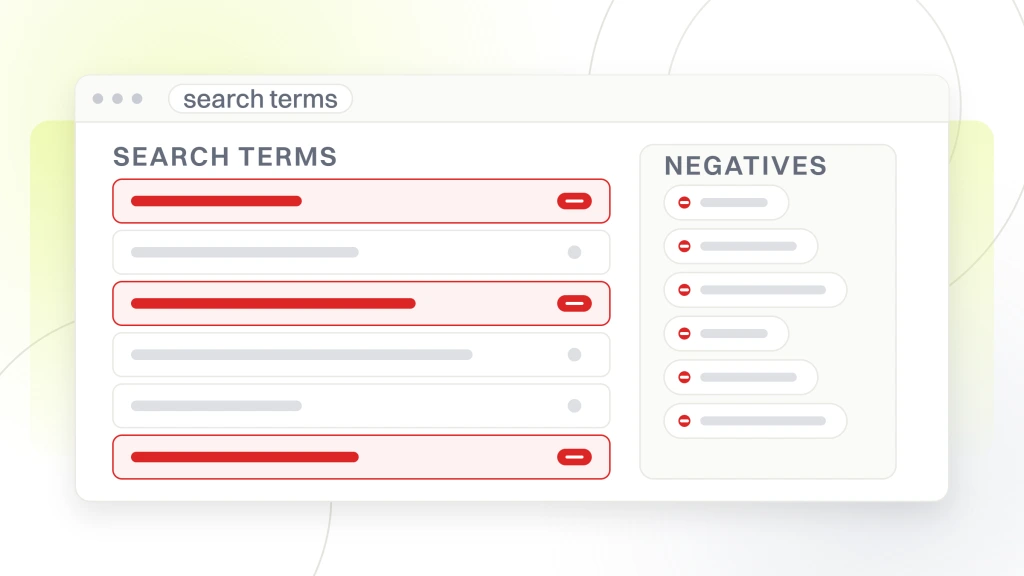
For chiropractic accounts, the recurring waste comes from job queries, DIY queries (“how to crack my own back”), veterinary queries in markets where pet chiropractic exists, and comparison shopping queries where the searcher is just price-hunting.
Add 5 to 10 negatives every week for the first 90 days. Practices that skip this pass see 30 to 45% of ad spend land on unbookable searches.
The search terms report workflow
Open the search terms report every Monday, filtered to the last 7 days, sorted by cost descending. Any query with more than $15 spent and 0 conversions is a candidate. Read it, decide if a person searching that phrase could plausibly book an exam, and if not, add it as a phrase or exact negative. Keep the review under 20 minutes so it actually happens every week instead of once a quarter.
The shared negative list trick
Build one shared negative list called “chiropractor evergreen” and apply it to every campaign in the account. It holds the terms that will never convert regardless of ad group. Job, school, salary, DIY, adult content, and celebrity name variants all live here. New campaigns inherit it instantly and start clean instead of running for 30 days before someone notices “chiropractor jobs near me” burned $400.
Landing pages that book exams instead of clicks
A chiropractor PPC landing page has 1 job. Convert a searcher into a booked exam within 90 seconds. That means a headline that repeats the search query, a subheadline with the offer (usually a discounted first exam), a phone number in the top right that’s clickable on mobile, a short booking form (name, phone, best time to call), and 2 or 3 trust proofs above the fold. Everything else can wait for the second scroll.
Practices that send PPC traffic to the homepage typically convert at 1 to 2%. Practices that send it to a purpose-built landing page convert at 4 to 8%. That gap alone cuts cost per exam in half.
The mobile speed floor
Roughly 68% of chiropractic PPC clicks happen on a phone. If the landing page takes more than 2.5 seconds to show the main content, 20 to 40% of the click budget lands on a bounce. Google’s web.dev’s LCP guide covers what to measure. The practical rule is to test the landing page monthly on a real phone over 4G, not on the office wifi. If the phone number isn’t visible in under 3 seconds, the page is too slow.
The form versus call question
Chiropractic patients skew toward calling. Roughly 65 to 75% of booked exams come from a phone call, not a form fill. The form still matters for after-hours searches, but a landing page that hides the phone number below the fold cuts booking rate 25 to 40%. Put the number in the header, make it clickable, and use a form as the secondary path.
Practices that hide the phone number below the fold cut booked exams 25 to 40%. Put it in the top right, make it a clickable tel link.
Conversion tracking that keeps the account honest
Half of chiropractor PPC accounts we audit track the wrong conversion. They count form fills only and miss 70% of the actual booked exams that came in by phone. Or they count every phone call regardless of duration, which inflates conversion volume and hides which ads are actually booking exams.
The honest setup counts 3 things. Form fills that include a real phone number. Phone calls longer than 90 seconds (short enough that most booking calls make it, long enough to filter out wrong numbers and hang-ups). Offline conversions imported from the practice management system when a caller actually shows up for the exam.
Call tracking setup that works
Use Google Ads call tracking for the phone number on the landing page, set the minimum duration to 90 seconds, and import the calls as conversions. This tells Google’s bid algorithm which keywords produce actual booking calls, not which ones produce curious tire-kickers. Accounts that switch from form-only to call tracking usually see a 40 to 60% reported conversion increase within 30 days, since the phone-heavy traffic was invisible before.
Offline conversion imports that close the loop
The gold standard is importing exam attendance from the practice management system back into Google Ads as a conversion event. It requires a weekly export of new-patient records matched against click IDs, but the payoff is a bid algorithm that optimizes for people who actually show up. Practices that add this step typically see cost per exam drop another 15 to 25% within 60 days, as the algorithm stops chasing callers who never book.
The chiropractor PPC budget and bidding rules
Budget planning for chiropractor PPC starts with the exam target, not the ad spend. Decide how many new patient exams you want per month, multiply by your target cost per exam, and you have the monthly budget. A practice that wants 40 new exams at a $110 cost per exam target needs $4,400 in monthly ad spend, minimum.
Under-funded accounts are the most common failure mode. A $600 monthly budget in a competitive city gets you 4 to 8 clicks a day, which isn’t enough data for Google’s smart bidding to learn anything useful. If the budget can’t clear $1,500 to $2,000 a month, chiropractor SEO and Google Business Profile work usually produce more exams per dollar for the first 6 months.
The monthly budget decision
Match the budget to the exam goal, add 15% buffer for testing new ad groups and landing page variants, and set it as a monthly cap in Google Ads. Split it 40% branded, 30% non-branded local, 20% condition-specific, 10% Performance Max once search has 30 booked exams under its belt.
Seasonal adjustments that keep the account calibrated
Chiropractic search volume peaks in January (new year resolutions), September (school and sports return), and after weather events that spike back pain queries. Pull the last 24 months of Google Trends data for your top 5 keywords and set monthly budget multipliers by season. Most practices see a 20 to 35% swing month to month, and a flat budget wastes ad spend in slow months and caps out in peak ones.
The chiropractor PPC mistakes that drain the account
The 5 mistakes that drain almost every chiropractor PPC account are the same across markets. Broad match keywords with no phrase or exact backup. Homepage as the landing page. No call tracking. Smart bidding turned on before 30 conversions exist. Monthly budgets that fluctuate randomly instead of matching the seasonal pattern.
Any 1 of these can cut booked exam volume 25 to 40%. All 5 together produce the classic “we tried Google Ads and it didn’t work” story that’s actually a story about running the account with the settings that new accounts default to. Every one of them takes under an hour to fix.
When to pause a chiropractor PPC campaign
Pause any ad group with a 90-day cost per exam that’s 2x the account average and no positive trend. Pause any campaign with less than 1 booked exam per $500 in spend after 45 days. Pause everything and audit the tracking if the reported conversion rate suddenly doubles or halves without an obvious cause. The account rewards discipline, not activity.
When to hire outside help
The signals that say a chiropractic practice should hire a PPC specialist are consistent. Cost per exam that hasn’t dropped in 4 months even after weekly effort. Ad spend over $3,000 a month with no clear reporting. A practice owner who’s the only person managing the account and can’t sustain the weekly cadence. A specialist typically pays for the retainer inside 60 days by cutting waste that the practice can’t spot from the inside.
A real chiropractor PPC case study
Pain Cure Clinic came to Redefine Web with a Google Ads account that spent $3,800 a month and booked 12 to 15 new patient exams. Their cost per exam sat at $250 and drifted higher every quarter. The homepage was the landing page, call tracking wasn’t set up, and the account had 4 broad-match ad groups with no negative keyword list.
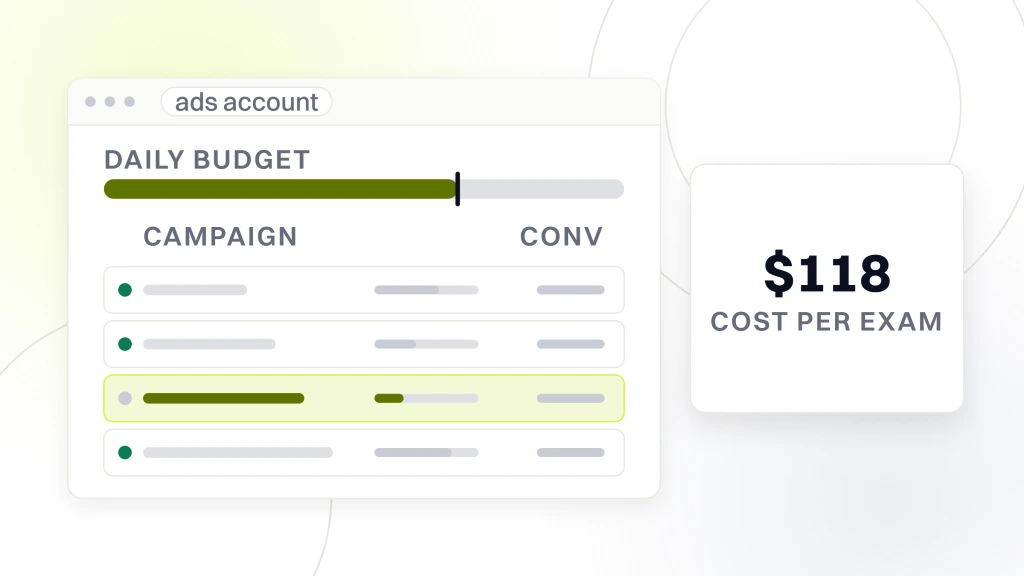
Within 9 months of restructuring the account, adding call tracking, and building 3 condition-specific landing pages, Pain Cure Clinic saw a 205% increase in patient appointments booked from paid search, at a cost per exam that dropped from $250 to $118. Ad spend held steady, yet booked volume more than tripled. The account structure and landing pages did the heavy lifting, and the weekly negative keyword pass held cost per exam steady over the 12 months that followed.
Pain Cure Clinic booked 205% more new patient appointments after restructuring paid search, at a cost per exam that fell from $250 to $118.
What carried the growth
Three moves carried the growth. Condition-specific landing pages replaced the homepage for all non-branded traffic. Call tracking with a 90-second duration filter went live in week 3. A weekly negative keyword pass cut wasted spend from an estimated 30% of clicks to under 8% within 60 days. Everything else was maintenance on top of those 3 changes.
What would not have worked
Doubling the ad budget without fixing the landing pages would have doubled the wasted spend, not the booked exams. Turning on Performance Max in month 1 would have trained it on the broken conversion signal from the homepage. Switching to smart bidding before call tracking was live would have optimized for form fills only and ignored the 68% of bookings that came in by phone.
The way Redefine Web runs chiropractor PPC
Our chiropractor PPC services follow the structure in this guide. Retainers start at $999 a month for practices spending under $2,000 in ad budget and scale up through $1,499, $2,499, and from $4,500 a month based on account complexity and reporting depth. Ad spend bills separately, direct from Google to the practice.
Every engagement starts with a 2-week audit of the existing account (or a fresh build if there’s no history), then a weekly rhythm of search terms review, bid adjustments, negative keyword additions, and a monthly reporting call that covers booked exams, cost per exam, and the next 30 days of planned tests. No 12-month lock-in on the reporting cadence, but the account results compound over 6 to 9 months, so we ask practices to plan for that window.
What a typical engagement covers
A typical engagement covers Google Ads and Microsoft Advertising management, landing page copy and design revisions for the condition pages, call tracking setup and monthly analysis, the weekly negative keyword pass, and a monthly report that ties spend to booked exams to revenue when the practice management system integration is in place. It does not cover ad spend, review generation, or SEO, which are billed separately if the practice wants them.
When chiropractor PPC does not fit the practice
PPC does not fit practices with ad budgets under $1,200 a month in most metros, practices without a functioning phone-answering process, or practices whose average patient value falls under $400 lifetime. In those cases we usually point owners to chiropractor marketing services that put Google Business Profile, reviews, and organic search first, then add PPC once the fundamentals are earning their keep. Our SEO for chiropractors guide covers the organic side in depth.
If you want a second set of eyes on your chiropractor PPC account or a plan for standing one up, our chiropractor marketing services team runs no-cost account audits and can tell you inside 3 business days whether paid search is likely to work for your market.