
A DTC apparel brand doing $1.8M annual revenue on Shopify asked our team for a real ppc strategy for ecommerce after two agencies had rotated through the account in 14 months. Monthly ad spend sat at $22,000 split between Google and Meta with no written channel plan behind the split. Blended marketing efficiency ratio read 2.4x on the vendor dashboard. The founder wanted to know why growth stalled at $180,000 monthly revenue every time the account tried to scale past $25,000 spend. The answer was simple. There was no strategy. There was a spreadsheet of last month’s numbers, a Slack channel of ad-copy edits, and a monthly report nobody was building decisions off. A written strategy fixed the account inside 90 days.
This guide is the exact ppc strategy for ecommerce our team writes for DTC brands between $500,000 and $10 million annual revenue. You’ll get the budget split across Shopping, Search, Performance Max, Meta, TikTok, and YouTube. You’ll get marketing efficiency ratio targets by stage of growth. You’ll get the ramp rules that stop the auction from wrecking early tests, and the four shift triggers that keep a budget honest. In short, the whole plan a founder or head of growth can hand a vendor and score against every 30 days.
Shopping and Performance Max inside a PPC strategy for ecommerce
Shopping and Performance Max carry the largest share of budget for most DTC brands. They sit at the bottom of the funnel where shoppers already know what they want. Any ppc strategy for ecommerce that under-invests in these two campaigns leaves the cheapest incremental revenue on the table. The two campaigns run against the same product feed but do different jobs, and the strategy has to name which job each one owns before the first dollar spends.
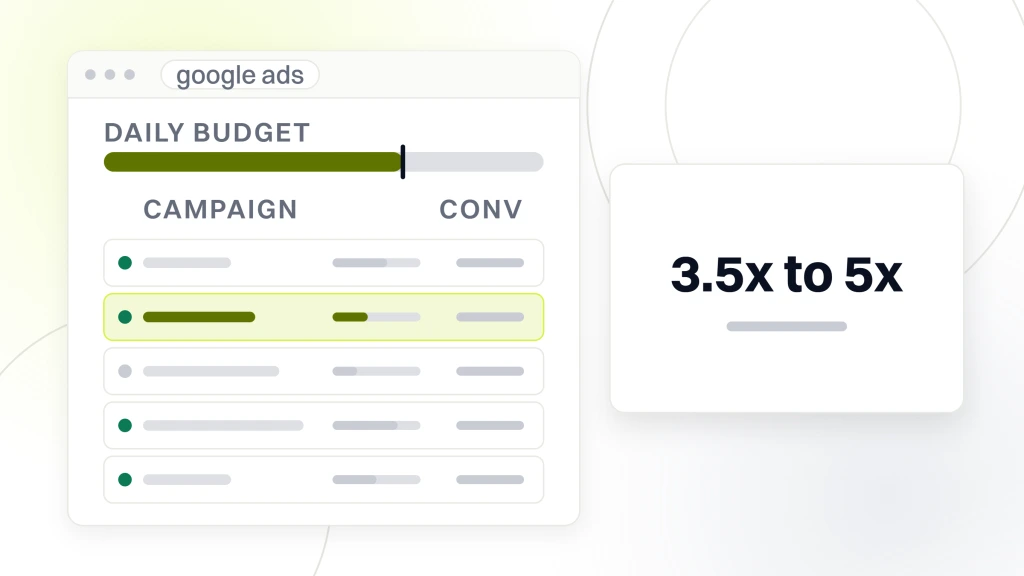
How Shopping and PMax split responsibilities
Shopping owns the products the store wants direct control over. Bestsellers with tight margin. High-consideration products where the store’s brand and price positioning matter. New releases the store hand-holds through the launch window. Performance Max owns everything else, with a brand-excluded asset group setup so PMax does not eat branded Search traffic. That split protects margin on the products where a percentage point of cost of acquisition matters, and lets PMax do the machine-learning work on the long tail where the store cannot bid every SKU by hand. Our writeup on the Shopify PPC agency guide covers the platform-specific overlays we apply to the feed and Merchant Center for Shopify stores.
The Shopping and PMax scoring benchmarks
A scoring pass on a ppc strategy for ecommerce starts with impression share. Shopping impression share should sit above 55 percent on core category queries. PMax should return 3.5x to 5x on categories the store has been in for at least six months. Cost per click on branded Shopping should sit below $0.80 in most verticals. Non-branded Shopping cost per click drifts by category. Home goods and apparel usually settle between $0.90 and $2.40. Any category running non-branded cost per click above $3 needs a feed audit before the next budget review. Google publishes the Ads quality score documentation, which founders should reference during every scoring session.
Meta prospecting and retargeting budget rules
Meta carries the demand-generation load in a modern ppc strategy for ecommerce. Google Shopping and Search only capture existing intent. Prospecting funds tomorrow. Retargeting funds today. Most DTC accounts run the two together with no split, which produces confused reporting and slower audience learning across both jobs. Writing the split down forces the vendor to pick sides and stops the weekly report from double-counting revenue.
Prospecting audience map
- Broad prospecting as the primary campaign, letting Meta’s algorithm find shoppers based on the pixel signal rather than manual audience picking.
- Lookalike prospecting at 1 to 3 percent on the store’s top-value purchaser segment, used as a lower-budget test alongside broad.
- Interest-based prospecting only where broad and lookalike have plateaued, targeting narrow adjacent interests with dedicated creative.
- Creative rotation at two-week cycles with three to five active concepts per audience, tracked against thumbstop rate and cost per click.
- Attribution window set to 7-day click and 1-day view with a Conversions API stream feeding server-side event data alongside the pixel.
A ppc strategy for ecommerce Meta line reads as three sub-budgets rolling up into one campaign group. A DTC brand spending $8,000 monthly on Meta prospecting should hold roughly 60 percent of that budget on broad, 25 percent on lookalike, and 15 percent on interest tests. That split matches roughly 30 DTC accounts we operate in the $500,000 to $5 million revenue band. Prospecting under $4,000 monthly usually cannot support a proper audience map, in which case the account collapses down to broad only until spend can support the fuller structure.
Retargeting job scoping
Retargeting closes shoppers already inside the funnel and is the highest-ROI line inside a ppc strategy for ecommerce. The audience map runs three windows. Site visitors 1 to 7 days get dynamic product ads pulling from the same feed the Shopping campaign runs against. Site visitors 8 to 30 days get softer creative with a category-level pitch. Abandoned cart visitors 1 to 14 days get direct product plus incentive if the margin supports it. Retargeting return should sit at 6x to 10x in most DTC verticals. Any retargeting campaign returning under 4x has either exhausted its audience or is firing on broken pixel events. Diagnose the cause before shifting the budget.
TikTok, YouTube, and the test-channel slot
Test channels are the 10 percent of budget that qualifies new inventory for scale. Every ppc strategy for ecommerce past the $500,000 annual revenue mark should hold a test-channel slot. Accounts that skip the slot end up dependent on Meta and Google when platform rules shift underneath them. TikTok, YouTube Shorts, Pinterest, and Reddit each earn a test rotation across a 12-month window. The rotation is the audit trail that shows the account did the work before it declared a channel dead.
How the test-channel rotation runs
Test channels get 8 to 12 weeks each to hit qualifying benchmarks before the account decides to scale, hold, or retire the channel. Qualifying benchmarks are simple. Cost per acquisition within 30 percent of the account’s blended cost per acquisition. Marketing efficiency ratio at 2.5x or higher for the trailing 30 days. Volume showing week-over-week growth for at least three consecutive weeks. A channel that hits all three moves from the test slot to the scaled slot on the next quarterly review. A channel that misses one moves to hold. A channel that misses two moves to retirement. Rotation stops the account from paying platform tuition on channels that will never scale for the store’s category.
Which channels qualify for which verticals
A ppc strategy for ecommerce store built on apparel or beauty is a natural fit for TikTok in the test slot. TikTok qualifies for apparel, beauty, home goods, and impulse-purchase categories where creative can carry the sale in under 20 seconds. YouTube qualifies for higher-consideration categories where the shopper needs to see the product in use. Pinterest qualifies for home, wedding, and DIY categories where visual planning drives the purchase. Reddit qualifies for narrow verticals like audio gear, hobbies, and technical products where the community’s editorial trust affects the sale. A DTC brand outside those matches should still test the channel if the founder has a strong hypothesis, but the qualifying window tightens to six weeks instead of ten. Unfit categories usually reveal themselves inside the first month.
MER targets by stage of DTC growth
Marketing efficiency ratio is the metric a real ppc strategy for ecommerce holds itself against. Blended cost of acquisition tells you what one order costs to buy. Marketing efficiency ratio tells you whether the whole marketing budget is producing incremental revenue at a rate the business can afford. MER targets shift by stage. Contribution margin and working capital shift by stage too, so scoring against a fixed number across five years of growth is how founders end up chasing the wrong ratio at the wrong revenue mark.
The MER matrix by revenue stage
| Revenue stage | Monthly ad spend range | MER target | Blended CAC target |
|---|---|---|---|
| Launch, under $500K annual | $3K to $8K | 3.5x to 5x | $20 to $35 |
| Growth, $500K to $2M annual | $8K to $25K | 3x to 4x | $25 to $45 |
| Scale, $2M to $10M annual | $25K to $120K | 2.5x to 3.5x | $30 to $60 |
| Mature, $10M to $30M annual | $120K to $400K | 2.2x to 3x | $35 to $75 |
| Enterprise, $30M+ annual | $400K+ | 2x to 2.8x | $40 to $90 |
MER inside a ppc strategy for ecommerce is not a fixed target. The targets drop as the store scales. Incremental revenue gets harder to buy past a certain penetration of the reachable audience. A DTC brand doing $1.2M annual revenue holding a 3.2x marketing efficiency ratio has a healthier account than a $28M brand holding the same 3.2x, since the $28M brand should be pulling in more incremental spend at a lower ratio. Any founder benchmarking against a competitor’s headline ratio without stage-adjusting the comparison is reading the numbers wrong.
Stage-adjusted targets account for contribution margin too. A brand with 65 percent gross margin can carry a lower marketing efficiency ratio than a brand with 40 percent margin at the same revenue stage, since the marketing spend claws back a bigger slice of each order. Founders should write the margin assumption next to the target so the whole team scores against the same math. Our writeup on ecommerce marketing metrics covers the stage-adjusted math in more depth.
Ramping tests without wrecking the auction
New campaigns and creative need a ramp path that respects the platform’s learning phase. Ramping too fast blows up cost per acquisition inside the first 72 hours and produces a bounce the account never fully recovers from. Ramping too slow leaves the test starved of signal and forces the account to keep it live longer than it should. Discipline on the ramp is the biggest single lever a founder can pull on a scaled account, and yet it’s the one most vendors skip when they want the monthly report to read strong.
The 20-percent rule for campaign ramps
The 20-percent rule is the ramp discipline every ppc strategy for ecommerce writes into scope. New campaigns launch at 20 percent of the category’s total daily budget for the first 7 days, scaling to 40 percent by day 14 if the qualifying metrics hold. Scaling above 50 percent of category budget inside the first 21 days pushes the campaign into cost of acquisition drift, since the platform’s algorithm has not yet found its cheapest converters. Established campaigns can absorb 30 percent budget increases week over week without ramp damage as long as the account’s blended marketing efficiency ratio has held for the trailing 14 days. Creative tests inside an established campaign follow the same 20-percent rule for the new creative set alone, not the whole campaign budget.
When the ramp path breaks
The ramp path breaks when the founder pushes budget on a campaign that is showing early positive signal, thinking the ramp rule is over-cautious. Early signal is usually noise inside the platform’s learning phase, and doubling budget on noise produces a cost of acquisition spike inside 96 hours that takes 14 to 21 days to unwind. Discipline on the ramp path is the difference between an account that compounds and an account that seesaws every 30 days. Accounts that hold the ramp path for six consecutive quarters run 20 to 35 percent lower cost of acquisition variance than accounts ramped on gut feel.
Budget-shift triggers that keep the account honest
Budget shifts happen for four reasons. Real reasons produce disciplined shifts that compound. Fake reasons produce whipsaw shifts that burn learning. A real ppc strategy for ecommerce writes down the triggers before the shift is needed so the decision does not become emotional in the moment. The trigger list is the founder’s shield against vendor pressure, peer envy, and the reactive urge to chase last week’s numbers.
The four legitimate shift triggers
- Marketing efficiency ratio drift where a channel underperforms its stage target for two consecutive 14-day windows.
- Volume saturation where a channel returns strong ratios but cannot absorb incremental budget without cost of acquisition drift.
- Test qualification where a channel from the test slot hits scale-up benchmarks and needs 5 to 10 percent of budget shifted in.
- Platform structural change where iOS or algorithm changes shift a channel’s fundamental economics inside a single quarter.
Any budget shift outside those four triggers is emotional. The founder had a call with a peer whose account is doing better on TikTok. The vendor sent a dashboard that made Meta look weaker than it is. A competitor launched an aggressive brand campaign and the founder wants to respond. Emotional shifts produce accounts that never learn what a stable split actually returns. The written strategy holds against emotional shifts, since the founder can point at the trigger list and say the reason for this week’s shift is not on the list, so the shift waits until the next scheduled review.
Written triggers make vendor conversations shorter too. A retainer partner suggesting a mid-cycle shift has to point at which of the four triggers fired, with the data to back the claim. That framing filters out reactive vendor suggestions that would have shown up as budget noise on the next monthly report. Accounts that hold the trigger list for two consecutive quarters usually cut marketing efficiency ratio variance by 25 to 40 percent, since the budget stops swinging on gut-feel adjustments.
PPC keyword strategy for ecommerce accounts
The keyword layer of a ppc strategy for ecommerce covers three keyword segments across Search inventory. Branded terms where the store defends its own name. Non-branded terms where the store buys category demand. Competitor terms where the store buys share against named rivals. Each segment has a different budget cap and a different cost per acquisition target. Mixing the three under one campaign is how founders end up with attribution that no one on the team trusts.
Branded, non-branded, and competitor segments
Branded search should sit at 3 to 6 percent of paid media budget for most DTC brands, held in a capped campaign with exact match and phrase match structure so misspellings and variant queries still capture. Non-branded search runs at 12 to 18 percent of budget with an exact-match plus phrase-match structure and a deep negative keyword list. Competitor search runs at 4 to 8 percent of budget where the vertical supports it. Some verticals like personal care and jewelry make competitor bidding a losing game where the click cost outpaces the conversion rate. Founders should test competitor bidding in a controlled 6-week window before committing budget above the test threshold.
Negative keyword layers
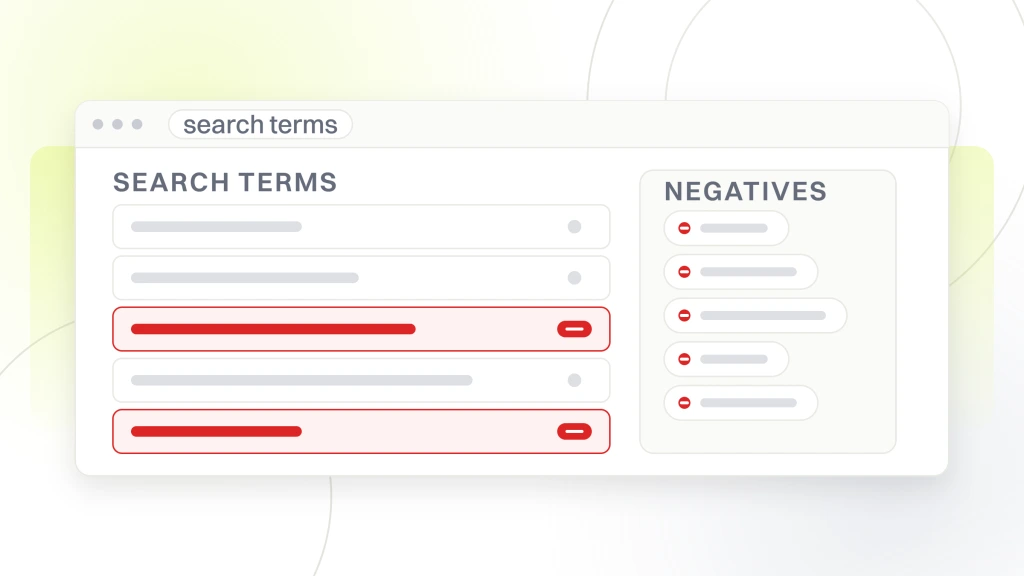
Negative keywords stop the account from paying for irrelevant queries. Account-level negatives hold terms no campaign should ever spend on. Free, cheap, DIY, and job-related searches. Campaign-level negatives hold terms that make sense in one campaign but not another. Branded terms sit as negatives on the non-branded search campaign so attribution stays honest. Competitor brand names sit as negatives on Shopping so PMax does not chase them at a loss. Ad-group-level negatives handle the tight overlap between related product categories. Our writeup on best PPC platforms for ecommerce covers the platform-specific negative-keyword tools founders should be using at each stage.
Ecommerce PPC campaign management cadence
A ppc strategy for ecommerce campaign management engagement runs on a written cadence or it drifts. Weekly review catches query drift, creative fatigue, and audience exhaustion before they hit the monthly report. Monthly review reallocates budget across channels based on the trailing 30 days. Quarterly review rewrites the strategy against the trailing 90 days plus the next 90 days of business goals. Without a written cadence the account gets whatever attention the vendor has left over after the noisier client of the week.
The weekly review checklist
- Search terms review across Shopping and non-branded Search, adding 5 to 30 negative keywords per week to the working list.
- Creative fatigue check on Meta prospecting, flagging any creative below 60 percent of the campaign’s average click-through rate.
- Audience saturation check on Meta lookalike, watching frequency creep above 3.5 for a 7-day window.
- Pixel and Conversions API validation confirming events are firing with unique values, tested through the Events Manager browser.
- Placement report scan on Performance Max, excluding any placement that has spent above $40 with zero conversions.
A DTC brand spending $20,000 monthly needs roughly 90 minutes of weekly review across the checklist, plus 45 minutes of writeup for the founder. Accounts that skip weekly review lose 12 to 20 percent of monthly spend to query drift and creative fatigue inside 45 days. Weekly review is the cheapest single line item in a real ecommerce PPC management engagement, since the recovered spend usually pays for the review time three times over. Our writeup on ecommerce PPC management covers what the cadence looks like inside a retained relationship.
A real ecommerce PPC strategies engagement in production
Topps Tiles, the UK’s largest tile specialist selling through hundreds of physical stores plus a growing ecommerce channel, engaged our team for paid media strategy work during the pandemic-driven digital shift. Monthly paid media spend sat in the mid-six figures. The account faced an aggressive competitor set on Shopping and Search, and the founder wanted a structured test-and-learn approach to defend ecommerce share as physical stores reopened. In brief, the brief was strategic defense with room to press for share.
Our team wrote a six-month ppc strategy for ecommerce plan with a bi-monthly test schedule. Test one measured cannibalization across paid search and Shopping using a statistically valid hold-out group and quantified how much branded traffic the account paid for twice across channels. Test two rolled out dynamic search feeds against the long tail with template-driven ad copy that stayed brand-consistent at scale. Test three tied search visibility to live stock availability so customers only saw products they could buy. Budget shifted every two months based on tested outcomes rather than gut feel.
Across the six-month window the account added 5,465 net new visitors, gained 1.3 million additional impressions between June and September, grew click-through rate 7 percent, and captured 33.3 percent unique-visitor share in the tile market ahead of the original schedule. Marketing efficiency ratio held against the target across every test window. The engagement moved into an ongoing retained cadence at the end of the six-month block with quarterly test rotation, monthly performance reporting, and a written strategy refresh every 90 days that keeps the account honest against the moving competitive set.
Where a PPC strategy for ecommerce fits the DTC growth stack
A ppc strategy for ecommerce sits at the coordination layer of the DTC growth stack. Every downstream tactic (creative production, feed management, conversion rate work, email lifecycle) either compounds through the strategy or fights against it. Founders that run tactics without a written strategy end up with tactical wins that cancel each other out. Writing the strategy first is the cheapest way to make the next 12 months of tactics stack instead of collide.
How the strategy ties into the retainer stack
Our team runs the strategy work as the first deliverable inside every paid media retainer we open. The strategy produces the written channel split. The channel split produces the weekly cadence. The weekly cadence produces the monthly report. The monthly report produces the quarterly rewrite. Removing the strategy at the front breaks the whole chain, since the retainer is then operating on unwritten assumptions about what the account is trying to do. The retainer deliverables that stack on top of the written strategy include creative testing, feed hygiene, weekly reporting, and quarterly rewrite ownership.
Honest scoping at signing
Honest scoping at signing on a ppc strategy for ecommerce retainer includes a written strategy deliverable in the first 30 days, a channel split document the founder can read in 20 minutes, a marketing efficiency ratio target by stage that the whole engagement is scored against, and a quarterly rewrite baked into the retainer scope. PPC retainer pricing runs $999, $1,499, or $2,499 per month across the standard tiers, with enterprise scopes starting at $4,500 per month. Ad spend gets billed separately from the retainer, straight from the founder’s card to the platform, so the fee stays clean and the account never pays a percent-of-spend markup. Six-month contracts are standard, since paid media learning phases take 45 to 60 days to stabilize and quarterly strategy rhythm needs at least two learning phases to produce compounding results.
The ecommerce PPC agency hub covers the retainer scope for founders who want the strategy and execution run together across search, shopping, and paid social under one weekly cadence.
Put your ppc strategy for ecommerce to work
A written ppc strategy for ecommerce is the cheapest lever a DTC founder can pull in the first 30 days of a new engagement. The channel split, the MER matrix, the ramp rule, and the four shift triggers together take a paid media budget from reactive to compounding inside two learning phases. Score the account against the plan, not against last week’s dashboard. In short, if the strategy is written, the vendor conversation is short. If it is not, the vendor conversation runs the account. Redefine Web builds the ppc strategy for ecommerce, runs the weekly cadence, and rewrites the plan every 90 days so your paid media budget keeps compounding through six-month windows and past them.