
Custom Web Development Services for Startups and SaaS Companies
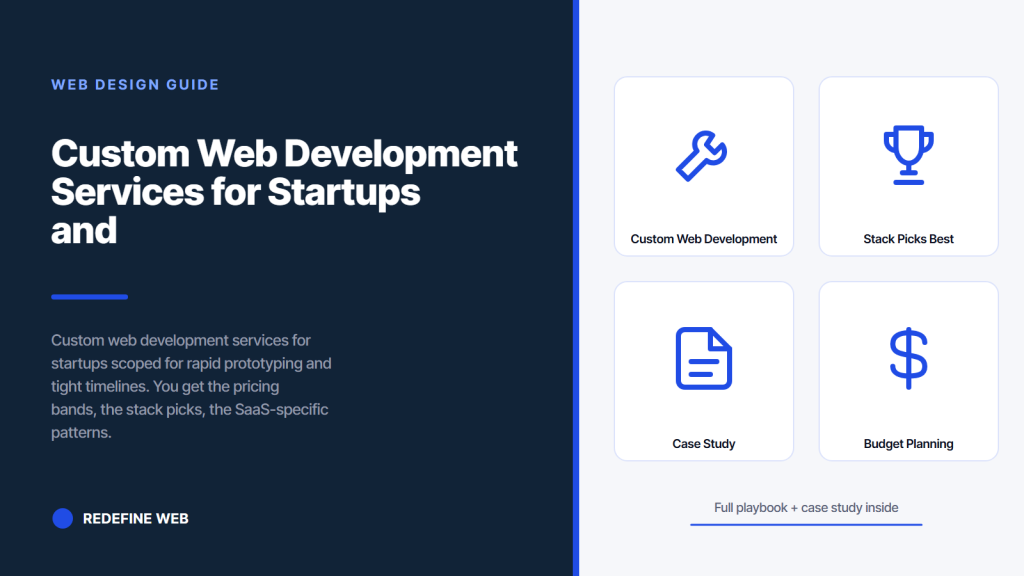
- Four phases scope startup web builds cleanly.
- Seed MVP lands at $35k to $90k on 8 to 12 weeks.
- Rapid prototyping runs a 1-week sprint cadence.
- Retainer at $2.5k to $12k per month bridges to first hire.
- Rocket Software, Inc. drove activation up 300 percent.
- Custom web development service providers for tight timelines
- Stack picks for the best custom web development services for SaaS startups
- Top-rated web development services for custom business needs
- Custom web development services for startups case study
- Budget planning for founders
- Post-launch retainer for startup engagements
- Common mistakes in custom web development services for startups engagements
- Where to start with your startup web development project
Custom web development services for startups is a different job than enterprise custom work. You have 90 days to a demo, 180 days to a beta, and no room in the calendar for a scope reset. Every feature has to earn its way in. Every dollar of the seed check has to hit product-market fit before the burn eats it. This guide is what you get, what it costs, and how our team at Redefine Web scopes a startup engagement on the first call.
You will read the four startup phases we scope differently, the pricing bands from $12,000 to $180,000, the stack picks that hold up post-Series A, why the best custom web development services for SaaS startups run 6 to 10 week engagements, the rapid prototyping iteration cadence, when custom web development service providers with tight timelines win, and a case study where a rebuilt SaaS onboarding drove activation up 300 percent in month one.
Custom web development service providers for tight timelines
Custom web development service providers for tight timelines run different processes than agencies that ship enterprise work. Tight-timeline work runs on 1-week sprints instead of 2-week sprints. Discovery collapses from 2 weeks to 3 days. Design reviews collapse from 4 hours to 1 hour with pre-recorded walkthroughs. Every ceremony is shorter, every deliverable is smaller, every decision is faster. That process shift is what turns a 20-week enterprise build into an 8-week startup build.
Tight timelines are not about working harder. They are about cutting scope. Every founder who asks for a 4-week timeline on a 12-week scope has to pick 4 weeks of features. The best custom web development services for SaaS startups agencies know how to run that scope conversation without breaking the relationship. We name the tradeoff on the first call. You want it fast, cheap, and complete. Pick two.
Scope triage in the first week
Every tight-timeline engagement starts with a scope triage in week 1. Every feature the founder listed goes into one of three buckets. Must-ship for the launch demo. Should-ship for the launch demo. Could-ship in phase 2. The must-ship bucket has 4 to 6 items. The should-ship bucket has 4 to 6 items. Everything else waits. That triage saves 3 to 4 weeks of scope negotiation in the middle of the sprint. Every founder we run this exercise with lands in a real scope by end of week 1.
Pre-recorded reviews save timeline
Pre-recorded Loom walkthroughs replace 40 percent of the design review time on a tight-timeline engagement. The designer records a 5 to 10 minute walkthrough of the week’s screens. The founder watches it on their schedule, comments with timestamps, and files async feedback. The live review that follows runs 20 minutes instead of 90. That single process change saves 2 to 3 hours per week on a 3-person team over an 8-week engagement.
Stack picks for the best custom web development services for SaaS startups
Stack picks for the best custom web development services for SaaS startups come down to five choices. Next.js on the front-end covers 70 percent of the SaaS builds we ship. Supabase for auth, storage, and Postgres covers 50 percent of pre-seed and seed stage picks. Stripe for billing covers 95 percent. PostHog or Segment for analytics covers 90 percent. Vercel for hosting covers 60 percent. That stack ships a real SaaS product in 8 to 12 weeks at seed scale.
You do not need to pick the stack on the first call. Your vendor should recommend based on your team’s existing skills, your fundraising timeline, and your integration requirements. What you should know is that the stack is a downstream decision from the workflow. A vendor who leads with the stack on the first call is selling the tool, not the outcome. See MDN Web Docs on modern web development for the reference against which every stack pick gets evaluated.
| Layer | Pre-seed pick | Seed pick | Series A pick |
|---|---|---|---|
| Front-end | Next.js starter | Next.js custom | Next.js + design system |
| Auth | Supabase or Clerk | Clerk or Auth0 | Auth0 or Cognito |
| Database | Supabase Postgres | Managed Postgres | Managed Postgres + replicas |
| Billing | Stripe Checkout | Stripe Billing + webhooks | Stripe Billing + custom flows |
| Analytics | PostHog free | PostHog Pro or Segment | Segment + warehouse |
| Hosting | Vercel Hobby | Vercel Pro or AWS Amplify | AWS or Vercel Enterprise |
Supabase vs Neon for early database
Supabase gives you Postgres plus auth plus storage in one platform. Neon gives you Postgres with branching for feature-flag database environments. Supabase wins for pre-seed and seed teams who want auth batteries-included. Neon wins for teams who already picked Clerk or Auth0 for auth and want a specialized Postgres. Both are $25 to $50 per month at seed scale. Both scale into 6-figure MRR without a re-platform. Every pre-seed or seed startup we ship uses one of these two picks.
Vercel vs AWS for early hosting
Vercel gives you a zero-config deploy for Next.js apps in 30 seconds. AWS gives you every knob at the cost of a full DevOps engineer. Vercel wins for pre-seed, seed, and most Series A SaaS builds because the engineering time saved compounds. AWS wins when you have unusual traffic patterns, on-prem clients, or a specific compliance requirement that forces the pick. Every SaaS build we ship starts on Vercel and moves to AWS if and when the workload demands.
Top-rated web development services for custom business needs
Top-rated web development services for custom business needs come down to four filters. Portfolio of shipped SaaS products at your stage. Team size that matches your build scope. Sprint cadence that matches your calendar. Communication style that matches your team. Every one of these filters knocks out 60 to 80 percent of the vendor market on the first call. Startups that skip the filters end up in a 3-month vendor relationship that ships nothing.
Portfolio is the leading indicator. A vendor whose portfolio is 80 percent enterprise sites and 20 percent SaaS is a wrong pick for a seed startup. A vendor whose portfolio is 80 percent SaaS and 20 percent enterprise is a right pick. The vendor with 90 percent WordPress marketing sites is a wrong pick regardless of price. Every startup we advise reviews the vendor’s last 5 shipped SaaS products before signing the SOW. That review takes an hour and saves 2 months of misfit.
Team size that matches your build
A 12-person agency is a wrong pick for a $30,000 pre-seed prototype because their overhead does not fit your scope. A 2-person shop is a wrong pick for a $150,000 Series A build because their bench does not cover the required roles. A 4 to 8 person shop is the right pick for most seed-stage SaaS builds. Every startup we advise scales the vendor team size to the phase. Every one saves 20 to 30 percent versus a larger agency that had to load the project with billable hours.
Communication style fit
A vendor that runs on Jira and 2-week sprints is a wrong fit for a founder who lives in Slack and expects a demo every week. A vendor that runs on Slack and 1-week sprints is a wrong fit for a corporate innovation lab that expects Gantt charts. Every startup we advise runs a 30-minute vibe check on communication style before signing. That check takes 30 minutes and saves 8 weeks of friction on a bad match.
Pre-seed prototype, seed MVP, and Series A hardening have different budgets. If your vendor pitches the same scope for all three, they've never actually shipped for a startup.
Custom web development services for startups case study
Rocket Software, Inc. came to us at pre-launch with a subscriber acquisition tool losing 93 percent of trial signups before the second session. Four weeks to a scheduled marketing push. No time for a full rebuild. We scoped a targeted 4-week engagement on the exact 6 features that mattered. Three-step onboarding wizard, activation event tracking, drip campaign engine, activation-likelihood scoring, admin dashboard, and bulk export.
Inside 30 days we plugged the rebuilt features into the existing product, wired the event pipeline to Segment, and pushed the release. Rocket Software, Inc. drove activation rate up 300 percent in month one, hit 3,000 customers in launch week, and settled into 400-plus new subscribers per day post-launch. Every one of those numbers came from a scoped 4-week custom web development engagement focused on the six moments with the highest drop-off instead of a 6-month full rebuild that would have missed the marketing window.
The six features that moved the needle
Three-step onboarding wizard. Activation event tracking wired to Segment. Drip campaign engine triggered on activation gaps. Activation-likelihood scoring model. Admin dashboard with cohort filters. Bulk export to CSV for the go-to-market team. Six features. Four weeks. One integrated release. That focus is what a good custom web development services for startups scope looks like when the calendar is tight and the stakes are real.
The outcome measured 30 days out
Activation rate up 300 percent. Three thousand customers in week one. Four hundred plus new subscribers per day. Those three numbers came from a scoped 4-week engagement that focused on the moments in the funnel with the highest drop-off. Not a full rebuild. Not a fine-tuned model. A wizard plus event tracking plus a scoring model plus a bulk export. Every feature earned its place in the scope before it earned its way into the codebase.
Budget planning for founders
Budget planning for founders on custom web development has four buckets. The initial build. The first year of hosting and third-party services. The first hire in-house post-launch. And the reserve for phase 2 features you have not scoped yet. Every founder budget we have reviewed underestimates the third and fourth buckets. Overestimating them is how you avoid a cash crunch 6 months post-launch.
The initial build is the smallest bucket for most SaaS founders. A $60,000 build turns into $8,000 to $18,000 in first-year hosting and third-party services. That is another $12,000 to $50,000 in first hire onboarding cost if you bring someone in-house post-launch. Add 25 to 40 percent of the initial build cost as a phase 2 reserve. The true first-year cost of a $60,000 seed MVP lands closer to $110,000 all-in. Budget for the all-in number, not just the build.
The universal startup founder experience is signing a $60,000 SOW, celebrating the launch 12 weeks later, then opening the $1,500 monthly hosting bill 30 days after that. Every founder has been there. Every founder learns. The fix is a simple budget appendix in the SOW that names every recurring cost with a specific dollar figure. Every SOW we write includes this appendix. Every founder still finds one line item they missed. Progress, not perfection.
First-year all-in cost
First-year all-in cost for a seed MVP lands at 1.5 to 2x the initial build cost. That includes hosting, third-party services, monitoring, backups, and 25 to 40 percent of the initial cost held in reserve for phase 2 features. Every founder we advise budgets 1.75x as the base plan. That number rarely surprises anyone in year 2 when the phase 2 build lands. Founders who budget only the initial cost end up on a fundraise treadmill 9 months post-launch to cover the shortfall.
The first in-house hire post-launch
The first in-house engineer hire post-launch runs $130,000 to $220,000 fully loaded for a mid-market SaaS in the US. That hire takes 3 to 5 months on the recruiting side, another 2 months on onboarding, and a full 6 months before they are shipping features independently. Most seed startups keep an agency retainer for the first 12 months post-launch instead of hiring, because the agency retainer at $6,000 to $12,000 per month costs less than the first hire and covers more scope. Every founder we advise runs this math before hiring.
Post-launch retainer for startup engagements
Post-launch retainer for a startup engagement runs $2,500 to $12,000 per month depending on scope. That retainer covers minor feature additions, security patches, dependency updates, one round of design refinement per quarter, and on-call coverage. Most seed startups keep the retainer for the first 6 to 12 months post-launch while they raise the Series A and hire in-house engineers. Every retainer we run for a startup has a monthly cadence, a written scope, and a clear exit ramp.
Retainer scope should shrink as the in-house team grows. A pre-launch retainer covers 100 percent of the engineering work. A 6-month post-launch retainer covers 60 percent while the founder hires the first engineer. A 12-month post-launch retainer covers 20 to 30 percent as the in-house team takes over. Every retainer we run tracks the transition with a written monthly scope so both sides know what is in and out. That discipline prevents scope creep and preserves the relationship.
Monthly cadence on a retainer
Every retainer we run has a monthly kickoff, a mid-month check-in, and a monthly review. Every ceremony has a Zoom link, a shared doc, and a written scope for the month. That structure keeps the founder in the loop without turning the retainer into a Slack thread. Every month ends with a written status report on scope delivered, scope carried, and scope pushed to next month. That report is what the founder shares with investors and the internal team. See web.dev Core Web Vitals reference for the performance metrics we track against on every retainer.
Exit ramp planning
Every retainer we run for a startup has a written exit ramp. Typically the retainer wraps when the in-house team hits 3 engineers or when the Series B closes. Ramp-down happens over 60 days with a documentation handoff, a codebase walkthrough, and a warm intro to specialty vendors for anything the in-house team is not ready to own. Every startup we run this ramp with has kept us as a phase 3 partner for specific projects rather than a full-time vendor. That relationship shape wins for everyone.
Common mistakes in custom web development services for startups engagements
Common mistakes in custom web development services for startups engagements cluster around three patterns. Over-scoping the MVP. Under-budgeting for post-launch cost. Picking a vendor whose portfolio does not match the phase. Every one of these mistakes costs 6 to 10 weeks of runway on average. Every one shows up in the first month of the engagement. Every one has a simple prevention on the scoping call.
Over-scoping is the biggest killer. Founders arrive with a 30-feature wish list and a 12-week budget. The scope conversation has to trim 60 to 70 percent of features to the phase 2 backlog. Founders who resist that trim end up with a 24-week build that ships nothing users cared about anyway. Every custom web development services for startups engagement we run treats the scope trim as the first paid deliverable. That trim earns its price 3 times over in avoided rework.
Over-scoping the MVP
Over-scoping happens when the founder confuses a beta with a full product. A beta needs the core workflow, real auth, real billing, and real analytics. It does not need every edge case, every admin dashboard, or every integration on the wish list. Every over-scoped MVP we have seen postponed launch by 4 to 8 weeks. Every one delayed the founder’s fundraise conversations. Every one traced back to a first-week scope conversation where the vendor said yes when the honest answer was let’s push that to phase 2.
Under-budgeting for post-launch cost
Under-budgeting for post-launch cost is the second common mistake. Founders budget the initial build and forget the hosting, the third-party services, the monitoring, and the phase 2 reserve. Every founder we advise budgets 1.5 to 2x the initial build cost as the first-year all-in number. That number rarely surprises anyone in year 2. Founders who budget only the initial cost end up on a fundraise treadmill 9 months post-launch to cover the shortfall.
Where to start with your startup web development project
Start by naming the phase you are in. Pre-seed, seed, Series A, or post-Series A. Match the phase to a vendor whose portfolio shows work at your phase. Run the 30-minute communication vibe check. Ask for a 3-day scope triage as the first paid engagement. If the triage lands a scope you both trust, sign the SOW for the build. If the triage exposes a mismatch, walk away and try another vendor. That process saves 8 to 12 weeks of misfit on the wrong engagement.
Ready to scope a startup custom web build with a team that ships SaaS products. Our custom web development services covers pre-seed prototypes through Series A hardening. For the wider service context, see our web design and development services. For the base scope math, see our custom web application development services, custom web portal development services, and custom web development cost. For AI-specific patterns, see our custom web development services with AI integration. For authoritative reference, see MDN Web Docs on modern web development.
Frequently asked questions
What custom web development services for startups actually include?
Custom web development services for startups include discovery, product design, front-end build, back-end API, auth and billing setup, third-party integrations, testing, launch, and a 30-day hypercare window. Every stream has its own deliverables and its own risk. A vendor who quotes a flat number without breaking out the streams is quoting a website with a login form, not a SaaS product. The honest quote itemizes every stream so you can compare vendors on the same axes. Every scoping call names the phase (pre-seed, seed, Series A, post-Series A) on the first pass because phase drives every other decision.
How much do custom web development services for startups cost?
A pre-seed prototype ships in 4 to 6 weeks on a template stack for $12,000 to $30,000. A seed MVP ships in 8 to 12 weeks on a production stack for $35,000 to $90,000. A Series A hardening ships in 12 to 20 weeks for $95,000 to $180,000. Post-Series A platform work runs on retainer. Every phase transition is a real budget conversation. Founders who try to buy a Series A build with a seed budget end up in a 3-month vendor relationship that ships nothing. Match the vendor and the budget to the phase you are actually in.
How does rapid prototyping iteration work in a startup engagement?
Rapid prototyping runs on a 1-week sprint cadence. Every Monday morning the founder and engineering team pick the top 3 features. Every Friday afternoon a working demo runs on the founder's laptop. Every weekend the founder tests the demo with 3 to 5 target users. That cadence turns 6 weeks into 6 rounds of user feedback. Rapid prototyping does not mean cutting quality. It means cutting scope. Every feature that ships gets full auth and error handling. Edge cases wait for phase 2. Founders who try to cover every edge case in the prototype lose 3 weeks of runway.
Which tech stack should a SaaS startup pick for the MVP?
The best custom web development services for SaaS startups pick Next.js on the front-end, Supabase or Clerk for auth, managed Postgres for the database, Stripe for billing, PostHog or Segment for analytics, and Vercel for hosting. That stack ships a real SaaS product in 8 to 12 weeks at seed scale and holds up through Series A without a re-platform. A vendor who leads with the stack on the first call is selling the tool, not the outcome. The stack is a downstream decision from the workflow, the team's existing skills, and the fundraising timeline.
Should I hire an in-house engineer or keep an agency retainer post-launch?
The first in-house engineer hire post-launch runs $130,000 to $220,000 fully loaded for a US mid-market SaaS. That hire takes 3 to 5 months on the recruiting side, 2 months onboarding, and 6 months before they ship features independently. Most seed startups keep an agency retainer for the first 12 months post-launch because the retainer at $6,000 to $12,000 per month costs less than the first hire and covers more scope. Every founder we advise runs this math before hiring. Retainer scope shrinks as the in-house team grows over the first 12 months.
How do I pick the right custom web development service provider for tight timelines?
Filter on four axes. Portfolio of shipped SaaS products at your stage. Team size that matches your build scope (4 to 8 people for seed-stage). Sprint cadence that matches your calendar (1-week for tight-timeline work). Communication style that matches your team (Slack-first for founder-led builds). Run a 30-minute vibe check on communication style before signing the SOW. Ask for a 3-day paid scope triage as the first engagement. Custom web development service providers for tight timelines run different processes than enterprise agencies. Match the vendor to the phase you are actually in.
Book your free 30-minute strategy call.
No spam, no sales rep. We use your email to schedule your call with a senior strategist. That is it.
More from the blog
View all articles → Web Design
 Core Web Vitals Healthcare Websites Actually Need to Book Patients
Read article Web Design
 Professional Services Website Design Best Practices for 2026
Read article Web Design