
SaaS SEO Checklist and Roadmap for B2B Software Teams
- The 90 day fix list has 60 items across technical, content, and strategy.
- Assign each item a single owner. Split by role: engineer, editor, marketing lead.
- Aim for 30 to 40 items shipped in the first quarter, not all 60.
- The roadmap picks up in month 2 and runs a compounding curve through month 12.
- Report pipeline to the CFO, not rankings and traffic.
- Content items on the saas seo checklist
- Strategy items that live above the checklist
- The b2b saas seo roadmap for months 2 through 12
- Tooling and budget checklist
- Reporting items on the saas seo checklist
- A real SaaS engagement and what the checklist produced
- B2b saas seo guide mistakes that kill the checklist
- Putting the saas seo checklist to work this week
A saas seo checklist is only useful if you can hand it to your team on Monday morning and see fixes going live by Friday. This is that checklist plus a 12 month roadmap wrapped around it. You get the priority-ordered fix list, the assignment shape by role, the tooling requirements, and the milestone map that turns 90 days of foundation work into a compounding search program by month twelve.
Read straight through in about ten minutes. Written for founders, heads of growth, and content leaders at $2M to $80M ARR B2B SaaS companies. Copy the checklist into your project tracker of choice. Assign each item to the right role. Move it. The saas seo roadmap sections cover what to plan for months 2 through 12, so you are not just fixing the immediate mess but building the long compounding curve. Pair this saas seo checklist with the review cadence and reporting shape covered later in the guide and you have every artifact a first-time SaaS marketing lead needs to run search work end to end.
Content items on the saas seo checklist
Content items sit alongside the technical work in the first 90 days but pay back on a longer curve. Build the editorial engine in month one, publish steadily from month two, and the compounding curve starts showing up in month five to seven. Skip the content build and even a perfect technical foundation ranks nothing.
The content checklist is 20 items in the first 90 days. Do not treat it as separable from the technical checklist. The two lists work together. A great blog on a broken site does not rank. A great site with no blog does not rank either. Both matter.
20 content items for the first 90 days
- Complete a keyword architecture document covering 200 to 400 target keywords
- Map every keyword to a buyer stage: awareness, solution research, comparison, or JTBD
- Assign each keyword to one of the six SaaS content patterns
- Audit existing content for keyword cannibalization and consolidate duplicates
- Identify 5 to 10 direct search competitors and map their ranking URLs
- Identify the top 30 keyword gaps by intent
- Draft a 6 month editorial calendar aligned to the keyword architecture
- Write briefs for the first 8 pieces of content at 500 to 800 words each
- Publish 4 to 6 pieces of new content in the first 60 days
- Refresh the top 5 existing pages that already rank on page 2
- Rewrite title tags on the top 20 pages using the SaaS pattern conventions
- Rewrite meta descriptions on the top 20 pages for SERP CTR
- Add FAQ schema to any page with a Q&A block
- Build one comparison page for your top three competitors
- Build one alternative-to page for the biggest competitor by search volume
- Build one integration guide for your highest-usage native integration
- Cross-link every new post to 3 to 5 relevant existing posts
- Add 2 to 4 inbound internal links to every new post within 30 days of publish
- Set up pipeline attribution reporting in your CRM for organic-sourced deals
- Define the north-star metric with the CFO before month 3 ends
Content quality bar per published piece
Every published piece hits 2,500 words minimum for category primers, 1,800 words minimum for comparison pages, 2,200 words minimum for use-case guides, and 1,200 words minimum for integration tutorials. Below those floors the piece reads thin against ranking competitors. Above 4,500 words is padding unless the topic genuinely demands the depth. The floors are honest. The ceilings are guidance. Every piece also carries original data, an original quote, or an original example. Pure summary content ranks nothing in 2026.
Strategy items that live above the checklist
Strategy items on the saas seo checklist are the shortest list and the most important. Get these wrong and every technical fix and every published piece works against the wrong goal.
There are only six strategy items. Every one of them is a document, not a task. The documents live above the tactical checklist and inform every downstream decision. Skip them and the tactical work drifts. Write them once, review them quarterly.
Six strategy documents to write once
- Buyer persona summary with pain points, jobs-to-be-done, and search behavior
- Competitive analysis naming 5 to 10 direct search competitors and their strengths
- Category positioning statement covering how you sit in the buyer’s mental map
- Content pattern allocation showing the six patterns and target counts per year
- North-star metric definition with the CFO signed off in writing
- Publishing cadence commitment with owner names and monthly counts
Quarterly strategy review pattern
Every quarter, review the six strategy documents against actual results. Did the persona summary hold up in the last 90 days of pipeline data. Did any new competitors appear in the SERPs. Did the positioning statement match the sales pitch or drift from it. Did the content pattern allocation deliver on the intended pipeline mix. Did the north-star number move in the right direction. Did the cadence commitment hold. Where any of these drift, update the strategy document before you touch the tactical checklist.
The b2b saas seo roadmap for months 2 through 12
The b2b saas seo roadmap picks up where the 90 day checklist ends. Month 2 is publish cadence stabilization. Month 3 is first ranking gains. Months 4 through 6 is scale of the winning patterns. Months 7 through 9 is link building and category consolidation. Months 10 through 12 is optimization and expansion.
The roadmap assumes the 90 day checklist is done. If you skip the checklist and jump to the roadmap, the compounding curve either delays or stalls entirely. Foundations first, roadmap second. That order is not negotiable, no matter how much your CMO wants results by end of quarter.
| Month range | Focus area | Expected output | Success signal |
|---|---|---|---|
| Month 1 | Audit plus foundations | 40 technical fixes plus 4 content pieces | Search Console coverage clean |
| Months 2 to 3 | Cadence plus first rankings | 12 content pieces plus schema coverage | First page 2 rankings |
| Months 4 to 6 | Scale winning patterns | 18 to 24 content pieces plus link outreach | First page 1 rankings on longtails |
| Months 7 to 9 | Link building plus category | 15 to 30 editorial links plus category primer | Pipeline attribution starts flowing |
| Months 10 to 12 | Optimization plus expansion | Refresh top 15 pieces plus scale winners | 3x pipeline-to-spend ratio |
Months 4 to 6 pattern scale
By month 4 you know which content patterns produce the strongest engagement metrics. Scale the winners. If comparison pages convert at 5 percent to trial, build 8 more comparison pages in months 4 to 6. If use-case guides drive assist pipeline, build 8 more use-case guides. Do not scale patterns that under-perform, even if the CMO likes them. Data first, opinions second. This is where a lot of SaaS content programs go sideways: they scale the patterns the founder personally likes rather than the patterns that convert.
Months 7 to 9 link building focus
By month 7, your content foundation is deep enough to support serious link outreach. Original data reports, integration partnership pushes, ghost-written expert commentary, and Product Hunt style launches. Target 15 to 30 editorial links in this window. Skip guest posts on generic marketing blogs. The link building pattern that works for SaaS is more journalistic than SEO-traditional. Ahrefs on SaaS SEO covers the outreach patterns at a peer level worth reading.
Every row needs one name on it or it sits in Jira for 90 days. Before you copy this list, decide who owns tech vs content. If both = one person, cut the list in half.
Tooling and budget checklist
Tooling and budget items are the boring checklist rows that determine whether the plan is executable. The right tooling costs $300 to $900 per month for a Series A to Series B SaaS. The right budget lands at $18,000 to $32,000 per month all-in for the same stage. Under-tool or under-fund and the plan stalls somewhere in month 4.
Budget by line item. Strategy and management 30 percent. Content production 35 percent. Technical fixes and developer time 15 percent. Link building 20 percent. That mix carries most Series A to Series B SaaS programs through a 12 month cycle without a re-plan. Skew any single line above 45 percent and something else stalls.
Tooling must-haves
- Search Console verified on every subdomain
- Screaming Frog or Sitebulb for site crawling
- Ahrefs or Semrush for keyword tracking and competitor analysis
- DebugBear or Calibre for Core Web Vitals monitoring
- CMS with template-level schema support
- CRM configured to attribute organic-sourced pipeline
- Google Analytics 4 with proper channel grouping
Budget allocation by stage
Pre-Series A: $8,000 to $14,000 per month, mostly consultant plus one writer. Series A: $12,000 to $22,000 per month, agency retainer plus two writers. Series B: $18,000 to $32,000 per month, agency retainer plus 3 writers plus dedicated technical time. Series C: $28,000 to $65,000 per month, in-house team plus agency partner. The bands are wide because your specific site complexity moves the number. Fintech and healthtech push fees to the higher end of each stage.
Every SaaS founder we meet reads a Zapier growth case study and text messages their team at 11pm about spinning up a programmatic SEO experiment by end of week. We used to argue against it. Now we just send them the same reply. Yes, we can build that. It requires eight engineering weeks, a real integration catalog with 300+ entries, and 12 hand-written variants per template. If any of those three are missing, we skip programmatic and build 10 great use-case pages instead. The founder either laughs and agrees, or hires someone else who says yes to the 11pm plan.
Reporting items on the saas seo checklist
Reporting items are where most SaaS marketing teams still show the wrong numbers to the wrong audience. The CFO does not want to see rankings and traffic. The CFO wants pipeline sourced from organic, CAC payback by channel, and the trend across quarters. Build the reporting once, and every month gets easier.
The reporting checklist has 10 items in the first 90 days. Get all 10 in place before month 4 or the whole program starts flying blind by month 5. The reporting infrastructure is not optional. Search Engine Journal’s coverage of the technical SEO reporting patterns lines up with what CFOs expect to see.
10 reporting items to build in the first 90 days
- Attribute organic-sourced pipeline in the CRM
- Track CAC payback by acquisition channel
- Build a monthly report template that leads with pipeline
- Track rank position on top 50 keywords weekly
- Track organic sessions to product-led landing pages
- Track trial signups by first-touch source
- Track activation events by first-touch source
- Track expansion revenue among organic-sourced accounts
- Set up quarterly review with the CFO signed off
- Build a competitor keyword tracking dashboard
The CFO-facing slide that wins budget
The one-slide CFO update carries pipeline sourced from organic this month, prior three months trend, CAC payback for organic-sourced customers versus paid-sourced, and the ratio of pipeline-to-spend on the search program. All four numbers on one slide. Everything else is appendix. That is the slide that wins budget quarter after quarter. Build the reporting to spit it out in 10 minutes on the first of every month. Related retainer shape at SaaS Marketing Retainer Plans from $599/mo.
A real SaaS engagement and what the checklist produced
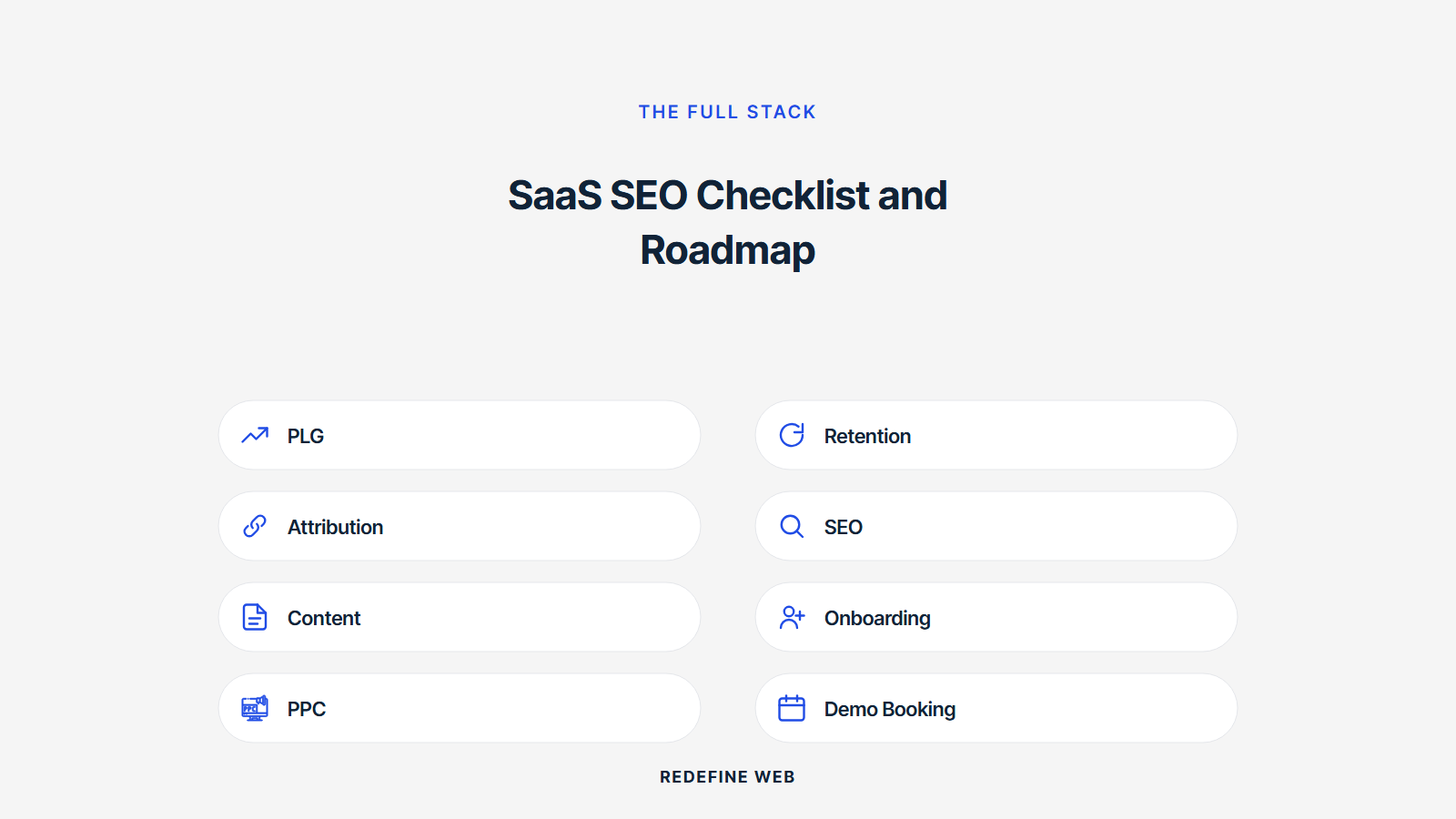
Rapyd Financial Network worked the checklist across a 24 month engagement. First quarter fixed the technical foundations. Second quarter built out the content patterns. Quarters three and four scaled the winners and layered link building. Inbound pipeline hit $1.8m across the 24 months.
The specific numbers. Organic traffic grew 5x across the engagement. Inbound leads tripled from roughly 5 per month at start to over 15 per month by month 18. Total inbound sales pipeline crossed $1.8m. The pattern that moved most of the results was disciplined pipeline attribution work in the CRM, followed by category-level content sprints that positioned Rapyd against the comparison keywords their buyers were actually searching. That is the checklist working as designed. Related: SaaS SEO Agency Tied to Pipeline & ARR.
What worked in the Rapyd engagement
Two moves produced most of the pipeline. First, rebuilding the CRM and marketing automation stack so organic-sourced pipeline could be attributed cleanly. Without that reporting the CFO would never have signed off on the retainer expansion in year two. Second, a category-level content sprint that positioned Rapyd against the comparison keywords their fintech buyers were searching for. Six category pages, four alternative-to pages, and eight use-case guides in a single quarter. The technical foundation work and the link building were necessary but not the primary levers in this account.
What broke along the way
A redesign in month 8 broke a set of URL structures and cost a week of technical seo cleanup. The team wanted to skip building a proper redirect map to save engineering time. Skipping it would have cost roughly 30 percent of the existing organic base. We pushed back, the redirect map got built, the ranking hold survived. The moral of that story is not to trust anyone who wants to save developer time by skipping redirects during a redesign. Skipping the redirects saves 3 days of dev time and costs 6 months of organic traffic. The math is not close.
B2b saas seo guide mistakes that kill the checklist
Four mistakes kill a saas seo checklist even when the items are all correct. Assigning too many items to one owner. Trying to fix everything in month one. Skipping the strategy documents. Reporting the wrong metrics to the CFO. Any one of these four will tank the program by month 6.
The most common mistake we watch is trying to fix everything in month one. Founders read a checklist like this, get excited, and try to assign 60 items to a team of 3 in the first sprint. The team burns out, half the items ship at bad quality, and the momentum collapses by month 3. Aim for 30 to 40 items in the first quarter. Keep 20 in the backlog for month 4 through 6. Pace matters.
The single owner trap
Assigning too many items to one owner is the classic trap in SaaS marketing orgs where one senior person is responsible for everything. A checklist of 60 items assigned to one person is not a plan, it is a stress test. Split ownership across at least three roles from day one. If you cannot split the ownership, you do not have the team to execute the checklist. That is a hiring problem, not a strategy problem, and no consultant fixes it for you.
The wrong metric trap
Reporting rankings and traffic to the CFO makes the search program look like a hobby. Reporting pipeline sourced from organic and CAC payback trend makes the search program look like an investment. Same underlying work, different framing, radically different budget outcomes. The framing is not marketing spin. It is the honest way to describe the value the program produces. Rankings and traffic are the how. Pipeline is the why. Show the why first every time. Related: SEO for SaaS strategy.
Putting the saas seo checklist to work this week
Print the checklist. Assign the 30 technical items to a growth engineer. Assign the 20 content items to a content manager. Assign the 6 strategy documents to the marketing lead. Assign the 10 reporting items to whoever owns your CRM. Set a Monday standup. Set a Friday status check. That structure moves the whole plan by end of quarter.
The teams we watch move this checklist fastest share three habits. They celebrate specific shipped items in Slack every Friday with a screenshot. They keep the checklist visible in a shared workspace, not buried in a personal Notion. They review the strategy documents on the first Monday of every month, not annually. Copy those three habits and the checklist starts moving on its own by week 4. For the retainer wrapper that runs this pattern across accounts, see Search Engine Optimization Services.
The first week action items
Day 1 assign owners. Day 2 buy tooling. Day 3 verify Search Console coverage and pull the last 90 days of ranking data. Day 4 run a full Screaming Frog crawl and export the errors. Day 5 hold the first Monday standup and pick the 15 items each owner will close by end of month one. That is the honest first-week shape. Anyone promising more before you have tooling and baseline data is guessing.
Momentum that carries into month two
By end of month one the technical foundations are 60 to 80 percent done, the strategy documents are drafted, and the first 4 content briefs are in production. That is enough momentum to carry the team through month two without a crisis. Do not chase 100 percent completion in month one. Leave 20 to 30 percent for month two and use the residual capacity to publish content. Trading foundation depth for publish cadence at the end of month one is one of the smartest moves a first-time SaaS marketing lead can make.
Frequently asked questions
What is the SaaS SEO checklist and how do I use it?
The SaaS SEO checklist is a 90 day fix list covering 30 technical items, 20 content items, 6 strategy items, and 10 reporting items. Copy the checklist into your project tracker. Assign each row a single owner across three roles: growth engineer, content manager, marketing lead. Aim to complete 30 to 40 items in the first quarter rather than all 60. Every item that sits in Jira for more than 30 days is a signal you assigned it to the wrong person. Run a 30 minute Monday standup where each owner names three things they will finish that week. That rhythm turns the checklist into shipped work rather than a wish list.
What is the difference between the checklist and the roadmap?
The checklist is the immediate 90 day fix list. The roadmap is the 12 month plan that picks up where the checklist ends. Month 1 is audit plus foundations. Months 2 to 3 is cadence and first rankings. Months 4 to 6 is scaling the winning content patterns. Months 7 to 9 is link building and category consolidation. Months 10 to 12 is optimization and expansion of proven patterns. The roadmap assumes the checklist is done. Skip the checklist and jump to the roadmap and the compounding curve either delays or stalls entirely. Foundations first, roadmap second. That order is not negotiable no matter how much your CMO wants results by end of quarter.
How many items should I complete in the first 30 days?
Aim for 15 to 20 checklist items in the first 30 days, weighted toward technical foundations. Rendering verification, canonical policy, sitemap health, Core Web Vitals baseline, and Search Console coverage on every subdomain. Also complete the strategy documents in the first 30 days because those inform every downstream decision. Content publishing kicks off in weeks 3 to 4 with the first 2 to 4 briefs written. Do not attempt more than 20 items in month one. Overloading month one is the classic pattern that burns teams out by month 3 and collapses the whole program before rankings even move.
What technical items should I fix first?
Fix in this order. Rendering strategy first so Google can see your pages. Canonical logic second so duplicates do not fragment your ranking signal. Internal linking third so link equity flows correctly. Structured data fourth so rich results and AI extraction pick up your content. Sitemap and robots fifth. Core Web Vitals sixth. Skip the order and you spend budget in ways the ranking curve will not reward. Most SaaS marketing sites we audit fail on 5 to 12 of these on the first audit. Fix them all in 90 days and content investment starts returning at 2x to 3x the pre-fix rate.
What content patterns work for B2B SaaS SEO?
Six patterns carry the load in B2B SaaS SEO. Category primers for awareness keywords. Comparison pages for X vs Y phrases. Alternative-to pages for buyers switching from a competitor. Use-case guides for jobs-to-be-done phrases. Integration pattern pages for solution research. Docs-adjacent tutorials for post-signup activation. Every published URL in the first 12 months should fit one of these six patterns and tie to a specific downstream conversion whether that is trial signup, demo request, activation event, or newsletter subscription. Content outside these patterns rarely produces pipeline at scale. Thought leadership belongs on a personal blog, news content belongs in a newsletter.
What should I report to the CFO about SaaS SEO progress?
Report pipeline sourced from organic search, CAC payback by acquisition channel, and the ratio of pipeline-to-spend on the search program. All three numbers on one slide with the trend across the last four quarters. Rankings and organic traffic are appendix. The CFO cares about the pipeline number and the CAC payback trend. Structure your monthly report so pipeline sourced from organic is the first thing anyone sees when they open the deck. A working program produces 3x to 6x pipeline-to-spend by month 12 and CAC payback 20 to 40 percent below paid channels. Those are the numbers that win budget quarter after quarter.
How long before the SaaS SEO checklist produces measurable pipeline?
First page 2 rankings appear in months 2 to 3. First page 1 rankings on long-tail keywords appear in months 4 to 6. First meaningful pipeline attribution shows in months 7 to 9. Full compounding curve with 3x pipeline-to-spend ratio hits by month 12 in a well-executed program. Anyone promising measurable pipeline in month 3 is misrepresenting the timeline. Search compounding is a 12 to 24 month asset. Paid channels give you speed on a weekly cadence. Search gives you durability on a quarterly cadence. Both belong in a growth stack. Match the timeline to the channel or you will keep firing consultants at the wrong problem.
Book your free 30-minute strategy call.
No spam, no sales rep. We use your email to schedule your call with a senior strategist. That is it.
More from the blog
View all articles → SEO
SEO Organic Search Engine Optimization Services That Grow Real Traffic
Read article SEO
SEO SEO for Pet Groomers That Fills the Appointment Book Weekly
Read article SEO
SEO