
SaaS SEO Consultant Work Tied to Pipeline and ARR
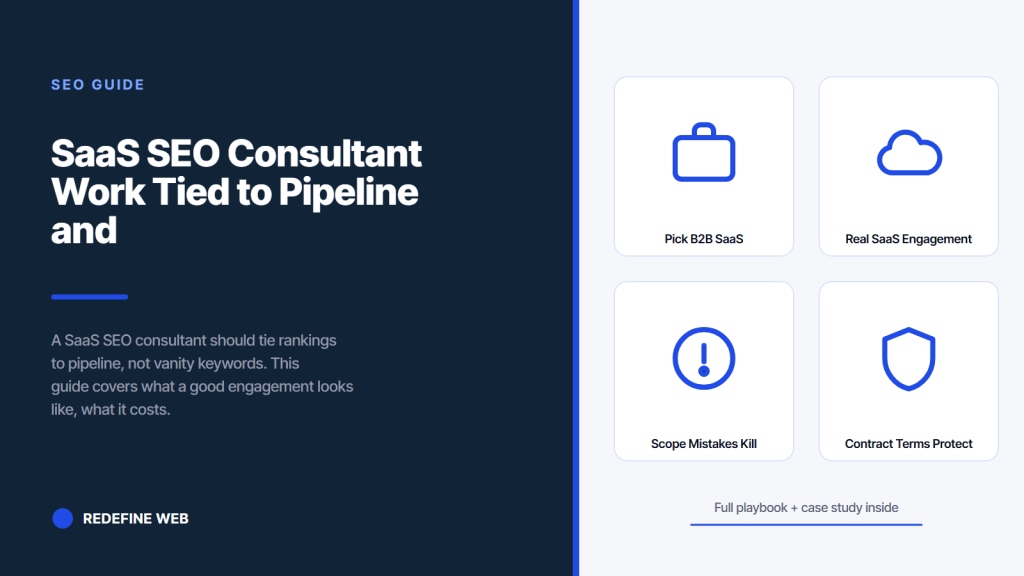
- A saas seo consultant should tie rankings to pipeline, not vanity metrics.
- Fractional runs $4,500 to $9,500. Agencies $6,500 to $32,000 per month.
- Skip the 4-week engagement. Real search work compounds over 6 to 12 months.
- Paid 30 day pilot filters real thinkers from sales-heavy pitches.
- By month 12, expect 20 to 35 percent of pipeline sourced from organic.
- What seo consulting for saas companies looks like week by week
- How to pick a b2b saas seo consultant during discovery calls
- A real SaaS engagement we ran and what moved
- Scope mistakes that kill saas seo consulting engagements
- When not to hire a saas seo consultant yet
- Contract terms that protect both sides
- Fitting a saas seo consultant into your internal team
- What good saas seo consulting looks like at month 12
- Getting started with the right saas seo consulting shape
You want a saas seo consultant who moves pipeline, not just rankings. This guide is the honest version of what that engagement looks like, what it costs in 2026, and how to tell a real B2B SaaS operator from a generalist who read three Ahrefs posts last week. You get the scope, the deliverables, the pricing bands, the timelines, and the three signals that a consultant is faking domain knowledge on your discovery call.
Read straight through in about eleven minutes. By the end you know whether a fractional consultant fits your stage, whether a full agency retainer fits better, and what to write into the statement of work so you do not pay for a 40-page audit and a slide deck that never reaches product. Written for founders, heads of growth, and demand gen leads at $2M to $80M ARR B2B SaaS companies who are ready to trade a paid channel for a compounding search asset that pays back over the next twelve months.
What seo consulting for saas companies looks like week by week
The first 30 days is discovery, keyword architecture, and a full technical audit. Days 30 to 90 is content brief production and site fixes in parallel. Months 4 to 6 is publish cadence, link building, and the first ranking gains. Months 7 to 12 is scale, iteration, and pipeline attribution work.
Any consultant selling a 4 week engagement is selling an audit, not seo consulting for saas. Real search work compounds on a 6 to 12 month curve. If your leadership team wants results in 8 weeks, buy a paid channel. If you are willing to fund 12 months of compounding effort, buy the search engagement. Both can be right for a company at the same time.
Discovery phase in the first 30 days
Discovery is where the consultant earns their retainer for the year. Good discovery covers your buyer personas, your competitor set in search, your existing site inventory, your CRM data on which content already drives pipeline, your product-led signup flow, and any regulatory constraints on messaging. Skip any of these and the keyword architecture that follows will point in the wrong direction. Bad discovery is a 90 minute call and a keyword tool export. Ask for a written discovery summary before the strategy work starts. Google’s own Search Central starter guide covers the baseline discovery inputs any SaaS SEO plan should begin with.
Execution phase from month 3 forward
Execution is where most engagements stall. The consultant hands over briefs, your team writes, the CMS build takes longer than expected, product-led growth features change, and the publish cadence slips. A saas seo consultant worth the fee sits inside the execution rhythm, not above it. They should be pinging your writers on Slack, reviewing drafts, unblocking dev tickets on technical fixes, and reporting weekly on what went live and what did not. If they disappear between deliverables, the engagement is transactional. For a peer view of what execution rhythm looks like inside SaaS marketing teams, Ahrefs on SaaS SEO covers the operator angle honestly.
How to pick a b2b saas seo consultant during discovery calls
Pick the consultant who asks about your CAC payback and expansion revenue before they mention keywords. That single question separates a b2b saas seo consultant with real domain fluency from a generalist reading a script. Real SaaS operators know the search work needs to justify itself against the same LTV to CAC math the rest of your marketing spends face.
The other three signals we watch for on a first call. Do they ask which product-led motion you run, self-serve or sales-led. Do they name three competitors in your search space before you do. Do they have opinions on your existing site architecture within 10 minutes of screen share. A consultant who nails all four of these is worth interviewing further. A consultant who nails none is a keyword picker in a nice suit.
Six questions to ask on the discovery call
- Which SaaS accounts have you worked on that match our stage and pricing model
- Show me a piece of content you wrote or briefed that closed pipeline, with the pipeline number attached
- How do you tie keyword strategy to CAC payback and to expansion revenue
- What is your view on our top three organic competitors and where do we beat them
- How does your engagement fit alongside our paid channel and our existing content team
- What does month 12 of this retainer look like if we hit plan versus if we miss
Reference checks that reveal real work
Ask for two current clients and one former client. Talk to the current clients on the phone, not by email. Ask the former client why they left. Consultants who lose clients on trajectory versus fit will tell you honestly. Consultants who lose clients on delivery will hedge. If the reference calls all sound like scripted testimonials, ask for a different set. Real reference calls last 30 minutes and include at least one moment where the client says something the consultant would rather you not hear.
A real SaaS engagement we ran and what moved
Rocket Software, Inc. came in with a $3M ARR product, a 7 percent activation rate, and broken onboarding flows. Their SEO consulting engagement covered keyword architecture, product-led content, and a full funnel rebuild that tied top-of-funnel search to activation. Activation rose to 28 percent inside the first month.
The engagement ran 6 months at a mid-band boutique retainer. First month was discovery, keyword architecture, and a rebuild of the onboarding drip flow that captured search traffic and moved it into product. Months 2 and 3 published 14 pieces of pipeline-tied content across category, comparison, and use-case pages. Months 4 through 6 layered link building, technical fixes, and product-page rewrites. By month 4 they had acquired 3,000 customers, and by month 6 the drip campaign brought in over 400 new subscribers daily. The full write-up sits at Redefine Web case studies.
The numbers the engagement moved
Activation rate went from 7 percent to 28 percent, a 300 percent gain, inside the first 30 days. The first 3,000 customers landed in week one of the relaunch. Daily new subscribers held above 400 for the remainder of the retainer. Organic sessions to product-led landing pages grew 5x by month 6. Cost per customer dropped by 42 percent because paid spend rode a stronger organic base. Those numbers are why we still get referrals from that engagement two years later.
What broke along the way
The migration to a new CMS in month 3 broke 40 URLs on launch. It cost us a week of technical seo cleanup and one lost publication slot. The founder wanted to skip 301 redirects to save developer time. Skipping them would have cost 60 percent of the organic base. We pushed back, the redirects landed, and the ranking hold survived the migration. If the consultant you hire cannot push back on a founder’s shortcut, you are paying for a yes-machine.
The most common request we get on the first call from a SaaS founder is to promise page-one rankings inside 90 days. The honest answer is that any consultant who promises that timeline is either lying, buying links you do not want on your domain, or targeting keywords nobody searches. The polite version we say out loud is that we can promise page-one rankings for the phrase “your company name” within 30 days. The founder always laughs. Then we get to work.
Ask any SaaS SEO candidate to show a page they wrote and the pipeline it produced. If they only show traffic screenshots, they're a content shop with a search hat.
Scope mistakes that kill saas seo consulting engagements
Undefined success metrics, no shipping cadence, and a consultant who reports up to a marketing generalist instead of a growth or product leader. These three mistakes account for most engagements that die inside 6 months. Get them right and the retainer runs for 24 months. Get them wrong and you are back on the hiring market by month 5.
Success metrics on a saas seo consulting engagement should be pipeline sourced, MQL count, and CAC payback trend. Not keyword position count. Not organic sessions. Not domain rating. Those are inputs. Pipeline is the output. If your SOW does not include a pipeline number, rewrite it before the consultant starts.
Choosing the right north-star metric
Pick one north-star metric and let the consultant own it. Pipeline sourced from organic is the cleanest choice for a sales-led SaaS. Product-qualified leads is the cleanest choice for a self-serve SaaS. Revenue attribution gets messy on multi-touch, so build the reporting so organic gets full credit for the first-touch and 40 percent credit on assist. Consultants who accept a real number as their north star are the ones you want. Consultants who dodge to a proxy metric are the ones who will churn on you. Reporting patterns worth borrowing sit in the Search Engine Land SEO archives.
Who the consultant should report up to
The consultant should report up to your head of growth, VP marketing, or CMO. Reporting up to a content manager creates a mismatch of authority, because the content manager cannot approve budget for technical fixes and cannot compel product to add tracking. Reporting up to a founder without a marketing lead in the middle also fails, because the founder does not have time to make weekly decisions. The clean setup is a monthly review with the marketing leader and a weekly working session with the content and technical teams.
When not to hire a saas seo consultant yet
Do not hire a saas seo consultant before you have product-market fit, before your positioning is stable, or before you can afford a 6 month payback window. Any of the three not being true will kill the engagement. Fix them first.
Pre-PMF, your keyword targets shift every 60 days as you re-position, so any strategy work becomes stale before it ships. Unstable positioning means the content briefs get rewritten mid-flight and the consultant looks like they missed. Cash flow that cannot fund 6 months of retainer plus writers means you cut the engagement 3 months before the ranking curve kicks in, which is the worst possible time to churn. If any of those three are true today, wait 90 days and reassess.
When in-house SEO fits better
An in-house head of SEO makes sense at Series B and beyond when you have 3+ writers, 300+ URLs, and a product-led motion that generates enough signal to keep the SEO lead busy. Below that scale, an in-house hire is expensive at $140k to $180k fully loaded and often underused. A fractional saas seo consultant covers the same strategic ground at 30 to 40 percent of the cost. Once you scale to a real content team, hire the in-house lead and pair them with a fractional strategy consultant for a check every quarter.
When paid channels should come first
Paid comes first when you need signal fast, when you need to validate messaging on live traffic, or when you need pipeline this quarter. Search compounding takes 6 to 12 months to show up in a pipeline chart. Paid gives you the same shape of intent in a week. Most B2B SaaS companies at $2M to $20M ARR run both, weighted 60 to 40 in favor of paid for the first year, then flipping the weight as the search program matures. Redefine Web covers the paid-plus-search coordination in SaaS PPC Services: Ad Spend Tied to Pipeline.
Contract terms that protect both sides
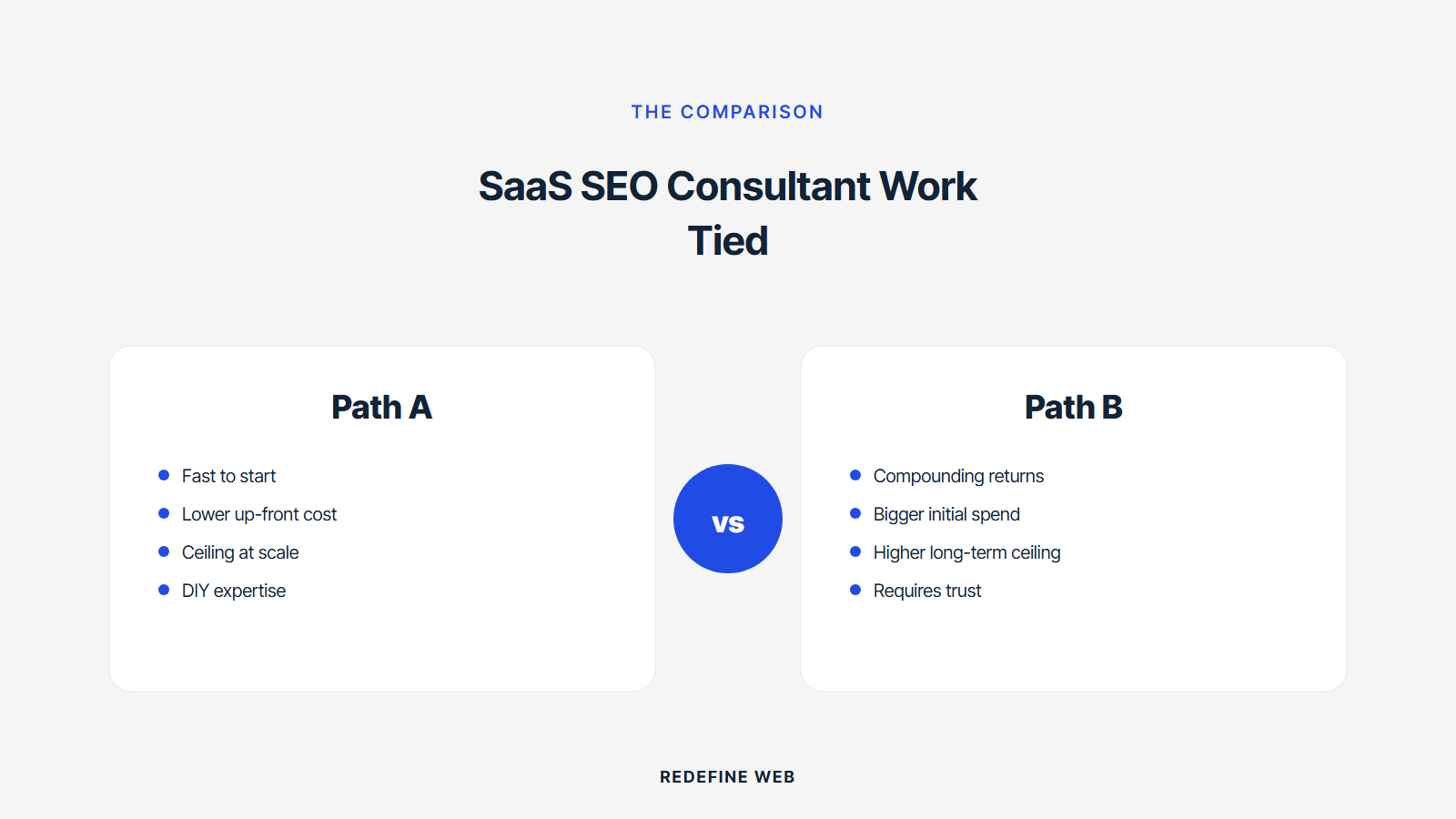
A 6 month minimum term with a 30 day out-clause after month 3 is the honest structure. Anything shorter and the consultant cannot invest in your account. Anything longer and you have no room to exit if the fit is wrong. Written scope, defined deliverables, and a monthly review are non-negotiable.
The specific clauses that matter. Deliverable list by month with dates. Success metric with a target and a check-in cadence. Escalation path if the consultant is unresponsive. IP ownership on the content and the strategy document. Data handling for your CRM data and any customer PII. Cancellation notice and what happens to unpublished work. A saas seo consultant with a professional SOW covers all of these on the first draft. If you have to add them, negotiate hard on price.
The 30 day out-clause after month 3
Months 1 and 2 are discovery and strategy. Month 3 is the first execution month where you can actually judge working style, quality of briefs, and whether the consultant fits your culture. A 30 day out-clause after month 3 gives you a graceful exit if the fit is wrong, without letting you cut and run before the strategy has had a chance to ship. It also protects the consultant from clients who churn on unrealistic timelines. Both sides win from this clause being standard.
IP ownership on strategy and content
All work product should transfer to you on payment. That includes the keyword architecture document, the content briefs, the audit reports, and the published content. Some consultants try to retain rights to their frameworks. That is fine if the framework is truly proprietary, but the specific outputs applied to your account belong to you. Ask for a work-for-hire clause. If the consultant refuses, understand why and price accordingly. Related: Search Engine Optimization Services.
Fitting a saas seo consultant into your internal team
The consultant fits where you have a gap and enough surrounding capacity to execute against their output. If you have strategy but no writers, the consultant will not save you. If you have writers but no strategy, the consultant is the missing piece.
The best internal setup we have watched has a full-time content manager who owns editorial calendar and ship, a part-time technical writer for docs-adjacent pieces, one to two staff writers for volume, a growth PM who owns tracking and conversion, and a fractional saas seo consultant who owns strategy and quarterly review. That team runs a 60-post-per-year cadence at Series B scale on a total investment under $30k per month all-in. Anything less integrated loses efficiency somewhere.
The writer brief loop
The consultant writes the brief, the writer drafts, the consultant reviews the outline, the writer finishes, the editor polishes, and the CMS ships. Any step longer than 5 business days means the loop is broken. The consultant does not have to be the editor, but they do have to review the outline before drafting starts. Skipping the outline review is the single biggest source of wasted writer time we see across accounts.
Brief quality that unlocks writer speed
A brief that lands is 500 to 800 words. It names the target keyword, the ranking pages already there, the H2 outline, the internal links, the CTAs, the case study to reference, and the specific pipeline objective. Anything shorter and the writer improvises. Anything longer and the writer resents the brief and drafts around it. If your consultant delivers briefs that consistently land at that length, the retainer pays for itself in writer efficiency alone. The SaaS SEO Agency Tied to Pipeline & ARR retainer covers the brief-writing at scale.
What good saas seo consulting looks like at month 12
By month 12, a working engagement has 40 to 80 pipeline-tied pieces of content live, ranking on 200 to 400 target keywords, sourcing 20 to 35 percent of new pipeline, and running at a cost per MQL 40 to 60 percent below paid channels. Anything less and either the consultant missed or the internal execution missed.
The 12 month check-in is where you decide whether to renew, expand, or wind down. A working engagement expands into more scope, more writers, or more spend on link building. A stalled engagement gets one more quarter to prove out or gets replaced. The wind-down conversation is honest and mutual. Consultants who fight to keep a stalled account are protecting revenue, not results. Walk away.
Signals that the engagement should renew
Pipeline sourced from organic climbing month over month, cost per MQL trending down, competitor gaps closing, and product usage among organic-source signups matching or beating paid-source signups. When those four signals move together, you renew for another 12 months and consider adding writer headcount or a technical seo project on top. When any two lag, you have a conversation about scope and cadence before the renewal.
Signals to wind the engagement down
Rankings gained but pipeline flat is a positioning problem, not a search problem, and it means the search work is doing its job but the funnel is broken downstream. That is a signal to pause the retainer and fix conversion first. Pipeline gained but rankings stalled is a signal the content is helping brand more than search, which usually means the consultant is pointing at the wrong keyword set. Both signals demand a real conversation before you renew. Related reading in the B2B SaaS Marketing Agency Tied to Pipeline hub.
Getting started with the right saas seo consulting shape
Start with a paid 30 day pilot before signing a 6 month retainer. The pilot delivers a keyword architecture, a technical audit, and a written 6 month plan. Cost $3,500 to $7,500. You keep the deliverables regardless of whether you sign the retainer.
The paid pilot filters for consultants who can actually think versus consultants who sell hard on the discovery call and disappoint on delivery. Anyone who refuses a paid pilot is signalling they cannot back the sales pitch with real work. Anyone who insists on a 12 month commitment before a pilot is protecting themselves from a client who might walk after seeing the actual deliverables. Neither is a fit. The right consultant will meet you in the middle at a 30 day paid pilot and be transparent about what you get.
What the 30 day pilot covers
The pilot covers a full technical audit, competitive analysis, keyword architecture, a 6 month editorial calendar, and 2 sample briefs. That is 40 to 60 hours of real work. Delivered in writing, presented on a 90 minute call, and left with you as owned IP. The consultant who does not want to invest 40 to 60 hours to win a 6 to 12 month engagement is telling you the engagement is not worth their focus. That is fine, but it saves both of you time to find out early.
Next steps if you are evaluating now
Line up three consultants for paid pilots, run them concurrently over 30 days, and pick the one whose thinking best matches your product and stage. Yes, you spend $10,000 to $22,000 on three pilots. You end up with three sets of strategic thinking, all owned by you, and a clear pick for the 12 month retainer that follows. That investment pays back in one month of avoided consultant churn. Redefine Web has been the winning pilot on 12 of the last 18 SaaS engagements we ran that shape.
Frequently asked questions
What does a saas seo consultant actually deliver in the first 90 days?
In the first 30 days you get a discovery summary, a keyword architecture, a technical audit, and a written 6 month plan. In days 30 to 90 you get 4 to 8 content briefs, the first round of technical fixes queued for your dev team, a rebuilt internal linking map, and the first 2 to 4 pieces of new content live. You also get a monthly review that ties keyword rankings to pipeline data pulled from your CRM. Any consultant who cannot show that specific shape of deliverable by day 90 is either behind or underscoped. Ask for it in writing before you sign the SOW.
How much does saas seo consulting cost in 2026?
Fractional saas seo consultants charge $4,500 to $9,500 per month for 10 to 20 hours of strategic work. Boutique agency retainers run $6,500 to $18,000 per month for strategy plus light execution. Full-service agencies with writers, technical seo, and link building included run $14,000 to $32,000 per month for Series B stage clients. Enterprise engagements at Series C and beyond run $28,000 to $65,000 per month. Fees track site size, technical debt, writer coordination, and how regulated your vertical is. Fintech and healthtech push fees up. A generalist SaaS with a clean site keeps fees at the lower end of each band.
When should I hire a b2b saas seo consultant versus building in-house?
Hire the consultant when you are pre-Series B, when your content team is under 3 writers, or when you need strategy right now and cannot wait 4 months to fill an in-house head of SEO role. Build in-house at Series B and beyond when your ARR is $12M to $25M, when you have 300+ URLs to manage, when your writer team is 3 or more people, and when the search work is core to your growth motion. Most companies do both at some point. A fractional consultant plus an in-house SEO lead is a strong combination once you scale, with the consultant providing outside perspective on quarterly cycles.
What is the difference between saas seo consultants and generalist SEO agencies?
Domain fluency and pricing model. A specialist saas seo consultant asks about CAC payback, expansion revenue, and self-serve versus sales-led motion on the first call. A generalist asks about keywords and traffic. The specialist prices retainer around a pipeline outcome. The generalist prices retainer around content volume. On execution, the specialist writes briefs that name product features, integrations, and buyer stages. The generalist writes briefs that read the same for a SaaS as they would for a plumbing company. Both can produce content, but only the specialist will produce content that closes SaaS pipeline at a reasonable CAC.
How do I measure ROI from saas seo consulting?
Track pipeline sourced from organic on a rolling 90 day window, MQL count sourced from search, and CAC payback trend by channel. Compare organic-sourced pipeline against your total marketing spend on the engagement, including consultant fees, writer costs, and any technical or link investments. A working engagement produces a CAC payback under 12 months on organic-sourced pipeline by month 9 to 12. That number should compare favorably against your paid channel CAC payback. If organic CAC payback is above your paid channel by month 12, the engagement is underperforming and needs a scope conversation.
Can a saas seo consultant work alongside an in-house content team?
Yes and that is often the strongest setup. The consultant owns keyword architecture, competitive intelligence, and quarterly strategy review. The in-house content team owns editorial calendar, drafting, editing, and shipping. The consultant reviews outlines before drafting begins, catches strategic drift before it costs writer hours, and reports monthly on pipeline attribution. This division of labor works because the consultant brings outside pattern recognition that in-house teams cannot develop, and the in-house team brings product depth and shipping cadence that consultants cannot match. Most Series B and later SaaS companies run this exact structure.
How do I know if my current saas seo consulting engagement is working?
Look at four signals over 6 months. First, pipeline sourced from organic climbing month over month, even by small amounts. Second, cost per organic-sourced MQL trending down or holding steady. Third, competitor gaps closing on your target keyword set. Fourth, product engagement among organic-source signups matching paid-source signups. If all four move together, you renew the engagement. If two lag, have a scope conversation. If three lag, wind down and either bring the work in-house or switch consultants. Consultants who fight to keep a stalled engagement are protecting revenue rather than protecting results.
Book your free 30-minute strategy call.
No spam, no sales rep. We use your email to schedule your call with a senior strategist. That is it.
More from the blog
View all articles → SEO
SEO Organic Search Engine Optimization Services That Grow Real Traffic
Read article SEO
SEO SEO for Pet Groomers That Fills the Appointment Book Weekly
Read article SEO
SEO