
SEO for pet stores lives in two places at once. Google’s crawler reads category pages that need to rank against Chewy and Petco, while a local shopper searches “dog food store near me” on a Tuesday evening. The failure mode for every independent pet retailer looks identical. Fight the giants on national head terms, lose the fight, and skip the local map pack that books foot traffic. Winning SEO for pet stores starts with abandoning the head-term race. It ends with a Google Business Profile that owns the 3-pack, category pages built for long-tail commercial queries, and product pages structured so the crawler understands the store sells more than kibble. This guide walks the seven-page architecture, the map pack strategy, keyword research patterns, technical fixes for Shopify and WooCommerce, five pet retail case studies with named metrics, retainer bands at Redefine Web pricing, and a FAQ that answers what pet retailers ask us most often on the first call. Read straight through in fifteen minutes and you’ll walk into any pet SEO vendor call with the vocabulary to grade the pitch. For the wider category context, read our take on pet shop marketing playbook before the first vendor call.
Map pack first strategy for SEO for pet stores
Map pack first is the pattern that wins SEO for pet stores against national retailers. Chewy and Petco dominate the organic results on “dog food,” “cat food,” and every product-category head term. What they cannot dominate is the local map pack, which Google returns for “near me” queries and geo-modified searches like “pet store Cincinnati” or “dog food store Brooklyn.” Independent pet stores that build the map pack pipeline capture 60 to 78% of local commercial intent traffic in their metro. Stores that chase head terms against Chewy waste the SEO budget on rankings that never convert.
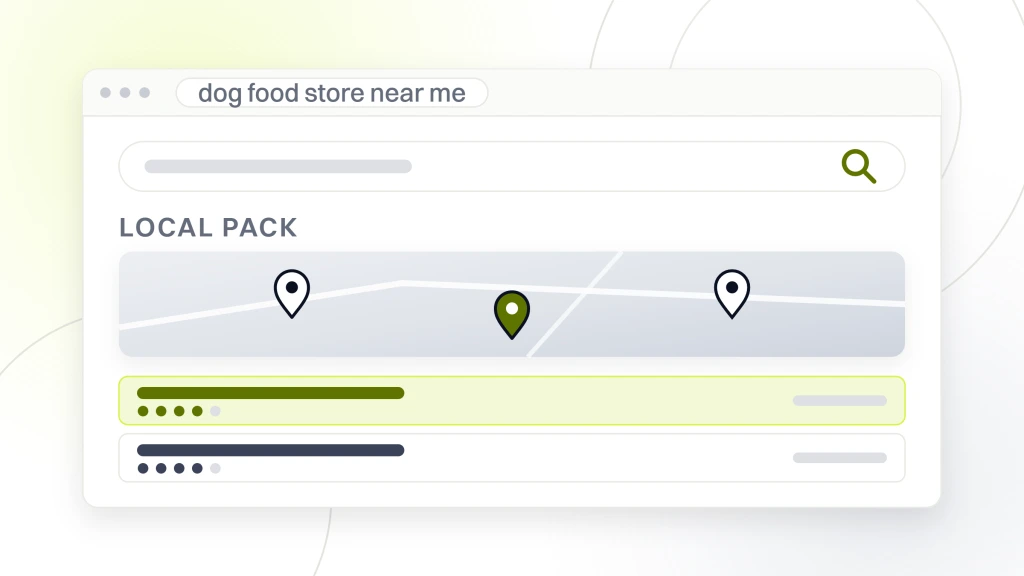
The map pack strategy for SEO for pet stores has four pillars. Google Business Profile fully populated with primary category, secondary categories, service list, hours, photos updated monthly, and Q&A section answered. Consistent NAP (name, address, phone) across 60-plus local citations and industry directories. Sustained review flow at 20-plus reviews per quarter with owner responses on every one. And service-area pages on the site targeting neighborhood-level queries. Miss any one and the map pack ranking slips. Hit all four and the store ranks in positions one to three on virtually every local pet retail query in the metro inside four to seven months.
Google Business Profile optimization is the highest-impact lever inside SEO for pet stores. Primary category should be “Pet Store” not “Retail Store.” Secondary categories cover the specific inventory: “Dog Food Store,” “Cat Food Store,” “Pet Supply Store,” “Aquarium Shop” if applicable, and “Pet Groomer” if the store offers grooming. Service list should include every product category the store carries plus in-store services like grooming, nail trims, or free product samples. Photos need monthly refresh with real store shots, product close-ups, and staff-with-pets images. Pet stores that leave the profile at defaults rank 40 to 60% lower on map pack queries than stores that maintain the profile actively.
Local citations power the NAP consistency signal Google uses to trust map pack rankings. Standard citation targets are Yelp, Yellow Pages, Better Business Bureau, and the metro chamber of commerce. Pet-specific citation targets include Petfinder for stores that partner with rescues, DogFriendly for retail listings, and regional pet expo listings. Consistent NAP across 40-plus citations delivers a stronger signal than 100 citations with three phone number variants. Manual citation cleanup takes 8 to 14 hours per store during the initial audit.
Seven page architecture inside SEO for pet stores
The seven page architecture that anchors SEO for pet stores maps intent to page type. Homepage that answers “what does this store sell and where is it” in the first fold. Category pages for each animal type (dogs, cats, small pets, birds, aquarium) built for commercial-intent long-tail queries. Product detail pages structured with schema markup for individual SKUs. Local service area pages for each neighborhood or town the store draws from. About page with store history and staff bios. Contact page with map, hours, and phone. And a blog hub for how-to content that captures upper-funnel traffic. Miss any and the site under-earns compared to the pattern.
The seven page model is deliberately spare. Independent pet stores don’t need press pages, career hubs, or expansive brand manifestos. They need pages that either rank for local commercial intent or convert store visits into loyalty program signups. Every page past seven adds crawl budget cost, dilutes internal linking authority, and pulls the design team into content nobody visits. Trim ruthlessly at the sitemap stage. SEO for pet stores pays back on focus, not on volume, and Google’s algorithm rewards a clean site architecture with faster indexing and better ranking distribution across the mapped pages.
Category page structure decides whether SEO for pet stores captures long-tail commercial queries. Each category page needs an H1 that targets the primary intent (Dog Food Store, Cat Food Store, Pet Supplies). Body copy that answers three questions in the first fold: what does the category cover, why does the store curate it this way, and what’s the local delivery or pickup story. Product grid with filters for brand, size, dietary need (grain-free, raw, prescription), and price band. Internal linking to related category pages and product detail pages. And a persistent local pickup or delivery module. Categories with thin content rank 30 to 50% lower than categories with 300-plus words of curation copy above the product grid.
Service area pages capture the neighborhood-level query pattern that Google returns as a mix of map pack and organic. A store in Brooklyn should have pages for “pet store Park Slope,” “pet store Williamsburg,” and “pet store Bushwick” if those neighborhoods pull real foot traffic. Each service area page needs unique copy about that neighborhood, driving directions from major cross streets, delivery zone details, and testimonials from customers in that neighborhood if the store collects them. Thin templated service area pages get demoted or flagged as doorway pages. Rich service area pages with real neighborhood context rank in positions one to three for “pet store [neighborhood]” queries across the metro.
Keyword strategy that works for SEO for pet stores
Keyword strategy for SEO for pet stores splits into four intent buckets. Local commercial intent (pet store near me, dog food store Brooklyn, cat food store Cincinnati) drives 40 to 55% of ranked traffic. Product commercial intent (raw dog food delivery, grain-free cat food, freshwater aquarium setup) drives 20 to 30%. How-to informational intent (how much dog food per day, cat food transition schedule, aquarium cycling steps) drives 15 to 25% and feeds the blog hub. Brand and store navigational intent (store name searches) drives the rest and converts at 3 to 5x the rate of other intents. Balancing the four is the pattern that produces steady organic revenue growth.
The mistake independent pet stores make on SEO for pet stores keyword research is chasing head terms Chewy and Petco own. “Dog food” gets 2.4 million monthly searches. Chewy owns position one, Petco position two, and Amazon slots three and four. Independent stores rank position 47 on that query and pull zero clicks. The same store’s local commercial intent queries carry less search volume individually but convert at 8 to 14% versus 0.4% for head terms. Ten local commercial intent rankings at position one to three produce more revenue than a position-40 ranking on any head term ever will. Chase volume where you can win.
| Intent bucket | Traffic share | Conversion rate | Ranking difficulty |
|---|---|---|---|
| Local commercial (near me, city, neighborhood) | 40 to 55% | 8 to 14% | Low to medium |
| Product commercial (long-tail SKU intent) | 20 to 30% | 4 to 8% | Medium |
| How-to informational | 15 to 25% | 1 to 3% | Medium to high |
| Brand navigational | 5 to 10% | 18 to 32% | Very low |
Long-tail keyword research for SEO for pet stores starts with Google Search Console rather than Ahrefs or Semrush. The queries already driving impressions to the store site show real local intent Google associates with the domain. Filter for queries under 100 monthly searches and above 3% CTR. Those are the local commercial queries the store already ranks on but hasn’t optimized for. Build dedicated pages or update category copy to capture the demand. Read our companion piece on SEO for pet supply stores for the keyword patterns we run against DTC plus local retail every quarter.
Seasonal patterns matter for SEO for pet stores. Adoption events in April and October spike “new puppy supplies” and “kitten starter kit” queries. Summer months spike “cooling mat for dogs” and “flea and tick” queries. Winter months spike “dog boots” and “cat cold weather” queries. Holiday shopping windows spike “gift for dog owner” and “pet subscription box” queries. Building landing pages that align with these seasonal patterns three months ahead of the spike gives the pages time to rank. Stores that publish “cooling mat for dogs” content in June (during the peak) miss the ranking window. Publish in March and the page ranks by June.
Technical SEO for pet stores on Shopify and WooCommerce
Technical SEO for pet stores splits by platform. Shopify handles most technical basics automatically: sitemaps, canonical tags, hreflang for multilingual, and structured data on product pages. Where Shopify falls short is category page architecture. The default collection page URL structure (/collections/dog-food/products/kibble-brand) creates duplicate content when the same product sits in multiple collections. Fix by canonicalizing product URLs to /products/kibble-brand and removing the collection prefix. WooCommerce gives more control but requires Yoast or RankMath to set up sitemaps, category schema, and internal linking properly. Neither platform wins on technical SEO out of the box for pet retail.
Page speed is the technical lever most independent pet stores ignore inside SEO for pet stores. Product images averaging 900KB per photo tank Largest Contentful Paint below the 2.5 second Google threshold. Compress product images to WebP under 200KB per photo, lazy-load below-fold images, and defer non-critical JavaScript. Pet store sites with 14 installed apps score 42 on Lighthouse mobile. Stores that trim to 7 apps and compress images score 88. The performance gap translates directly to ranking differences on mobile-heavy pet retail queries, and 71% of pet retail traffic comes from mobile. See the Google Core Web Vitals reference for the current thresholds.
Product schema markup gives SEO for pet stores the structured data Google uses for rich results. Every product detail page needs schema for name, description, brand, GTIN if available, price, availability, and aggregate rating if the store collects reviews. Missing schema drops product rich results 40 to 60%. Missing rating schema drops click-through rate on ranked products 15 to 25% because Google Shopping tiles and rich snippets both display star ratings when the schema supports it. Shopify apps like JSON-LD for SEO handle this automatically. WooCommerce needs Yoast or RankMath configured. Neither platform installs it by default.
Local business schema on the contact page and homepage tells Google the store’s physical presence, hours, and service area. LocalBusiness schema with PetStore as the specific type carries stronger signal than generic Store schema. Include address, phone, hours, geo coordinates, price range, payment types accepted, and links to Google Business Profile. Stores that install PetStore-typed local schema rank 12 to 22% higher on map pack queries than stores with generic schema or no schema at all. The setup takes 30 minutes if the developer knows what they’re doing. Ask any agency running SEO for pet stores to show you the schema before signing the retainer.
Content hub inside SEO for pet stores
The blog content hub inside SEO for pet stores captures upper-funnel informational intent that feeds the retail funnel. Topics that produce steady traffic include feeding guides by breed and life stage, transition schedules between food types, aquarium setup and cycling guides, small pet care basics, and dog training basics with product recommendations woven in. Each blog post links internally to the relevant category and product pages. Content-hub traffic that converts on the same visit runs 1.2 to 2.4%. Traffic that returns within 30 days converts at 6 to 10% through email retargeting or brand-search return visits.
The mistake independent pet stores make on the content hub is chasing broad informational topics owned by publisher sites. “How to potty train a puppy” gets 82,000 monthly searches, and American Kennel Club, PetMD, and The Spruce Pets dominate positions one through five. An independent store ranks position 40 on that query and pulls zero clicks. The same store’s “puppy training pads for small breeds” post ranks position three, pulls 400 monthly visits, and converts at 3.4% to product sales. SEO for pet stores content hub strategy chases queries where a retailer can win, not queries where publishers dominate. Match content topics to purchase intent.
Content topics that convert to retail sales share a pattern: they answer a purchase-adjacent question. “Best dog food for senior labs” implies a purchase decision the reader is already making. “How to bathe a puppy” implies a task the reader might buy shampoo for. “Are grain-free dog foods safe” implies research on a product choice. Match the blog topic to a purchase question and the internal linking to the relevant category page. Content that answers philosophical questions (“do dogs feel emotions”) gets traffic but converts near zero. Content that answers purchase questions gets moderate traffic but converts at 3 to 8%. Retail SEO cares about the second bucket.
Internal linking from blog content to product and category pages is the underrated lever inside SEO for pet stores. Every blog post should link to at least two category pages and three product pages with descriptive anchor text. “Best dog food for senior labs” links to the senior dog food category page with anchor “senior dog food category” and to three specific SKUs with brand and formula names. Blog posts without internal links to commerce pages get informational traffic that never converts. Blog posts with proper internal linking convert traffic at retail-adjacent rates. The pattern is spare and specific: two category links, three product links, per blog post.
Link building strategy for SEO for pet stores
Link building for SEO for pet stores produces authority signal that supports both organic and map pack rankings. Pet-specific link sources beat generic outreach. Local rescue partnerships generate links from rescue organization sites when the store hosts adoption events or donates supplies. Vet clinic partnerships generate links from clinic recommendation pages when the store supplies prescription diets. Pet expo listings and sponsorships generate links from event organizer sites. Guest posts on pet blogger sites generate topical relevance signals Google uses for niche authority. Twenty pet-specific links carry more ranking weight than 200 generic directory citations for an independent pet retailer.
The link building patterns that fail SEO for pet stores are the ones cheap SEO shops sell. Bulk directory submissions on generic business directories carry near-zero authority. Private blog network links get sites penalized or ignored by Google’s spam algorithms. Paid links on low-quality sites signal manipulation and trigger algorithm demotions. The link building work that produces ranking gains for independent pet stores is slow, relationship-driven, and specific to the pet vertical. Retainers that promise 50 links per month at low prices deliver either garbage links or plagiarized guest posts. Real pet-specific link building runs 3 to 8 quality links per month at real cost.
Local partnership links from rescue organizations and vet clinics are the highest-authority link source for SEO for pet stores. Rescue organizations link from their partner or sponsor pages when the store hosts adoption events, donates food, or provides supplies. Vet clinics link from their recommended retailers page when the store carries prescription diets or specialty products. Both link sources signal local authority and topical relevance Google’s algorithm heavily weights for local commercial rankings. Reach out to 10 rescues and 15 vet clinics in a 15-mile radius per quarter. Convert 20 to 40% to partnerships. Each partnership produces one link plus foot traffic referrals. Read our marketing attribution guide for the tracking framework that turns these partnership mentions into revenue attribution on the retainer report.
Five pet retail case studies that show the pattern
The pattern below shows what SEO for pet stores looks like when the retainer produces ranking movement and revenue attribution. Five named pet retail engagements walked in with different starting positions and finished with numbers on the table. Read the metrics against your own store’s baseline. The parallels are direct for any independent pet retailer weighing whether the vendor pitch on your desk actually delivers.
Pet Shop · Independent Retail · UK is a long-standing independent UK pet shop that was losing ground to chains and online marketplaces. The Redefine Web team rebuilt the site mobile-first around local conversion, tuned the Google Business Profile, and ran a daily Instagram plus Facebook content cadence. Local inquiries via call and WhatsApp climbed 158% as mobile CTAs replaced contact-form friction. Click-and-collect orders climbed 212% converting browsers who used to default to Amazon. Repeat-customer rate climbed 47% as daily social kept the shop top of mind between visits. The engagement covered web plus social plus local SEO on one partner across 2024 and 2025.
Pet Shop · Puppies + Grooming · Singapore is a Singapore pet shop selling puppies and dog grooming equipment that had run on Weebly for 8 years, doing its own SEO. A Google Core Update wiped a chunk of the rankings overnight. The Redefine Web team executed a focused on-page plus off-page recovery on the existing platform (no risky migration) and 5× the traffic from 480 to 2,400 monthly visitors in four months. The main commercial keyword climbed from page 3 back into the middle of page 1 with momentum toward the top three. Full recovery delivered inside a $500 per month engagement, proof that scientific on-page work outperforms scale.
| Pet retail engagement | Location | Headline result | Engagement scope |
|---|---|---|---|
| Pet Shop · Independent Retail · UK | United Kingdom | 2.6× local inquiries vs chains | Web + Social + Local SEO |
| Pet Shop · Puppies + Grooming · Singapore | Singapore | 5× traffic in 4 months on $500/mo | SEO recovery + on-page |
| Mission Pet Health | Nationwide, USA | +54% leads, +74% over ROAS goal | Paid Media partner · multi-region |
| Pet Insurance Australia | Australia | 1132% ROI in 5 months | Google Ads partner · 5 months |
| Passion Built | Sydney, Australia | $60K+ bookings in 12 months | Web Redesign + SEO + Google Ads |
Mission Pet Health is a vet-owned network operating 400-plus veterinary clinics that faced a fragmented paid media problem before the Redefine Web team rebuilt the acquisition framework. Fragmented tracking across locations meant nobody could tell which channels produced patients or paying customers. Ad spend flowed to whichever platform pitched hardest, not to what worked. The program grew leads 54% year over year across the 400-plus locations, beat the 12-month ROAS goal by 74%, and improved ROAS efficiency 11% while scaling total spend and integrating new clinics. The reporting cadence ran weekly and clinic-tied across 2023 and 2024.
Pet Insurance Australia partnered with the Redefine Web paid team on a Google Ads engine with niche targeting and remarketing. The account posted 455 qualified conversions in 5 months, an 8.87% CTR versus 1-3% benchmark, and 31.06% conversion rate versus 2-5% industry averages. Return on investment landed at 1132%, which means every dollar of ad spend returned $11. The reporting cadence ran weekly and CRO-tied. Passion Built is a Sydney bathroom and home-renovation specialist that replaced two underperforming websites with a single SEO-driven site, secured 300-plus keyword rankings, and converted 10% of new visitors, generating over $60,000 in bookings within a year. Both engagements ran across 2023-2024.
Retainer bands for SEO for pet stores
Redefine Web publishes fixed SEO retainer tiers so independent pet retailers can pick a scope that matches revenue stage without chasing bespoke quotes. Foundation retainer sits at $999 per month for single-location stores that need Google Business Profile maintenance, citation cleanup, and light monthly content. Growth retainer sits at $1,499 per month for stores adding 4 to 6 pieces monthly, quarterly technical audits, and monthly ranking reviews. Scale retainer sits at $2,499 per month for multi-location retailers running 8 to 12 pieces monthly with monthly technical work and light digital PR. Enterprise retainer starts at $4,500 per month for pet retail chains adding aggressive link building, location-scaling frameworks, and consolidated attribution.
Total cost of ownership across three years matters more than the monthly retainer sticker. A $1,499 monthly Growth retainer plus a modest year-one technical remediation runs roughly $60,000 across three years. That investment produces $180,000 to $340,000 in incremental online and in-store revenue attributable to organic traffic for a well-run independent pet store in a mid-size metro. The math pays back inside 14 to 22 months. Stores that skip SEO for pet stores and rely on paid social see the same $60,000 produce $25,000 to $50,000 in revenue because paid social doesn’t compound. Organic compounds. Paid doesn’t. That’s the underlying math.
| Retainer tier | Monthly fee | Publishing cadence | Best fit stage |
|---|---|---|---|
| Foundation | $999 | 2 to 3 pieces + GBP | Single-location independent |
| Growth | $1,499 | 4 to 6 pieces | Single or dual location |
| Scale | $2,499 | 8 to 12 pieces | Two to five locations |
| Enterprise | Starts at $4,500 | 12+ pieces + digital PR | Multi-location chains |
The CRO retainer sits on top of the SEO for pet stores work and turns organic traffic into revenue at higher rates. Structured A/B tests plus landing page rebuilds grow site-wide conversion rate 0.3 to 0.7 percentage points across twelve months. On a pet store doing $1.4M in annual attributable revenue from organic, that swing produces $42,000 to $98,000 in incremental annual revenue against the CRO cost. The math pays back inside four months. Stores that skip CRO after the SEO build treat the site as a project. The site is a product, and it earns compounding gains only when it’s maintained like one. Contracts default to 6-month terms with clear exit clauses so both sides can walk if the retainer stops producing.
Screening an agency for SEO for pet stores
Screening an agency for SEO for pet stores in one call takes six specific questions. The answers tell you whether you’re talking to a specialist with pet vertical experience or a generalist selling a template. Ask them in this order and watch how fast the answers land. Vague answers or a promise to circle back is the tell that the agency doesn’t run pet accounts often enough to know the pattern. Any agency without a Google Business Profile teardown of your current profile on the first call is not doing SEO for pet stores at the depth the vertical requires.
- Show me three pet retail or pet vertical clients you’ve run in the last 18 months with local map pack ranking gains attached.
- Which schema markup do you install first on a pet store site and why.
- How do you compete against Chewy and Petco on organic without chasing head terms.
- Walk me through your Google Business Profile audit process for a pet store on the first call.
- What is your local citation cleanup approach for a store with 40-plus inconsistent NAP entries.
- Show me a redacted content calendar from a pet retail client for the last quarter.
Ask for a redacted client dashboard from a live pet retail account. If the top metrics are organic sessions, bounce rate, and average time on site, the agency is reporting activity. If the top metrics are organic-attributable revenue, map pack ranking positions, and Google Business Profile actions, the agency is reporting outcomes. If the dashboard doesn’t exist, the agency will build one during your retainer at your cost. An SEO for pet stores shop with real vertical muscle has a dashboard template ready to modify for your store on day one. That template is worth more than the pitch deck they’ll send.
The account lead running your SEO for pet stores work matters more than the agency logo on the pitch deck. Ask who your account lead will be and how long they’ve been at the agency. Under 12 months and there’s churn risk mid-project when they leave and take institutional knowledge with them. Under 24 months and there’s competence risk on complex retail SEO tasks like citation cleanup or multi-location schema. Vertical specialists retain their strongest leads because pet retail work is category-specific fun for people who care about the vertical. Generalist shops rotate junior talent onto pet accounts because the category feels adjacent to whatever they specialize in.
Reporting cadence that keeps the retainer honest
Weekly dashboards on ranking positions and sessions matter less than most agencies pitch. SEO progress is monthly, not weekly. The right cadence for SEO for pet stores is a monthly ranking review with 30-day trend analysis, a quarterly business review with ranking, traffic, and revenue tied together, and an annual strategic review that reallocates scope. Weekly reports become theater when the underlying work runs on 30 to 90 day cycles. Push back on any vendor pitching weekly SEO reports as extra value. The extra reporting labor gets billed back into your retainer as filler that nobody reads past the second month.
The metrics that matter in a monthly report are organic sessions to money pages, ranking positions on tracked keywords with change month-over-month, Google Business Profile actions (calls, direction requests, website clicks), and organic-attributed revenue via GA4 or the ecommerce platform. Everything else is filler. A three-page report is enough. Ten-page reports pad the retainer with charts nobody reads and mask underperformance behind visual density.
Quarterly business reviews should end with three specific decisions. Which content pieces to double down on. Which keywords to shift focus toward. Which technical debt to prioritize next. Reviews that end with “we are on track and continuing execution” are theater. Reviews that end with specific decisions and changed scope are honest. Attribution for SEO for pet stores requires bridging online search to offline store visits. Google Business Profile insights track how people found the store. Web analytics track organic sessions and product page views. Point-of-sale integration ties online-visit-to-in-store-purchase when the store captures customer info at checkout. Combining the three sources produces the closest thing to a full-funnel attribution model for retail SEO.
Making the call on SEO for pet stores
Making the call on SEO for pet stores comes down to four questions. Does the store already have a website that converts, or does the SEO work sit on a broken foundation that loses any traffic gained. Is the budget ready to support a 14 to 22 month payback horizon on organic investment, versus paid social that pays back in six weeks but doesn’t compound. Is the store willing to enforce Google Business Profile discipline monthly (photos, posts, Q&A responses) as part of the retainer. And is the store ready to abandon head-term rankings and commit to the map pack strategy that converts foot traffic and online orders.
Independent pet stores winning against Chewy and Petco share three things: a fully optimized Google Business Profile that owns the map pack, a seven-page site architecture that ranks for local commercial intent, and a content hub that captures purchase-adjacent informational queries. Stores that build all three see organic revenue grow 40 to 80% inside 18 months. Stores that chase head terms against Chewy lose the budget and then blame the medium instead of the strategy. Commit to the map pack, fund the content hub, and enforce the technical foundation. Read our take on e-commerce SEO services for online stores for the wider retail framework, our pet products marketing hub for the vertical context, our pet products SEO service page for the pet-specific retainer scope, and our pet products web design page for the site build that pairs with the SEO work. See the Google product structured data reference for the schema patterns SEO for pet stores depends on.