
Shopify Plus Development Agency When to Upgrade Your DTC Store
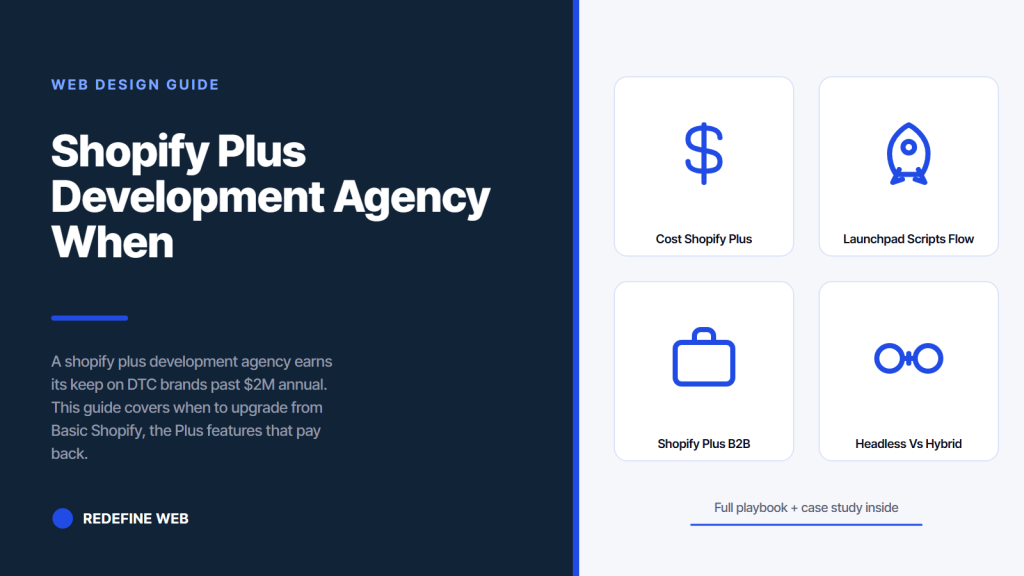
- Plus pays back when 3 of 5 triggers hit (revenue, checkout, wholesale, drops, logic).
- Basic Shopify covers 70 percent of DTC brands under $2M annual just fine.
- Launchpad, Functions, Flow, and B2B are the Plus features worth the upgrade.
- Headless is the right pick for 30 percent of Plus brands, Liquid for the rest.
- A real Plus partner shows five live Plus URLs and a named engineering lead.
- Shopify Plus features that earn the tier upgrade
- Cost of a shopify plus development agency engagement in 2026
- Vetting shopify plus agency partners the right way
- Launchpad, Scripts, Flow, and Functions inside a shopify plus scope
- Shopify Plus B2B and Markets Pro work an agency should scope
- Headless vs hybrid vs Liquid on Plus (agency scope tradeoffs)
- A real shopify plus development agency engagement that shipped
- Where a shopify plus development agency fits the DTC growth stack
A shopify plus development agency gets pitched to every DTC founder who crosses $1M annual revenue, and roughly half of those founders would win faster on Basic Shopify with a good custom theme instead. The other half will fight Basic Shopify’s checkout ceiling for a year and rebuild on Plus anyway, six figures later than they needed to. Both groups pay a Plus tax that only earns back at a specific brand shape. The tier is a spending decision that turns on order volume, checkout customization, wholesale traffic, and the automation the founder actually plans to run.
This guide covers what a shopify plus development agency actually delivers on the Plus tier. When to upgrade from Basic or Advanced. The Plus-exclusive features (Launchpad, Scripts, Flow, Functions, checkout extensibility, B2B, Markets Pro) that earn the $2,300 monthly floor back. Cost tradeoffs across theme customization, headless, and hybrid stacks. Vetting questions that separate real Plus partners from Shopify Experts who upgraded their listing badge last week. Every number runs off real Plus builds our team scoped through 2024 and 2025 for DTC brands at $2M to $40M annual.
Shopify Plus features that earn the tier upgrade
The Plus-exclusive feature stack has grown sharply since 2022. What used to justify Plus (Scripts, higher API limits, dedicated success manager) is now half the story. Checkout extensibility, Shopify Functions, native B2B, Markets Pro, and expanded Flow triggers have moved the value line. A shopify plus development agency worth its fee builds the storefront around these features rather than treating them as line items.
The Plus features an agency actually builds against
- Checkout Extensibility. Custom checkout UI extensions replacing the old checkout.liquid customization. Gift wrapping, custom fields, delivery slot picker, upsell blocks native inside checkout.
- Shopify Functions. Server-side custom logic for discounts, delivery rules, payment methods, cart validation, and shipping rate calculation. Written in Rust or JavaScript, deployed to Shopify’s runtime.
- Shopify Flow. Visual automation builder for post-purchase, inventory, fraud, tagging, and customer segmentation triggers. Runs on Basic too now but Plus gets expanded triggers and higher execution limits.
- Launchpad. Scheduled event manager that swaps theme, price, inventory, and script blocks at set times. Drop days, flash sales, seasonal campaigns run without midnight staff shifts.
- Shopify B2B. Native wholesale storefront with company accounts, buyer roles, price lists, quote flow, net terms, and tax exemption inside the Plus admin.
- Markets Pro. Fully managed international selling with local currencies, duty prepayment, tax collection, and localized checkout in 150 plus countries.
- Wholesale Channel. Legacy wholesale channel for brands not ready to migrate to the newer B2B storefront. Still supported through at least 2027.
Which features move revenue and which move ops cost
Founders picking a Plus scope should split the features into two buckets. Revenue-moving features (Launchpad drops, Markets Pro international, Shopify Functions discount stacking, B2B wholesale) directly raise gross revenue when built well. Ops-cost features (Flow automations, checkout UI extensions, custom apps for internal admin) reduce staff hours per order or per drop but do not directly raise revenue. Founders who ask their shopify plus development agency to name which features fall into which bucket for their brand get a scope built around cash flow rather than feature checklists. The Shopify Functions documentation covers the technical surface for founders and CTOs who want to pressure-test agency claims before signing. The Shopify checkout extensibility guide covers what is possible in checkout customization today.
Cost of a shopify plus development agency engagement in 2026
The cost of a shopify plus development agency engagement breaks down cleanly across four buckets. Discovery and IA (roughly $10k to $22k). Design system and PDP/PLP redesign ($22k to $60k). Front-end theme code plus checkout extensions and Functions ($20k to $70k). Integrations, QA, and launch stabilization ($15k to $30k). Total build cost lands $45k to $180k for a bespoke Plus theme. Headless on Next.js against Shopify runs another 40 to 80 percent on top. Fully custom headless with a design system rebuild runs $180k to $350k.
Somewhere in Manhattan right now, a “headless commerce transformation” agency is preparing a $340,000 proposal for a DTC candle brand doing $1.4M annual revenue that has never once used the discount editor. The line item labeled “Composable Commerce Readiness Sprint” runs $28,000 and includes zero writable code. The founder will sign, spend nine months in Figma workshops, launch on Basic Dawn eighteen months later at $9,000 with a solid retainer, and wonder aloud where the year went. This story repeats across the DTC ecosystem roughly 30 times a month. The proposal that includes the word composable in the header is almost always priced at 15 times the store it is scoped to.
Where money splits on a $120k Plus build
On a $120k Plus bespoke build, the money splits roughly as follows. Discovery and requirements $12k. IA and UX $16k. Visual design system $26k (the biggest single bucket, because component libraries are real work). Front-end theme code $28k. Checkout extensions and Functions $14k. Integrations $12k. QA plus 30-day stabilization $12k. Bundled scopes with one shopify plus development agency running the whole thing carry these numbers cleanly. Split scopes across a strategy shop, a design shop, and a dev shop tax the founder 20 to 30 percent for the same output on the same timeline. Split scopes also tend to slip the launch date by four to eight weeks because handoff friction eats the calendar. Bundled is not always better on principle. It is better when the founder has run split scopes twice and does not want a third go at coordinating three vendors.
Ongoing costs past the build
Ongoing costs on Plus include the $2,300 monthly platform fee (or 0.25 percent of revenue past $800k monthly, whichever is higher). Third-party apps run $200 to $2,500 monthly depending on the stack (Klaviyo, Yotpo, Recharge, Loop returns, Rebuy). Post-launch retainer with the build agency runs $599 to $6,000 monthly for design system extensions, Functions updates, Flow automation additions, seasonal drop template work, and CVR test cadence. Under $599 buys break-fix hours only. Over $6,000 usually means the brand should hire in-house Shopify engineering. Retainers with the original build agency run cheaper than break-fix work with a rotating vendor list because code documentation and design tokens live inside one shared context.
Vetting shopify plus agency partners the right way
Vetting shopify plus agency partners is harder than vetting a Basic Shopify shop because the Plus tier attracts agencies who upgraded their Shopify Experts badge to Plus Partner last month and started billing at Plus rates. Real Plus experience shows in the sales conversation. Fake Plus experience shows in the pricing deck and hides everywhere else.
Five signals of a real Plus partner
Five signals separate a real shopify plus development agency from a rebranded Basic shop. A portfolio of five plus live Plus storefronts the founder can visit today (live URLs, not screenshots, not case study PDFs). A named engineering lead who joins the first sales call and can talk Functions, Checkout Extensibility, and Flow without reading from a deck. A written scope that names the Plus-exclusive features in the build (not “Shopify implementation” as a line item) with hours per feature. A written 30-day post-launch stabilization block with a named on-call dev. Direct Shopify Plus Partner status verifiable through the Shopify Partners directory (not “Shopify Partner” which is the standard tier). Agencies that dodge any of the five are pitching a Basic Shopify build at Plus prices.
Five questions that reveal the agency early
Ask five questions on the first sales call. Which Plus-exclusive features are in scope, and what does each one deliver for our brand specifically? How many Shopify Functions has your engineering team written in the last 12 months, and can we see a code sample? How do you handle the transition from checkout.liquid customizations to Checkout Extensibility if a legacy Plus brand needs a re-platform? Who is the project manager, and what other Plus builds are they running concurrently right now? How does the 30-day stabilization block work, and who is on call for it? Agencies that answer with specifics have built dozens of Plus stores. Agencies that answer with buzzwords will bill the founder for the learning curve. Our previous piece on shopify design agency partners covers the design-side vetting for founders scoping both together.
Under 5,000 orders/month and no wholesale or complex discounts, Plus is a tax. Run one month's checkout customization needs on paper first.
Launchpad, Scripts, Flow, and Functions inside a shopify plus scope
The four Plus-tier automation tools (Launchpad, legacy Scripts, Flow, Functions) do overlapping but distinct work. A shopify plus development agency worth signing knows when to use each and when to combine them. Founders who understand the tools at a high level pressure-test scoping proposals more honestly and end up with scopes that match the brand’s real operations rather than the agency’s default template.
Launchpad, the scheduled event tool
Launchpad runs scheduled events on the Shopify Plus admin. At a set time (say midnight on Friday for a drop), Launchpad swaps the active theme, changes product prices, updates inventory levels, and toggles script blocks. At the end time it reverts. Drop-heavy brands (streetwear, limited-edition collectibles, seasonal apparel) save 3 to 6 staff hours per drop by moving from manual admin swaps to Launchpad automation. Flash sale brands run 30 plus events per year on Launchpad. The alternative on Basic is a third-party app (Bold, Regios, Custom Product Options) that costs $30 to $200 monthly and lacks the native theme swap Launchpad supports. Brands running 4 plus scheduled events per year usually see Launchpad pay back the Plus tier just on drop days.
Scripts (legacy), Flow, and Functions
Scripts is the legacy Ruby-based customization layer for cart and checkout. It still runs on legacy Plus stacks but Shopify has moved new development to Functions. Flow is the visual automation builder for post-purchase, inventory, fraud, tagging, and customer segmentation triggers. It runs on Basic too now but Plus unlocks expanded triggers and higher execution limits. Functions is the Rust/JS server-side custom logic layer for discounts, delivery, payment method rules, cart validation, and shipping rates. A modern Plus scope uses Flow for the automation triggers, Functions for the checkout and cart logic, and Launchpad for the scheduled events. Scripts appears only when migrating a legacy Plus store off the deprecated stack. Founders whose agency pitches Scripts as a fresh implementation on a 2026 build are working with a shop that has not updated its Plus knowledge in three years. The Smashing Magazine writeup on Shopify’s modern stack covers the shift from Scripts to Functions in more depth for engineers evaluating the transition.
Shopify Plus B2B and Markets Pro work an agency should scope
Shopify Plus B2B and Markets Pro have absorbed roughly 60 percent of the enterprise-tier reasons brands used to leave Shopify for BigCommerce or Salesforce Commerce Cloud. A shopify plus development agency that scopes both features cleanly can consolidate a brand running B2B on Magento, a DTC store on Shopify, and an international storefront on WooCommerce into one Shopify Plus admin. The consolidation savings alone often justify the Plus tier for brands running multiple platforms today.
Native B2B on Plus
Shopify B2B on Plus ships company accounts, buyer roles (buyer, admin, requester), custom price lists per company, quote flow, net terms, purchase orders, tax exemption, and wholesale-specific checkout inside the standard Plus admin. A shopify plus development agency scopes B2B work as roughly $18k to $45k on top of a standard DTC build, depending on the number of price lists and the complexity of quote flows. Brands with 200 plus wholesale accounts running on a Handshake or WholesaleGorilla app usually see 40 to 60 percent monthly app cost savings by moving to native B2B. Wholesale reps also work faster because they operate inside one Shopify admin rather than jumping between the retail store admin and a wholesale app dashboard. The consolidation is the operational value, not the feature list.
Markets Pro for international
Markets Pro is Shopify’s fully managed international selling program. It ships local currencies, duty prepayment (shopper pays duty at checkout, no surprise fees on delivery), local tax collection, translated checkout in 150 plus countries, and international payment methods (SEPA, iDeal, Alipay) inside one storefront. A shopify plus development agency scopes Markets Pro work as roughly $10k to $30k for market configuration, translation workflow, and regional catalog logic. Brands running international on separate Shopify stores per country (a common pattern before Markets Pro) usually consolidate three or four regional stores into one Plus store with Markets Pro. The consolidation reduces admin overhead, inventory sync complexity, and platform fees at the same time. Founders who assumed Shopify could not do international well should reevaluate Markets Pro. It shipped its 2024 update with major duty prepayment improvements and now competes credibly with Global-e and Zonos on cost.
Headless vs hybrid vs Liquid on Plus (agency scope tradeoffs)
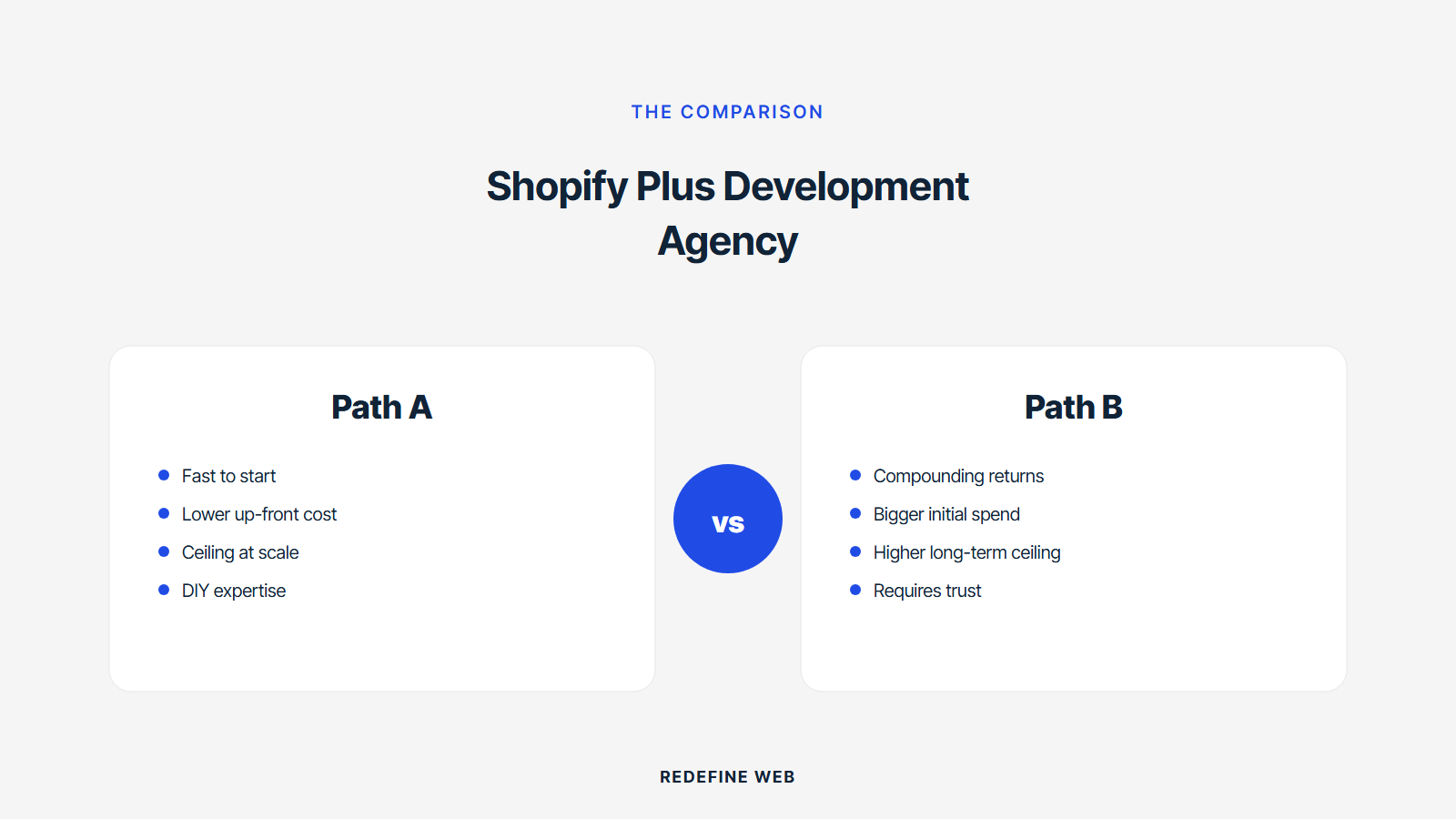
A shopify plus development agency will pitch one of three stack shapes for the front end. Traditional Liquid theme (customized Dawn or bespoke). Headless with Hydrogen or Next.js against Shopify Storefront API. Hybrid with Liquid on PDP and PLP plus a React app on custom pages. The three carry sharply different cost, timeline, and maintenance profiles. Founders who let the agency pick without pressure-testing the choice usually overpay for headless when Liquid would have shipped.
When Liquid is the honest choice
Liquid on Plus is the right choice for 70 percent of DTC brands upgrading to Plus. It ships faster (16 to 24 weeks), costs less ($60k to $140k), and inherits every native Shopify feature (Launchpad, checkout extensions, Functions, B2B, Markets Pro) without integration friction. The Liquid ecosystem is mature. Every app has a Liquid integration. Every developer knows Liquid. The tradeoff is design freedom on the front end. Liquid allows any HTML and CSS the designer specifies, but the interactive logic runs against Shopify’s rendering pipeline rather than a React component tree. For brands whose competitive advantage is not the storefront interactive UX, Liquid is the honest pick.
When headless earns its cost
Headless on Hydrogen or Next.js earns its 40 to 80 percent cost premium for brands whose competitive advantage is on-page interactive UX (visual customizers, real-time bundle builders, complex configurators, immersive lookbook interactions). Headless also earns its cost for brands running the storefront as one surface across web, native mobile, and in-store kiosk, where the same GraphQL API serves three fronts. Headless does not earn its cost for a standard DTC brand that wants a pretty PDP and a fast checkout. Founders often get pitched headless for the wrong reasons (agency prefers React, headless sounds enterprise). A shopify plus development agency worth signing will tell the founder Liquid is the right pick when Liquid is the right pick. Our post on shopify web development agency services breaks down the Liquid-versus-headless decision at more length for founders sitting on that fork.
A real shopify plus development agency engagement that shipped
Abigail Ahern came to our team with a Shopify Plus storefront that had grown organically over four years across a premium home decor catalog of roughly 900 SKUs. The brand voice was luxury; the theme was optimized for discount-led messaging. Category pages listed by newest, not by curated mood. Product photography was strong; the PDP framed it in a 60/40 layout designed for supermarket brands, not aspirational interior design. Paid media relied heavily on branded search and discount ads. The founder wanted a bespoke Plus build that let the brand look like itself, plus a paid media rebuild aligned to premium creative rather than discount banners.
Our team scoped a bespoke Shopify Plus theme build with a custom design system across 24 weeks. Discovery took three weeks including founder interview, top ten customer interviews, and a merchandising audit. The design system landed at 48 components with four states each, built against real product photography rather than stock. Front-end code ran nine weeks against the design system with a component-first workflow. Integrations covered Klaviyo, ShipStation, Yotpo reviews, Meta Conversion API with server-side dedup, and a custom mood-board recommendation engine using Shopify metaobjects. Checkout extensibility added gift wrapping and delivery date selection. Shopify Functions expressed the volume-discount stacking the discount editor could not. Launchpad scheduled the two seasonal drops per year. QA ran three weeks. Launch happened on a Tuesday morning behind a Sunday DNS rehearsal.
Over the following 18 months on the bespoke Plus build, ecommerce revenue grew 179 percent year over year. Paid search return on ad spend hit 1,588 percent. Paid social return on ad spend hit 3,000 percent. Add-to-cart rate on the PDP moved from 6.2 percent to 13.4 percent. Average order value moved from $128 to $184. The Plus tier and the bespoke build did not cause the numbers alone. It removed the ceiling the previous theme had been placing on brand-aligned merchandising and gave the paid media program a store worth sending traffic to. Founders looking at Plus as a status buy should map their own numbers against a build like this before signing. Our follow-up piece on top ecommerce web design examples breaks down more storefronts running similar patterns at the Plus tier.
Where a shopify plus development agency fits the DTC growth stack
A shopify plus development agency sits at the top of the growth stack for DTC brands that have earned the right to invest in the Plus tier. Paid media, SEO, email, retention, and content all rely on a store that converts the traffic they send. Founders who fix the storefront first make every downstream marketing dollar 20 to 40 percent more efficient. Founders who patch the storefront while running ads pay customer acquisition cost against an underperforming funnel and blame the ad platform.
The Plus upgrade is worth it when three of five triggers hit. Monthly revenue past $200k where the variable rate pays for itself. Checkout customization needs Basic cannot express. Wholesale traffic worth consolidating into native B2B. Automation cadence with 4 plus scheduled events per year. Complex discount or delivery logic that Functions expresses cleanly. Fewer than three, and Basic Shopify plus a good agency retainer is the honest choice. More than three, and Plus pays back inside 12 to 18 months of daily shopper interactions and staff hours saved.
The rest of the growth stack sits alongside. Paid media pointed at a converting store. SEO on category and product pages treated as landing pages. Email and SMS flows that catch shoppers who bounced. Retention programs that raise second-order rate. Every tactic works better when the Plus storefront is not fighting it. Our ecommerce website design services team runs both the Plus build and the growth work under one roof, and the Shopify Functions documentation pairs cleanly with the Functions scope in this guide for founders and CTOs pressure-testing agency claims before signing anything.
Design hiring is a parallel decision to the Plus tier upgrade for most DTC brands. Our writeup on shopify web designer hiring options covers freelance-versus-agency-versus-in-house economics with real 2026 rates by profile and the portfolio checks that separate real Plus-experienced designers from padded resumes.
Frequently asked questions
What does a shopify plus development agency actually do that a Basic Shopify agency does not?
A shopify plus development agency builds against Plus-exclusive features that Basic Shopify cannot ship. Custom checkout extensions inside Checkout Extensibility. Shopify Functions for discount, delivery, and payment rules the standard editor cannot express. Flow automations for post-purchase, fraud, and segmentation. Launchpad scheduled drops that swap theme, price, and inventory at set times. Native B2B storefront work with company accounts, price lists, and quote flow. Markets Pro for international with duty prepayment. Wholesale channel work. Basic Shopify agencies handle theme customization, PDP work, integrations, and standard flows, which cover roughly 70 percent of DTC brands under $2M annual revenue. The Plus scope only earns its premium when the brand actually uses the Plus-exclusive stack.
How much does a shopify plus development agency cost in 2026?
A shopify plus development agency engagement in 2026 costs $45k to $180k for a bespoke Plus Liquid theme build. Headless on Hydrogen or Next.js against Shopify runs another 40 to 80 percent on top, or $80k to $320k. Fully custom headless with a full design system rebuild runs $180k to $350k. On a $120k Plus build the money splits roughly $12k discovery, $16k UX, $26k design system, $28k front-end code, $14k checkout extensions and Functions, $12k integrations, and $12k QA plus 30-day stabilization. Bundled scopes carry these numbers cleanly. Split scopes across three vendors tax the founder 20 to 30 percent. Post-launch retainers run $599 to $6,000 monthly depending on the maintenance and iteration cadence.
When should a DTC brand upgrade from Basic Shopify to Plus?
A DTC brand should upgrade from Basic Shopify to Plus when three of five triggers hit. Monthly revenue above $200k where the 0.25 percent variable rate pays for itself against transaction fees. Checkout customization needs Basic cannot express (custom fields, gift wrapping upsell, delivery slot picker). Wholesale traffic worth consolidating into native B2B rather than running on a separate store or clunky app. Automation cadence with 4 plus scheduled events per year where Launchpad saves real staff hours. Complex discount stacking that Shopify Functions expresses cleanly but the standard discount editor cannot. Fewer than three triggers, and Basic Shopify plus a good agency retainer is usually the honest choice for another 12 to 18 months.
What are the top shopify plus agencies vetting signals a founder should check?
Top shopify plus agencies show five signals in the first sales call. A portfolio of five plus live Shopify Plus storefronts the founder can visit today (live URLs, not screenshots or PDFs). A named engineering lead who joins the first call and can discuss Functions, Checkout Extensibility, and Flow without reading from a deck. A written scope that names the Plus-exclusive features in the build with hours per feature, not a generic "Shopify implementation" line item. A written 30-day post-launch stabilization block with a named on-call developer. Verified Shopify Plus Partner status in the Shopify Partners directory, not the standard Shopify Partner tier. Agencies that dodge any of the five are usually pitching a Basic Shopify build at Plus prices.
Should a shopify plus development agency build a headless storefront or a Liquid theme?
A shopify plus development agency should build Liquid for roughly 70 percent of DTC brands upgrading to Plus. Liquid ships faster (16 to 24 weeks), costs less ($60k to $140k), and inherits every native Shopify feature without integration friction. Headless on Hydrogen or Next.js earns its 40 to 80 percent cost premium for brands whose competitive advantage is on-page interactive UX (visual customizers, real-time bundle builders, complex configurators, immersive lookbooks) or brands running the storefront across web, native mobile, and in-store kiosk against one GraphQL API. Headless does not earn its cost for a standard DTC brand that wants a pretty PDP and a fast checkout. Founders should pressure-test the agency's stack pick against actual brand needs, not against agency preference.
Book your free 30-minute strategy call.
No spam, no sales rep. We use your email to schedule your call with a senior strategist. That is it.
More from the blog
View all articles → Web Design
 Core Web Vitals Healthcare Websites Actually Need to Book Patients
Read article Web Design
 Professional Services Website Design Best Practices for 2026
Read article Web Design