
Small Business Web Design and Management Services That Actually Grow Revenue
- One partner for build plus monthly upkeep beats splitting the two.
- Bundled scopes run $499 to $2,400 per month depending on stack.
- Uptime, backups, and security patches ship weekly, not annually.
- SEO edits every month keep rankings from drifting off page one.
- Pick a partner who reports on revenue, not on tasks.
- Pricing bands for full service web design for small business
- WordPress or a hosted builder for a small business site
- Hosting, security, and backups inside a management retainer
- SEO work inside a small business web design and management retainer
- A real small business case study: Best Fit Movers
- Monthly reports should tie to revenue, not to tasks
- How to vet a small business web design and management partner
- Common mistakes small businesses make hiring web design and management partners
- What to do next if you’re shopping for a bundled partner
Small business web design and management is the whole stack, not the launch party. You need a site that ranks, converts, and stays online, plus a partner who patches the plugins, backs up the database, and edits the service page every month while you run the actual business. Splitting the build and the upkeep between a freelance designer and a nephew who “knows WordPress” is how a $12,000 site turns into a $340 monthly liability by year two.
This guide is what a bundled small business web design and management service actually covers, what the pieces cost in 2026, and how to price the whole thing so the site keeps earning after launch. You will see the monthly scope, the pricing bands, the real reporting shape, and a case study from a small business we run this exact model for. You will also see the five questions to ask a prospective partner on the sales call before you sign anything. Read straight through in eleven minutes and keep the pricing table open when you interview partners.
- Weekly. Uptime check, security scan, plugin updates on staging, form-submission test, page-speed spot check.
- Bi-weekly. WordPress core and theme updates pushed to production after staging QA.
- Monthly. Full backup verification, database optimization, broken-link scan, redirect audit, GA4 sanity check, SEO refresh on the top three pages, monthly report.
- Quarterly. Deep speed audit, Core Web Vitals check, content pruning pass, sitemap review, schema validation across templates.
- On demand. 2 to 8 hours per month of scoped edits: new service page, blog post publish, image swap, form update, CRM field addition.
The edit hours are where most small business owners get burned by cheaper plans. A $99 per month plan often includes only “backups and updates.” When you need a new page in October, that page is a $600 change order. Bundled small business web design and management builds edit hours into the retainer at a wholesale rate. Two hours of scoped edits monthly, applied by a team that already knows your stack, is worth more than four hours from a freelancer catching up on the site.
Security is the piece owners underweight until it bites. WordPress powers about 43 percent of the web, which makes it the most-scanned target on the internet. Weekly patching is not paranoia. It is the difference between a Tuesday spent on a client call and a Tuesday spent explaining to your customers why your site is serving a Russian pharmacy landing page. Google’s Search Central blog lists hacked-site recovery among the most common support tickets year over year.
Pricing bands for full service web design for small business
Bundled small business web design and management pricing sits in three honest tiers. Below the first tier you are buying a template with backups. Above the third tier you are buying agency-scale work. Everything in between is what most small businesses actually need.
| Tier | Build fee | Monthly management | What you get |
|---|---|---|---|
| Starter | $4,500 to $8,000 | $499 to $799 | 5 to 10 pages, stock theme, GA4, backups, updates, 2 edit hours |
| Growth | $8,000 to $18,000 | $799 to $1,600 | 15 to 30 pages, custom theme, CRM sync, on-page SEO, 4 edit hours, monthly SEO refresh |
| Scale | $18,000 to $45,000 | $1,600 to $2,400 | 30 to 80 pages, multi-location, ecommerce or membership, 8 edit hours, quarterly speed audits, custom reporting |
The single mistake owners make is picking a Starter build and expecting Scale-tier results. If your business runs 40 SKUs, three locations, and a booking system, a $499 monthly plan on a stock theme will not carry the weight. Match the tier to your actual scope. The retainer covers the site you have, not the site you wish you had budgeted for.
Real small business web design and management services should also publish their pricing bands, not hide them behind a “let us send a custom quote” wall. Custom quotes are appropriate at the Scale tier where scope varies wildly. At Starter and Growth, a partner who cannot name a price on the first call is fishing to see what your budget is. Compare the same scope across three partners before you sign anything.
WordPress or a hosted builder for a small business site
Pick WordPress when you want SEO ceiling, code ownership, and a real chance at ranking. Pick a hosted builder when you want speed to launch and never plan to touch the site past week two. Both work for small businesses. They solve different problems.
WordPress powers about 43 percent of every site online. The reason boils down to control. You own the database, the theme, the plugins, and the hosting. When you want to add a members area in year three, you pick a plugin instead of migrating to a new platform. When Google releases a new schema type, your SEO plugin adds it inside a week. On WordPress you can customize what you need to customize.
Hosted builders such as Squarespace, Wix, and Webflow trade control for simplicity. Squarespace launches a competent five-page brochure in two weekends. Wix is faster to launch but harder to rank past a five-mile radius. Webflow is a designer’s dream and a developer’s compromise, priced accordingly. All three are honest tools for the right job. None of them beat WordPress on total cost of ownership past year two if your site is your main customer acquisition channel.
Full service web design for small businesses skews WordPress because the monthly retainer has real levers to pull: content adds, schema updates, speed tuning, custom fields, integrations. On a hosted builder, the monthly work is mostly editing text inside a locked template. Cheaper to maintain, harder to grow. When you interview partners, ask which platform they default to and why. “It depends on the client” is a hedge. A real answer includes a decision tree.
Hosting, security, and backups inside a management retainer
The infrastructure layer is invisible when it works and existential when it fails. A serious small business web design and management partner runs managed WordPress hosting, weekly backups stored off-server, a security plugin with active scanning, and an SSL certificate that renews itself. If the retainer does not list these items line by line, they are not happening.
Managed WordPress hosts like Kinsta, WP Engine, and Cloudways run $30 to $70 per month for a small business site. Their advantage over shared hosting is object caching, staging environments, PHP tuning, and support agents who read WordPress error logs for a living. Shared hosting at $6 per month costs the same site $400 in lost bookings the first time it crashes during a Google Ads push. The Kinsta blog publishes real benchmarks worth reading before you pick a host.
Backups are your insurance policy against a bad plugin update, a hacked login, or an intern who accidentally deletes the services page at 4:45 p.m. on a Friday. A real retainer keeps daily incremental backups plus weekly full backups, stored on at least two independent providers. If your partner cannot name where your backups are stored, they are not backed up.
Security patching runs weekly on staging first, then production after a QA pass. Zero-day WordPress vulnerabilities publish on a rolling schedule, and the median time from disclosure to public exploit is under 72 hours. A monthly patch cadence is a monthly window for the attack. Weekly is the honest cadence. Faster than weekly is theater unless your site handles PHI or PCI data.
A split designer plus nephew combo costs -14k/year in scope creep. Ask any web partner if hosting, edits, and SEO all sit in one retainer before you sign.
SEO work inside a small business web design and management retainer
SEO is not a separate line item on a real management scope, it is baked in. Every month your partner refreshes at least the top three revenue pages, publishes one new content piece, and reviews the technical SEO layer for regressions. Google’s ranking factors move quarterly. A site that publishes fresh work every month keeps its ranking floor. A site that sits still loses about six positions per year on average across its money keywords.
The monthly SEO work sits in four buckets. First, on-page refreshes: title tags, meta descriptions, H1s, internal links, schema. Second, content additions: one to two new pages or posts targeting a real keyword from the map. Third, technical health: broken-link scans, redirect audits, sitemap validation, Core Web Vitals check. Fourth, off-page hygiene: citation cleanup, Google Business Profile updates, review responses if the plan includes them.
Full service web design and management for small businesses that ignores SEO produces beautiful sites that no one finds. If the sales pitch focuses on “modern design” without a word about search visibility, ask directly how much monthly SEO work is in the retainer. If the answer is vague, look elsewhere. You want the partner who talks about internal linking on the first call, not the one who shows off a color palette.
When you’re ready to run search work across the whole site, our search engine optimization services covers the full stack including technical audits, on-page refreshes, and link building. Retainer starts at $599 per month and stacks with the web management scope on the same account. Third-party benchmarks on ranking cadence from Search Engine Land back the monthly refresh pattern with dozens of case reports each quarter.
A real small business case study: Best Fit Movers
Best Fit Movers is a family-owned moving company in San Diego running local and long-distance service. When we picked up the account in 2023, the site was a five-page WordPress build with no schema, no service pages beyond the homepage list, and a monthly maintenance plan from a freelancer that covered “updates” and nothing else. Phone leads were flat quarter over quarter. Google Ads was running blind because none of the conversion actions were tied to the site.
We ran the full bundled small business web design and management scope. First a rebuild: new WordPress theme, dedicated service pages for local moves, long-distance moves, packing, and storage, plus a location page per service radius. Then the monthly work: weekly patching, on-page SEO refresh every month, one new blog per month tied to a real keyword, GA4 event tracking, Google Business Profile management, and a monthly report tied to booked jobs, not tasks.
By the end of year one on the retainer, Best Fit Movers hit +108 percent phone-call leads, +72.6 average rank gain across target keywords, and 2 times online leads. The numbers were not magic. They were what happens when the build and the monthly work sit on the same account and every hour is scoped to a revenue outcome.
The account still runs. The reporting sends every second Tuesday. The retainer sits at the Growth tier. The founder answers his own phone on lead calls because now the phone actually rings. Real management means exactly this. Not plugin updates on a spreadsheet. Booked jobs on a calendar.
Monthly reports should tie to revenue, not to tasks
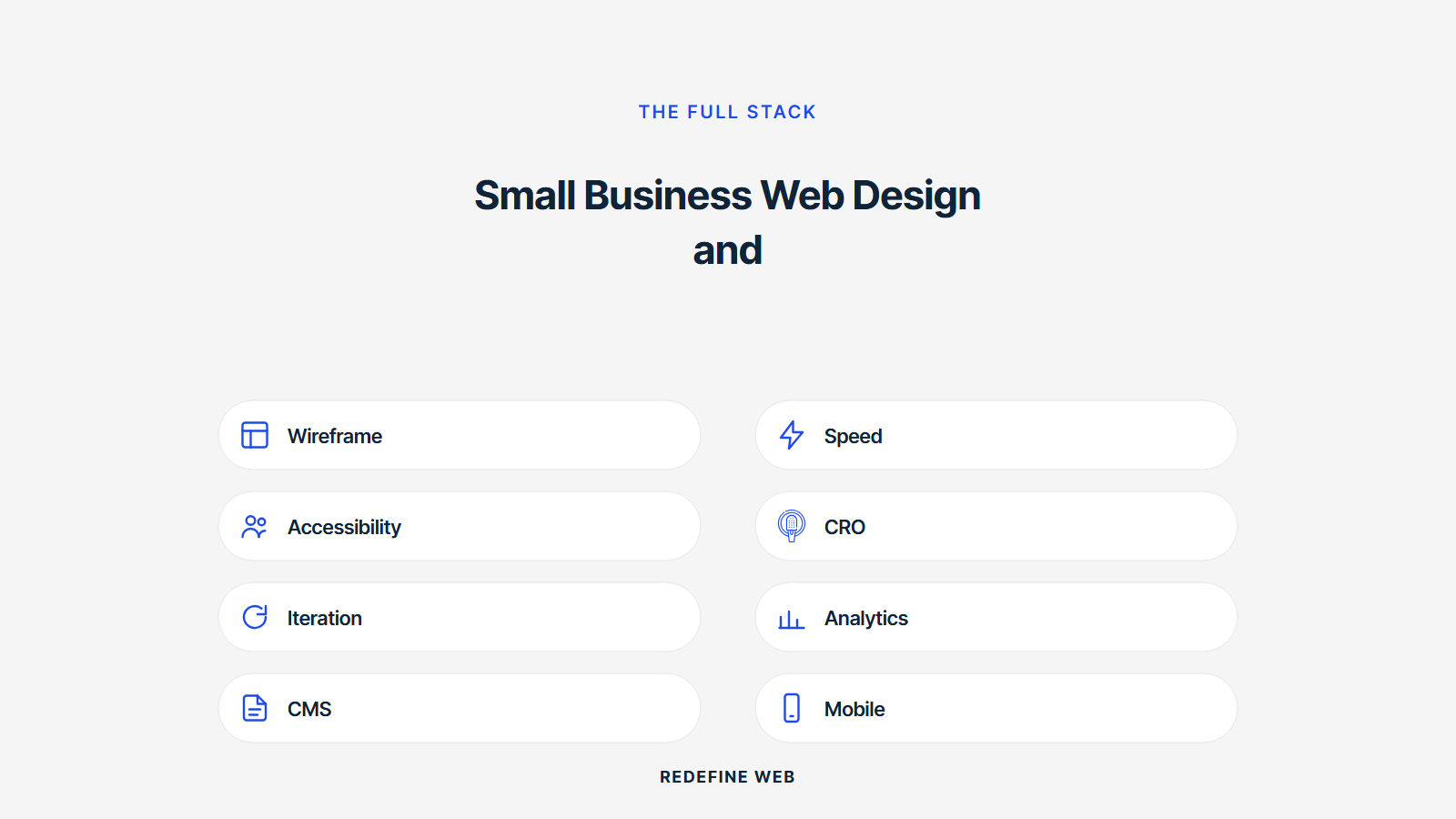
A management report that lists “12 plugin updates, 4 security patches, 3 blog posts published” is a task ledger. Task ledgers are useful internally. They are worthless to a small business owner. Your report should answer three questions in a single email your accountant could read at breakfast.
- What moved? Organic sessions, form fills, phone calls, booked appointments, revenue. Month over month and year over year.
- Why did it move? Specific work tied to specific gains. New page ranked, checkout speed improved, GBP review count jumped.
- What is next? The top three priorities for next month with expected impact.
Attach the task ledger as an appendix if the client wants it, but keep the front page focused on outcomes. Small business owners buy management services to get their time back, not to review your project management tool.
Our approved report shape at Redefine Web fits on one printed page. Top: three-number summary. Middle: two paragraphs on what changed and why. Bottom: three ranked priorities for next month with expected impact and effort. That is the whole report. Founders read it in three minutes and get back to running the actual company. Sprawling twelve-tab PDFs impress procurement teams and no one else.
The report should also flag red items early. A page that lost 30 percent of its organic traffic in the last 30 days belongs on page one of the report with a proposed fix. A form that stopped receiving submissions belongs at the top too. Owners who read the report on a Tuesday morning should know within the first paragraph whether last month was a green month or a red month. Padding good and bad news together across ten pages hides the signal.
How to vet a small business web design and management partner
The sales call is the interview. If a prospective partner cannot answer these five questions on the first call, keep shopping. Any partner worth signing has the answers ready because they get the questions every week. Bring a notepad. Score each answer as you go. Three green answers out of five is a pass mark.
- What is your typical Starter, Growth, and Scale monthly price, and what does each tier include?
- Show me a small business site you built two years ago that is still on the retainer today, and share the monthly retention numbers.
- Which managed host do you default to, and what is your backup and staging environment setup?
- What percentage of your accounts publish new content every month, and who writes it?
- Can I see a real monthly report from an anonymized client account?
Partners who hedge on any of these are not vetted operators, they are marketing brochures. The second question in particular filters hard. Anyone who builds sites cannot show a two-year-old site still on the retainer. Only partners who actually run management retainers can.
The reference call matters too. Ask the partner for two current client contacts and a former client contact. Former clients tell you what breaks. Current clients tell you what works. Both matter. A partner who refuses to share a former client reference is telling you something without saying it.
For the full build side of the stack, see our web design services for small business. The scope pairs with the management retainer on the same account and is priced to bundle from day one.
Common mistakes small businesses make hiring web design and management partners
You could keep buying a rebuild every two years from a different agency and never once ask why the last three sites drifted off page one within six months of launch. Or you could hire the partner who bundles the build with a monthly retainer and stop paying for the same site three times.
Mistake one: shopping on price alone. A $299 monthly plan on a stock theme with backups is not equivalent to a $1,200 plan with SEO work, scoped edits, and monthly reporting. When you compare quotes, compare the scope line by line, not the number at the bottom.
Mistake two: skipping the reference call. Testimonials on a website are curated. A phone call with a current client tells you what the partner actually does in month four when the honeymoon is over. Five minutes on the phone is worth more than an hour reading case studies.
Mistake three: assuming the site will maintain itself. The number of small business owners who paid $8,000 for a site in 2023 and last touched it eight months ago is high enough to fill a Sunday newsletter. Sites need weekly patches, monthly content, and quarterly speed audits. A neglected site loses money quietly. You will notice on the payroll spreadsheet before you notice on the traffic dashboard.
Mistake four: treating the retainer as a rescue mission. Some owners hire a management partner only after a security breach or a Google penalty. That is the most expensive time to hire. A partner who inherits a hacked site charges more, moves slower, and cannot guarantee full recovery. Hire the partner before you need them, not after. For sibling reading on the build side, our post on how to choose a web design and development company covers the vet-the-agency angle in more depth.
What to do next if you’re shopping for a bundled partner
Start with a spreadsheet listing every current page by URL, last update date, monthly organic sessions, monthly conversion count, and whether a form or phone tracker is attached. The gaps in that spreadsheet are your scope. Any partner you interview should walk through it with you in the first thirty minutes of the call.
The spreadsheet forces the conversation from generic capabilities to the specific site on the screen. Every partner should have opinions about at least three pages by the end of the review.
Then shortlist three partners. One that quotes below your budget, one that quotes at your budget, and one that quotes above it. Compare their scopes line by line on the same spreadsheet. The gaps between the low quote and the high quote are usually SEO work, content production, and edit hours. Those gaps are where the site earns or does not earn its keep past year one.
Ask each partner for a written proposal with phase deliverables, monthly scope, pricing bands, and a sample report. The proposal itself is a work sample. Partners who send a two-page PDF with real numbers are showing you how they think. Partners who send a generic “we do everything” letter are showing you the same thing. Trust the sample. Sibling reading on the pricing side, our post on WordPress website development cost breaks down the same math from the build angle.
The last step is the trial. A serious small business web design and management partner will run a three-month evaluation period at the retainer rate before either side commits to a year. Three months is enough to see the reporting cadence, the response time, and the actual work. If a partner refuses the trial, they know something about their delivery that you do not. Skip them.
When you’re ready to price a full bundled scope for your business, our monthly website maintenance packages cover the monthly retainer side, and the build side gets scoped as a one-time engagement at signing. Together they price at the tier that matches your actual site, not a template package. Reach out through the contact page and mention the tier you think you need. We will send bands and a phase list within one business day.
Frequently asked questions
What do small business web design and management services actually include?
Small business web design and management services bundle the initial site build with the monthly work that keeps the site useful after launch. The build side covers strategy, wireframes, design, WordPress or headless development, on-page SEO, and analytics wiring. The management side covers hosting, uptime monitoring, security patching, weekly backups, plugin and core updates, form and speed testing, content edits, SEO refreshes, and a monthly report tied to leads or revenue. Bundling both under one partner saves the hand-off tax and keeps someone accountable when a page breaks at 6 p.m. on a Friday.
How much do small business web design and management services cost in 2026?
Bundled scopes for a small business site with 15 to 40 pages run $499 to $2,400 per month for the management side, plus a one-time build fee of $4,500 to $28,000 depending on custom design, page count, integrations, and content production. A five-page starter site with a stock theme and a light monthly plan lands near $499. A 30-page WordPress build with a custom theme, GA4, CRM sync, and weekly SEO edits lands around $1,600 per month. Multi-location or ecommerce scopes push past $2,400. Anything under $299 is usually a template with backups and nothing else.
Do you really need monthly management, or can you build once and leave the site alone?
You can leave a site alone. Most owners who try it lose about 30 to 50 percent of their organic traffic inside a year because Google refreshes ranking factors, plugins drift out of security compliance, and page speed degrades every time WordPress core ships a point release. Small business web design and management services keep the site earning by patching, testing, and updating on a weekly cadence. Skipping management is not a savings, it is a slow refund back to your competitors.
WordPress or a hosted builder for small business web design and management?
Pick WordPress when you want to own the code, run SEO deep, add custom functionality later, or connect to a CRM. Pick a hosted builder like Squarespace or Wix when the site is a five-page brochure and no one on the team will ever want to change it past launch. WordPress wins on flexibility, SEO ceiling, and total cost of ownership past year two. Hosted builders win on ramp speed. Most partners who bundle small business web design and management services default to WordPress because the monthly work has real levers to pull.
How fast can a small business web design and management partner launch a new site?
A five to ten-page WordPress build with a stock theme launches in three to four weeks. A 20 to 30-page custom build with brand-new content and a design system launches in eight to twelve weeks. A multi-location or ecommerce build runs twelve to twenty weeks. Timelines assume you deliver copy, images, and stakeholder approvals on schedule. The single most common cause of a slipped launch is client-side content delays. Partners who lock the copy before development starts finish on time. Partners who write copy during development almost never do.
What reports should you expect from a small business web design and management partner?
One monthly report that answers three questions in a single email. What was done this month across build, SEO, and infrastructure. What moved on the numbers that matter to your revenue, meaning organic sessions, form fills, phone calls, booked appointments, or ecommerce revenue. What is planned for next month with a ranked priority list. A report that reads like a task list without connecting tasks to revenue is a red flag. You are paying for outcomes, not for a list of plugin updates.
Can you switch from a freelance web designer to a bundled small business web design and management service without losing your site?
Yes. A clean handover takes about two weeks. Your new partner audits the current site, takes over hosting or migrates to a managed host, pulls DNS and email records into a documented sheet, exports the WordPress database and files, imports both into a staging environment, runs a full test, then flips the DNS. Your live site stays online the entire time. Ask the new partner for a written handover plan before you sign. Freelancers who resist a handover are usually holding logins hostage, which is a separate problem worth fixing on its own.
Book your free 30-minute strategy call.
No spam, no sales rep. We use your email to schedule your call with a senior strategist. That is it.
More from the blog
View all articles → Web Design
 Core Web Vitals Healthcare Websites Actually Need to Book Patients
Read article Web Design
 Professional Services Website Design Best Practices for 2026
Read article Web Design