
Text Marketing for Optometrists That Refills the Schedule
- SMS opens in 90 seconds, email in 6 hours.
- Reminder texts drop no-shows from 22% to 6%.
- Reactivation texts book 8-14% of lapsed patients.
- Send under 160 characters and always include an opt-out.
- Text marketing runs $89 to $329 monthly for a solo practice.
- The three programs every practice needs
- Reminder text templates that cut no-shows
- Reactivation text templates for lapsed patients
- Promotional text templates that convert
- Compliance and opt-out rules for text marketing
- What text marketing for optometrists costs monthly
- How to set up text marketing for optometrists in 30 days
- Mistakes optometrists make with text marketing
- How to layer text marketing with the rest of your channel mix
Text marketing for optometrists is the single fastest way to refill an exam schedule and shave the no-show rate. A reminder text hits within 90 seconds. A reactivation text books lapsed patients the same afternoon. A promo text on a frame line moves inventory the day it goes out. Nothing else on your marketing stack turns spend into booked chairs that fast, and nothing else pays for itself within the first three days of month one.
This piece walks the three text programs every optometry practice needs (reminders, reactivation, promos), the message templates you can copy tonight, compliance rules that keep you out of trouble, cost benchmarks by practice size, and the Vision Express numbers behind a 62% booking rise inside six months. Real numbers from real accounts, not directory-blog ranges. You will finish with the exact platform picks, cadence, and copy shapes ready to go live inside 30 days. Read straight through in twelve minutes.
The three programs every practice needs
Every optometry practice running text marketing needs three programs, in this order: appointment reminders first, patient reactivation second, promotional broadcasts third. Each solves a distinct revenue problem. Skipping the reminder program to jump to promos is the mistake we see most.
Appointment reminders drop your no-show rate from 22% average to 6% or lower. On a solo practice booking 400 exams a month, that is 64 recovered exam slots. At $180 per exam, that is $11,520 in monthly revenue that would have walked out the door. The reminder program pays for itself in the first three days of month one.
Patient reactivation books 8 to 14% of your lapsed-patient list per campaign. A three-doctor group with a 4,000-patient database and 30% lapsed rate (1,200 lapsed patients) books 96 to 168 exams from a single reactivation text. That is a $17,000 to $30,000 revenue swing on a single message that took six minutes to write and cost $12 to send.
Promotional broadcasts move frame inventory and insurance benefits before year end. December is the big month here. A Ray-Ban launch broadcast, a VSP year-end frame benefit reminder, a Rx sunglass promo before summer. Each broadcast books 4 to 9% of your active list.
- Program one: Automated appointment reminders 72 and 24 hours out.
- Program two: Monthly reactivation broadcasts to lapsed patients.
- Program three: Quarterly promotional broadcasts to your active list.
- Same platform, same contract. Different cadence, copy, and audience.
- Reminder program must go live first. Everything else compounds on top.
Reminder text templates that cut no-shows
The reminder text template that works is short, specific, and offers a one-tap reply. Long apologetic reminders reduce reply rates because patients see a wall of text and swipe past. Under 160 characters. Patient first name, appointment day, time, one-tap reply option.
Sample 72-hour reminder: Hi Sarah, this is Vision Express confirming your exam Wed 10:30am with Dr. Chen. Reply Y to confirm, R to reschedule. Reply STOP to opt out. Ninety-four characters. Delivers the fact, asks for one action, respects opt-out law.
Sample 24-hour reminder: Reminder: Sarah’s exam is tomorrow (Wed) at 10:30am at Vision Express. Reply R to reschedule. Address: 421 Main. One hundred nine characters. The address inclusion raises show rates for first-time patients by roughly 12% because it removes the where-do-I-go question the morning of.
Practices that send both a 72-hour and a 24-hour reminder cut no-show rates further than practices sending only one. The double reminder catches patients who confirmed the 72-hour reminder but forgot by day-of. On a 400-exam month, the double reminder recovers an additional 8 to 12 exam slots over the single-reminder practice.
Wire the reminder program into your practice management system before you ever run a manual send. Every tier-one platform integrates cleanly with Eyefinity, RevolutionEHR, and Compulink. The integration reads the exam schedule every 15 minutes, checks against the message queue, and sends when the 72-hour and 24-hour windows open.
Reactivation text templates for lapsed patients
The reactivation text works when it names the specific gap and offers a specific reason to come back now. Generic we miss you texts book under 2% of the list. Specific reactivation texts book 8% to 14%. The gap needs to be inside the text, not implied.
Sample 12-month lapse: Hi Sarah, it has been 14 months since your last exam at Vision Express. Your VSP benefits reset Jan 1 and unused frame credits expire. Reply YES for an exam this month or STOP to opt out. One hundred ninety-two characters. Splits across two SMS segments (which most platforms bill as one MMS or two SMS depending on setup).
Sample 24-month lapse: Sarah, we noticed it has been two years since your last visit. A lot changes with vision every year, especially over 40. Book a full exam in the next 30 days and we will honor last year’s copay: reply YES. Two hundred four characters. Names the health concern directly.
The reactivation broadcast runs monthly against a rolling window (12 to 18 months since last visit for the standard list, 24 to 36 months for the deep-lapsed list). Book rates are highest when sent between 10am and 11am on Tuesday or Wednesday. Avoid Monday morning and Friday afternoon.
Segment the list before you send. Split by insurance carrier (VSP, EyeMed, Davis, self-pay), by last visit date bucket, and by exam type (annual eye vs. contacts fitting vs. medical). A three-way segmented broadcast books 30% to 40% more exams than a flat send because the copy matches the patient’s actual next-visit reason. The extra 20 minutes of segmentation work pays out at $2,400 to $5,600 per broadcast.
TCPA lets one bad consent form nuke a whole SMS program. Pull your intake form today and check that patients tick a box specifically for texts.
Promotional text templates that convert
The promo text works when the offer is time-boxed and product-specific. Vague visit us for a great deal on frames texts book under 2% of the list. Product-specific texts with a deadline book 4% to 9%. The offer needs to feel like a real event, not a generic marketing broadcast.
Sample frame launch: Ray-Ban Fall 2026 dropped at Vision Express this week. Sarah, come try the new Wayfarer Reverse before Nov 30 and take 20% off your lens package. Reply YES to book. STOP opt out. One hundred seventy-nine characters. Names the product, the deadline, and the second-order benefit (lens discount).
Sample VSP year-end reminder: Sarah, your VSP frame allowance ($200) expires Dec 31. Book an exam before Dec 15 to use it on a new pair. Reply YES to book. STOP to opt out. One hundred forty-nine characters. This one is a $9,000 to $16,000 December revenue lever for the average practice.
Sample slow-Tuesday broadcast: Sarah, we have three exam openings tomorrow (Tue) between 2 and 4pm. Same-day booking discount: reply YES and we will hold your slot at $99 instead of $135. One hundred sixty-one characters. Uses the schedule gap itself as the offer. Book rate on this template runs 6% to 11% on the active list.
Combine promo texts with the ad calendar you already run. Our optometrist PPC services team schedules Google Ads flights against the same frame launches and year-end dates that drive the SMS calendar. When a Ray-Ban launch broadcast goes out, the Google Ads bid on Ray-Ban frames spikes for the same week.
Compliance and opt-out rules for text marketing
Text marketing for optometrists sits under the Telephone Consumer Protection Act (TCPA) and the CAN-SPAM Act for any transactional overflow. Every promotional and reactivation text needs prior express written consent from the patient. Every message needs a working opt-out mechanism. Every opt-out request needs to process within 10 business days.
The consent language on your intake form does the hard work. Add a specific SMS marketing consent checkbox to the digital intake form (not bundled under general communications). Store the timestamp, IP address, and consent language version. If a TCPA claim ever surfaces (they do, at about one per 10,000 messages sent), that record is your defense.
Every text you send needs the STOP keyword documented. Most platforms handle this automatically. If yours does not, the fix is a single line in the message. Reply STOP to opt out. Skip that line on one promotional broadcast and the platform will suspend your account within 72 hours, which halts your reminder program too.
The FCC also requires quiet-hours compliance: no marketing texts between 9pm and 8am local time to the recipient. Reminder texts are exempt because they are transactional, but promo and reactivation broadcasts are not. Schedule broadcasts for 10am to 6pm local time. Reference the current FCC guidance on marketing texts for the ongoing rule updates.
State-level rules stack on top of TCPA. Florida, Oklahoma, and Washington have their own mini-TCPA statutes with stricter consent language and higher per-violation penalties. If your practice sits in one of those states, get the intake form language reviewed by a healthcare marketing attorney once, and then keep the version-controlled record. The single fee runs $400 to $900. Skipping it once nets $500 to $1,500 per message on a single class complaint.
What text marketing for optometrists costs monthly
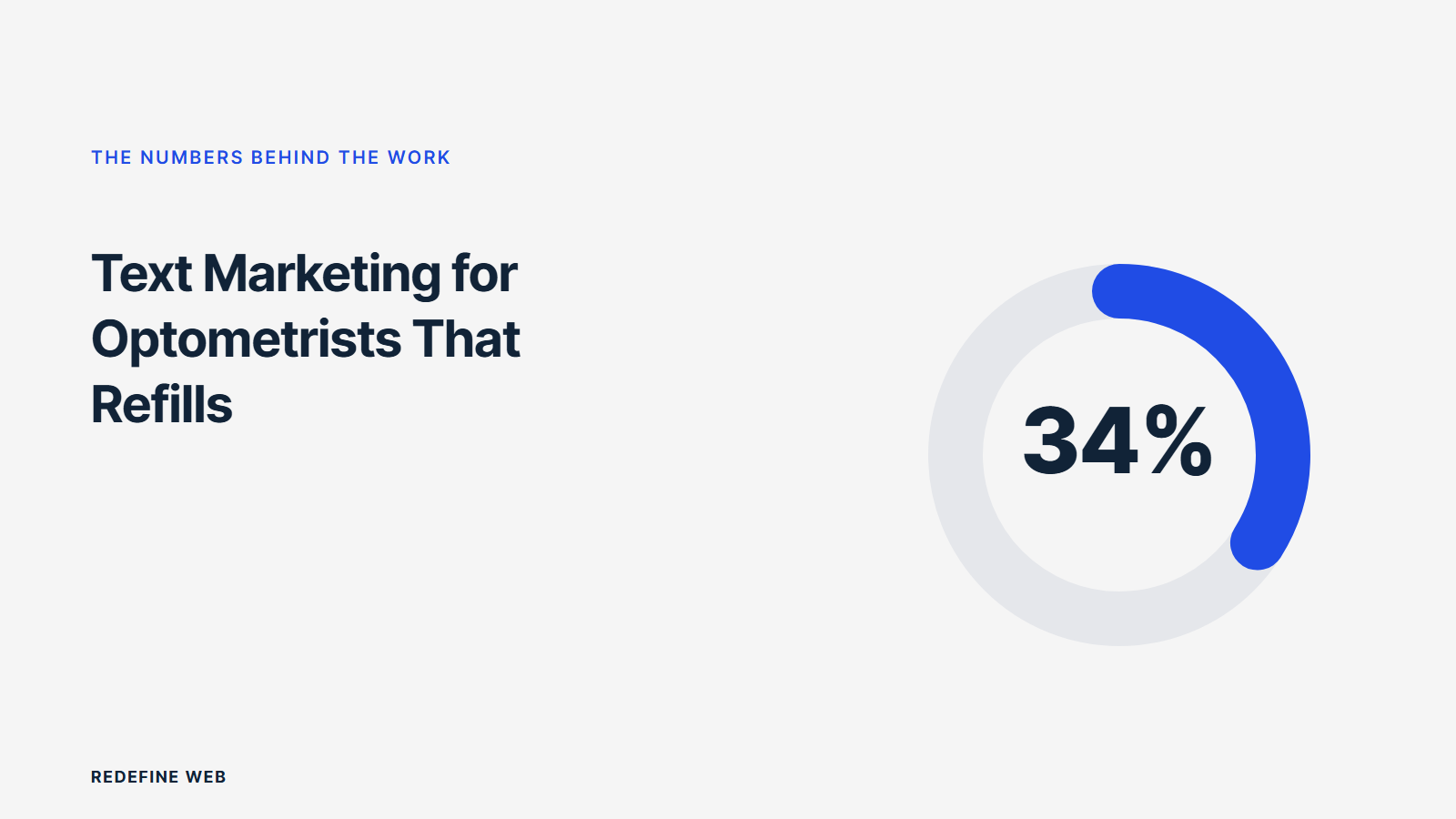
Text marketing for optometrists runs $89 to $329 per month for a solo practice depending on platform, message volume, and whether you use SMS-only or SMS plus MMS. Multi-location groups run $249 to $749 per month. Costs sit at the platform layer plus a per-message fee that averages $0.008 to $0.02 per SMS segment.
The platforms that work for optometry in 2026 sit in three tiers. Tier one (Weave, Solutionreach, Podium, SR Health) integrates directly with Eyefinity, RevolutionEHR, or Compulink and prices between $199 and $329 monthly. Tier two (SimpleTexting, EZ Texting, Klaviyo SMS) requires manual list uploads but runs $89 to $199 monthly. Tier three (Twilio direct) requires developer time but drops per-message cost to under $0.01.
For a solo practice booking 400 exams a month, the reminder program alone runs about 800 messages a month (72-hour plus 24-hour reminder per exam), plus roughly 300 confirmation replies. That is 1,100 messages. At $0.01 per segment plus a $99 platform floor, the monthly bill lands at $110. On the revenue side, the reminder program recovers roughly 60 exam slots at $180 each. That is $10,800 in recovered monthly revenue on a $110 spend.
Reactivation and promo broadcasts add another 400 to 900 messages a month depending on database size. Add another $40 to $90 to the monthly bill. Reactivation books 40 to 90 lapsed patients a month. Promo books another 20 to 50. Total revenue attributable to text on a $200 monthly spend runs $18,000 to $32,000 for a solo practice. See our Optometrist marketing cost piece for the full stack budget.
| Program | Monthly messages | Cost added | Exams booked | Revenue |
|---|---|---|---|---|
| Reminders | 800 to 1,200 | $99 to $149 | 40 to 80 recovered | $7,200 to $14,400 |
| Reactivation | 300 to 500 | $25 to $45 | 40 to 90 booked | $7,200 to $16,200 |
| Promotional | 200 to 400 | $20 to $40 | 20 to 50 booked | $3,600 to $9,000 |
| All three combined | 1,300 to 2,100 | $144 to $234 | 100 to 220 | $18,000 to $39,600 |
How to set up text marketing for optometrists in 30 days
The 30-day rollout stays lean. Week one is platform selection and integration. Week two is consent language and intake form updates. Week three is the reminder program going live. Week four is the first reactivation broadcast. This sequence protects the reminder program (the highest yield) from promo copy debates that stall the higher-yield work.
Week one: pick the platform based on your practice management system. If you run Eyefinity, Weave and Solutionreach both integrate cleanly. If you run RevolutionEHR, Podium and SR Health are the top picks. If you run Compulink, check the current integration list because it changes quarterly. Contract signed, integration confirmed by end of week.
Week two: update the digital intake form with the specific SMS consent language. Update the paper intake form for any walk-ins. Load the consent audit log into your compliance folder. Train the front desk on how to add SMS consent for existing patients who verbally agree during a checkout (log the timestamp and script the ask).
Week three: the reminder program goes live. Turn on 72-hour and 24-hour reminders for all scheduled exams. Watch the first three days for message failures, undelivered numbers, or duplicate sends. Fix any glitches by day five. By day seven, no-show rate starts dropping.
Week four: send the first reactivation broadcast. Pull the 12 to 18 month lapsed list from your PM system (or export from your patient database). Send at 10am on Tuesday. Watch the reply queue and route positive replies to the front desk for booking. Track book rate against list size to calibrate future broadcasts.
Mistakes optometrists make with text marketing
The mistakes we audit fall into five buckets. Sending too many messages per week (kills opt-out rate). Sending generic copy (kills book rate). Skipping the STOP keyword (kills the platform account). Batching all patients into one list (kills relevance). Ignoring the reply queue (kills the whole program by month three).
The frequency mistake is the most common. A practice sees the reactivation broadcast book 40 exams and thinks weekly broadcasts will book 200. They do not. Weekly broadcasts push the opt-out rate from 0.4% per month to 3% per month. Inside three months half the list has opted out and the program never recovers. The right cadence is one reactivation broadcast per month, one promo broadcast per quarter, plus the automated reminders.
The generic-copy mistake is the second most common. Practices copy the message template we shared above but strip out the patient’s first name, the specific product, or the deadline. Book rate drops from 8% to 1.4% overnight. The specificity is what makes the message work. Keep the fields.
The reply-queue mistake is the most expensive over time. A patient replies YES to a reactivation text on Tuesday. The front desk does not see the reply until Thursday. By then the patient has moved on and stops responding. Book rate on the same list drops from 12% to 4% because half the responders never get a callback. The fix is a shared inbox with a 4-hour response SLA and a single owner accountable for the queue.
- Cap message frequency at one broadcast per week (all programs combined).
- Keep patient first name and specific product or deadline in every promo.
- Include STOP opt-out on every promotional and reactivation text.
- Segment reminders, reactivation, promos into separate audience lists.
- Assign one owner to the reply inbox with a 4-hour SLA.
How to layer text marketing with the rest of your channel mix
Text marketing for optometrists works best as the tail end of a multi-channel funnel, not the front end. A new-patient acquisition sequence starts with paid search or organic, converts on the website, then hands off to text and email for retention and reactivation. Skipping the funnel logic upstream costs you the audience the text program depends on.
The Vision Express account ran this exact stack: Google Ads and Facebook Ads at the top of the funnel drove first exams. The optometrist website design services page converted those clicks into scheduled exams. Email nurtured the between-exam gap. Text handled reminders, reactivation, and time-sensitive promos. Every channel had a defined job. Nothing overlapped. Nothing sat on the shelf.
Our Optometrist marketing strategy piece walks the 12-month cadence that ties all five channels together. Read that before you commit to a text platform contract, so the platform integrates cleanly with the CRM and paid ad stack you plan to run. Cost per booked exam across the full stack averaged $34 over the twelve months, versus $80 in the six months before the program.
Practices comparing budgets often ask which channel to add next. If you already run paid search and email, text is the highest-yield next channel. If you already run text and paid search, the next add is Social media marketing for optometrists because that channel builds the audience your reactivation program depends on in year two. Read Neil Patel’s SMS marketing benchmarks if you want the wider view.
Text marketing for optometrists is not the shiny channel, but it moves the schedule harder than any other line on your budget. Set up the three programs in the right order, keep the messages under 160 characters, respect opt-out rules, and layer text on top of the exam recall cadence you already run. A solo practice adds 30 to 60 booked exams a month on a $200 SMS spend. A three-doctor group adds 90 to 180. Book the audit through our optometrist marketing agency hub when you want the exact scripts and platform picks running on client accounts today.
Frequently asked questions
Is text marketing legal for optometry practices?
Text marketing for optometrists is legal when the practice collects prior express written consent from every recipient before sending promotional or reactivation messages. Appointment reminders fall under transactional messaging and do not require the same consent standard, but every message still needs a STOP opt-out mechanism. The Telephone Consumer Protection Act (TCPA) sets the ground rules and the FCC enforces them. Add a specific SMS consent checkbox to the intake form, store the timestamp and consent language version in your compliance folder, and honor opt-out requests within 10 business days. Skipping either step exposes the practice to per-message damages that can reach $1,500 in class-action settlements.
How much does text marketing for optometrists cost per month?
Text marketing for optometrists runs $89 to $329 per month for a solo practice and $249 to $749 for a multi-location group. The platform floor sits between $89 and $199 for tier-two providers and between $199 and $329 for tier-one providers with direct PM integration. Per-message fees run $0.008 to $0.02 per SMS segment. A solo practice booking 400 exams monthly averages 1,300 to 2,100 messages a month across reminders, reactivation, and promos, landing the total bill at $144 to $234. Attributable revenue on that spend runs $18,000 to $39,600 monthly. Cost per booked exam averages $2 to $6.
What is the best SMS platform for an optometry practice?
The best SMS platform for an optometry practice depends on the practice management system running the exam schedule. For Eyefinity, Weave and Solutionreach both integrate cleanly and price at $199 to $329 monthly. For RevolutionEHR, Podium and SR Health are the top picks in the same price range. For Compulink, check the current integration list because it changes quarterly. For practices willing to run manual list uploads instead of PM integration, SimpleTexting and Klaviyo SMS drop the platform cost to $89 to $199 monthly. Twilio direct runs cheapest but requires developer time to build the integration.
How often should an optometrist send marketing texts?
The right cadence for optometrist text marketing is one broadcast message per week maximum across all programs combined. Automated appointment reminders (72-hour and 24-hour before the exam) do not count toward this cap because they are transactional. On top of the reminders, send one reactivation broadcast per month to lapsed patients and one promo broadcast per quarter to the active list. Weekly promo broadcasts push opt-out rates from 0.4% to 3% per month, cutting list size in half inside 90 days. Monthly rhythm keeps opt-out under 1% while capturing the yield the reactivation program produces.
Do appointment reminder texts really reduce no-shows?
Yes. Practices sending both a 72-hour and a 24-hour SMS reminder drop no-show rates from 22% average to 6% or lower. The double reminder outperforms the single reminder by 8 to 12 exam slots per 400 booked exams because it catches patients who confirmed the 72-hour message but forgot by day-of. The message needs to include patient first name, appointment day, appointment time, and a one-tap reply option to confirm or reschedule. Reminders that omit the reply option cut confirmation rates in half and leave the front desk phone tag problem intact. Vision Express saw no-show rates drop from 19% to 5% after wiring the double reminder into the exam booking flow.
Can text marketing replace email marketing for an optometry practice?
No, text and email cover different jobs and pair better than either channel runs alone. SMS opens in 90 seconds and works for time-sensitive moves (reminders, day-of promos, reactivation prompts). Email opens over a six-hour window and works for longer content (newsletters, insurance year-end explainers, procedure education, doctor bios). A practice running only text misses the education layer that closes higher-intent exams (dry eye treatment, myopia management, specialty contact fittings). A practice running only email misses the schedule-refilling speed text provides. Run both. Cost per booked exam on text runs $2 to $6. Cost per booked exam on email runs $4 to $9. Both beat paid search on a per-exam basis.
Book your free 30-minute strategy call.
No spam, no sales rep. We use your email to schedule your call with a senior strategist. That is it.
More from the blog
View all articles → Digital Marketing
 Dental Marketing Tips That Compound Into New Patients
Read article Digital Marketing
 Ecommerce Marketing Strategies That Drive Real DTC Revenue
Read article Digital Marketing