
WooCommerce Web Design Agency Guide for DTC Stores
- WooCommerce wins for content-heavy DTC brands and complex subscription logic.
- Shopify wins for standard catalogs and founders who want zero server work.
- Blocksy, Kadence, and GeneratePress carry roughly 60 percent of new Woo builds.
- Bricks Builder beats Elementor on performance for SEO-first brands.
- A real Woo partner shows five live storefronts and a named engineering lead.
- Theme picks a woocommerce web design agency uses today
- Page builders Elementor Bricks and native blocks
- Plugin ecosystem tradeoffs on the Woo stack
- WooCommerce vs Shopify an honest comparison for DTC
- Cost of a woocommerce web design agency engagement in 2026
- Hosting and performance on the Woo stack
- Vetting a real woocommerce web designer or agency
- A real woocommerce web design agency engagement that went live
- Where a woocommerce web design agency fits the DTC growth stack
A woocommerce web design agency pitches every DTC founder who wants full ownership of the storefront code, and roughly half of those founders would win faster on Shopify with a good custom theme instead. The other half will fight Shopify’s checkout ceiling and app tax for a year and rebuild on WooCommerce anyway, six figures later than they needed to. Both groups pay a WordPress plus WooCommerce tax that only earns back at a specific brand shape. The pick turns on catalog complexity, content depth, plugin appetite, and how much engineering the founder wants to own directly.
This piece covers what a good agency actually delivers. Theme picks (Blocksy, Astra, Kadence, GeneratePress, Storefront). Page builders (Elementor, Bricks, Breakdance, native block editor). Plugin ecosystem tradeoffs. WooCommerce versus Shopify context. Hosting reality on WP Engine, Kinsta, and Cloudways. Real scoping numbers from DTC builds our team wrote through 2024 and 2025 for brands running $500k to $12M annual on the WooCommerce stack.
Theme picks a woocommerce web design agency uses today
The WordPress theme choice sets the ceiling on how fast, how flexible, and how maintainable the storefront ends up. Five themes come up in almost every Woo agency’s stack rotation. Blocksy, Astra, Kadence, GeneratePress, and Storefront. Each carries a different tradeoff between out-of-box speed, page-builder friendliness, and design flexibility. A good agency should pick the theme against the brand’s needs rather than against the agency’s default habit.
| Theme | Best for | Page builder fit | Speed baseline | Learning curve |
|---|---|---|---|---|
| Blocksy | Modern block-first stores | Elementor, Bricks, native blocks | Fast (Lighthouse 90+) | Low |
| Astra | Broad template library, quick launches | Elementor, Beaver, Brizy | Fast | Very low |
| Kadence | Content-heavy DTC brands | Kadence Blocks, Elementor | Fast | Low |
| GeneratePress | Speed-first, developer-friendly | Native blocks, GenerateBlocks | Very fast (Lighthouse 95+) | Moderate |
| Storefront | Simple catalogs, WooCommerce-native | Native blocks only | Fast | Very low |
| Bespoke child theme | Custom brand voice, code ownership | Any (or none) | Depends on build | High |
Blocksy and Kadence for content-heavy DTC
Blocksy and Kadence have taken over roughly 40 percent of new Woo builds our team scoped in 2024 and 2025 for DTC brands with meaningful content programs. Blocksy pairs cleanly with either Elementor or Bricks, includes a header and footer builder inside the theme, and lands Lighthouse mobile scores in the 90 to 95 range out of the box. Kadence carries a stronger native block library and a template kit ecosystem that shortens the build phase by two to three weeks on a standard DTC catalog. Both themes cost $59 to $199 annual for the pro license, come with a woo-specific starter site catalog, and support translation-ready workflows. Content-heavy brands (food, beauty, wellness, DTC apparel with a blog cadence) usually end up on Blocksy or Kadence when the numbers get audited against roadmap.
GeneratePress and bespoke child themes
GeneratePress remains the pick for speed-first Woo builds where a developer owns the front-end code and the design system is custom. It carries a very small footprint (under 30KB gzipped for the base theme), pairs with GenerateBlocks for the native block editor, and hits Lighthouse mobile scores in the 95 plus range without heavy optimization work. Bespoke child themes built against Blocksy, Kadence, or GeneratePress land at $18k to $60k depending on catalog complexity. Fully bespoke Woo themes with no framework parent (all custom PHP, custom templates, custom Gutenberg blocks) run $45k to $140k and only earn back for brands with a design system worth maintaining independently. A woocommerce web design agency worth its fee will name the framework choice on the first call and defend the pick against the brand’s actual roadmap.
Page builders Elementor Bricks and native blocks
The page builder decision matters more than the theme decision on most WordPress plus Woo builds. Elementor still runs the largest install base at 12 million plus active sites. Bricks Builder has taken the developer mindshare over the last three years for its clean code output. Breakdance sits in the middle for founders who want a design-agency workflow without Elementor’s bloat. Native Gutenberg blocks plus a block-first theme like Blocksy is the pick when the design system is bespoke and the founder wants zero page-builder lock-in.
Elementor for template speed
Elementor Pro at $59 annual pairs cleanly with Woo through Elementor’s WooCommerce widget pack. It carries single product templates, archive templates, cart, checkout, and my-account templates inside the same visual editor. A good agency using Elementor can put a 20-page DTC storefront live in six to nine weeks from kickoff. The tradeoff is the DOM depth Elementor generates. Pages end up with 40 to 60 nested divs where hand-coded HTML would use eight. Core Web Vitals scores suffer without heavy optimization work. Founders who care primarily about launch speed and iteration cadence rather than raw Lighthouse scores land on Elementor. Founders who care about performance-driven SEO usually move to Bricks or native blocks. The Kinsta writeup on WordPress page builders covers the DOM tradeoff at more length for founders sitting on the pick.
Bricks Builder for performance
Bricks Builder at $79 annual (or $249 lifetime) has moved the performance-minded developer segment sharply toward its stack over the last two years. It generates clean HTML, includes WooCommerce widgets natively, supports custom code injection at the element level, and hits Lighthouse mobile scores 15 to 25 points higher than an equivalent Elementor build. The learning curve is steeper. Fewer template kits exist. The community is smaller. Founders picking Bricks are picking engineering discipline over template speed, which pays back on brands that plan to run SEO as a primary channel. A woocommerce web design agency comfortable in Bricks usually charges 10 to 20 percent more than an Elementor-first shop and delivers a storefront that stays fast three years past launch. Our piece on wordpress ecommerce website development covers Bricks versus Elementor tradeoffs at more length for founders picking a stack.
Plugin ecosystem tradeoffs on the Woo stack
The WooCommerce plugin ecosystem is the reason founders pick Woo and also the reason they regret picking Woo. Every feature Shopify handles as a native admin toggle exists on Woo as a paid plugin, a free plugin, and sometimes both. A good agency picks the plugin stack against the brand’s roadmap rather than reaching for the same 30-plugin default on every build the shop scopes.
The plugin stack every Woo store needs
- WooCommerce core. Free, cart, checkout, product types, orders, coupons.
- WooCommerce Subscriptions. $199 annual, native recurring billing.
- WooCommerce Product Add-Ons. $49 annual, custom PDP options.
- WooCommerce Bookings or WooCommerce Memberships when the model demands it.
- Rank Math or Yoast for SEO surface (both free tier plus paid).
- WP Rocket or FlyingPress for cache and speed ($59 to $99 annual).
- Wordfence or Solid Security for security hardening.
- UpdraftPlus or WP Vivid for automated backups to S3 or Google Drive.
Plugins that quietly break Woo stores
Every Woo store our team has audited past two years old carries three to five plugins that silently break on a WordPress core update. Old versions of Slider Revolution. Abandoned Woo add-ons whose original developer stopped writing updates. Free plugins from the WordPress.org repository with no code review. Custom snippets pasted from Stack Overflow into a functions.php that nobody documented. A good agency running a proper handoff will produce a plugin inventory with vendor, version, last update date, and a replace-if-abandoned column. Founders who inherit a Woo store without that inventory usually end up rebuilding half the stack inside 18 months. The Yoast writeup on choosing WordPress plugins covers the vetting criteria for founders picking their own stack. Fewer plugins beat more plugins on almost every audit our team runs.
WooCommerce pays off with real WP engineering and content depth. If you're 800 SKUs of standard product with no dev on payroll, you'll fight the plugin ecosystem for a year.
WooCommerce vs Shopify an honest comparison for DTC
Founders comparing WooCommerce against Shopify usually get one of two pitches. A Shopify shop tells them Woo is a maintenance nightmare. A WordPress shop tells them Shopify is a revenue tax. Both pitches are partially true and mostly self-serving. The honest picture depends on the brand’s catalog shape, content depth, engineering appetite, and revenue band. A good agency will walk the founder through the tradeoffs without pushing either platform on principle.
Somewhere on the internet right now a WordPress developer is explaining to a candle brand founder that WooCommerce is objectively superior to Shopify because “you own the code.” The founder does not want to own the code. The founder wants to sell candles. The developer will spend the next four hours diagramming CPT-UI, ACF, and a headless Next.js proof of concept on a Zoom whiteboard. The founder will sign the SOW anyway because the developer is very confident. Six months later the store will launch nine weeks late on a hosting stack the founder cannot log into. The candles will still sell. The founder will privately wonder how a Shopify install would have gone.
When WooCommerce wins
Woo wins for content-driven DTC brands (recipes, guides, editorial-heavy category pages) where WordPress content depth compounds with the storefront. Woo wins for founders who already run a WordPress site and want to add commerce without replatforming the content library. Woo wins for brands with complex subscription models that Shopify Subscriptions plus Recharge cannot express cleanly at $99 monthly minimum. Woo wins for brands with a bespoke product configurator where the engineering team wants full server-side control. Woo wins when the founder already has a developer or a technical cofounder who wants the code ownership and can live with the maintenance overhead. Roughly 25 to 30 percent of new DTC builds our team scopes land honestly on Woo. The other 70 percent would win faster on Shopify. A good woocommerce web design agency comfortable saying that on the first call is worth signing.
When Shopify wins
Shopify wins for standard product catalogs (apparel sizes, beauty shades, food flavors) with no unusual configurator logic. Shopify wins for founders who want to launch in eight weeks and iterate on the storefront weekly without a developer on retainer. Shopify wins for brands running paid media as the primary channel where the platform’s CDN and checkout speed compound with ad performance. Shopify wins for brands past $2M annual revenue where the Plus tier variable rate pays for itself and the Plus features (Launchpad, Functions, native B2B) earn the upgrade. Shopify wins for founders who explicitly do not want to manage servers, plugin updates, and PCI compliance. Our companion piece on shopify vs woocommerce seo breaks down the SEO-side tradeoffs for founders sitting on the platform pick.
Cost of a woocommerce web design agency engagement in 2026
The cost of a woocommerce web design agency engagement breaks down across four buckets. Discovery and IA ($6k to $18k). Design system and PDP or PLP redesign ($14k to $45k). Front-end theme code plus WooCommerce customization ($18k to $60k). Integrations, QA, and launch stabilization ($10k to $22k). Total build cost lands $30k to $140k for a bespoke Woo storefront depending on catalog size, subscription complexity, and custom feature scope. Headless Woo with a Next.js or Astro front end against the WooCommerce REST API runs another 60 to 100 percent premium on top of the standard Liquid Woo build baseline.
Where money splits on an $80k Woo build
On an $80k Woo bespoke build the money splits roughly as follows. Discovery and requirements $9k. IA and UX $11k. Visual design system $18k (largest single bucket because component libraries stay real work regardless of platform). Front-end theme code and WooCommerce customization $22k. Integrations across Klaviyo, ShipStation, Yotpo, and payment gateways $8k. QA plus 30-day post-launch stabilization $9k. Domain, hosting setup, and DNS migration $3k. Bundled scopes with one agency running the whole thing carry these numbers cleanly. Split scopes across a strategy shop, a design shop, and a dev shop tax the founder 20 to 30 percent for the same output and slip the launch by four to eight weeks because handoffs eat calendar. Our piece on ecommerce web design pricing covers the split versus bundled question at more length.
Ongoing costs past the build
Ongoing costs on Woo include managed hosting ($30 to $500 monthly depending on traffic). Premium plugin licenses ($400 to $2,000 annual across the standard stack). Retainer with the build agency for updates, plugin patch management, security hardening, and Core Web Vitals maintenance ($599 to $4,500 monthly). Klaviyo, Yotpo, and third-party SaaS ($200 to $2,000 monthly). Payment gateway processing fees at the standard Stripe or PayPal rate. Under $599 monthly retainer buys break-fix hours only. Founders on Woo without a retainer are one broken plugin update from a checkout outage on a Tuesday morning during peak sale week. Woo without maintenance is a bill deferred, not a bill avoided, which is the honest math founders should run before signing anything at all.
Hosting and performance on the Woo stack
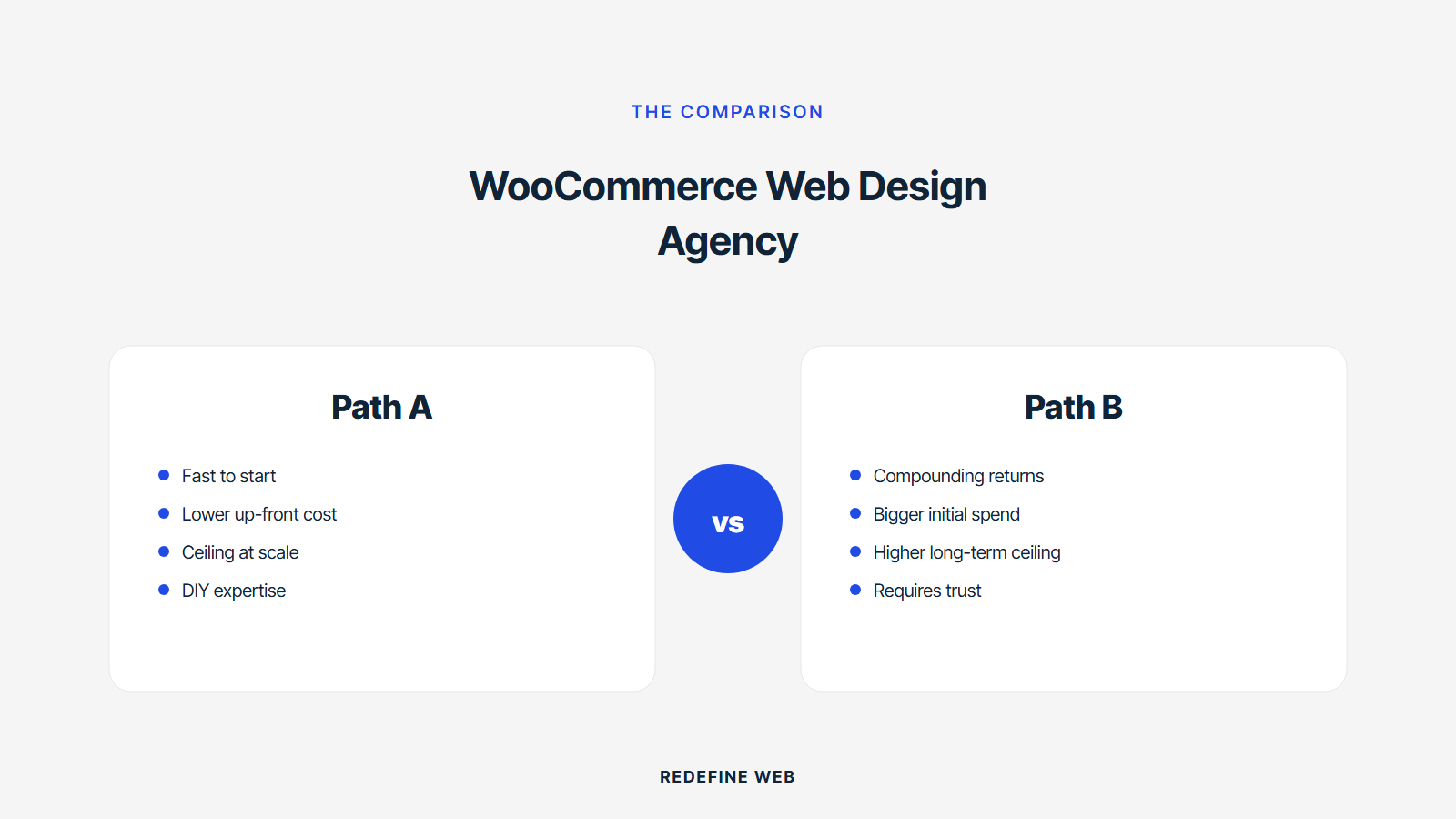
Hosting is the single largest performance decision on a Woo build. Shopify handles the CDN and edge network by default. Woo does not. A good agency picks the hosting stack against the brand’s traffic profile rather than defaulting to whatever the agency resells at a markup. That decision often costs more than the plugin stack combined over three years of operation.
Managed WordPress hosts that handle Woo well
Three managed WordPress hosts consistently handle Woo well. WP Engine ($30 to $290 monthly for standard tiers) includes EverCache with Woo-aware page caching that respects cart cookies, staging environments, and a solid dev-friendly deploy workflow. Kinsta ($35 to $600 monthly) runs on Google Cloud Platform C2 instances, carries built-in APM for slow-query tracing, and handles global CDN through Cloudflare Enterprise. Cloudways ($15 to $500 monthly) offers unmanaged control over the stack with DigitalOcean, Vultr, or AWS underneath, which suits founders who want more knobs. Founders past $2M annual revenue running Black Friday spikes usually land on Kinsta or WP Engine. Founders under $500k with modest traffic land on Cloudways or SiteGround. The Kinsta writeup on WordPress hosting options covers the tier decision at more length for founders picking the stack themselves.
Core Web Vitals discipline on Woo
Core Web Vitals discipline on Woo takes real engineering work. Largest Contentful Paint (LCP) drops through hero image optimization, WebP conversion, and preload hints. Interaction to Next Paint (INP) drops through JavaScript deferral, event handler cleanup, and third-party script auditing. Cumulative Layout Shift (CLS) drops through fixed dimensions on images, no font-loading jank, and reserved space for late-loading content. A properly built Woo store on Blocksy or Kadence with WP Rocket lands Lighthouse mobile scores 85 to 95 without exotic optimization. A poorly built Elementor store on shared hosting lands 30 to 50 and blames WordPress. The difference is engineering discipline, not platform choice. Founders whose agency delivers a Woo store scoring under 70 on mobile Lighthouse should ask specifically what optimization work was done before launch, and get a written punch list for the next sprint.
Vetting a real woocommerce web designer or agency
Vetting a woocommerce web designer is harder than vetting a Shopify designer because WordPress attracts a much broader set of shops. Every freelancer who built a template site in 2018 now lists Woo in the service menu. Real Woo experience shows in the sales conversation and in the demo site quality. Fake Woo experience shows in the demo library and hides everywhere else, which is why the first sales call matters more than the pricing PDF.
Five signals of a real Woo partner
Five signals separate a real Woo agency from a template shop. A portfolio of five plus live Woo storefronts at meaningful traffic (10k plus monthly visits per site) that the founder can visit today. A named engineering lead who joins the first sales call and can discuss Woo hooks, filters, and template overrides without reading from a deck. A written scope naming specific Woo customizations (checkout modifications, custom PDP fields, subscription flow work) with hours per feature. A written 30-day post-launch stabilization block with a named on-call developer for plugin update breakage. Direct experience with the specific plugin stack the brand needs (WooCommerce Subscriptions, Product Add-Ons, Bookings) at code depth rather than just at admin depth. Agencies that dodge any of the five are usually pitching template work at bespoke prices.
Five questions that reveal the agency early
Ask five questions on the first sales call. Which theme framework do you prefer for our catalog shape and why? What is your standard plugin stack and how do you handle plugin update breakage? Do you build custom Gutenberg blocks or lean on the page builder for everything? What Core Web Vitals scores do your recent Woo builds hit at launch on mobile? Who owns hosting after launch, and what does your maintenance retainer include? Agencies that answer with specifics have written dozens of Woo storefronts. Agencies that answer with buzzwords or start pitching a bespoke Next.js headless build for a brand that needs a $30k Blocksy site are optimizing for their fees, not for the brand’s outcome. Our companion piece on custom ecommerce web design services covers the bespoke-versus-template decision at more length for founders sitting on that fork.
A real woocommerce web design agency engagement that went live
Passion Built came to our team with two failing WordPress sites, six ranking keywords total, and almost no organic visibility despite a strong offline reputation across Sydney residential renovation. Referrals covered the calendar loosely but the pipeline was thin and expensive third-party lead gen platforms ate the margin. The founder wanted a single site that could carry the brand voice, showcase the portfolio properly, and rank for renovation-related searches across greater Sydney. WooCommerce was the pick because the founder wanted the option to sell design consultations, downloadable planning guides, and eventually branded material bundles through the same admin.
Our team scoped a bespoke WordPress plus Woo build with Elementor Pro on a Blocksy parent theme across 14 weeks. Discovery took two weeks including founder interview and a portfolio audit. The design system landed at 28 components with three states each, built around real project photography rather than stock. Front-end theme code ran five weeks against the design system. WooCommerce customization added a consultation booking flow through WooCommerce Bookings and a downloadable-guide funnel through WooCommerce Product Add-Ons. Google My Business overhaul ran in parallel to fix the local pack visibility gap. Klaviyo and Google Ads wired in for lead capture and paid traffic. QA ran three weeks. Launch happened on a Tuesday morning behind a Sunday DNS rehearsal.
Over the following 12 months on the new WooCommerce build, keyword rankings grew from 6 to over 300 competitive terms. Monthly organic visitors climbed past 800 from near-zero baseline. The visitor-to-lead conversion rate hit 10 percent on the primary service pages, driving $60,000 plus in renovation bookings through the site alone inside the first year. The Woo stack did not cause all the gains. It removed the ceiling the previous two-site setup had been placing on the brand’s ability to rank, convert, and operate. Founders looking at Woo as an option for a service-plus-storefront hybrid should map their own numbers against a build like this before picking a platform. Similar hybrid Woo builds usually run at 12 to 18 week timelines with a $30k to $80k build cost plus a monthly maintenance retainer past launch.
Where a woocommerce web design agency fits the DTC growth stack
A good agency sits at the front of the growth stack for DTC brands that have picked the WordPress plus Woo road knowingly. Paid media, SEO, email, retention, and content all rely on a store that converts the traffic they send and stays fast under load. Founders who fix the storefront first make every downstream marketing dollar 20 to 40 percent more efficient. Founders who patch the storefront while running ads pay customer acquisition cost against an underperforming funnel and blame the ad platform.
The Woo pick is worth it when three of five triggers hit. Content depth as a primary channel (recipes, guides, editorial category pages). Complex subscription or configurator logic that Shopify plus a stack of apps cannot express cleanly at reasonable monthly cost. Existing WordPress content library the founder does not want to replatform. Technical founder or a developer already on the team who wants code ownership. Compliance requirements that self-hosted infrastructure serves better than a hosted platform. Fewer than three triggers, and Shopify with a good shopify design agency partner is usually the honest pick for another 18 to 24 months of iteration on top of what Basic Shopify already ships out of the box for a DTC storefront under $2M annual revenue.
The rest of the growth stack sits alongside. Paid media pointed at a converting store. SEO on category and product pages treated as landing pages. Email and SMS flows that catch shoppers who bounced. Content that ranks for the informational searches the brand’s shoppers actually type. Every tactic works better when the WooCommerce storefront is not fighting it. The WooCommerce documentation pairs cleanly with the scope in this guide for founders and CTOs pressure-testing agency claims before signing anything at all.
Frequently asked questions
What does a woocommerce web design agency actually do that a Shopify agency does not?
A woocommerce web design agency builds against the WordPress plus WooCommerce stack with full code ownership, custom post types, subscription flexibility, and multisite architecture Shopify cannot ship cleanly. Standard PDP and PLP work runs comparably across both platforms. The Woo-specific value shows in content depth, self-hosted control, and no revenue-scaling platform fees on custom features. Shopify agencies handle standard DTC storefronts faster with less maintenance overhead, which matters for founders who explicitly do not want to own the server layer or patch cadence past launch.
How much does a woocommerce web design agency cost in 2026?
A woocommerce web design agency engagement costs $30k to $140k for a bespoke Woo storefront depending on catalog size, subscription complexity, and custom feature scope. Headless Woo on Next.js or Astro against the WooCommerce REST API runs another 60 to 100 percent premium. On an $80k Woo build the money splits roughly $9k discovery, $11k UX, $18k design system, $22k front-end code, $8k integrations, $9k QA plus stabilization, $3k hosting setup. Retainers run $599 to $4,500 monthly.
Which WordPress theme should a woocommerce web designer pick for DTC?
A woocommerce web designer should pick Blocksy or Kadence for content-heavy DTC brands where the storefront pairs with a meaningful blog cadence. GeneratePress fits speed-first builds where a developer owns the front-end code. Storefront fits simple catalogs staying close to native Woo. Bespoke child themes on Blocksy or Kadence land at $18k to $60k depending on catalog complexity. Fully bespoke Woo themes with no framework parent run $45k to $140k and only earn back at design-system depth the brand plans to maintain.
Is Elementor or Bricks Builder the right pick on a Woo build?
Elementor fits speed-to-launch and template-driven builds where iteration cadence matters more than raw Lighthouse scores. Bricks Builder fits performance-driven SEO builds where clean HTML output and Core Web Vitals discipline pay back over years. Bricks generates DOM that scores 15 to 25 Lighthouse points higher than Elementor at equivalent build depth on standard DTC catalog work. A Bricks-first woocommerce web design agency usually charges 10 to 20 percent more than an Elementor shop and delivers a storefront that stays fast three years past launch date.
When should a founder pick WooCommerce over Shopify for a new DTC store?
A founder should pick WooCommerce over Shopify when three of five triggers hit. Content depth as a primary channel like recipes, guides, or editorial category pages. Complex subscription or configurator logic Shopify plus apps cannot express cheaply. Existing WordPress content library the founder does not want to replatform. Technical founder or developer already on the team who wants code ownership. Compliance requirements self-hosted infrastructure serves better than a hosted platform. Fewer than three triggers, and Shopify usually wins for a modern DTC storefront.
Book your free 30-minute strategy call.
No spam, no sales rep. We use your email to schedule your call with a senior strategist. That is it.
More from the blog
View all articles → Web Design
 Core Web Vitals Healthcare Websites Actually Need to Book Patients
Read article Web Design
 Professional Services Website Design Best Practices for 2026
Read article Web Design