
Affordable Search Engine Optimization Services That Still Rank
- Affordable SEO sits at $500 to $2,000 monthly.
- Under $500 monthly is rarely worth it in real markets.
- The $1,200 to $1,800 tier is the affordable sweet spot.
- Local industries thrive on affordable retainers.
- SaaS and enterprise B2B need bigger budgets to rank.
- What affordable search engine optimization services really cost in 2026
- Affordable search engine optimization service scope by tier
- Where cheap search engine optimization services fail
- Best affordable search engine optimization services vendor traits
- A real affordable engagement in the field
- Reading affordable search engine optimization services reviews
- Scaling from affordable to standard SEO
- Affordable search engine optimization services by industry
- Contract terms for affordable search engine optimization services
- Wrapping the affordable question
Affordable search engine optimization services get a mixed reputation. Some buyers get real results at $1,200 per month. Others waste $600 per month for two years and rank nowhere. The difference is not the price. It is what the money buys. A $1,200 retainer that runs on 12 focused hours of skilled work per month can outperform a $600 retainer that runs on 30 hours of unskilled work. The skill density inside the retainer matters more than the retainer total.
You will get the honest budget floor for real SEO work, the scope that fits under $2,000 per month, the traps that make cheap SEO worse than no SEO, and a real client case study that shows what an affordable retainer can produce when the vendor stays focused. Read straight through in about ten minutes. You will leave knowing whether an affordable retainer fits your business and, if it does, what to look for on the vendor call so you avoid the packages that just burn budget.

What affordable search engine optimization services really cost in 2026
Affordable search engine optimization services in 2026 sit at $500 to $2,000 per month for a small business. Below $500 you are almost always buying template work with no real strategy. Above $2,000 you have moved out of the affordable band into standard small-business SEO pricing.
Inside the affordable band, the scope depends heavily on whether your business is local, national, or niche. A local business can move on a $600 retainer if the vendor focuses on Google Business Profile, citations, and 4 to 6 reviews per quarter. A national business fighting for competitive keywords needs at least $1,500 per month to make meaningful progress, and even that is tight. A niche B2B tool with 500 buyers globally can rank on $800 per month because the competition is thin. Match the retainer floor to the competitive shape of your market.
The below-$500 trap
SEO packages priced under $500 per month almost never produce real results. What they typically deliver is a monthly citation submission run, one AI-generated blog post, and a rankings dashboard with no human review. The vendor cannot afford to put skilled hands on your account at that price because their own labor cost floor is above $75 per hour. If they promise 10 hours of work per month on your $400 retainer, someone is losing money and it is not going to stay you. The retainer usually gets cancelled or the delivery drops after month 3.
The $1,200 to $1,800 sweet spot
The affordable-band sweet spot sits at $1,200 to $1,800 per month for most small businesses in competitive local markets. That price buys 10 to 15 hours of skilled work: 2 to 3 pieces of blog content, on-page tuning across 3 to 5 money pages, monthly Google Business Profile posts, a rankings report reviewed by a human, and 1 to 2 link placements. A vendor who cannot articulate what those 10 to 15 hours cover on your account is either not doing them or hiding the breakdown behind a package label.
Affordable search engine optimization service scope by tier
Affordable search engine optimization service scope varies by tier inside the affordable band. Under $800 buys light-touch local SEO. $800 to $1,500 buys focused local plus small content cadence. $1,500 to $2,000 buys real small-business SEO with content, on-page, and some link work.
The trap that catches most buyers is assuming the cheaper tier gets you a scaled-down version of the more expensive tier. That is not how SEO scales down. The cheaper tier gets you a narrower focus. You give up national ambitions and settle for local map pack. You give up content cadence and settle for on-page tuning of existing pages. You give up link building and settle for citations. The affordable tier is not a diluted premium tier. It is a focused version that trades scope for depth in a specific slice.
| Retainer | Focus | Best for |
|---|---|---|
| $500 to $800 | Google Business Profile, citations, reviews | Solo local businesses in low-competition markets |
| $800 to $1,500 | Local plus 1 to 2 blog posts monthly | Small local businesses in moderate markets |
| $1,500 to $2,000 | Content 2 to 3 pieces, on-page, some links | Small businesses in competitive local markets |
| $2,000 to $3,500 | Full small-business SEO across content, links, technical | Growth-stage small businesses ready to invest |
| Under $500 | Citation submission, template blog, no strategy | Rarely worth the money except in trivial markets |
Local map pack focus at $500 to $800
The $500 to $800 tier focuses entirely on local map pack rankings. Google Business Profile management, citation building or cleanup, review generation systems, and 1 to 2 GBP posts per month. That is the scope. It works for solo dentists in suburbs, single-location plumbers in rural counties, and independent salons in small metros. It does not work in downtown Chicago where 12 competitors are running the same play at the same price. Check the competitive shape of your market before signing at this tier.
Local plus content at $800 to $1,500
The $800 to $1,500 tier adds 1 to 2 blog posts per month on top of the local map pack focus. Content targets long-tail buyer intent keywords in your service area. The posts should rank in 4 to 8 weeks for the target keyword and pull traffic through to your service pages. This tier works for small businesses in moderately competitive markets. Boutique gyms, dental practices in suburbs, HVAC contractors in mid-size metros. Content quality matters more than volume at this tier because you only get 12 to 24 pieces per year.
Where cheap search engine optimization services fail
Cheap search engine optimization services fail in five specific ways. AI-generated content without strategy. Guest posts on low-authority blogs. PBN link packages. Citation-only work in competitive markets. Blended-role hours that hide unskilled labor. Any one of these can waste your year even if the retainer number looks attractive.
The most common failure mode is AI content published without strategic direction. A vendor charges $600 per month, generates 4 AI blog posts, publishes them without editorial review, and the site accumulates thin content that Google’s spam updates devalue. By month 12, the site has 48 pieces of AI content, none of which rank, and the vendor claims the algorithm is unfair. The Google Search Central updates on spam policies explicitly flag this pattern as demotion-worthy. Cheap content without strategy is not just neutral. It hurts.
- AI-generated content published without editorial review or topic strategy
- Guest post placements on directories or low-quality blogs nobody reads
- Private Blog Network link packages that violate Google’s guidelines
- Citation-only work in competitive markets where citations alone move nothing
- Blended hourly rates that hide low-skilled labor doing unskilled tasks
- Guaranteed ranking claims that lead to index manipulation and manual actions
- 24-month contract lock-ins with punitive exit clauses
The PBN link risk
Private Blog Network links are one of the most common tactics in cheap SEO packages. The vendor buys or rents a network of expired domains, publishes thin content on them, and links to your site. It looks like editorial links to a naive observer. Google’s link spam detection has gotten sophisticated at spotting these networks. Sites caught in a PBN pattern get manual actions that can deindex your entire domain. Recovery takes 6 to 18 months and sometimes never fully resolves. If a $400 retainer promises 50 backlinks per month, PBN is where those links come from.
The blended hours trap
Cheap SEO retainers often quote blended hours at a single rate to hide labor mix. A proposal that says 30 hours of work per month at a blended rate might really be 25 hours of virtual assistant time at $15 per hour and 5 hours of strategist time. The VA cannot do the strategic work that moves rankings. The strategist has too few hours to make an impact. You get busywork billed at strategy rates. Ask for the hour breakdown by role. If the vendor refuses, they are hiding the labor mix and the retainer is wasted.
Cheap SEO wastes hours on citation spam. Ask the vendor to list exactly which pages get worked on this month. Vague answers mean template work billed as strategy.
Best affordable search engine optimization services vendor traits
The best affordable search engine optimization services vendors share five traits. Narrow focus. Transparent hour breakdown. Content written by real strategists, not templated by tool. Real editorial links from real publications. Monthly reports with named work items and rankings movement. Any vendor missing two of these is not delivering real SEO at any price, let alone at the affordable tier.
Narrow focus is the biggest differentiator inside the affordable band. Vendors who try to deliver premium-tier scope on affordable-tier budgets end up spreading the retainer too thin. Vendors who commit to a narrow slice, say local map pack plus 2 blog posts per month for $1,400, deliver visible results within 90 days because they concentrate the hours where they move the needle. Ask any prospective vendor what they will NOT do inside the retainer. Vendors who cannot answer that question are spreading themselves thin and your rankings will show it.
Content by real strategists
Even in the affordable tier, a real human who understands SEO should draft the content. Not templated by an AI tool without review. The signal to look for is content that reads like a human wrote it, not like a Reddit summary written through a template. Ask the vendor for 3 sample blog posts they wrote in the last quarter. If the samples read as clearly human, the vendor is investing in content quality even at the low retainer. If the samples read as templated, the vendor is skimming.
Real editorial links
Real editorial links from real publications matter even at the affordable tier, though the volume is lower. Expect 1 to 2 links per month at $1,500 monthly, 2 to 4 links at $1,800 monthly. Any vendor promising 10-plus links per month at these prices is using PBNs or directory submissions. Ask for the last 3 links they placed for another client. If they hesitate to share, the links are not the kind you want your name on. Real links come from real publications with real editorial standards.
A real affordable engagement in the field
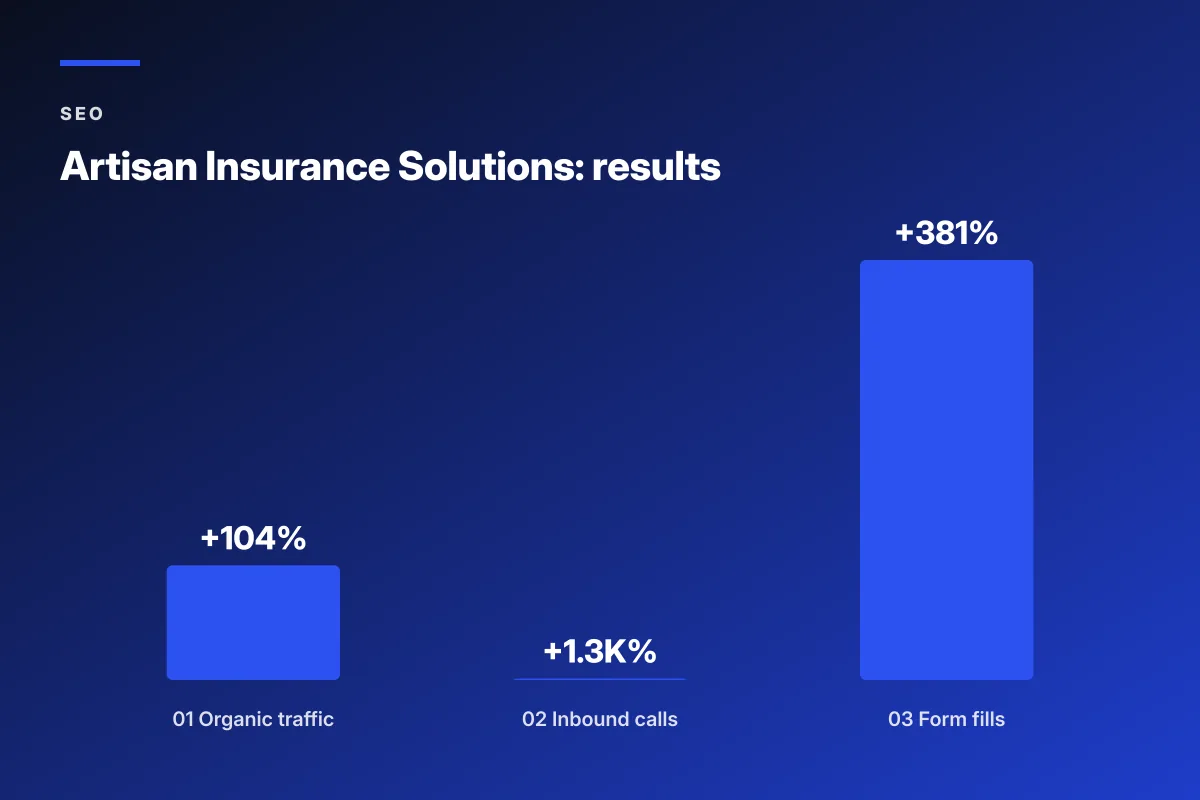
Artisan Insurance Solutions, a US-based insurance firm serving artisan contractors, came to us on a tight budget. They needed better organic visibility, more inbound calls, and a stronger local presence, without a bigger paid budget than they were already running.
We ran a focused SEO engagement covering website redesign, on-page content strategy, and local search optimization. The retainer stayed in the affordable band. Focus was tight: fix the technical debt, rewrite the money pages with intent-matched content, build 30-plus local citations, and target 3 to 4 link placements per quarter in artisan trade publications. Organic traffic climbed 104 percent, inbound call volume grew 1,300 percent, and form fill volume grew 381 percent. That is the kind of movement an affordable retainer produces when the scope stays focused and the vendor puts skilled hands on the work.
Why the numbers moved on an affordable retainer
Three factors moved the numbers. First, the technical fixes closed a Core Web Vitals gap that had capped previous vendors’ work. Second, the content strategy targeted specific artisan-contractor buyer intent, not generic insurance keywords. Third, the local citations and trade publication links stacked authority in a defensible way. When those three lever pulls compound, small retainers produce big movement. When any of them get skipped, the retainer stalls at surface-level activity.
Lessons from the Artisan engagement
The lesson: an affordable retainer is not automatically weak. It is weak only when the vendor tries to deliver everything and delivers nothing well. When the vendor and client agree on 3 specific outcomes and put the full retainer against those 3, results follow. Artisan agreed to defer content velocity in favor of technical and links in months 1 through 3. That focus is why traffic jumped. Every affordable engagement needs the same conversation: what are we prioritizing and what are we deferring. Skip that conversation and the retainer stalls.
Every buyer looking at affordable SEO packages runs into the same LinkedIn ad: SEO from $99 per month, unlimited keywords, ranking guaranteed. Nobody wants to be the person who clicks it. Everybody knows someone who did. The someone always has a story about how their site got deindexed, how the vendor stopped responding, and how they eventually gave up and hired a real agency at eight times the price. The moral is not that all affordable SEO fails. It is that ninety-nine-dollar SEO absolutely does.
Reading affordable search engine optimization services reviews
Affordable search engine optimization services reviews on Clutch, G2, and Trustpilot lag reality by 12 to 18 months. A vendor who got hammered by the March 2024 core update might still have 4.7 stars because the reviews reflect pre-update work. Read reviews for delivery quality and communication, not for ranking claims. Ranking claims in reviews are almost never verifiable.
The most useful review signal is repeat client language. Reviews that mention specific work done, specific challenges handled, and specific outcomes with numbers carry more weight than reviews that use generic praise words. Filter reviews for that signal. Discount reviews that read like the vendor’s marketing team wrote them. Look for reviews that include the reviewer’s business name, industry, and rough business size. Anonymous 5-star reviews on Trustpilot are rarely worth much for a $60,000 vendor decision over 24 months.
Clutch verification signal
Clutch verifies reviewers by phone or email before posting, which makes Clutch reviews slightly more trustworthy than open review sites. That still does not solve the lag problem. A vendor with 5-star Clutch reviews from 2023 might be struggling in 2026. Filter Clutch reviews by date and look at the 6-month rolling window. If reviews thin out or drop in quality inside the last 6 months, the vendor may be losing quality. Ask about client retention rate directly, and expect an honest answer.
Review pattern red flags
Two review patterns disqualify vendors. First, clusters of 5-star reviews posted within a 30-day window suggest incentivized reviews. Second, reviews that all use the same key phrases suggest coached responses. Real reviews have variation in tone, length, and vocabulary because real clients write differently. If every review reads like the vendor wrote it, someone did. Skip the vendor. There are enough good vendors on Clutch that you do not need to compromise on review authenticity.
Scaling from affordable to standard SEO
Best affordable search engine optimization services engagements often scale into standard-band retainers within 12 to 18 months as the business grows. The right time to scale is when the affordable retainer starts producing measurable revenue and the business can absorb the higher spend without financial stress. Scale before that and the math does not clear.
The scaling conversation should cover three things. What content velocity would the higher tier enable. What link volume would open up. What new keywords could you target that you cannot afford to chase now. A move from $1,500 to $3,000 per month should roughly double your content output, add 2 to 4 more links per month, and open up 15 to 25 new keyword targets. If your vendor cannot describe the delta in those three terms, they are not thinking about scaling strategically. Push for specificity before signing the higher retainer.
When to scale the retainer
Scale the retainer when three signals line up. First, the current retainer has produced measurable revenue attributable to organic search, verified in analytics. Second, the business can absorb the higher spend without cutting other necessary marketing. Third, the vendor has demonstrated they can execute the additional scope, not just promise it. All three matter. Businesses that scale on the first signal alone often run out of budget in month 4 of the higher tier and get stuck between too small and too big.
Common scaling mistakes
Two mistakes stand out. Scaling too early because the vendor is pushing for more revenue on their side, not because your ROI justifies it. Scaling into scope you cannot support internally, meaning the vendor delivers more content or more strategy than your team can review and approve. The vendor’s velocity gets capped by your approval throughput, and the higher retainer produces the same output as the lower one. Scale only when both the money math and the internal capacity math line up. Otherwise the incremental spend is wasted.
Affordable search engine optimization services by industry
Affordable retainers work differently by industry. Local service businesses do well on affordable retainers because map pack ranking pulls the weight. B2B and SaaS struggle at the affordable tier because keyword competition needs deeper content investment. Ecommerce sits in the middle depending on catalog size and niche.
Industries that thrive on affordable SEO share three properties. Local intent that maps to the map pack. Buyer research that is short, typically 2 to 6 weeks. Competitive shape that has room for another player to rank in the top 5. Industries that struggle on affordable SEO share the opposite properties. National or global intent. Long buyer research cycles that need long-form content stacks. Saturated competitive shapes where the top 5 are entrenched. Match the retainer floor to the industry shape before signing.
Local industries that thrive
Home services, dental practices, med spas, chiropractors, restaurants, and boutique gyms all thrive on affordable retainers when the local market has room. Berks Plumbing runs on a small-business retainer and produced a 99 percent gain in ad conversions with a 67 percent drop in cost per lead. Our Home Services SEO Built for Local Map Pack Dominance spells out how the affordable-tier scope maps to home services specifically. Similar patterns hold for dental and med spa, covered on our Dental SEO Services Built for Local Map Dominance.
Industries where affordable struggles
SaaS, enterprise B2B, national ecommerce, and regulated finance struggle on affordable retainers. Keyword competition is fierce, content depth requirements are high, and link acquisition costs stack up fast. A SaaS company trying to rank for CRM at $1,200 per month is spending on a job that needs $8,000 minimum to move. If your industry falls into this category, either raise the budget or accept that SEO will not be your primary growth channel in the near term. Paid channels and outbound may make more sense while you build a runway to a real SEO budget. Broader context on the shift lives on the Search Engine Land SEO coverage.
Contract terms for affordable search engine optimization services
Contract terms matter more at the affordable tier because the price advantage evaporates the moment a lock-in traps you with a weak vendor. A fair affordable retainer runs on a 3-month or 6-month term with a 30-day exit clause. Anything longer than that gives the vendor too much runway to underdeliver before you can act.
Read the exit clause line by line. Look for language that restricts you from continuing to use the content or the links the vendor created after the contract ends. Some vendors write those restrictions in to make switching agencies painful. A fair contract hands back everything the vendor produced in editable form. If the vendor’s contract restricts asset transfer, negotiate the clause out or walk away. That single detail can save you 12 months of pain in month 8 of a bad engagement.
Performance-triggered exit clauses
Push for a performance-triggered exit clause tied to specific KPIs. A fair example: if primary keyword rankings do not move at least 5 positions inside 6 months of consistent work, you can exit with 30 days notice and no penalty. Vendors confident in their delivery accept this kind of clause. Vendors who hedge or refuse are telling you something about how they expect the engagement to go. Ask early, negotiate hard, and get the answer in writing before signing.
Reporting cadence in the contract
Set the reporting cadence in the contract itself, not as a verbal promise. A monthly report by the 15th of the following month with named work items, ranking movement, and next-month priorities is the standard. Add the language to the SOW. That way if reports go missing in month 4, you have a written commitment to hold the vendor accountable to. Reporting fights that start in month 4 are almost always contract fights that should have been settled in month 0. Deeper vendor-selection framing lives on the Ahrefs guide to hiring an SEO agency.
Wrapping the affordable question
Affordable search engine optimization services work when the scope is narrow, the vendor stays focused, and the industry has room for the retainer to move the needle. They fail when the retainer tries to do everything at a fraction of the cost. Pick a vendor who commits to a specific slice and delivers it well. Skip vendors who promise premium scope at affordable prices. Those promises break by month 4.
If you are evaluating affordable retainers right now, use the traits from the vendor-quality section as a filter. Narrow focus, transparent hour breakdown, human-written content, real editorial links, monthly reports with named work. Any two missing, keep looking. Our team runs affordable-band engagements for local service, dental, and small-business clients. We are transparent about scope, pricing, and exit terms on our Search Engine Optimization Services. For a look at the pricing math specifically, our Search Engine Optimization Services Pricing breakdown covers the tiers side by side. Bring your business specifics to a call and we will show you what an affordable retainer would look like on your account.
Frequently asked questions
Do affordable search engine optimization services actually work?
Yes, when the scope is narrow and the vendor stays focused. Affordable SEO retainers in the $500 to $2,000 monthly band can produce real ranking gains for local service businesses, small dental or medical practices, restaurants, boutique gyms, and niche B2B tools with thin competition. The key is matching the retainer floor to the competitive shape of the market. A local business in a moderately competitive market can move meaningfully on $1,200 to $1,800 per month if the vendor concentrates the hours on Google Business Profile, focused content, and citation cleanup. National keywords in saturated markets rarely respond to affordable retainers because the competitive backlink volume and content depth requirements exceed what the retainer can fund. Pick the tier that matches the market shape.
What can you realistically expect from an affordable search engine optimization service?
Realistically, an affordable retainer at $1,500 monthly buys 10 to 15 hours of skilled work covering 2 to 3 pieces of blog content per month, on-page tuning on 3 to 5 money pages, monthly Google Business Profile posts, a rankings report with human review, and 1 to 2 editorial link placements. In a moderately competitive local market, that scope moves the map pack rank from position 8 to top 3 in 90 to 120 days, adds 2 to 4 non-brand keywords to the top 10, and grows organic traffic 30 to 80 percent over the first 12 months. Numbers depend heavily on starting authority, current index status, and how competitive the target keywords are.
Are cheap search engine optimization services ever worth the money?
Cheap SEO under $500 per month is rarely worth it. What the price buys is typically citation submission runs, one AI-generated blog post per month, and a rankings dashboard with no human review. None of that moves rankings in competitive markets because Google's 2024 and 2025 spam updates devalue thin AI content and low-quality directory work. Edge cases exist where cheap SEO can work: a hyperlocal service business in a rural market with almost no competition, or a niche B2B tool with 200 buyers globally. Outside those edges, cheap SEO usually costs more in wasted time than in retainer dollars, because it delays real progress by 12 to 18 months.
How do best affordable search engine optimization services differ from cheap ones?
Best-tier affordable vendors share five traits that separate them from cheap operators. Narrow focus, meaning they commit to a specific slice of work and deliver it well rather than promising premium scope at low prices. Transparent hour breakdown by role, so you know exactly how the retainer time gets spent and by whom. Content written by real strategists, not templated by an AI tool. Real editorial links from real publications, at low volume but honest quality. Monthly reports with named work items, rankings movement, and specific next-month priorities. Any vendor missing two of these five is running a cheap package regardless of what the price sheet says, and the delivery will show it within 90 days.
How reliable are affordable search engine optimization services reviews on Clutch?
Clutch reviews are slightly more reliable than open review sites because Clutch verifies reviewers by phone or email before posting. That helps filter obvious fake reviews but does not solve the lag problem. A vendor with a 4.9-star Clutch profile from 2023 reviews might be delivering worse work in 2026 after algorithm updates or team churn. Filter Clutch reviews by date and pay attention to the last 6-month rolling window. If review count drops off or ratings decline recently, the vendor may be losing quality. Also filter for detail: reviews that mention specific work done, specific challenges handled, and specific outcomes with numbers carry more weight than generic praise. Ask about client retention directly on the sales call.
When should you scale from affordable to standard SEO retainers?
Scale the retainer when three signals line up. First, the current affordable retainer has produced measurable revenue attributable to organic search, verified in analytics rather than assumed. Second, the business can absorb the higher spend without cutting other necessary marketing or operations. Third, the vendor has demonstrated they can execute the additional scope, not just promise it, based on the last 90 days of delivery quality. All three signals matter. Scaling on any one alone often produces buyer regret in month 4 of the higher tier when the results do not match expectations. A move from $1,500 to $3,000 monthly should roughly double content output, add 2 to 4 more links monthly, and open 15 to 25 new keyword targets.
Which industries fit affordable search engine optimization services best?
Industries with local intent, short buyer research cycles, and competitive shapes that leave room to rank do well on affordable retainers. Home services like HVAC, plumbing, and roofing thrive when the map pack has room. Dental practices, med spas, chiropractors, and boutique fitness studios rank on focused local scope. Small ecommerce brands in niche categories with 50 to 500 SKUs can move on affordable retainers if the niche is thin. Industries that struggle on affordable retainers include SaaS, enterprise B2B, national ecommerce, and regulated finance. Those categories need deeper content stacks and heavier link investment than $500 to $2,000 monthly can fund. If your industry falls into that category, either raise the budget or pick a different growth channel until you can afford real SEO.
Book your free 30-minute strategy call.
No spam, no sales rep. We use your email to schedule your call with a senior strategist. That is it.
More from the blog
View all articles → SEO
SEO Organic Search Engine Optimization Services That Grow Real Traffic
Read article SEO
SEO SEO for Pet Groomers That Fills the Appointment Book Weekly
Read article SEO
SEO