
Most B2B SaaS Marketing Agencies Do Not Move Pipeline
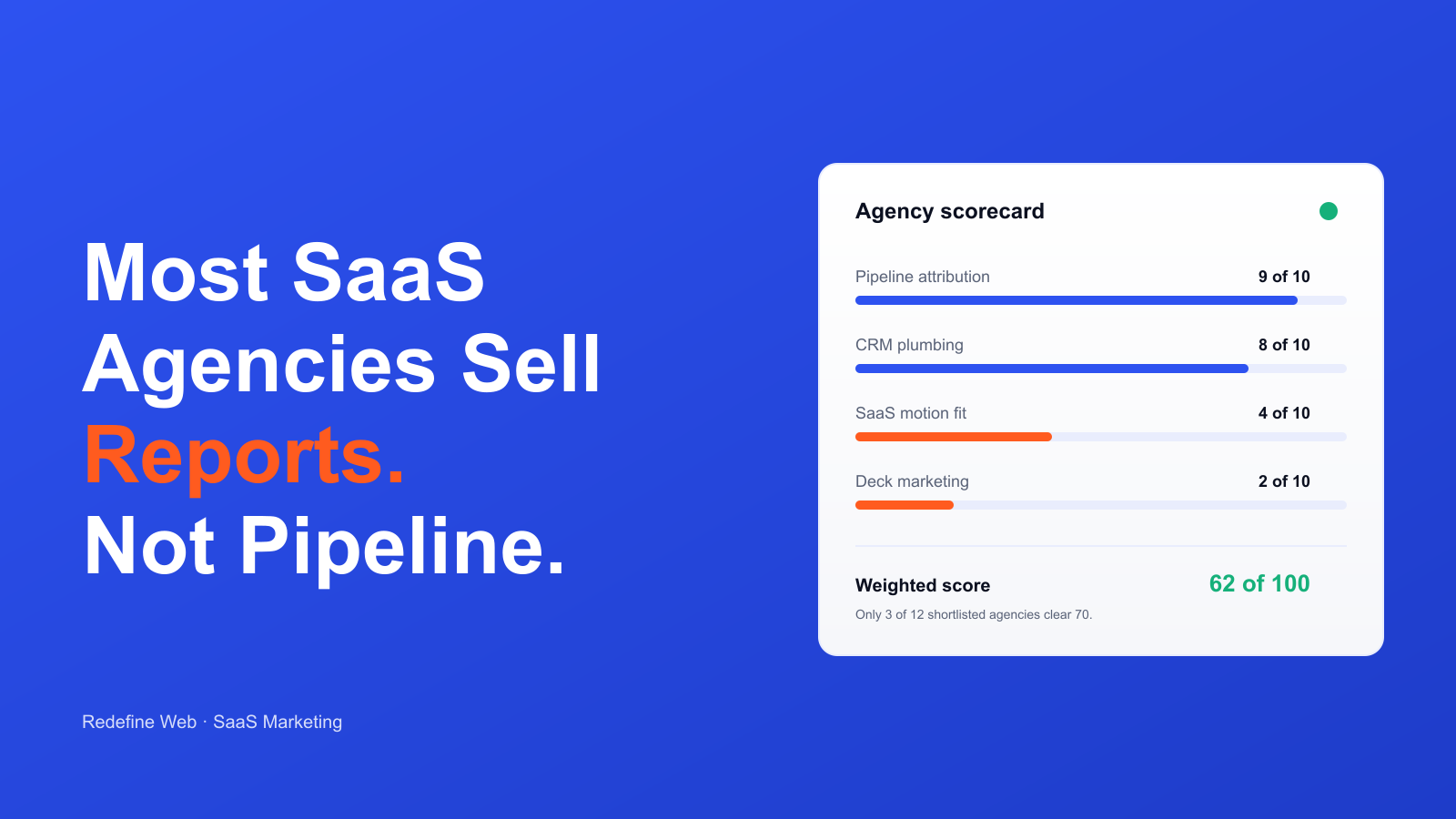
- The best B2B SaaS marketing agencies tie every campaign to a pipeline stage in HubSpot or Salesforce and can screen-share a live CRM chart on the intro call.
- Pipeline attribution carries 30 points on the vetting scorecard. Named case studies with real ARR movement carry another 25. Anything softer is deck marketing.
- SaaS motion drives the channel mix. Under $5K ACV goes product-led, $5K to $30K goes hybrid, $30K and up goes sales-led with ABM through 6sense, Clearbit, or Demandbase.
- First pipeline shows inside 60 to 90 days for paid channels and 4 to 7 months for SEO. If the CRM report does not exist at day 90, the plumbing was never wired.
- Founders who ask four pointed questions on the intro call cut a shortlist of ten agencies to two or three real candidates inside an hour.
A B2B SaaS marketing agency is only worth the retainer if it moves pipeline into HubSpot or Salesforce that closes at your normal win rate. Most do not. They send monthly deck reports full of impressions and MQLs and no line that ties spend to closed ARR. The best B2B SaaS marketing agencies are the ones that can screen-share a live CRM pipeline stage chart on the intro call and point to the accounts their work created. Everything else is deck marketing.
This post is the vetting framework we run when a SaaS founder asks us who to talk to. It grades agencies on four things: pipeline attribution, SaaS motion fit, named case studies with real ARR numbers, and pricing plus contract shape. It also lists the questions that separate a real SaaS shop from a general B2B agency that added SaaS to the pitch deck last quarter.

What separates the best B2B SaaS marketing agencies from the shortlist noise
Every founder we talk to has a shortlist of ten agencies pulled from Clutch, Google, and a Slack community thread. Nine of them look the same on the landing page. All of them claim ROI focus, full-funnel expertise, and a specialist SaaS practice. The list flattens fast when you make three asks: show me the CRM pipeline chart, name the last three SaaS clients by ACV band, and read me the CAC payback math on your best account this quarter. Two of the ten answer clean. The other eight talk about brand and vague growth outcomes.
The best B2B SaaS marketing agencies share four traits. They work on one motion at a time, not all three at once, the same discipline we teach in our B2B SaaS marketing strategy playbook. They wire attribution into the customer’s CRM in week one, with gclid, li_fat_id, and msclkid stored on the lead record so the source is traceable back to the ad. They report on MRR added, ARR run rate, and CAC payback in months, not MQL count. And they publish real client work with named companies, real dollar figures, and pipeline stage screenshots that hold up under founder review. Anything softer than that is a general B2B agency writing SaaS on the homepage.
The vetting scorecard that filters ten agencies down to three
We run every B2B SaaS marketing agency evaluation on a 100-point scorecard. Thirty points go on pipeline attribution because it is the one input that decides whether the retainer is measurable. Twenty-five points go on SaaS motion fit because a PLG shop cannot serve a $60K ACV sales-led SaaS without a rewrite. Twenty-five points go on named case studies with real ARR numbers because unnamed logos and “3x growth” claims are unverifiable. Twenty points go on pricing and contract shape because a 12-month lock with vague deliverables is a red flag even at a low monthly number.
| Scorecard axis | Weight | The pass mark | The tell |
|---|---|---|---|
| Pipeline attribution | 30 points | Live HubSpot or Salesforce pipeline stage chart on call one, gclid + UTM + li_fat_id captured per lead | Monthly PDF report with impressions, clicks, MQLs, no CRM screenshot |
| SaaS motion fit | 25 points | Names the client motion (PLG, sales-led, hybrid) and matches channel mix to ACV band on call one | Same channel mix pitched to every SaaS regardless of ACV |
| Named case studies | 25 points | Three named SaaS clients with dollar figures, timeframes, and named services | Unnamed logos, “3x growth” claims, no ARR numbers |
| Pricing + contract | 20 points | Clear retainer band, 6 month term, monthly kill switch on channels not producing | 12 month lock, opaque deliverables, one line invoice |
Anything under 70 points does not get to the second call. Above 70, the shortlist usually collapses to two or three agencies, and the pick from there is a fit call. Founders who skip the scorecard end up rehiring an agency inside 12 months because the first pick treated marketing as reports, not pipeline. Our B2B SaaS marketing agency page walks through the same four axes on how we handle each one.
Pipeline attribution is the single biggest agency filter
Pipeline attribution is where good B2B SaaS marketing agencies pull ahead. The pass mark is simple. Every lead captured through paid, organic, or content lands in HubSpot or Salesforce with the source click ID stored on the record. Google Ads writes gclid, LinkedIn writes li_fat_id, Microsoft writes msclkid, plus the full UTM string. That single record becomes the trail from ad impression to closed ARR. Without it, every conversation about channel performance is guesswork dressed as data.
The agencies that fail this axis usually pitch a Google Data Studio dashboard aggregating platform stats. Impressions from Meta plus clicks from LinkedIn plus form fills from a landing page. None of those numbers touch the CRM. When the CFO asks which channel added $180K in ARR last quarter, the agency has to invent an answer. The right SaaS agency shows a HubSpot deal report grouped by original source, with a filter on stage equals closed-won and a date range on the quarter. If that report cannot exist on day 90, the plumbing was never wired.
The other check inside pipeline attribution is Marketo or HubSpot workflow ownership. A great B2B SaaS marketing agency will build the marketing automation itself, not send edits to an in-house RevOps person twice a month. Latency in the workflow is where MQL to SQL conversion drops from 22% to 14%. The SaaS PPC services we run wire the gclid capture, offline conversion upload, and workflow scoring on the same call so the SDR team never has to wait on a ticket.
SaaS motion fit is where general B2B agencies fall apart
SaaS motion drives every channel decision. Product-led growth loads spend on the trial funnel, self-serve pricing content, and long-tail SEO for feature-comparison queries. Sales-led loads spend on ABM lists, LinkedIn account targeting, and paid search that books demos. Hybrid runs both at once and needs two owners so the PLG signup flow does not get starved by the enterprise pipeline push. The best B2B SaaS marketing agencies name the motion on call one and pick the channel mix from the ACV band, not from a template.
A quick sanity check: ask what channel mix the agency runs for a $4K ACV self-serve SaaS versus a $60K ACV mid-market SaaS. If the pitch sounds the same, the SaaS practice is a rebrand. Under $5K ACV, product-led with content, Product Hunt, G2, and long-tail SEO wins. Between $5K and $30K, hybrid with paid search, review sites, and inside sales works. Above $30K, sales-led with ABM through 6sense, Clearbit, or Demandbase pays back inside two quarters. Below that ACV, ABM tooling costs more than the pipeline it produces.
The three-motion check for shortlist calls
Ask the agency to walk through the freemium versus 14-day trial conversion math for a $4K ACV product. The agency that stops at “we test both” is guessing. The right answer names the trial-to-paid conversion floor at 4 to 6% for a self-serve tool, the freemium-to-paid conversion floor at 1.5 to 3%, and the payback timing on each depending on gross margin. That level of specificity signals the agency has run the math on live accounts and can defend the recommendation to a board.
Named case studies with real ARR are the trust filter
Case studies separate a real B2B SaaS marketing agency from a general shop. The check is simple. The case study names the client, states the ARR or MRR movement, gives the timeframe, lists the services used, and includes a stage-level metric like SQL volume or opportunity conversion. A page that only shows a logo grid with “helped 100+ SaaS companies grow” is a marketing agency without receipts. Verified named work is the E-E-A-T signal that matters for both buyer trust and Google’s evaluation of the agency site itself.
When River SaaS Capital came to us, their Google Ads were pulling in unqualified traffic across broad SaaS financing queries and none of the messaging matched what a SaaS founder searching for non-dilutive venture debt actually wanted. We rebuilt the campaigns around SaaS-specific offers, wrote landing pages tuned to the founder audience, and layered in automated nurture workflows for warm leads that did not convert on first visit. Qualified lead volume grew 350%, conversion rate improved 21%, and 279 conversions came out of a $9,770 managed ad budget. Every one of those numbers ties to a stage in HubSpot, not a dashboard impression count.
That is the shape a real SaaS case study takes. Named client, named channels, real dollar spend, real conversion count. Anything softer than that is a story. The Custimy engagement is another named example: a customer data platform we ranked in Google’s top 10 for 500+ SaaS keywords and drove to 25,000 organic monthly visits with isometric brand design plus SEO. The SaaS SEO agency work we run publishes the same detail on organic case studies, including keyword-level ranking movement and traffic tied to demo requests.
Pricing and contract shape reveal how the agency thinks about accountability
The last axis is contract shape. A B2B SaaS marketing agency worth hiring quotes a clear retainer band, ties the fee to a defined deliverable list, and gives the client a monthly kill switch on channels not producing. Our SaaS marketing retainer starts at $599 a month for a smaller stage and scales with the channel load. The number matters less than the shape. Vague scope on a $15K retainer with a 12-month lock is worse than a $4K retainer with a defined output.
Watch for two specific red flags in the pricing conversation. First, a pitch that bundles strategy, execution, and reporting into one line item with no cost breakdown. That structure means the agency can quietly cut execution hours later and keep charging the same. Second, a contract that penalizes channel cuts with a fee. If the SaaS motion changes at month four because the ACV band moved, the client needs to shift budget without paying a switching cost. Real SaaS agencies build for that reality because the SaaS pricing model itself changes every 18 months.
| Pricing signal | Green flag | Red flag |
|---|---|---|
| Retainer shape | Line-item scope, 6 month term, monthly channel review | Single-line retainer, 12 month lock, no channel review |
| Ad spend markup | Flat management fee or transparent percentage under 15% | Bundled into retainer with no visibility |
| Reporting cadence | Weekly CRM pipeline check, monthly ARR + CAC payback readout | Monthly PDF with impressions and MQL count only |
| Renewal terms | Auto-renews with 60 day notice, no penalty on channel cuts | Auto-renews with 30 day notice, penalty on scope reduction |
The questions to ask on the shortlist call
Every shortlist call runs the same four questions. Founders who want a deeper walk-through of the vetting frame can see the full six-axis scorecard for how to choose a B2B SaaS marketing agency before the call. Show me a live HubSpot or Salesforce pipeline stage chart from a current SaaS client with permission to screen share. Name the last three SaaS clients you took from a signed contract to first pipeline dollar, with the ACV band and the timeline. Read me the CAC payback math on your best account this quarter, with gross margin, ACV, and CAC divided. Walk me through the retainer scope and what happens at month four if a channel is not producing.
The answers separate the field fast. The agencies that pass all four are the ones that treat marketing as a pipeline operation. The ones that stall on question one are the deck-marketing shops. This filter takes a shortlist of ten and cuts it to two or three inside an hour of calls. Founders who run it save an average of nine months of wasted retainer that ends in a hire-again cycle.
What the best agencies do differently in the first 90 days
The first 90 days tell you whether the agency choice was right. A real B2B SaaS marketing agency wires attribution into HubSpot, Salesforce, or Marketo inside week two. It captures gclid, li_fat_id, msclkid, and the UTM string on every form fill and stores them on the contact record. It sets up offline conversion upload back into Google Ads so the ad platform trains on closed opportunities, not landing page form fills. It builds the workflow that scores signup activity for a PLG motion or SDR-touched accounts for a sales-led motion. All of that is week one and week two work, not month three.
By day 45, the agency should have a first channel report grounded in CRM data, not platform impressions. By day 90, the ARR line and CAC payback readout should exist in the shared file. If the agency is still asking for CRM permissions at month two, the retainer is already misfiring. The SaaS founder who wrote a $180K annual retainer needs the agency inside HubSpot on day three, not day sixty. That difference is what separates the top B2B SaaS marketing agencies from the shortlist noise.
Frequently asked questions
What defines the best B2B SaaS marketing agencies
The best B2B SaaS marketing agencies tie every campaign to a pipeline stage in HubSpot or Salesforce, name their SaaS motion on the intro call, publish real client case studies with dollar figures, and quote a clear retainer with a monthly kill switch on channels that are not producing. Anything softer than that is a general B2B agency with SaaS on the landing page.
The four-axis scorecard we walk through above filters a founder’s shortlist of ten agencies down to two or three real candidates inside an hour of calls. Pipeline attribution carries 30 points because it is the single input that decides whether the retainer is measurable. Named case studies with real ARR movement carry 25 points because unnamed logos and vague growth claims are unverifiable and a leading tell of thin work.
How much does a B2B SaaS marketing agency cost per month
B2B SaaS marketing agency pricing runs $4,000 to $30,000 per month for most engagements, with the band set by SaaS motion, ACV, and channel load. Our SaaS marketing retainer starts at $599 for a smaller stage focused on one channel and scales up as PPC, SEO, and lifecycle automation stack on.
Under $5K ACV self-serve SaaS usually runs a $4K to $8K retainer built around content, SEO, and lifecycle email. $5K to $30K ACV hybrid SaaS runs $8K to $18K with paid search, review site management, inbound content, and often a SaaS website design refresh tuned to trial conversion. $30K plus ACV sales-led SaaS runs $15K to $30K with ABM tooling, LinkedIn campaigns, and content that supports SDR outbound. Ad spend sits on top and the transparent management fee should stay under 15% of the ad budget.
Should a SaaS company hire an agency or build in-house
SaaS companies under $10M ARR are usually better off with a specialist B2B SaaS marketing agency for the first 12 to 24 months. A senior in-house head of marketing costs $180K to $260K fully loaded, and adding a PPC lead, an SEO lead, and a lifecycle owner triples that number fast. An agency delivers the same seat mix at a third of the cost while the ARR run rate proves out the model.
Over $10M ARR, the calculus flips. A full in-house marketing team gets cheaper per pipeline dollar than an agency, and the internal team owns the CRM, product marketing, and lifecycle. The right pattern at that stage is usually an in-house team plus an agency retainer for the paid media execution the internal team does not want to staff.
What questions should a founder ask on the agency intro call
Four questions filter the shortlist fast. Show me a live HubSpot or Salesforce pipeline stage chart from a current SaaS client. Name the last three SaaS clients you took from contract to first pipeline dollar with the ACV band and timeline. Read me the CAC payback math on your best account this quarter. Walk me through what happens at month four if a channel is not producing.
Any agency that stalls on question one is a deck-marketing shop. The ones that answer clean on all four are the two or three worth the second call. That single hour of pointed questions saves an average of nine months of retainer misfire for founders who run it before signing.
How long before a B2B SaaS marketing agency shows real pipeline
First pipeline usually shows inside 60 to 90 days for paid channels and 4 to 7 months for SEO and content. Paid search and LinkedIn ABM can be attributing pipeline into HubSpot by day 45 if the attribution wiring was done in week two. SEO takes longer because Google needs time to crawl, index, and rank the new content against a stable topical footprint.
The 90-day mark is the check point. By then the retainer should have a real CRM report grouped by original source with a stage filter on the pipeline. If that report does not exist at day 90, the plumbing was never wired and the retainer is already at risk. Founders who set the 90-day expectation up front avoid the six-month drift that ends in an agency change.
Do the best B2B SaaS marketing agencies work with early-stage startups
Yes, but the retainer shape changes. Early-stage SaaS under $2M ARR usually runs a $4K to $6K retainer focused on one channel and one motion. A pre-seed or seed SaaS with a self-serve product runs content and SEO, following the same lightweight B2B SaaS go to market strategy we run on early-stage engagements. A Series A SaaS with a mid-market ACV runs paid search plus LinkedIn. Any earlier and the retainer money is usually better spent on the product and one internal growth hire.
The mistake early-stage SaaS founders make is hiring a full-service agency and paying for capacity that will not fire for six months. A focused single-channel agency at $4K to $6K produces attributed pipeline faster than a $15K generalist retainer at the same stage.
Where to go next
See how our B2B SaaS marketing agency practice wires attribution, picks the motion, and reports on ARR from day one.
{“@context”:”https://schema.org”,”@type”:”FAQPage”,”mainEntity”:[{“@type”:”Question”,”name”:”What defines the best B2B SaaS marketing agencies”,”acceptedAnswer”:{“@type”:”Answer”,”text”:”The best B2B SaaS marketing agencies tie every campaign to a pipeline stage in HubSpot or Salesforce, name their SaaS motion on the intro call, publish real client case studies with dollar figures, and quote a clear retainer with a monthly kill switch on channels that are not producing. Anything softer than that is a general B2B agency with SaaS on the landing page. The four-axis scorecard we walk through filters a founder shortlist of ten agencies down to two or three real candidates inside an hour of calls. Pipeline attribution carries 30 points because it decides whether the retainer is measurable. Named case studies with real ARR movement carry 25 points because unnamed logos and vague growth claims are unverifiable.”}},{“@type”:”Question”,”name”:”How much does a B2B SaaS marketing agency cost per month”,”acceptedAnswer”:{“@type”:”Answer”,”text”:”B2B SaaS marketing agency pricing runs $4,000 to $30,000 per month for most engagements, with the band set by SaaS motion, ACV, and channel load. Our SaaS marketing retainer starts at $599 for a smaller stage focused on one channel and scales up as PPC, SEO, and lifecycle automation stack on. Under $5K ACV self-serve SaaS usually runs a $4K to $8K retainer built around content, SEO, and lifecycle email. $5K to $30K ACV hybrid SaaS runs $8K to $18K. $30K plus ACV sales-led SaaS runs $15K to $30K with ABM tooling and LinkedIn campaigns.”}},{“@type”:”Question”,”name”:”Should a SaaS company hire an agency or build in-house”,”acceptedAnswer”:{“@type”:”Answer”,”text”:”SaaS companies under $10M ARR are usually better off with a specialist B2B SaaS marketing agency for the first 12 to 24 months. A senior in-house head of marketing costs $180K to $260K fully loaded, and adding a PPC lead, an SEO lead, and a lifecycle owner triples that number fast. An agency delivers the same seat mix at a third of the cost while the ARR run rate proves out the model. Over $10M ARR, the calculus flips and a full in-house team gets cheaper per pipeline dollar.”}},{“@type”:”Question”,”name”:”What questions should a founder ask on the agency intro call”,”acceptedAnswer”:{“@type”:”Answer”,”text”:”Four questions filter the shortlist fast. Show me a live HubSpot or Salesforce pipeline stage chart from a current SaaS client. Name the last three SaaS clients you took from contract to first pipeline dollar with the ACV band and timeline. Read me the CAC payback math on your best account this quarter. Walk me through what happens at month four if a channel is not producing. Any agency that stalls on question one is a deck-marketing shop.”}},{“@type”:”Question”,”name”:”How long before a B2B SaaS marketing agency shows real pipeline”,”acceptedAnswer”:{“@type”:”Answer”,”text”:”First pipeline usually shows inside 60 to 90 days for paid channels and 4 to 7 months for SEO and content. Paid search and LinkedIn ABM can be attributing pipeline into HubSpot by day 45 if the attribution wiring was done in week two. SEO takes longer because Google needs time to crawl, index, and rank the new content. The 90-day mark is the check point. By then the retainer should have a real CRM report grouped by original source with a stage filter on the pipeline.”}},{“@type”:”Question”,”name”:”Do the best B2B SaaS marketing agencies work with early-stage startups”,”acceptedAnswer”:{“@type”:”Answer”,”text”:”Yes, but the retainer shape changes. Early-stage SaaS under $2M ARR usually runs a $4K to $6K retainer focused on one channel and one motion. A pre-seed or seed SaaS with a self-serve product runs content and SEO, following the same lightweight B2B SaaS go to market strategy we run on early-stage engagements. A Series A SaaS with a mid-market ACV runs paid search plus LinkedIn. Any earlier and the retainer money is usually better spent on the product and one internal growth hire.”}}]}Book your free 30-minute strategy call.
No spam, no sales rep. We use your email to schedule your call with a senior strategist. That is it.
More from the blog
View all articles → Marketing Strategy
 How Dental DSOs Grow Through Marketing. Tactics That Scale
Read article Marketing Strategy
 Dental DSO Marketing Services. What to Expect From an Agency Partner
Read article Marketing Strategy