
What Makes Dental Ads Actually Book Patients
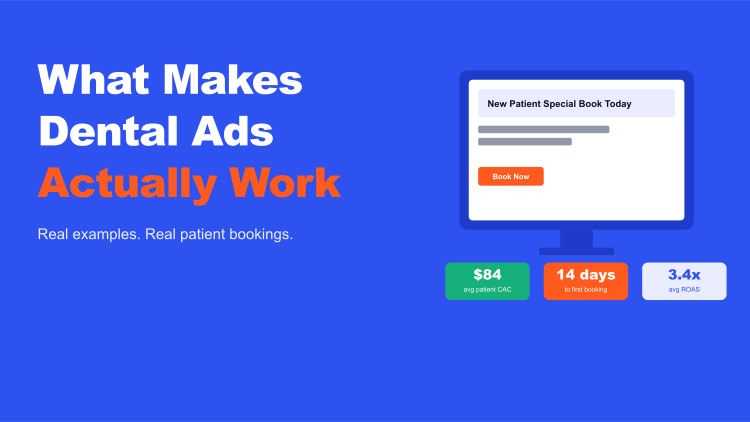
Most dental practices run ads that look fine on screen but never book a single patient. The problem is not the budget or the platform. It is that the ad does not do any real work. This guide breaks down what the best dental ads get right, with real examples across Google, Meta, and display so you can see the exact structure that drives bookings.
[rdw_takeaways items=”The best dental ads lead with a single patient problem or benefit, not a generic welcome message.|Hook, proof, and one clear call to action are the three elements every high-performing dental ad shares.|Google search ads convert best when they mirror the patient search term and land on a dedicated booking page.|Meta ads for dentists work when the creative speaks to a specific treatment concern, not a broad family dentistry pitch.|Compliance is not optional. Dental boards restrict before-and-after imagery, outcome guarantees, and several common claim types.”]
[/rdw_takeaways]
Why Most Dental Ads Fall Flat Before Anyone Clicks
Walk through any dental Google Ads account and you will find the same patterns: generic headlines like Accepting New Patients, landing pages that point to the homepage, and ad groups with 40 keywords shoved together. The ads technically exist. They just do not produce appointments.
The core problem is that most dental ads are written from the practice perspective, not the patient perspective. A practice wants people to know it is accepting new patients. A patient searching at 8 p.m. wants to know if you can fix their cracked molar before a work trip on Friday. Those two messages are completely different.
The dental ads that consistently book patients share three traits: a hook that matches the patient immediate problem, a proof element that makes the practice feel credible fast, and a single low-friction action to take. Strip any one of those out and click-through drops. Strip two and you are paying for impressions with zero return.
The Three-Part Structure Behind the Best Dental Ads
Every top-performing dental ad follows a predictable structure. All three elements need to be present somewhere in the creative or the copy.
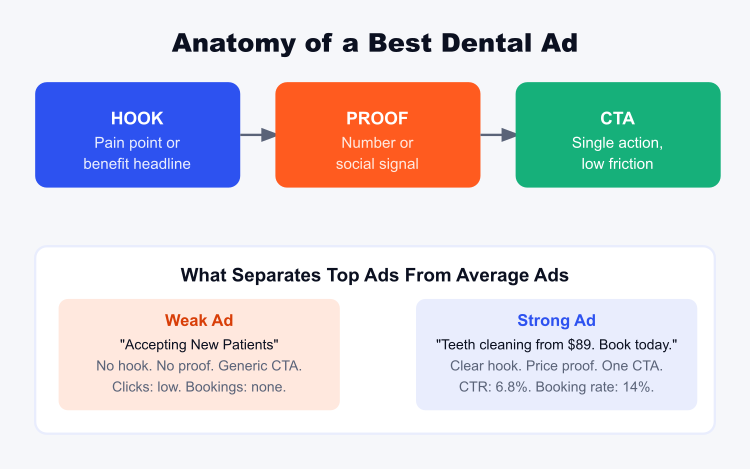
Hook. This is your opening line in a search headline or the first three seconds of a Meta video. It must name something the patient is already worried about or already wants. Toothache this week? works better than Family Dentistry. Same-day crowns works better than Modern dental technology.
Proof. Patients do not trust ads. They have seen a hundred dental practices claim they are friendly and affordable. Proof counters skepticism with something specific and checkable. Numbers work: 543 five-star reviews, $89 cleaning with no hidden fees, open Saturday 8 a.m.
Call to action. One action, framed as easy. Book online in 60 seconds outperforms Call us today by a wide margin for practices with online scheduling, because it removes the fear of being put on hold. The action should match where the patient is in their decision.
| Ad Element | Weak Version | Strong Version | Why It Matters |
|---|---|---|---|
| Headline | Accepting New Patients | Toothache? Same-Day Appointment Available | Matches real search intent |
| Proof | Experienced team | 543 Google reviews, 4.9 stars | Specific and checkable |
| CTA | Call us today | Book online in 60 seconds | Removes friction for the patient |
| Landing page | Homepage | Dedicated page for the service | Removes off-topic distractions |
Best Dental Google Search Ads by Structure
Google search ads reach patients who are actively looking. They have typed something specific and they are comparing options. That intent window is narrow. Practices that close it win the appointment.
The best dental Google Ads follow a tight match between keyword, headline, and landing page. A patient who types emergency dentist today should see a headline that contains emergency dentist, then land on a page that explains same-day availability, lists what you treat, and has a click-to-call button above the fold.
Headline slots in responsive search ads give you up to 15 options. Google mixes and matches, so write each headline as a standalone statement. Your best performers fall into four categories: problem-acknowledging, benefit-stating, proof-carrying, and action-driving. Keep them tight at 10 words or fewer.
The landing page is where most dental Google Ads campaigns lose their return. Getting the click is step one. Converting that click into a scheduled appointment requires a page built for that specific patient intent. A general homepage kills conversions. A dedicated page for emergency dental appointments, with a booking widget and office photo, closes them.
Best Dental Facebook and Meta Ads by Creative Type
Meta ads reach patients who are not searching. They are scrolling. Your job is to stop the scroll with something that feels relevant before they have typed a single word.
The dental Facebook ads that produce the most appointment requests speak to one specific patient situation. Not general dentistry for the whole family. Something like: Adults over 40 in this city are replacing missing teeth with implants that look completely natural. That message stops the right person. It scrolls past everyone else, but that is the point.
Video outperforms static in dental Meta ads for two reasons. First, it establishes trust in under 10 seconds: a dentist speaking to camera, showing the office, or walking through a simple procedure feels more credible than a stock photo. Second, video lets you control the hook timing. The first three seconds must do the job.
Before-and-after imagery performs well when compliant with state dental board rules. The dental advertising compliance requirements vary by state. Non-compliant ads get flagged by Meta and can result in account suspension.
Best Dental Display Ads for Awareness and Retargeting
Display ads work in two modes: cold awareness and retargeting. The best dental ads for each mode look completely different.
Cold display ads should aim for one thing: brand familiarity. A patient who has never heard of your practice will not book from a banner ad. Simple, high-contrast creative with your practice name, one benefit, and a clean visual performs better than crowded designs with four bullet points and a phone number.
Retargeting display ads target people who already visited your website. That audience is warm. Limited-time offers, appointment availability, or a specific reminder about a service they viewed all outperform generic book-now retargeting.
The paid media discipline we applied at Topps Tiles shows why a test-and-learn approach beats set-and-forget display campaigns. In a structured paid media program for the UK largest tile retailer, we generated 5,465 new visitors, 1.3 million impressions, and a 7% CTR improvement while sustaining ROAS targets across the full campaign window. The same discipline applies directly to dental: run variants, measure what drives bookings, cut what does not, and reinvest in what does.
Best Dental Ads for High-Value Services
High-ticket dental services like implants, full-arch restoration, veneers, and Invisalign need different ad structures than routine services. A patient considering a $4,000 implant is not going to book from a single ad. The funnel is longer and requires multiple touchpoints.
For implants, the best performing search ads qualify the patient before they click. Headlines that mention cost ranges like Implants from $3,200 filter out people who are not serious and improve lead quality. Yes, click-through rate drops. Conversion rate rises. Lower volume at higher case value is a better outcome for revenue per ad dollar.
For veneers and cosmetic work, Meta video and Instagram ads work well when they show real patient transformations with explicit consent documentation. The audience for cosmetic dental work skews female, 30-55, with above-average household income. Targeting by income bracket and aesthetic interest topics outperforms broad local targeting.
| Service Type | Best Platform | Key Ad Element | Avg Conversion Range |
|---|---|---|---|
| Emergency dental | Google Search | Same-day availability headline | 12-18% |
| Teeth cleaning | Meta Lead Ads | Specific price plus review count | 8-14% |
| Dental implants | Google Search plus Meta video | Cost qualifier plus consultation CTA | 4-8% |
| Veneers or cosmetic | Meta and Instagram | Before-and-after creative with consent | 3-6% |
| Invisalign | Google Search plus retargeting | Monthly payment framing plus free consult | 5-9% |
What the Best Dental Ads Avoid
Knowing what not to do prevents the most expensive mistakes. Several patterns show up in underperforming dental ad accounts consistently.
Outcome guarantees. Guaranteed results and similar claims violate dental board advertising rules in most US states. They trigger ad disapprovals on Google and Meta and create professional liability exposure.
All traffic to the homepage. Patients who click an ad for emergency dental care and land on a page about your team backgrounds leave immediately. Bounce rates above 80% on dental landing pages are almost always a sign that the landing page does not match the ad.
Running one creative forever. Creative fatigue hits dental display and Meta ads within four to six weeks. The same audience tunes it out, CTR drops, cost per click rises. Rotating fresh creative monthly keeps frequency manageable and performance stable.
No negative keyword list. A dental Google Ads campaign without negative keywords pays for clicks from people searching for dental school tuition, dental billing jobs, and free dental care programs. See the full waste pattern breakdown in the guide to dental Google Ads keywords.
Dental Ad Copy Formulas That Consistently Perform
Copy formulas are starting points, not scripts. They give you a structure tested across many accounts so you are not writing from a blank page. Use them as a base and customize for your practice specific differentiators.
Pain-interrupt formula: Name the problem. Acknowledge it is frustrating. Present your solution as the obvious next step. Dealing with tooth sensitivity every time you eat? Our dentists identify the cause and fix it the same week.
Specificity formula: Replace every adjective with a number. Experienced becomes performing dental care since 2009. Affordable becomes cleanings from $79. Convenient becomes open weekends, book online in 90 seconds.
Social proof formula: Lead with the review count or rating, follow with a service, close with availability. 1,400 Google reviews, 4.9 stars. Family dental care. Same-week appointments available.
For multi-location dental groups, ad copy needs to vary by location. What drives patients in a suburban market differs from an urban one. The full channel breakdown for reaching patients across platforms is in our guide on dental social media ads.
Frequently Asked Questions About the Best Dental Ads
What makes a dental ad the best performer in its market?
The best dental ads match the patient specific problem to a specific outcome your practice delivers. They carry a proof element, land on a dedicated page built for that service, and ask for one action. Practices that nail all four consistently outperform competitors spending twice as much on generic campaigns.
Which platform produces the best dental ads for new patient acquisition?
Google Search produces the best dental ads for high-intent, near-term appointments: emergency dental, same-day services, and specific treatment searches. Meta produces the best dental ads for high-value elective treatments like implants, veneers, and Invisalign where patients need multiple touchpoints before booking. Running both platforms in a coordinated campaign produces better results than either alone.
How much should a dental practice spend on ads to see real results?
The minimum to see meaningful data from best dental ads on Google is $1,500 to $2,000 per month in a competitive metro market. That covers enough clicks to identify what is working within 60 to 90 days. Meta can produce results at lower spend of $500 to $1,000 per month for local awareness and retargeting. The full cost breakdown is in the dental PPC advertising cost guide.
Can dental ads guarantee a certain number of new patients?
No reputable dental marketing agency guarantees a specific patient count from ads. Ad performance depends on market competition, budget, landing page quality, and the practice ability to answer calls and book appointments when they come in. After 60 to 90 days of data you can predict a cost range per booked appointment.
Do best dental ads work for small practices competing against DSOs?
Yes. The best dental ads for independent practices focus on what DSOs structurally cannot offer: a named dentist, same-day availability, flexible payment options, and a local community connection. Own that message and your ads compete on identity, not budget.
What are the most common reasons best dental ads stop performing?
Creative fatigue is the number one cause of performance decay in dental Meta campaigns. On Google, performance drops most often from keyword creep, landing page drift, and bid strategy changes without proper conversion tracking in place. We cover the full list of structural failures in the dental PPC management guide.
Ready to build dental ads that produce booked appointments? See how we structure campaigns at our dental marketing hub.
Book your free 30-minute strategy call.
No spam, no sales rep. We use your email to schedule your call with a senior strategist. That is it.
More from the blog
View all articles → PPC
PPC Home Services PPC Marketing: What a Strong Campaign Looks Like
Read article PPC
PPC PPC for Home Service Businesses: How to Lower Cost Per Lead
Read article PPC
PPC