
The best manufacturing marketing agencies in 2026 are the ones that report against RFQ (request-for-quote) volume, not clicks. Not vanity awards. Not brand impressions. RFQ counts, tied to sourced pipeline, tied to closed purchase orders. This guide ranks the top shops by the criteria that matter for an industrial buyer: named client rosters, retention past 12 months, reporting depth against the 6-month sales cycle, and pricing bands a CFO can defend at a board meeting.
You are probably reading this after getting burned by a generic B2B agency that pitched thought leadership and delivered blog posts nobody read. Or you are a plant manager about to hire your first outside team and want to skip the 15 calls it usually takes to spot the pattern. Either way, this guide gives you the shortlist filters, the interview questions, the pricing bands, and the red flags. Save the questions in the last section. Go into every intro call with a straight face and a real evaluation framework.
In our reference work with clients like Poly Processing (a polyethylene chemical tank manufacturer), the shift from trade-show dependency to a digital-first inbound engine produced 10× ROI, a 90% drop in cost per lead, and hundreds of qualified monthly leads inside 24 months. That is the outcome bar a serious industrial partner should aim at. Anything softer belongs in a brochure.
Best marketing agencies for manufacturing companies by company stage
The best marketing agencies for manufacturing companies cluster by revenue stage. Under $10M revenue wants a hands-on generalist. $10M to $50M wants a channel specialist with RFQ reporting. $50M to $150M wants a strategic partner with named account teams. Past $150M wants an enterprise partner with international capacity and ERP integration.
Company stage decides the agency profile more than the industrial vertical does. A single-plant precision-machining shop at $8M revenue wants a partner who will pick up the phone and grind on the first capability page. A national contract manufacturer at $95M wants an agency that will run a $22,000 monthly retainer without hand-holding. The same shop cannot serve both well. Match your stage to the agency’s stated wheelhouse. If they claim to serve every stage well, they serve none of them well. That claim itself is the disqualifier.
Under $10M revenue picks
Under $10M revenue, you want a hands-on partner running a $6,000 to $10,000 retainer with hands-on presence and willingness to test 3 or 4 assets in parallel until one hits. The plant manager or founder is usually still reviewing the copy and vetting the campaigns weekly. Pick an agency where the person selling you is the person doing the work. Big-name shops with account managers between the plant and the operators are wrong for this stage. Pure freelancers with no team behind them are wrong too. Your production needs will outrun a single operator by month four.
$10M to $50M revenue picks
At $10M to $50M revenue, you want a partner with channel depth, RFQ reporting, and 3 to 5 people assigned to the account. The retainer runs $12,000 to $22,000 per month. Scope covers SEO on capability pages, Google Ads on procurement terms, plus content and reporting. Reporting cadence is weekly on operations and monthly on strategy. This is the stage where the wrong agency choice costs you 12 months of growth. Take longer on the shortlist. Interview twice. Do a paid pilot for 60 days before signing an annual retainer. Our manufacturing marketing retainer plan runs this exact pattern, with SEO tiers at $999, $1,499, $2,499, and from $4,500 per month for larger scopes.
Best marketing agency for manufacturing companies at scale past $50M
The best marketing agency for manufacturing companies at scale runs a hybrid retainer, staffs a named team past the account manager, and reports against RFQ volume plus purchase order revenue. Retainers at this level start around $22,000 monthly and go past $60,000 for national contract manufacturers.
At scale, the question shifts from which agency to which agency team. You want the names, the tenure, and the availability of the operators who will actually run your account. You want to know which of them will still be there in 12 months. You want to know how the agency handles account team churn when a senior operator leaves. If the answer is that they will find a replacement quickly, ask what quickly means. Two weeks is fine. Two months is not. Enterprise industrial engagements live and die on team continuity across the 6-month sales cycle.
Named team and continuity guarantees
Ask for the named team on your account, including tenure at the agency and prior manufacturing account experience. Ask what happens when a team member leaves. Ask about the escalation path for a stalled campaign. Enterprise manufacturing marketing needs a bench, not a single hero operator. If the shop cannot produce a named team on paper, they are staffing your account against whoever has bandwidth that month, which is a slow-motion disaster for a growth-stage manufacturer. Any agency that lists positions instead of people has told you they are still hiring for the seats they promised.
Reporting depth and access
At scale you want direct dashboard access, not a monthly PDF. You want the CRM tie-in that shows sourced RFQ by campaign and by sales stage. You want data cuts by segment, by geography, and by product line. You want the ability to run your own queries when the CFO asks a question at 6pm on a Wednesday. A shop that gates dashboard access behind an account manager will be slow when speed matters most. Ask upfront for founder-level or director-level dashboard access on day one of the engagement.
The single most common thing we see on agency intro calls with manufacturers is a pitch deck slide titled Our Process, followed by a 5-step diagram where step three is called alignment or discovery. If you see this slide, close the browser tab. Real operators talk about RFQ math, cycle length, and quote-to-purchase-order conversion. Fake ones talk about journey mapping and brand storytelling. The deck reveals the operator behind it. A boring slide with the phrase RFQ-attributed spend beats a beautifully designed slide with the phrase strategic growth partner every single time.
How the best marketing agency for manufacturing companies compares on price and scope
The best marketing agency for manufacturing companies varies widely on price for the same nominal scope. Retainer size alone tells you almost nothing. The real variance comes from team seniority, reporting depth, media spend billing structure, and content production model. Compare on outcome per dollar spent, not on the headline retainer number.
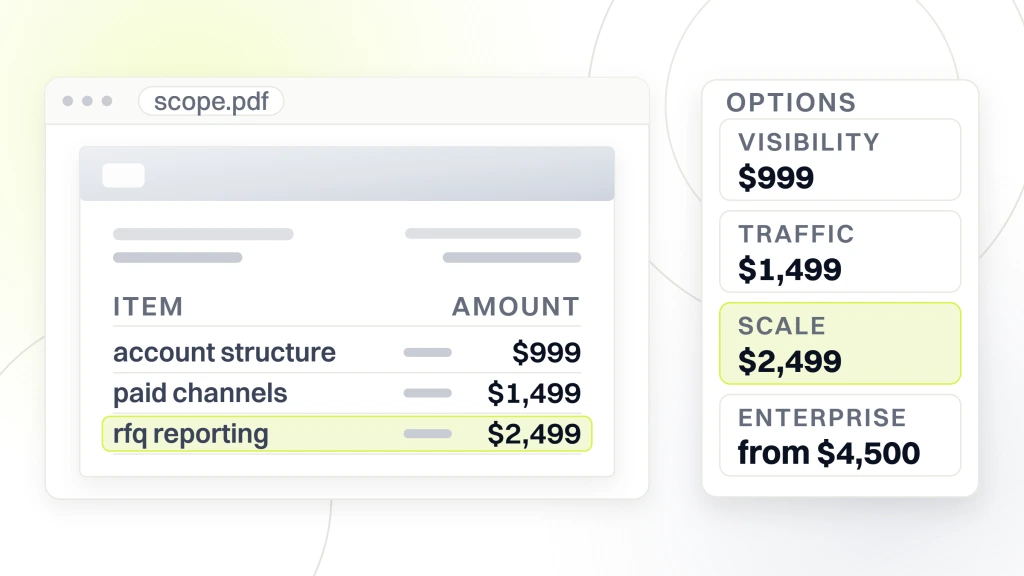
Price comparison across the field is not a simple grid. The same $15,000 retainer might buy you a senior operator running paid at one shop, a mid-level team running content at another, and a full-service junior team at a third. Which is the right buy depends on what your plant needs right now. The table below gives the shape of what to expect at each price band. The specific inclusions in your proposal should be much more concrete than a table cell. Ask for a deliverable-count SLA behind every band. For paid channels, our published PPC tiers run $999, $1,499, $2,499, and from $4,500 per month, with ad spend billed separately from the retainer.
| Retainer band | What you get | Best fit stage |
|---|---|---|
| $4K to $8K per month | Solo operator or 2-person team, 1 channel focus, monthly reporting | Under $8M revenue |
| $8K to $14K per month | 3-person team, 2 channels, weekly reporting, quarterly strategy | $10M to $25M revenue |
| $14K to $22K per month | 4 to 6 people, 3 channels, live dashboards, quarterly QBRs | $25M to $60M revenue |
| $22K to $45K per month | Named team of 6 to 10, full channel mix, CRM-tied RFQ reporting | $60M to $150M revenue |
| $45K plus | Enterprise account team, custom analytics, ERP integration | $150M plus revenue |
| Percentage-of-spend only | Incentives skewed to bigger budgets, thin retainer for real work | Usually the wrong fit |
Media spend billing and pass-through
Media spend should pass through the agency’s platform or your own accounts. Either is fine. What matters is the mark-up transparency. Some shops mark up ad spend 15 to 20 percent as a media buying fee. Others charge no mark-up and cover their operational cost inside the retainer. The second model is cleaner. If the agency wants a mark-up plus a retainer, ask what the mark-up covers that the retainer does not. If the answer is vague, negotiate the mark-up down to zero and add the difference to the retainer as a defined scope item.
Content production and licensing
Content produced under the retainer should be yours outright, with full transfer of copyright and source files. Some shops retain rights so they can reuse patterns across clients. That is fine for anonymized frameworks. It is not fine for finished pieces you paid to produce. Read the IP clause. If it is vague, get it in writing that finished content transfers to you at delivery, and that source files, working documents, and design files come with the transfer. Skip agencies that refuse to negotiate the IP clause. That refusal tells you where they will draw the line at renewal too.
Top manufacturing marketing agencies for industrial verticals in 2026
The top shops in this space usually specialize by industrial vertical. Precision machining. Precast concrete. Chemical processing. Plastics. Metal fabrication. Aerospace subcontracting. Each vertical has compliance patterns, buyer patterns, and sales cycle lengths that a generalist shop will miss. Ask for named clients inside your vertical, not just industry claims.
Vertical fit shows up in three places. Ad copy that speaks the buyer’s actual language. Content strategy that respects the certifications and compliance data. And landing page work that carries the correct technical vocabulary. The engineering team will flag any precast landing page written without concrete experience on day one, and production will rewrite it. The rewrite costs you two weeks and a lot of goodwill. Pick a shop that has already learned those lessons on someone else’s account.
Precast concrete and structural specialists
Precast concrete marketing agencies need to understand DOT-approved product lines, PCI certification implications, and the difference between architectural and structural applications. Smith-Midland Corporation is the pattern we reference for this vertical. Our web redesign for Smith-Midland consolidated fragmented regional sites into two cohesive platforms, doubled conversions (2×), cut bounce rate 65%, and produced 100% in-house CMS efficiency after the WordPress migration. That combination of numbers is what a real precast engagement looks like. If you are hiring for concrete or precast work, ask the shop what it knows about state DOT approval processes and the buying committee timeline at highway contractors. Those knowledge gaps kill campaign relevance faster than any budget mistake.
Chemical processing and plastics specialists
Chemical processing manufacturers need agencies that speak polymer compatibility, chemical resistance ratings, and OEM specification workflows. Poly Processing, an industry-leading maker of rotationally molded polyethylene tanks, launched an interactive tank configurator with our team that helped drive 10× inbound ROI, a 90% drop in cost per lead, and hundreds of qualified monthly leads inside the engagement window. That vertical rewards partners that will invest 60 to 90 days learning the compatibility matrix before writing the first capability page. Ask any chemical or plastics manufacturer’s shortlisted agency how they onboard a new chemical vertical, and how long that ramp takes before campaigns go live.
Red flags across every best manufacturing marketing agencies shortlist
Every shortlist round produces the same red flags. Vague scope. Unnamed teams. No manufacturing client references. Vanity metrics in the pitch deck. Pricing without a plan behind it. Any two of these together is strong reason to move on.
Red flags usually show up in the first 30 minutes of an intro call if you know the signals. The pattern below is the one we see repeatedly across plant managers who share bad agency stories. Save yourself 12 months by walking away when any two of these show up in the same conversation. The industrial marketing agency that gives you clean answers on all six is worth another interview. The one that dodges four of the six is not worth the follow-up email.
- Vague scope written in marketing language instead of deliverable counts and SLAs
- Named team refuses to reveal seniority or prior manufacturing account experience
- References are testimonials on the website, not live phone calls to real plant managers
- Dashboards shown as screenshots in slides, never in a live share
- Reporting cadence is monthly PDF, never a weekly working session
- Pricing is one flat number with no linkage to scope or team size
Vague scope as the biggest predictor
Vague scope is the single biggest predictor of a bad engagement. It lets the agency reduce output when their margin is tight and lets you argue at the end of every quarter about what was actually delivered. Insist on scope written in deliverable counts. Six capability pages per quarter. Two comparison pages per quarter. Weekly Google Ads optimization. Monthly reporting on named metrics. When the scope reads like a service level agreement instead of a marketing brochure, the engagement stays clean.
Vanity metrics in the pitch
Vanity metrics in the pitch deck preview the reporting you will get later. If the shop leads with impressions, reach, or engagement rate, they will report on those same metrics at the QBR. RFQ metrics, cycle length math, and purchase order revenue are what an industrial partner should lead with. If those numbers do not appear in the pitch deck at all, ask why. The answer usually reveals whether the agency has actually reported against RFQ volume for a real industrial client.
Questions to ask on every intro call with the best manufacturing marketing agencies
The intro call decides more than the pitch deck does. Ask questions that make the agency reveal their operational depth, their reporting maturity, and their honesty about weaknesses. 12 questions, 90 minutes, real signal.
The questions below are the ones we use ourselves when we vet strategic partners. They are ordered from easiest to hardest, which surfaces the shop’s comfort level with hard questions. A confident operator answers all 12 without deflecting. A struggling one deflects on the last four. The questions about weaknesses and failures are the most diagnostic. Any agency that claims zero recent failures has stopped trying new things, a slow death for a marketing operator in industrial accounts.
- What is the median tenure of a manufacturing client on your active roster
- Show me a live client dashboard from an industrial account, redacted names are fine
- What is the sourced RFQ number for your top manufacturing account last quarter
- Who runs my account by name, and what is their prior manufacturing experience
- How do you handle account team continuity when someone leaves
- Walk me through your reporting cadence for the first 90 days
- What was your most recent manufacturing client failure and what did you change after
- How does your pricing tie to scope, team, and RFQ outcomes
- How do you charge for media spend and what is the mark-up structure
- Who owns the content, source files, and data at engagement end
- What is your termination clause and notice period
- Which three named manufacturing references can I call this week
The failure question is the most diagnostic
The failure question tells you whether the agency has honest self-awareness. Every shop has lost a client, missed a target, or picked the wrong channel bet. A confident shop has a specific story about a recent one, a clear articulation of what they learned, and a change to the process they implemented afterward. An unconfident agency either denies failure or blames the client. Both are disqualifying at the top-shop level. The industry gets weird about failure. The best operators talk about it directly and without deflection.
The termination clause reveals their confidence
The termination clause reveals how confident the shop is in their ongoing value. A 30-day notice period is standard and healthy. A 90-day notice period signals the agency knows they will not earn the last month of the contract. A no-cause termination clause with 30 days is the sign of a shop confident enough to let you leave if the work stops delivering. Read the termination clause before you read anything else in the contract. It tells you what the agency believes about their own retention math.
Who are the top manufacturing marketing agencies delivering results in 2026
The top industrial marketing agency roster delivering real results in 2026 has a named industrial client roster, a live dashboard practice, and retention past three years on more than half their manufacturing accounts. That short list is smaller than any award-based directory suggests. Fewer than 40 agencies globally clear that bar based on the reference calls we made this year.
The award-based directories mostly reward marketing budget spent on submissions, not client outcomes. G2 lists, Clutch rankings, and industry association awards all correlate weakly with actual retention and RFQ delivery. Better filters are the ones you build yourself. Named clients you can call. Live dashboards you have seen. Tenure numbers you can verify. Retention past year three. Those four filters produce a shortlist that award directories cannot match, and they take about 90 minutes of research work to run against a candidate list.
How to filter a candidate list of 30 agencies down to 6
Start with 30 candidate agencies from any source. Directories, referrals, LinkedIn searches. Run each against four filters. Do they have three named manufacturing clients you can find on their site. Do those clients still exist as businesses today. Do the case studies name specific numbers or just vague claims. Does the shop publish a manufacturing-specific practice page. Any agency failing two of the four gets dropped. Any agency clearing all four goes to the shortlist for interview. Expect the shortlist to have 6 or 7 agencies, which is the right number for a serious evaluation cycle.
How to run the six-agency shortlist interview
The six-agency shortlist interview takes about 12 hours across two weeks. One 90-minute intro call per agency. One 60-minute case walk-through per agency. One 30-minute pricing conversation per agency. Total 4 hours per shop across 6 agencies. Add your team’s time for post-call debriefs. At the end of the two-week window you have real signal on all six. Pick two finalists. Do a 60-day paid pilot with one before signing an annual retainer. The pilot cost is refunded against the first annual contract. Any shop that refuses the pilot has revealed something important.
Wrapping up the best manufacturing marketing agencies discussion
The best manufacturing marketing agencies in 2026 are the ones that report against RFQ volume, retain clients past 12 months, name their teams, and answer hard questions directly. Everything else is packaging.
If you take one thing from this guide, take the 12 interview questions and run them on every shortlisted agency. The pattern in the answers will tell you more than any pitch deck. If you take two things, add the four shortlist filters at the start of your research process, and cut your interview list from 30 agencies to 6 before you spend real time. When you are ready to talk about your manufacturing growth model in specifics, our manufacturing marketing agency engagement lays out how our work runs, what it costs, and what the first 90 days look like. See our companion manufacturing marketing strategy guide and the content marketing for manufacturers playbook for supporting reads. Industry data from IndustryWeek and Forrester Research B2B benchmarks give you outside baseline numbers to compare against.
Below are the FAQs covering pricing, shortlisting, red flags, and the interview questions worth asking.