
Top food marketing agencies in 2026 split into three working camps that founders can actually tell apart. Category specialists sit deep in CPG snack, beverage, and functional playbooks. DTC operators run Amazon plus Shopify plus TikTok Shop revenue as the primary scorecard. Retail-forward shops build every calendar around Whole Foods, Sprouts, Kroger, and specialty grocery merchandising windows. The category matters because a generalist apparel agency stretching into food misses the shelf math, the FDA claim review, and the Instacart discipline that separates a paid program printing predictable orders from a proposal stapled together on the flight over. Top food marketing agencies read contribution margin per SKU before they touch a bid.
This food marketing agency guide walks the working filter you can run in a single afternoon. Category specialization versus generalist shops, retainer scope by service line, integrated retail-plus-DTC programs, regulatory review workflows on alcohol and functional claims, and named case results from Boogie Board, Vejrø Resort, Abigail Ahern, BSH Hausgeräte, Custimy, and Ibemploy. Every number and pattern below runs on active accounts we operate at Redefine Web, and the retainer pricing quoted stays consistent across every food and beverage program we run. Read straight through in 12 minutes and pick from top food marketing agencies with a real rubric in hand.
What separates top food marketing agencies from generalist shops
Top food marketing agencies read contribution margin before they open a media plan. A generalist agency scoping food work with the same slide deck they use for SaaS misses the shelf math, the co-manufacturer lead times, and the demo calendar. Food margins run 18 to 34 percent gross on retail SKUs, which means a target cost per order on paid social can never match the target an apparel or wellness brand tolerates. Working food agencies build target cost per order from the SKU margin, not from an industry benchmark screenshot.
Category specialization by brand mix
Category specialization means the agency runs 5 or more current brands in the target category with named account leads on each. A shop with three CPG snack accounts and one craft beverage account is legitimately specialized in snacks. The same shop pitching a functional beverage brand is stretching. Founders can filter fast by asking for the three most recent food brand launches the agency ran, the specific SKU count on each, and the trailing 12 month revenue outcome. Answers that stall on that question are answering the wrong question.
Retail plus DTC integration on one team
Retail plus DTC integration on one team is the working structure for 2026. Brands running paid social with one agency, Amazon with another, and retail with a broker end up with three separate calendars fighting each other on the same demo week. The working pattern is one team running Meta, TikTok, Amazon Sponsored Brands, Google Search, and retail promotional support on a shared quarterly cadence. That structure keeps a Whole Foods reset from crashing an Amazon Prime Day forecast, and keeps the paid team from bidding against a retail promotion the brand already funded.
Retainer scope across top food marketing agencies
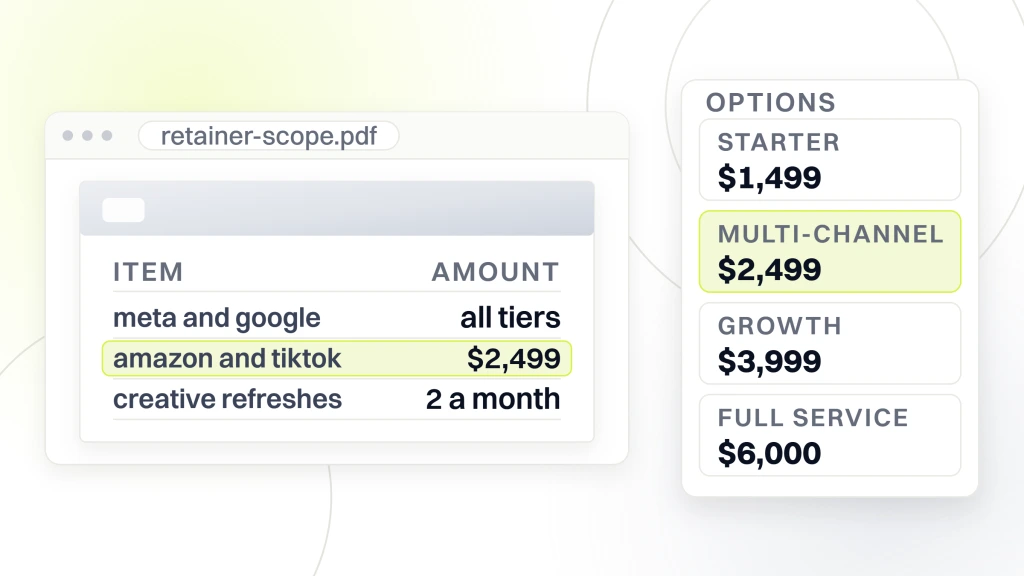
Retainer scope across top food marketing agencies runs $1,499 to $6,000 per month on standard tiers at Redefine Web, with custom scopes above that band for brands running paid budgets over $250,000 monthly. Founder-led boutique shops in the food category sit at $1,499 to $2,499 monthly for part-time attention on Meta plus Google. Mid-market food specialists sit at $2,499 to $3,999 monthly for multi-channel paid and organic. Full-service integrated programs at Redefine Web start at $6,000 monthly and scale from there for brands running the full retail plus DTC plus PR stack. Every tier is priced against the working scope, not against a padded hourly rate.
What the retainer covers by tier
The $1,499 tier covers Meta plus Google paid media on a single funnel with one landing page, one creative refresh per month, and monthly reporting. The $2,499 tier adds Amazon Sponsored Brands and Sponsored Products, TikTok Shop coordination, and two creative refreshes per month. The $3,999 tier layers organic SEO on top with a content calendar, on-page technical work, and quarterly link building. The $6,000 tier covers the full paid plus organic plus retail plus PR stack with a named account lead, weekly cadence, and named creator program on top. Founders reading a proposal that stuffs everything into a $2,500 line item are reading a proposal that will underdeliver on at least two of the five workstreams.
What every serious retainer excludes
Every serious food agency retainer excludes ad spend, creator flat fees, tool licenses (Triple Whale, Northbeam, Perpetua for Amazon Sponsored, Helium 10 for keyword research), landing page hosting, and creative production for shoots that go beyond the standard scope. Founders reading a proposal that folds ad spend into the retainer number are looking at a scope structured to overspend on paid to justify the retainer. That structure misaligns incentives on tight food margins where contribution margin per SKU already leaves limited room. Ask for line-item scope with ad spend split out. If the agency will not split it, that answer is the answer.
Boogie Board case study on cost per conversion at scale
Boogie Board partnered with Redefine Web on a scaled paid media program targeting DTC ecommerce and Amazon marketplace revenue. The brand came in with strong product-market fit on reusable writing tablets, an educated customer base, and a paid program that had plateaued at unsustainable cost per acquisition. The prior agency ran broad Meta prospecting without a cleaned product feed or catalog structure, which produced impressions without efficient orders across the top three SKU families the brand needed to move.
Our team rebuilt the paid structure around Meta Advantage Plus Shopping with a clean product feed, layered Amazon Sponsored Brands with dedicated video creative on the top three SKU families, and added Google Search branded protection plus non-branded category keywords on educational-tablet search intent. Creator whitelisting through Meta Brand Partnership Ads picked up the top-performing organic creator content and pushed it into paid amplification. Every campaign fed a treatment-specific landing page with schema markup and one-second load times measured on Real User Monitoring.
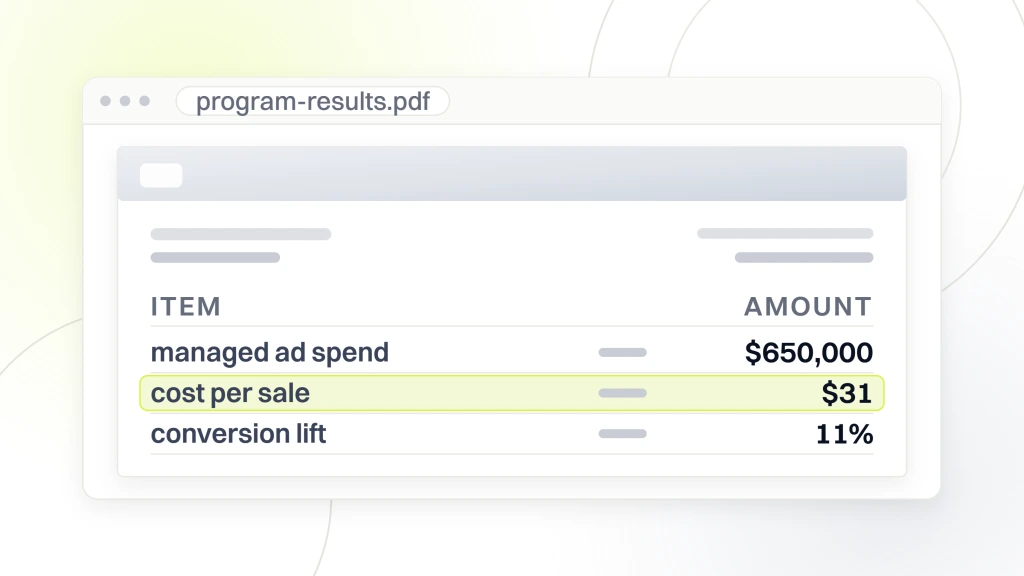
The combined program drove Boogie Board revenue at $31 cost per sale at scale, an 11 percent conversion rate boost through optimized landing pages plus refined ad targeting, and $650,000 in managed ad spend delivering sustainable revenue growth across Meta, Amazon, and Google. The pattern translates directly to food and beverage brands with functional or sustainability positioning, which is why the food and beverage marketing hub keeps the Boogie Board engagement in the top three references we walk during discovery calls with functional beverage and snack founders.
Regulatory review workflows top food marketing agencies run
Regulatory review workflows top food marketing agencies run cover FDA structure-function claim compliance for functional beverages and supplements, USDA organic and non-GMO Project verified label compliance for organic food marketing per the USDA organic labeling standards, alcohol advertising rules under the TTB and state ABC boards, and infant formula marketing rules where WHO Code compliance applies in international markets. A working regulatory review workflow catches non-compliant creative before it goes live and blocks assets that would trigger a warning letter from FDA, USDA, or TTB inside a 60 to 90 day window.
Structure-function claim review process
Structure-function claim review process for functional beverages covers the specific claim language (supports focus, promotes hydration, aids sleep), the substantiation documentation on file for each claim, the required disclosure language on paid creative, and the required notification to FDA within 30 days of first commercial use. A working agency-side reviewer holds a legal or scientific advisory role and reviews every claim-heavy asset before launch. Skip this step and the brand catches a warning letter inside 60 to 90 days of a claim-heavy ad launch, which triggers a full asset pull and a rebuild cycle that costs 4 to 6 weeks of forward revenue.
Alcohol advertising rules by state and platform
Alcohol advertising rules by state and platform cover age-gate compliance on Meta and TikTok, geographic targeting restrictions in dry counties and states with specific advertising limits, required disclaimers on creative (drink responsibly, must be 21 to purchase), and creative rules against sports imagery in some jurisdictions. Per the TTB alcohol beverage advertising rules, non-compliant creative on alcohol brands catches a federal warning inside 90 days of platform detection, which is why alcohol brands need agencies with alcohol-specific compliance workflows built into the creative approval chain, not tacked on after launch.
Pricing comparison across top food marketing agencies
Pricing across top food marketing agencies varies more than any other agency category because scope varies more. The table below lists working monthly retainers, target brand stage, included workstreams, and typical reporting cadence across four tiers Redefine Web quotes for food and beverage brands. Every tier holds ad spend, tool licenses, and creator flat fees separate from the retainer number. Founders comparing agency pitches should build the same table from every proposal and compare line by line against the best food marketing agencies shortlist.
| Tier | Monthly retainer | Target brand stage | Included workstreams | Reporting cadence |
|---|---|---|---|---|
| SEO or PPC starter | $1,499 | Founder-led, single funnel | Meta plus Google, one landing page, one creative refresh | Monthly |
| Multi-channel paid | $2,499 | Growth stage, $100K to $500K monthly revenue | Meta plus Google plus Amazon plus TikTok Shop, two creative refreshes | Monthly plus mid-month check-in |
| Paid plus organic | $3,999 | Mid-market, $500K to $2M monthly revenue | Paid stack plus organic SEO plus content calendar plus link building | Bi-weekly |
| Full integrated | Starts at $6,000 | $2M plus monthly revenue, retail plus DTC | Everything plus retail support plus PR plus named creator program | Weekly |
Our Redefine Web tiers at $1,499, $2,499, $3,999, and from $6,000 monthly cover paid media, SEO, content, and retail-forward support for food and beverage brands from founder-led launch through $10M plus in annual DTC revenue. Same pricing structure applies across the SEO and PPC service lines, which keeps the total food marketing budget on one invoice rather than scattered across three vendors sending three separate reports on three different cadences.
Vejrø Resort case on organic ranking at 200 plus first-page keywords
Vejrø Resort, a private island resort in Denmark that runs hospitality plus event bookings plus a small food and beverage program on-property, engaged Redefine Web on a full SEO and content program targeting international bookings from Northern Europe. The baseline showed a nearly invisible site, an outdated booking system, and organic traffic that ran on brand searches only. Nothing ranked outside the branded term set, which meant every new booking came from paid channels or word of mouth without a compounding organic layer.
Our team rebuilt the site architecture around the four buyer personas that actually book private-island stays, wrote content clusters on wedding venues, corporate retreats, culinary weekends, and sustainable travel, and layered technical SEO on top of the booking flow so booking conversions stayed live across every keyword landing page. The food and beverage story on the island became a content pillar rather than a footnote, which pulled the culinary weekend segment from a rounding error into a reliable booking category.
Vejrø Resort reached 10K plus organic visitors in the first 3 months, 200 plus first-page Google rankings on hospitality and destination-food keywords, and a 2.2 percent organic conversion rate on the booking form. The pattern translates directly to food brands running content-driven organic acquisition around recipe, ingredient, and comparison keywords. Our food and beverage SEO team runs the same cluster architecture on functional beverage, snack, and specialty food accounts across 2026.
Creator programs top food marketing agencies build
Creator programs top food marketing agencies build cover TikTok food creators, Instagram Reels partnerships, YouTube long-form recipe content, and Amazon Live streaming for food category brands. Working programs run a named creator database of 15,000 plus vetted food creator handles with searchable filtering by follower count, engagement rate, category, and average creator-driven cost per acquisition. Programs without a searchable creator database are running creator outreach on Instagram DM at scale, which produces 30 to 60 day sourcing cycles and inconsistent brief adherence across the creators who eventually respond.
TikTok Shop coordination on food brands
TikTok Shop coordination on food brands runs against the platform native creator affiliate program, where the brand sets the commission rate it pays on creator-driven Shop revenue. Working agencies negotiate commission rates by SKU category, seed product to the top 40 creators in the food category monthly, and pull creator-driven sales into the same reporting dashboard as Meta and Google paid revenue. Brands running TikTok Shop without agency coordination usually see spiky creator revenue that peaks on one viral video and craters when that creator moves to the next brief.
Amazon Live streaming for food category
Amazon Live streaming for food category runs monthly product-focused streams with named influencers or brand-owned hosts on the top 3 to 5 SKU families. Streams average 40 to 90 minute session lengths with product demos, taste tests, and Q and A that convert 3 to 8 percent of viewers into orders during the stream window. Working programs pair Amazon Live with Sponsored Brands video ads on the SKU family being streamed, which pushes viewers from paid impressions into the live session rather than losing them to the general Amazon browse experience.
Abigail Ahern case on paid social return at 3,000 percent
Abigail Ahern, a luxury home decor ecommerce brand adjacent to the specialty food category in the way it approaches premium DTC positioning, engaged Redefine Web on a restructured SEO plus paid media program. The baseline showed a heavy discount mix that trained the customer base to wait for promotional windows, a paid search return that ran below 500 percent, and paid social spend that had never crossed the break-even threshold on the primary channel mix at scale.
Our team restructured the paid stack around full-price positioning, rebuilt the paid search account structure around branded protection plus non-branded high-intent keywords, and pushed the paid social program into a prospecting plus retargeting split that respected the buyer journey length on premium home decor purchases. Every discount banner came off the site outside two curated seasonal windows, which repositioned the brand from promotional to premium in the customer default assumption about pricing.
The combined program drove ecommerce revenue growth of 179 percent, paid search return on ad spend to 1,588 percent, and paid social return on ad spend to 3,000 percent through retargeting and prospecting without a single discount banner. The pattern translates directly to premium food and beverage brands running full-price positioning against a category default of promotional pricing. Craft alcohol, specialty coffee, and premium chocolate brands run the same playbook to break out of the promotional loop the category defaults to on retail shelves.
Measurement stack top food marketing agencies deploy
Measurement stack top food marketing agencies deploy covers GA4 with server-side tagging, Amazon Attribution for off-Amazon impact on Amazon sales, Triple Whale or Northbeam for multi-touch attribution on DTC revenue, and Instacart Ads analytics for retail measurement on Instacart-fulfilled SKUs. Every stack layers a first-party data warehouse on top (Snowflake, BigQuery, or a lightweight Supabase for smaller brands) that keeps 24 months of channel-level performance data queryable without depending on platform reporting windows that expire at 28 or 90 days depending on the source.
Server-side tagging on GA4
Server-side tagging on GA4 catches the 20 to 35 percent of paid conversions that browser-side tags miss on iOS 17 plus browsers, which routinely blocks pixel firing on privacy-conscious buyer segments. Working stacks deploy Google Tag Manager server-side containers on a subdomain, pipe every conversion event through server-side processing, and hydrate the event with server-known context (order value, product ID, first-party email hash) before sending to Meta CAPI, TikTok Events API, and Google Ads Enhanced Conversions. Brands running browser-only tagging lose 20 to 35 percent of conversion volume in reporting, which usually shows up as an inflated cost per acquisition on paid social in particular.
Amazon Attribution for off-Amazon impact
Amazon Attribution for off-Amazon impact tracks how paid social and paid search off Amazon drive sales on Amazon marketplace listings. Working setups tag every off-Amazon ad campaign with an Amazon Attribution tag, pull the tagged revenue back into the reporting dashboard, and credit off-Amazon spend for the Amazon revenue it drove. Brands running paid social to Amazon PDP links without Attribution tagging see the sales in Amazon Seller Central but cannot credit the source, which routinely leads to paid social budget cuts against campaigns that were actually printing efficient Amazon revenue.
BSH Hausgeräte case on backend plus UX optimization
BSH Hausgeräte GmbH, the European consumer goods brand behind Bosch and Siemens home appliances, engaged Redefine Web on a backend and UX optimization program for the Turkish market. The baseline showed an outdated backend, a weak funnel, and a lead generation program running well below the traffic the brand could support. The brand needed structural improvements without disturbing the SEO equity the site had built over years of ranking on high-intent appliance searches.
Our team ran a full UX redesign paired with funnel optimization that preserved the URL structure, schema, and internal linking that fed the site organic ranking. Backend performance improvements landed on the top 40 landing pages first, then rolled across the site. Every change went through a pre-launch SEO impact check to catch any accidental ranking risk before deploy, and the QA cycle held every deploy in staging for 48 hours before pushing to production.
The program produced a 15 percent increase in lead generation through UX redesign plus funnel optimization, 3 percent organic traffic growth on preserved SEO structure, and a 45 second increase in average session duration after the frontend redesign. The pattern translates directly to established food and beverage brands running site rebuilds without wanting to torch existing organic traffic. Brands rebuilding a legacy Magento or WordPress site to Shopify or headless commerce need the same discipline to protect the ranking equity they have already built.
Monthly reporting top food marketing agencies deliver
Monthly reporting top food marketing agencies deliver covers program-level revenue, channel-level return on ad spend with target versus actual, creative-level performance ranked by top and bottom quartile, creator program metrics on TikTok Shop and Amazon Live, and a forward-looking test plan for the next 30 days. Working reports run 12 to 20 slides and land in the brand inbox on the first Tuesday of every month with a 45-minute review call. Reporting cadence tighter than monthly usually reflects an agency trying to look busy. Cadence looser than monthly usually reflects an agency avoiding accountability on the numbers.
Channel-level return with target versus actual
Channel-level return with target versus actual covers Meta return set against contribution margin math, TikTok Shop return with the commission-adjusted target, Google Search return on branded and non-branded, Amazon Sponsored Brands and Sponsored Products advertising cost of sale, and Instacart Ads return on featured product placement. Every channel reports against the target set at the start of the quarter, with a delta explanation on channels missing target and a scaling recommendation on channels exceeding target. Targets that reset every month without a stated reason are a red flag for an agency avoiding accountability on the previous month miss.
Creative performance ranked by quartile
Creative performance ranked by quartile identifies the top 25 percent of creative by conversion rate and the bottom 25 percent by conversion rate across every channel. Top quartile creative gets budget expansion inside the next 14 days. Bottom quartile creative gets paused inside 7 days. Middle 50 percent stays in rotation while data accumulates for the next quarterly review. This discipline compounds over 6 months as the creative library refines toward the patterns that consistently produce revenue rather than the patterns that produced revenue once and got repeated on autopilot.
Custimy case on 500 plus first-page rankings for a SaaS platform
Custimy, a customer data platform serving ecommerce brands with SaaS positioning adjacent to food and beverage brands running their own data stack, engaged Redefine Web on an isometric design plus SEO program. The baseline showed low site visibility, no API integrations documented for the search engines, and organic traffic that ran on brand searches only against a category with substantial non-branded search volume the brand was leaving on the table.
Our team rebuilt the site around isometric design that visually clarified the CDP category for buyers landing from non-branded search, layered SEO on top with keyword clusters covering CDP comparison, integration guides, and use-case content, and set up technical SEO fundamentals (schema, internal linking, site speed) to hold the ranking gains once they landed. The program pulled in 25K plus monthly organic visits, ranked Custimy for 500 plus first-page SaaS keywords, and pushed average session duration to 165 seconds through content that answered the buyer real research questions.
The pattern translates directly to food and beverage brands running content-driven acquisition on ingredient, recipe, comparison, and use-case keywords. Functional beverage brands, specialty coffee brands, and premium snack brands all run similar content architectures to compound organic acquisition without depending on paid media spend continuing indefinitely. Read the food and beverage marketing retainer plans for the working structure across food and adjacent DTC categories.
Red flags in top food marketing agencies proposals
Every food brand founder reads at least one agency proposal a quarter promising guaranteed page-one Google rankings, a 5x return across every channel, and a 25 percent retail sell-through improvement for $2,500 monthly. The red flags below catch the majority of these pitches before the founder signs a contract that produces spend without revenue. Read every proposal against this list line by line, and if the pitch triggers three or more of these flags, the pitch is not worth a second meeting.
- Guaranteed return on ad spend across channels. Nobody guarantees return with algorithm changes week to week and iOS attribution losing a share of browser-side conversions.
- A low monthly retainer with multi-channel scope promised. That budget covers only a few hours of coordinator time on the workstream promised.
- No mention of contribution margin per SKU in the discovery call. Skips the math and the target cost per acquisition becomes guesswork.
- No regulatory review workflow on alcohol or claims-heavy categories. Missing this puts the brand in line for a warning letter.
- No named creator database size. A real food agency has 15,000 plus vetted food creator handles with searchable filtering.
- No case study with named brand and specific outcome numbers over 6 months. Generic marketing material is not evidence of a working program.
- Ad spend folded into the retainer number. This structure will overspend paid to justify the retainer.
Green flags in a real pitch
Green flags: category specialization with 5 plus current brand accounts in the target category, contribution margin math done during the discovery call, named measurement stack with Amazon Attribution setup covered, regulatory review workflow on alcohol and claims-heavy categories, named creator database size with searchable filtering, and case studies with named brands plus specific cost per acquisition or return numbers over 6 months. Any proposal hitting five of these six green flags is worth a second meeting inside the week the pitch lands.
Ibemploy case on 7,500 monthly visits and 4.2 percent conversion
Ibemploy, a Latvia-based workforce solutions and recruitment brand that runs a DTC acquisition funnel structurally similar to food and beverage subscription brands, engaged Redefine Web on a 12-month digital marketing program. The baseline showed lead source running offline, weak SEO on the target keyword set, and a website that had never been optimized for organic conversion despite substantial search demand in the Baltic market.
Our team rebuilt the site around search-intent-matched landing pages, wrote content clusters on the recruitment services that generated the highest offline lead value, and layered technical SEO plus a content calendar that pushed organic traffic from a rounding error into a primary acquisition channel. Every page hit conversion optimization discipline (single primary call to action, trust signals above the fold, form length matched to the buyer journey stage) before going live in the SEO calendar for organic acquisition.
Ibemploy grew to 7,500 plus monthly organic visits within a year of launch and a 4.2 percent organic conversion rate on the lead form. The pattern translates directly to DTC food and beverage subscription brands running conversion-focused organic acquisition against the paid channels that carry the launch phase. Once organic acquisition reaches 30 to 50 percent of total revenue, paid budget can shift from acquisition into brand and creative testing without dropping topline growth.
Wrapping up top food marketing agencies selection
Picking from top food marketing agencies in 2026 comes down to six operational disciplines that show up in the first discovery call. Category specialization matching the brand SKU mix. Contribution margin math done live during the pitch. Regulatory review workflow on alcohol and claims-heavy categories. Named measurement stack with Amazon Attribution layered on top of platform-native pixels. Retailer-forward operational discipline on Whole Foods, Sprouts, and Instacart calendars. Monthly reporting with named quartile bands on creative. Programs running all six produce compounding revenue growth with clean unit economics visible every month on one dashboard.
Real programs like the Boogie Board engagement produce $31 cost per sale at scale by pairing paid media with product feed rebuild and platform-specific creative on the same team. Real programs like Vejrø Resort produce 10K plus organic visitors in 3 months by running content architecture matched to buyer personas. Real programs like Abigail Ahern produce 3,000 percent paid social return by pulling discount banners off the site and repositioning to full price. If a food brand is picking a marketing partner in the next 30 days, ask three agencies for line-item scopes with named tooling, contribution margin math, regulatory review coverage, and case studies with real brand names and real cost per acquisition numbers. Book a call and we will walk the last three food marketing programs we ran end to end from launch through 12-month scorecard.
Match retainer scope to the working stack the brand actually needs, not to a proposal padded to justify a headcount. Redefine Web tiers at $1,499, $2,499, $3,999, and from $6,000 monthly cover paid media, SEO, content, and retail-forward support for food and beverage brands from founder-led launch through $10M plus annual DTC revenue on one invoice.
Ask every agency pitch for a named creator database size, a contribution margin math walkthrough during the discovery call, and case studies with real brand names plus specific cost per acquisition or return numbers over 6 months. Any pitch that stalls on any of the three questions is answering the wrong question.
How to do marketing for a food business?+
Marketing a food business well starts with brand positioning, packaging, and a clear unique selling point, then adds paid social, Google Business Profile, and email flows for repeat orders. For CPG and DTC food brands, the working stack is Meta and Google paid, Amazon Sponsored Brands, TikTok Shop or licensed creator content, Instacart Ads for grocery, and a monthly email plus SMS cadence. Retail-ready brands also fund demo calendars and shopper marketing tied to Whole Foods, Sprouts, and Kroger set windows. The right mix depends on brand stage and contribution margin per SKU. Founders under 3 million in revenue typically stay on a $1,499 to $3,999 monthly retainer covering paid plus creator. Brands past 15 million move to integrated retainers from $6,000 monthly with retail and PR added.
What separates top food marketing agencies from generalists?+
Top food marketing agencies separate from generalists through category specialization, retail-forward operational discipline, and regulatory review workflows on alcohol and claims-heavy categories. Category specialists carry 8 to 20 active brand accounts in the target category, a creator database of 15,000 to 40,000 vetted food-and-beverage handles, and case studies with named brands showing revenue growth over 6 to 18 month windows. The specialization compounds pattern recognition on TikTok Shop commission structures, Amazon Sponsored Brands video templates, and Instacart category takeover windows that generalists have to learn on the brand budget.
How much do top food marketing agencies charge per month?+
Top food marketing agencies charge $1,499 to $6,000 monthly on standard retainers at Redefine Web, with custom scopes above that band for brands running paid budgets over $250,000 monthly. The $1,499 tier covers Meta plus Google food and beverage PPC on a single funnel. The $2,499 tier adds Amazon plus TikTok Shop coordination. The $3,999 tier layers organic SEO on top. From $6,000 monthly covers the full paid plus organic plus retail plus PR stack with a named account lead. Every tier holds ad spend, tool licenses, creator flat fees, and creative shoots separate from the retainer number to keep incentives aligned on tight food margins.
How do top food marketing agencies handle FDA regulatory review?+
Top food marketing agencies handle FDA regulatory review through a structured workflow covering FDA structure-function claim compliance for functional beverages, USDA organic and non-GMO Project verified label compliance, alcohol advertising rules under the TTB and state ABC boards, and WHO Code compliance for infant formula marketing. A working agency-side regulatory reviewer holds a legal or scientific advisory role and reviews every claim-heavy asset before launch. Skip the review and the brand catches a warning letter inside 60 to 90 days of a claim-heavy ad launch.
Should a food brand hire a category specialist or a full-service agency?+
Food brands under 3 million in annual revenue typically win with a boutique paid media agency at $1,499 to $3,999 monthly for multi-channel paid media. Brands from 3 to 20 million typically win with a category specialist at $3,999 to $6,000 monthly for paid plus creative plus SEO with category depth. Brands past 15 million typically consolidate multiple agency relationships into a full-service integrated partner from $6,000 monthly covering every channel plus retail plus PR. Matching agency profile to brand stage predicts engagement success over the first 12 months.
What case studies should top food marketing agencies show?+
Top food marketing agencies should show case studies with named brand outcomes over 6 to 18 months with specific revenue, CPA, and ROAS numbers. A working case study covers the starting position of the brand, the agency intervention scope, the outcome numbers at 6-month and 12-month checkpoints, and the ongoing operational cadence the brand runs today. Generic case studies without named brands or specific numbers should be treated as marketing material, not evidence of a working program. Our Boogie Board case study on $31 cost per conversion at scale is an example of what named-brand outcome numbers look like.
What red flags catch a bad food marketing agency proposal?+
Red flags in a food marketing agency proposal include guaranteed ROAS across channels (impossible once iOS attribution loses a share of conversions), a low monthly retainer with multi-channel scope promised (it buys a few hours of coordinator time), no mention of contribution margin per SKU in the discovery call (skips the math and target CPA becomes guesswork), no regulatory review workflow on alcohol or claims-heavy categories (an invitation to a warning letter), no named creator database size, and no case study with named brand and specific outcome numbers over 6 months. Any proposal hitting three of these six should not progress.
What should a food marketing agency retainer include?+
A food marketing agency retainer should include named account lead time, strategy work, paid media management, creative refresh cadence, monthly reporting with a review call, and regulatory review workflow on claims-heavy categories. The retainer should exclude ad spend, tool licenses, creator flat fees, and creative production for shoots beyond the standard scope. Every workstream in the retainer should have a stated monthly hour band and named deliverable calendar. Retainers that describe deliverables in vague strategic language rather than named workstreams with hour bands are structured to underdeliver on at least two of the promised areas inside the first 90 days.
How long before a new food marketing agency shows revenue results?+
A working food marketing agency shows first paid media performance signal within 30 to 45 days on Meta plus Google, first Amazon Sponsored Brands lift within 45 to 60 days once search-term reports build, and first retail velocity signal within one full 12-week set cycle at Whole Foods or Sprouts. Organic SEO on the food category earns first ranking movement in 90 to 120 days on long-tail queries and 6 to 9 months on category head terms. Founders expecting a full CPA and ROAS turnaround inside 30 days are usually being sold on a channel that is not working yet. Real programs post their first honest 90-day scorecard and course-correct from there.