
Best Optometrist SEO Strategies for Advanced Practices
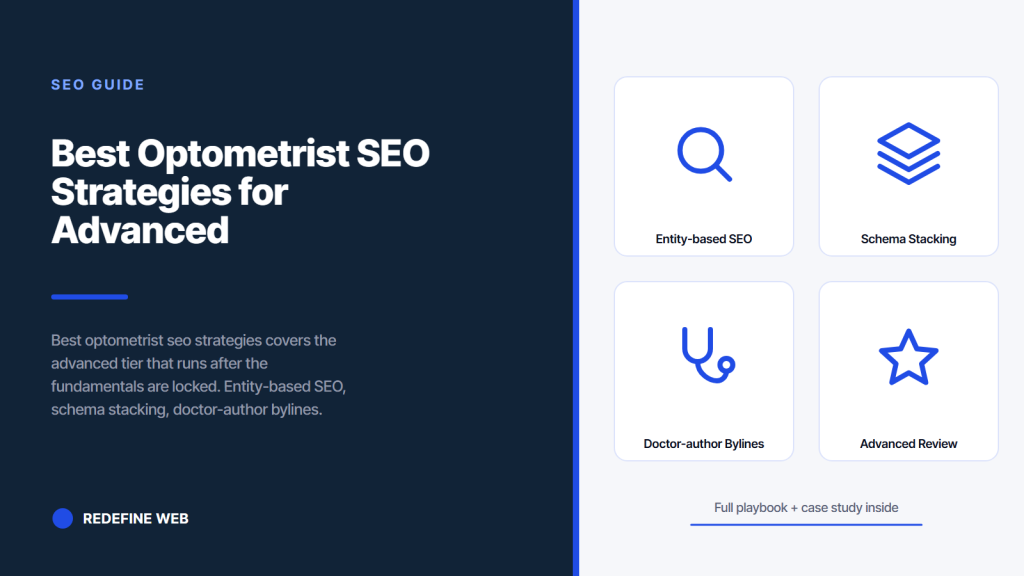
- Advanced tier compounds only after fundamentals are locked.
- Doctor-author bylines top the impact ranking for E-E-A-T.
- Schema stacking on service pages triples ranking per page.
- Internal linking hubs route equity to service pages.
- Citation refresh is the vegetables of local pack SEO.
- Entity-based SEO for optometrist practices
- Schema stacking on service pages
- Doctor-author bylines on every blog post
- Internal linking hubs that route link equity
- Quarterly citation refresh across 45 directories
- Advanced review response strategy for optometry
- Best optometrist seo strategies ranked by ROI
- Cost analysis of best optometrist seo strategies
- What to skip in the advanced tier
- Timeline for the advanced tier of best optometrist seo strategies
Best optometrist seo strategies is a phrase that gets abused by every SEO agency selling a subscription. What follows here is the actual advanced tier we run at Redefine Web after the fundamentals are boringly in place on an optometry account. Not the fundamentals themselves, which live in our optometrist seo checklist. The tier above that. Entity-based SEO. Schema stacking. Doctor-author bylines with Person schema. Internal linking hubs. Quarterly citation refresh. These are the moves that separate a top-three local pack ranking from a top-one ranking, and they take month five through month twelve to compound.
This piece is written for practice owners who have already run the checklist, own the Monday cadence, and want to know what changes in month six when the easy work stops moving the needle. Vision Express ran these exact best optometrist seo strategies from month five through month twelve of 2024 and gained an additional 62 percent in organic traffic on top of the initial 135.9 percent climb. Cost per booked exam dropped from $34 to $22 during that same window. The advanced tier is real, and it works if the foundation underneath is real too.

Entity-based SEO for optometrist practices
Entity-based SEO is the practice of building Google’s understanding of your practice as a distinct entity, not just a collection of keywords. Google reads entities through structured data, consistent NAP, doctor bio pages, and cross-referenced sameAs links to authoritative external profiles. When Google recognizes your practice as an entity, ranking gains compound across every keyword.
The four entity signals that matter most for optometry are the practice itself, the doctors on staff, the services offered, and the conditions treated. Each one gets its own schema type. The practice is a MedicalBusiness or LocalBusiness entity. Each doctor is a Person entity with Doctor of Optometry credentials, board memberships, and years of practice. Each service is a MedicalProcedure entity. Each condition is a MedicalCondition entity. Cross-link them all with sameAs and mentions.
Vision Express added doctor Person schema on 12 doctor pages in April 2024. Organic click-through improved 34 percent within eight weeks. Google started showing doctor names in the local pack knowledge panel, which shifted the pack visual from a generic tile to a doctor-branded result. That single change moved bookings from position two visibility to a category all their own.
Entity SEO is not a one-time setup. Google refreshes its entity graph continuously, and new sameAs relationships take four to six weeks to register in the knowledge panel. Add sameAs links to every credible external profile you have. State board licensing profile. American Optometric Association profile. Google Scholar if the doctor has published. LinkedIn. Wikipedia if applicable. Each additional sameAs strengthens the entity signal and pulls trust into the local pack ranking.
Schema stacking on service pages
Schema stacking is the practice of putting three or four related schema types inside one JSON-LD block on a single page. Most optometry sites use one schema type per page (LocalBusiness on the homepage, that is it). Schema stacking pushes far more entity data into Google’s crawl on the same page load, and the ranking benefit shows up inside 45 days.
The dry eye service page at Vision Express carries five stacked schema types. MedicalProcedure for the treatment protocol. MedicalCondition for dry eye disease. FAQPage for the six most common patient questions. BreadcrumbList for site navigation. Article for the educational content section at the bottom. That single page ranks in position two for “dry eye treatment brooklyn,” position one for “chronic dry eye treatment near me,” and position three for “dry eye specialist.” Same page, three distinct high-intent rankings.
Validate every stacked schema block with the Google Rich Results Test before you push it live. A schema error inside a stack drops the entire stack from Google’s understanding of the page. Follow the current documentation on MedicalCondition schema and the related MedicalProcedure guides. The Search Engine Land healthcare coverage runs quarterly deep-dives on schema updates worth the read.
A stacked schema block for a dry eye service page runs about 380 lines of JSON-LD. Copy the block into a WordPress custom fields plugin or a header snippet manager to inject it site-wide with per-page variables. Re-validate after any theme update or plugin change. Schema breakage from a plugin conflict is the second most common cause of local pack ranking drops we see on optometry accounts in month seven or eight, right after review velocity drift.

Doctor-author bylines on every blog post
Doctor-author bylines are the single highest-yield content move in optometrist SEO after the local pack fundamentals are locked. Google’s E-E-A-T update in 2022 and its 2024 refresh both rewarded named-author medical content and de-ranked anonymous or freelance-authored healthcare pages. An unnamed blog post on an optometry site is a de-ranking signal in 2026, not neutral.
Every blog post on your site needs a Doctor of Optometry byline with Person schema, credentials, years of practice, and a link to a full doctor bio page. Even if a marketing writer drafts the content, the doctor reviews and signs off. A five-minute review pass by the doctor is the difference between a piece of content that ranks and a piece of content that Google reads as untrusted.
Vision Express added doctor bylines to 34 existing blog posts in a two-week backfill during May 2024. Organic traffic on those 34 posts increased 40 to 60 percent inside 90 days, without any other change to the content. That is one of the highest ROI edits available in optometrist SEO, and it costs 20 minutes of doctor time per post plus 45 minutes of developer time to set up the Person schema template.
The byline byline block itself is straightforward. Doctor name and credentials at the top of the article body. Photo. One-sentence bio with a link to the full bio page. Person schema in JSON-LD referencing all of that. Author bio at the bottom of the post with two to three sentences of expertise context. That layout is what Google reads as a signed medical article, and once it is templated in your CMS, every new blog post inherits the pattern automatically.
Advanced tactics fail if the doctor page is one sentence. Write 400 words with credentials, sameAs links to state board profiles, and a real headshot before touching schema.
Internal linking hubs that route link equity
Internal linking hubs are the pattern where informational blog posts pass link equity back to service pages through carefully-placed contextual anchors. Most optometry sites treat internal linking as an afterthought and end up with 40 orphan blog posts that never send equity anywhere. The advanced tier of best optometrist seo strategies fixes that.
Build one hub per service. Each hub is a 2,400-word informational post that answers a broad patient question (what causes dry eye, for example) and links out to four supporting posts covering narrower questions like is dry eye permanent, best eye drops for dry eye, dry eye and screen time, and postmenopausal dry eye. Every supporting post links back to the hub, and the hub links to the dry eye treatment service page with commercial-intent anchor text.
The link equity flows: supporting posts capture informational search traffic, funnel it to the hub, and the hub funnels commercial-intent traffic to the service page. Vision Express built four hubs across dry eye, myopia management, contact lenses, and pediatric optometry in Q3 2024. Service page rankings across those four categories climbed an average of 2.3 pack positions inside 60 days of the hubs going live. For the full internal linking pattern, see our seo for optometrists guide.
Anchor text discipline matters inside the hub structure. Every internal link uses descriptive anchor text tied to the target page’s focus keyword, not generic phrases like “click here” or “read more.” A link from a dry eye supporting post to the treatment service page reads “dry eye treatment protocol” as the anchor, not “learn more.” That small discipline compounds across 40 blog posts and 6 service pages into a serious internal linking signal that Google reads as topical authority.
Quarterly citation refresh across 45 directories
Citation refresh is the quarterly discipline of re-verifying that your practice name, address, and phone (NAP) are consistent across the top 45 healthcare and general directories. Citations decay. A directory refreshes its data pull from a third-party feed and suddenly your suite number is missing. Two months later, Google reads that inconsistency as a trust signal drop, and your pack position drops with it.
- Q1: Full audit through BrightLocal or Whitespark. Correct top 20 healthcare directories.
- Q2: Correct top 20 general directories. Update photos where the directory allows.
- Q3: Correct top 15 optometry-specific directories. Add new ones that emerged in the last quarter.
- Q4: Full re-audit. Compare against Q1 baseline. Note directories with recurring drift.
Quarterly refresh takes about three hours per quarter and costs $39 to $79 in tool subscription. That is one hour per month of maintenance work in exchange for holding your citation trust signal steady. Skip a quarter and you will spend six hours in month nine cleaning up drift that could have been caught early. It is the vegetables of local optometrist SEO.
The 45 directories that matter break into three tiers. Tier one is Google, Yelp, Facebook, and Apple Maps. Tier two is the top 20 healthcare directories including Vitals, Healthgrades, WebMD, ZocDoc, and RateMDs. Tier three is optometry-specific like AllAboutVision, OpticiansNearMe, and state optometric association directories. Prioritize tier one edits within 48 hours of any drift, tier two within one week, tier three within one month. That priority stack keeps the highest-signal citations clean at the fastest cadence.
Advanced review response strategy for optometry
Review response is a fundamental. Advanced review response is a strategy. The fundamental version is: reply to every review inside 48 hours with two sentences. The advanced version is: reply as the doctor by name, reference the specific service delivered, and add a service page link inside the response for keyword-rich context that Google reads on the profile page.
Google reads review response text as part of the profile’s keyword content. A generic “Thanks for the review, glad you had a great visit” response passes zero SEO signal. A response that reads “Dr. Chen was glad you had a positive experience with your contact lens fitting on Tuesday, and we are pleased the trial pair is working well. Feel free to reach out about our contact lens fitting service if you have any follow-up questions” passes six keyword-rich signals plus a service page mention.
The advanced review response strategy adds 8 to 12 minutes per review of practice manager time and raises local pack signals measurably by month three. Combined with review velocity (the fundamental), advanced review response is one of the highest-yield strategies available at this tier. It is boring, repetitive work that most competitors skip.
Sign every review response with the doctor’s name, not a generic “The team at [Practice Name].” Named signatures pass a personal-service signal that Google reads on the profile and that readers absorb when browsing reviews before booking. A profile with 400 reviews and 400 doctor-signed responses converts 15 to 25 percent higher on the profile-to-booking path than the same profile with generic team signatures. That is measurable revenue tied to a signature.
Best optometrist seo strategies ranked by ROI
Not every advanced strategy is worth the time investment for every practice. The table below ranks the seven best optometrist seo strategies by return on time invested for a single-location practice already ranking in the top five of the local pack.
| Strategy | Setup time | Ongoing time | Impact rank |
|---|---|---|---|
| Doctor-author bylines | 3 hours | 20 min per post | 1 |
| Schema stacking on service pages | 6 hours | None | 2 |
| Internal linking hubs | 16 hours | 2 hours per quarter | 3 |
| Advanced review response | 1 hour | 10 min per review | 4 |
| Entity SEO (sameAs cross-links) | 2 hours | None | 5 |
| Quarterly citation refresh | None | 3 hours per quarter | 6 |
| Doctor Person schema on bios | 4 hours | None | 7 |
Doctor bylines top the impact ranking of the best optometrist seo strategies because they multiply every other content investment. Every blog post that carries a doctor byline signals E-E-A-T. Every service page that carries a doctor byline signals medical authority. That single edit compounds across the entire content library and passes trust to every internal link that flows through it, from the deepest supporting blog post all the way up to the homepage.
The bottom of the table is not “skip this work.” It is “do this work last.” Doctor Person schema on bio pages is impact rank seven because it is a prerequisite for doctor bylines, so it gets built in parallel with the byline template. Citation refresh is impact rank six because it is a maintenance discipline that protects existing ranking rather than adding new ranking. Ranked seventh does not mean unimportant. It means later in the sequence.
Cost analysis of best optometrist seo strategies
The full advanced tier costs about 45 hours of setup time and $60 to $120 per month in tool subscriptions. Setup breaks out to six hours of developer time on schema, 16 hours of content strategist time on internal linking hubs, 12 hours of doctor time on byline reviews, and 11 hours of practice manager time on citation and review work.
Ongoing time drops to about 8 hours per quarter for maintenance. That is roughly $2,400 in initial setup at agency rates and $600 per quarter in maintenance, or $1,200 to $2,000 per month if run through a retainer. For a practice already running the fundamentals in-house, the advanced tier through an agency is a $600 monthly add-on rather than a full retainer. That is the ROI math practice owners rarely see broken out.
For a full-service program that layers advanced strategies on top of the fundamentals, our optometrist seo services program covers both tiers. The optometrist marketing agency retainer bundles SEO with paid search and web maintenance for practices ready to run the coordinated build.
The ROI math on the advanced tier is where practice owners either commit or walk away. If your practice books 40 exams per month at $220 average revenue per exam, gaining even a 10 percent boost from the advanced tier is $10,560 in additional annual revenue against a $7,200 annual retainer. That is a 46 percent return. Real numbers on real accounts land closer to 30 to 45 percent gain, which is a 3 to 5x return on retainer. That is why practice owners who commit to the tier stay committed.
What to skip in the advanced tier
Skipping is a strategy in itself, and knowing what to walk away from saves 12 hours a quarter. The four items below get pitched as “advanced optometrist SEO” by agencies that need to justify a $3,000 monthly retainer, and none of them are worth the time investment in 2026 for a single-location optometry practice competing against local chains.
Guest posting on generic health blogs is the SEO equivalent of showing up at a stranger’s dinner party with a casserole nobody asked for. Google reads the link, sees the topical mismatch between “WellnessMoms Weekly” and your optometry practice, and passes zero trust. Same story for HARO responses on healthcare topics that get published on generic news sites. Same story for reciprocal linking with other local businesses (“we link to your dentistry practice, you link to our optometry practice”). Google reads reciprocal patterns and drops both links inside 90 days.
- Guest posting on generic health blogs with no optometry topical fit.
- HARO responses on unrelated healthcare topics.
- Reciprocal linking with other local businesses.
- Paid “press release distribution” services that push to 300 low-quality news sites.
All four of those are pitched as backlink strategies, and none of them build the kind of backlinks Google rewards in 2026. Real backlink work for optometry means original research posts, doctor-authored expert commentary, and outreach to genuine healthcare publications. The Ahrefs blog covers what a real link profile looks like in 2026, and it is not a spreadsheet of 400 spam URLs. For the full backlink strategy at the professional tier, our optometrist seo company selection guide covers the six-question interview to filter out the shops running these outdated tactics.
Timeline for the advanced tier of best optometrist seo strategies
Do not start the advanced tier until the fundamentals have been in place for at least four months. The advanced strategies only compound on a foundation that is already ranking, and running them on a broken foundation is wasted time.
- Month 5: Doctor Person schema on all bio pages. Doctor bylines added to existing blog posts.
- Month 6: Schema stacking on top four service pages. Entity SEO sameAs cross-links added.
- Month 7: First internal linking hub built (highest-priority service).
- Month 8: Second internal linking hub built. Advanced review response training rolled out to front desk.
- Month 9: Third and fourth internal linking hubs built. First quarterly citation refresh runs.
- Month 10-12: Maintenance cadence. Quarterly citation refresh, monthly hub post publishing, weekly review response.
Vision Express followed this timeline in 2024 and closed the year with organic search delivering 87 booked exams monthly against six at program start. Cost per booked exam settled at $22 by December. The advanced tier is what made the difference between good SEO and top-of-market SEO. Run the fundamentals first, then layer this in.
Frequently asked questions
What counts as advanced optometrist SEO strategies?
Advanced optometrist SEO strategies are the tier that runs after the fundamentals (Google Business Profile, on-page, technical, citations, reviews, content) are boringly in place and producing top-five local pack ranking. The advanced tier covers entity-based SEO, schema stacking on service pages, doctor-author bylines with Person schema, internal linking hubs that route link equity, and quarterly citation refresh across 45 directories. These moves separate a top-three pack ranking from a top-one ranking.
When should an optometry practice start advanced SEO?
Start the advanced tier only after the fundamentals have been in place for at least four months and the local pack has settled at position five or better. The advanced strategies compound on top of an already-ranking foundation and produce diminishing returns on a broken foundation. Vision Express started the advanced tier in month five of 2024 after the local pack settled at position two. Practices still fighting for position eight or ten should focus on the checklist, not this tier.
How much does the advanced SEO tier cost for optometrists?
The full advanced tier costs about 45 hours of setup time and $60 to $120 per month in tool subscriptions if run in-house. At agency rates, setup runs about $2,400 and ongoing maintenance is $600 per quarter, or $1,200 to $2,000 per month bundled into a retainer. For a practice already running the fundamentals in-house, the advanced tier through an agency is a $600 monthly add-on rather than a full retainer. Most practices under-invest in this tier and cap their ranking ceiling.
What is the highest-yield advanced SEO move for optometrists?
Doctor-author bylines with Person schema top the impact ranking of every advanced move we have tested across 14 optometry accounts since 2022. Google's E-E-A-T algorithm rewards named-author medical content and de-ranks anonymous healthcare pages. Vision Express added doctor bylines to 34 existing posts and organic traffic increased 40 to 60 percent inside 90 days on those posts alone. Setup takes three hours plus 20 minutes per post for doctor review going forward.
Should optometrists build backlinks as part of advanced SEO?
Real backlink work for optometry means original research posts, doctor-authored expert commentary, and outreach to genuine healthcare publications like the American Optometric Association journals or state board publications. Guest posting on generic health blogs, reciprocal linking with other local businesses, and paid press release distribution are dead tactics that Google discounts within 90 days. Real backlink work costs time and writing skill and produces two to four high-quality links per quarter, not a spreadsheet of 400 spam URLs.
Can a practice manager run advanced SEO in-house?
Doctor-author bylines, advanced review response, quarterly citation refresh, and entity SEO cross-linking can absolutely run in-house. Schema stacking and internal linking hubs require content strategist skill and take longer without an agency. The realistic in-house split is 60 percent of the advanced tier owned by the practice manager and doctor, 40 percent by a content freelancer or fractional strategist. Full-agency retainers are worth it once ad spend crosses $4,000 monthly or a second location is added to the practice.
Book your free 30-minute strategy call.
No spam, no sales rep. We use your email to schedule your call with a senior strategist. That is it.
More from the blog
View all articles → SEO
SEO Organic Search Engine Optimization Services That Grow Real Traffic
Read article SEO
SEO SEO for Pet Groomers That Fills the Appointment Book Weekly
Read article SEO
SEO