Real estate website design cost runs $2,800 for a solo agent template setup, $8,500 to $18,000 for a solo agent custom build, $18,000 to $38,000 for a team or brokerage build, and $48,000 to $120,000 for a luxury or multi-market brokerage build with custom IDX integration. Every price bracket in this guide comes from live Redefine Web engagements and public 2026 industry benchmarks. Match the bracket to your business scope before you brief a designer.
You’ll get honest pricing math across every scope, the components inside a full-service real estate website design package, the IDX vendor fees to expect on top, the ongoing hosting and maintenance costs after launch, and the 12-month payback calculation so you know when the build starts covering its own cost. Bring your last 90 days of Google Analytics data and your current Google Business Profile review count. Read it in eleven minutes and match a bracket to your scope.
Full-service real estate website design package components
Full-service real estate website design package components cover strategy, design, build, content, integration, and post-launch review. Each component carries a cost line, and understanding the breakdown lets you negotiate scope up or down inside a fixed budget. Full-service packages that skip any single component usually see conversion rate underperformance in that dimension for the entire engagement.
Strategy phase ($1,800 to $6,500) buys segment brief, competitor analysis, GA4 audit of the current site, top-5 keyword research, and stakeholder interviews. Design phase ($3,500 to $12,000) covers brand guidelines review, wireframes for 5 to 8 templates, high-fidelity mockups, and revision rounds. Build phase ($6,500 to $24,000) delivers WordPress or custom theme development, IDX vendor integration, schema markup, mobile-first responsive layout, and page-speed optimization. Content phase ($2,200 to $9,500) buys custom copy, professional photography, market-insight article template, and testimonial system.
Integration phase ($1,200 to $4,800) wires the CRM connection (HubSpot, Follow Up Boss, Salesforce), CallRail dynamic number insertion, GA4 event tagging, Microsoft Clarity install, and email marketing platform connection. Post-launch phase ($900 to $3,600) buys a 30 to 60 day analytics review, first A/B test setup, quarterly design refresh planning, and monthly reporting cadence documentation. Every phase pays back a specific slice of the total conversion outcome, and shortcuts on any single one show up in the analytics dashboard within 90 days.
Vendors skip these full-service real estate website design package features most often, and each one hurts conversion. The strategy phase before wireframes, professional local photography, structured schema markup on listing pages, and CallRail attribution. Those four components together carry roughly 40 to 55 percent of the total conversion outcome, and skipping any two of them usually produces a site that looks polished and converts at 0.6 percent.
A common trap on the solo agent scope is buying build hours without buying the strategy phase. The build phase runs the same way whether the brief is sharp or vague. But a build against a vague brief usually needs a second round of wireframes at week 6 to fix the conversion path the vendor spotted mid-build. That second round runs $1,500 to $3,500 on top of the invoice. Buying 8 hours of strategy work upfront costs less and prevents the mid-build rework almost every time.
IDX vendor fees on top of real estate website design cost
IDX vendor fees sit outside the design build cost and run $50 to $500 per month depending on vendor and tier. Showcase IDX starts at $80 to $150 per month for solo agent scope, $175 to $300 for team scope, and $350 to $600 for brokerage scope. iHomefinder starts at $130 to $260 per month for solo scope, $299 to $525 for team scope, and $600 to $1,200 for brokerage. Homes.com IDX bundles into the Homes.com portal listing spend and starts around $199 per month for solo agents.
MLS board dues and the initial IDX approval process add another $200 to $800 one-time cost at the start of the vendor engagement. Some MLS boards require background checks or specific vendor certifications, and the process runs 2 to 6 weeks before the vendor can pull the listings feed. Projects that miss the IDX approval timeline blow the launch date, frustrate the agents, and churn stakeholders.
Feature-tier decisions inside the IDX vendor stack matter. Saved-search email alerts, map search, polygon draw search, market-insight data widgets, and lead-capture forms usually sit in higher tiers. Solo agents can skip most of these on launch and add them at month 6 once the base site is producing consistent leads. Teams and brokerages usually need the higher tiers from day one so the buyer traffic gets the portal-grade search functionality it expects.
Every cost analysis needs to add the IDX vendor’s 12-month total to the build price when comparing scopes. A $12,000 solo agent custom build with a $150/month Showcase IDX vendor costs $13,800 in year one. A $12,000 build with a $260/month iHomefinder vendor costs $15,120 in year one. That $1,300 gap compounds over 3 years, and the vendor decision then matters as much as the initial design decision. Reference the web.dev LCP article when benchmarking vendor performance before signing a multi-year contract.
Hosting and maintenance costs after launch
Hosting and maintenance costs after launch run $40 to $600 per month depending on stack and traffic. WordPress solo agent hosting on Kinsta or WP Engine starts at $35 to $65 per month. WordPress team hosting bumps to $95 to $240 per month for higher traffic tiers and staging environments. Custom-built brokerage sites on AWS or Vercel start at $180 to $600 per month depending on IDX API request volume and image CDN usage.
Maintenance retainers add another cost line. Solo agents usually skip a maintenance retainer and handle small edits themselves through a simple content editor. Teams commonly hire a 4 to 8 hour per month maintenance retainer at $95 to $180 per hour, so $380 to $1,440 per month. Brokerages usually hire an 8 to 16 hour per month retainer at $125 to $220 per hour, so $1,000 to $3,520 per month. Skipping maintenance produces a site that drifts on plugin updates, browser compatibility, and IDX vendor API changes.
Redefine Web maintenance retainers sit at $199, $299, and $499 per month for hands-off cover on the WordPress build, so a solo agent team without an in-house webmaster can bundle hosting, security, plugin updates, and monthly edits into one line item that’s easier to model in the payback math. For clients on a pay-monthly build with no upfront design cost, the plans run $199 and $349 per month across a fixed 36-month term, and hosting rolls in on top of that per-month rate.
Ongoing SEO investment is separate from web hosting and maintenance. Solo agents commonly spend $600 to $1,200 per month on ongoing SEO once the site launches. Teams spend $1,800 to $4,500. Brokerages spend $4,500 to $18,000. That SEO spend usually covers keyword expansion, market-insight content publishing, technical SEO monitoring, and local-SEO optimization. Skipping the SEO investment means the site never ranks for anything beyond brand-name queries.
Full-service real estate website design package projects that plan for 12 months of hosting, maintenance, and SEO investment upfront usually save 20 to 40 percent on the total 12-month cost, and that’s why vendors bundle the ongoing services into the initial contract. Projects that treat the build as a one-time cost and hire vendors piecemeal after launch usually spend 30 to 50 percent more across the same 12-month window. Plan the whole year at contract time.
Real estate website design pricing by scope and market tier
Real estate website design pricing varies by scope and market tier. The table below sizes the honest range at every combination based on live engagements across the past 24 months. Numbers reflect the initial build cost only, not the IDX vendor or ongoing maintenance.
| Scope | Template setup | Custom build | Timeline | Payback window |
|---|---|---|---|---|
| Solo agent (rural) | $1,800 to $2,800 | $6,500 to $9,500 | 4 to 8 weeks | 4 to 8 months |
| Solo agent (metro) | $2,400 to $3,600 | $9,500 to $18,000 | 6 to 10 weeks | 6 to 10 months |
| Buyer-agent team | N/A | $18,000 to $28,000 | 10 to 14 weeks | 8 to 12 months |
| Boutique brokerage | N/A | $28,000 to $48,000 | 12 to 18 weeks | 10 to 14 months |
| Multi-market brokerage | N/A | $48,000 to $120,000 | 14 to 22 weeks | 12 to 18 months |
Payback window math assumes the site converts paid and organic traffic at the target rate for the segment. Solo agent paid traffic converting at 3 to 6 percent instead of 0.4 to 0.8 percent turns a $9,500 custom build into a positive-ROI investment inside 8 months on a modest $2,000 monthly ad budget. Team and brokerage builds pay back faster in absolute terms and slower in relative terms, given the underlying spend is much larger, but the payback math holds inside 12 months on well-scoped engagements.
Website design packages for real estate agents in 2026 that quote below the ranges above almost always skip the strategy phase, professional photography, or CallRail attribution. Those shortcuts save $2,500 to $6,500 on the invoice and cost 40 to 80 percent of the conversion outcome. Packages that quote above the ranges usually include enterprise CRM integration, custom brand identity work, or multi-market IDX handling that only makes sense at the brokerage scope.
Some solo agents and small teams sit in the SMB website package bracket at $799, $1,299, or $1,999 for a fixed-scope build that skips the IDX-integrated buyer search and treats the site as a lead-gen brand hub instead. That trade works when 70 percent or more of the incoming leads come from paid search on branded queries, in which case the buyer search grid has almost no traffic to convert on. For real estate builds that need the buyer search grid on day one, the $2,800 template setup or the $8,500-plus custom build is the honest floor.
A named case study for real estate website design cost
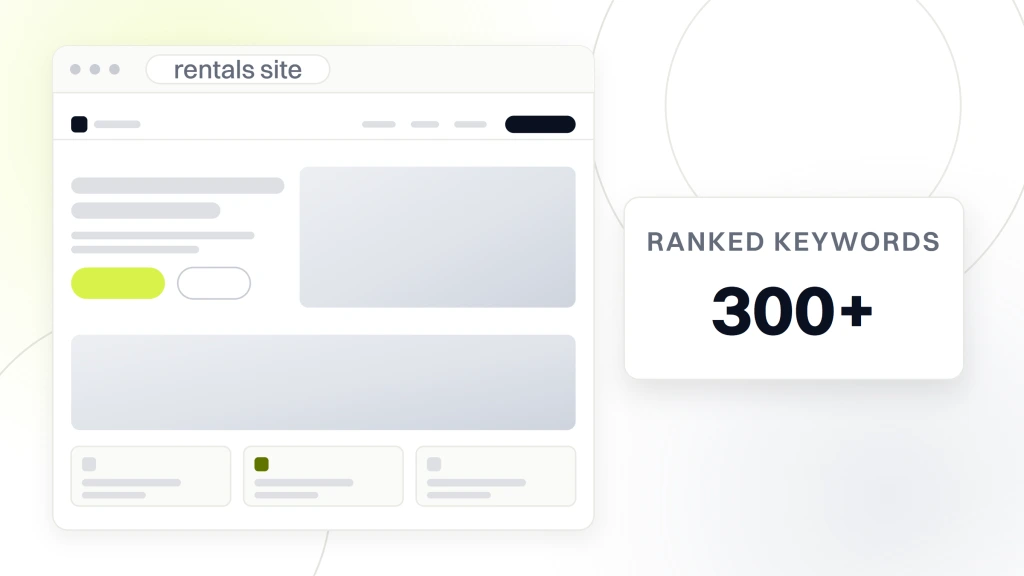
Abels Residential is a Redefine Web client, a new London lettings agency that briefed a conversion-focused website plus focused SEO from day one. The initial build sat in the team-scope custom bracket. The site produced 20+ qualified rental leads per month, 300+ keywords ranked on Google’s first page, and a sub-2-second fully loaded page speed across every template.
The Abels engagement is instructive for pricing math. The team scoped custom photography, a compact IDX-style property search, real neighborhood copy, structured data schema across every listing, and CallRail attribution before wireframes started. The site launched hitting the conversion targets rather than trying to reach them post-launch. Payback on the build sat inside 6 months on modest paid ad spend, and that’s why anticipating the conversion outcome in the brief beats hoping for it.
McCarthy Court is a second Redefine Web client and a useful counterpoint on pricing math for pre-construction developer scopes. The 7-unit luxury Sidcup development launched an immersive virtual showcase site instead of a traditional property listing site, and it sold out 100 percent within 3 months of completion with 60 qualified buyer leads and 10K targeted campaign visits. Developer scopes have a very different payback shape from agent scopes, and the goal is unit sell-through instead of lead-per-month volume.
Adjacent Redefine Web case, a top-tier Los Angeles luxury real estate team, ran a fully custom rebuild across a decade-long partnership. That engagement sat firmly in the luxury multi-market bracket with custom brand identity work, IDX integration, and SEO-optimized long-form market-insight content. Users doubled (+100 percent), new-user share doubled (+100.1 percent), and pageviews more than doubled (+102.6 percent) against the prior site baseline. Luxury-bracket builds pay back through compounding brand equity as much as through direct paid-lead attribution.
12-month payback math on real estate website design cost
12-month payback math depends on three variables: the build cost, the paid-traffic conversion rate gain versus the current site, and the paid-traffic volume. Solo agent example. Current template site converts at 0.6 percent on $2,000 monthly paid traffic. New $9,500 custom build converts at 4 percent. That’s 3.4 percent conversion rate delta on 1,000 monthly clicks, so 34 additional leads per month. At $180 cost per booked consult on the current site versus $27 on the new site, the $9,500 build pays back in about 7 months.
Team example. Current site converts at 1.1 percent on $6,000 monthly paid traffic. New $24,000 custom build converts at 5.2 percent. That’s 4.1 percent delta on 2,000 monthly clicks, so 82 additional leads per month. Payback on the $24,000 build lands at about 5 months at typical team-scope commission economics. Brokerage payback math works the same way, just with bigger absolute numbers on both sides of the equation.
Every pricing decision should run through this payback math before signing the contract. The math is straightforward, and it uses four inputs. Current site conversion rate. Projected new site conversion rate. Monthly paid-traffic volume. Typical booked-consult-to-closed-transaction ratio. Vendors that can’t produce this math on demand are either new to the segment or hiding the projection when the numbers don’t support their price. Ask the math question in the first sales conversation.
Payback math shapes the IDX vendor decision too. A $150/month IDX vendor that ranks pages faster but converts search users at the same rate as a $260/month vendor is the correct pick. A $150/month vendor that has slower search render and lower conversion is the worse pick even at the lower monthly cost. Real estate website design pricing never sits in isolation from the IDX vendor pick or the ongoing SEO investment.
Real estate website design cost deliverables checklist
Every full-service real estate website design package should hand you these deliverables at launch. Print the list and check against your vendor’s proposal before signing.
- Segment brief document. 4 to 8 pages naming the primary segment, secondary segments, competitor analysis, and target conversion rate.
- Design system. Figma or Sketch files with 5 to 8 core templates, brand tokens, and component library.
- IDX vendor selection. Written recommendation with pricing, feature comparison, and render speed benchmarks.
- Photography deliverable. 40 to 60 usable photos from a professional local shoot.
- Schema markup implementation. RealEstateListing schema on every listing page and Person schema on every agent bio.
- Analytics install. GA4 with 3 core events, Microsoft Clarity heatmaps, CallRail dynamic number insertion.
- Mobile-first responsive layout. Tested on real Android hardware over 4G before launch.
- 30-day post-launch review. Written analysis of GA4 data, first A/B test recommendation, iteration roadmap for months 2 to 6.
Missing any single deliverable produces a site that either converts below target or drifts within 90 days. The eight deliverables together carry roughly 85 to 95 percent of the conversion outcome. Proposals that skip 2 or more of the deliverables usually save 20 to 35 percent on the invoice and produce 40 to 60 percent worse conversion rates. That trade rarely favors the buyer. Reference the Google Real Estate Listing structured data guide when reviewing the schema markup deliverable.
Print the deliverables checklist and hand a copy to every vendor bidding on the project. Vendors that skip more than 2 items during their proposal usually skip them at launch too. The checklist is a fast triage tool on the vendor bake-off, and it forces the pricing conversation into a component-by-component discussion rather than a lump-sum negotiation that hides the shortcuts.
What to spec this week on your real estate website design cost brief
Three actions to finish by Friday. Pick your scope, solo agent, team, boutique brokerage, or multi-market brokerage. Write the primary purpose (buyer lead-gen, seller lead-gen, agent recruitment, or brand equity) in one sentence at the top of your brief. Pull your current site’s GA4 conversion rate and calculate the payback math against the projected new site conversion rate.
Those three inputs shape every vendor conversation. Proposals that arrive without a scope brief, purpose statement, and payback projection usually run 20 to 40 percent more than they should, and vendors scope conservatively to cover the uncertainty. Real estate website design pricing conversations that arrive with the brief already written usually get sharper pricing and faster delivery, so the vendor’s team can spec accurately from day one.
Custom-build clients that need a full brand system, IDX-integrated buyer search, multi-market SEO, and a bespoke CRM stack usually sit at $18,000 and above on the invoice. That bracket is where Redefine Web’s real estate work lands most often, and the payback shape is 8 to 12 months on team scope. For teams that want the brief plus the build handled together, our Real Estate Website Design Services team runs the segment call, competitor analysis, and build across one 8 to 12 week engagement. For the wider retainer motion behind a working real estate account, see Real Estate Marketing Agency for Brokerages. And for the responsive-web-first process behind every real estate build we run, see Responsive Web Design Services that Convert plus WordPress Website Development Services.