
Real estate IDX website design is the practice of pulling live MLS (Multiple Listing Service) listings into your website through an approved IDX (Internet Data Exchange) vendor and rendering them inside your brand chrome. Get this decision right at design time and the site pays back the vendor fee inside 4 months. Get it wrong and you spend two years fighting slow render, ugly template overrides, and drift in listing accuracy.
This guide covers the four dominant IDX providers in 2026 (Realgeeks, iHomefinder, Placester, and IDX Broker), the MLS approval steps every IDX build runs before launch, the hosting requirements that keep search fast, the schema markup that turns listings into rich results, the pricing to plan for, and the pre-launch tests every IDX site should pass. Reading time runs about twelve minutes.
First-hand context. Our team at Redefine Web has built real estate sites for London letting agencies, luxury pre-construction developers, and US brokerages running IDX feeds. The lessons below come from those builds, not from a vendor brochure.
MLS approval process for real estate IDX website design
MLS approval is the step most projects underestimate. Every MLS board requires the agent or brokerage account to be in good standing, the vendor to be pre-approved on the board’s IDX vendor list, and set attribution rules to be met on every listing render.
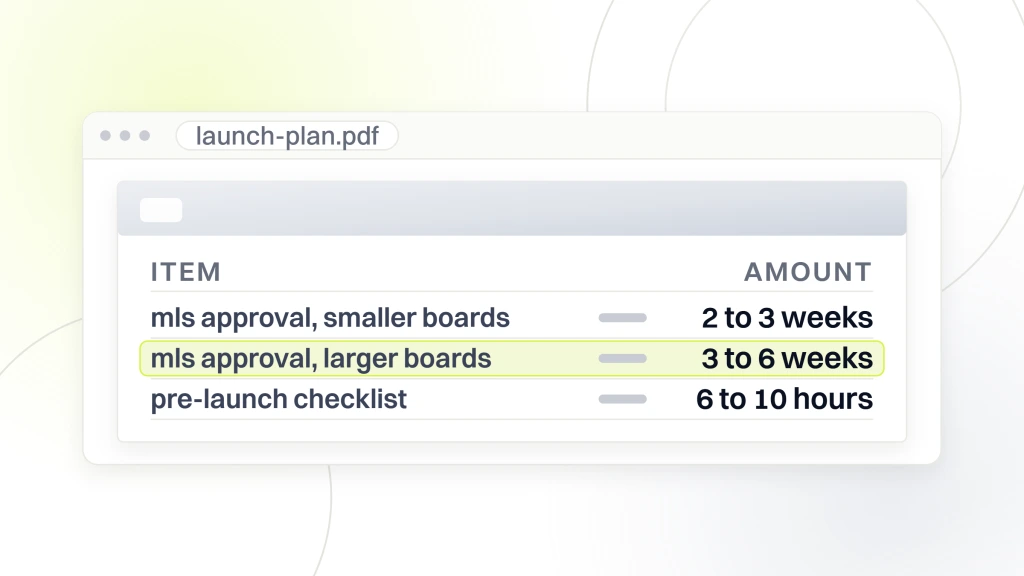
Approval timeline runs 2 to 6 weeks depending on the board. Larger boards (California Regional MLS, Bright MLS, Stellar MLS) run 3 to 6 weeks. Smaller regional boards run 2 to 3 weeks. The approval steps: submit the vendor pairing form to the board, sign the IDX agreement, pass agent-account verification, and wait for the board admin to activate the feed on the vendor side. Projects that launch design and dev in parallel with MLS approval absorb the wait window. Projects that wait for approval to start dev usually miss the launch date by 3 to 5 weeks.
Attribution requirements shape both compliance and design. Every listing page usually needs the MLS board name, the listing brokerage name, the listing agent name, and a disclaimer paragraph at the bottom of the page. Projects that skip the attribution block get flagged in the first monthly compliance audit and forced to add the block after launch. Bake it into the template from wireframe week.
Compliance covers what fields you can show. Some boards restrict listing history, days-on-market, and price reductions on IDX feeds. Some hide the listing agent’s phone number and require the buyer to contact through the IDX site owner. Every brief should include a field-by-field compliance review before wireframes. Skipping this review produces a launch-week discovery that half the listing detail pages have to be rebuilt to meet the board’s IDX policy.
Real estate website design and hosting requirements for IDX
Hosting requirements for an MLS-integrated build are stricter than for a plain agent brochure site. IDX search hits the vendor API on every buyer query, and slow hosting compounds with slow API response into search render times over 3 seconds. Search render past 3 seconds kills mobile conversion rate. Teams need to plan the hosting tier at brief time, not after launch. Reference the current real estate website design trends when scoping features.
WordPress solo agent hosting on Kinsta or WP Engine starts at $35 to $65 per month and works for Realgeeks or Placester at solo agent traffic volumes. Team hosting bumps to $95 to $240 per month for higher traffic tiers, staging environments, and dedicated PHP worker allocation that iHomefinder benefits from. Custom-built brokerage sites on AWS or Vercel start at $180 to $600 per month depending on IDX API request volume and image CDN usage.
Image CDN matters more on real estate sites than most content sites. Listings carry 25 to 50 photos per property. Serving those photos from the origin server kills page speed. Cloudflare Images, ImageKit, or Bunny.net CDN at $10 to $80 per month per site handles the image serving and the WebP conversion. Sites that skip image CDN see mobile page load hit 5 to 8 seconds on listing pages and lose 40 to 60 percent of paid mobile traffic.
Page speed sets the ceiling on IDX conversion. Google’s LCP benchmark puts the good threshold at 2.5 seconds. Teams should benchmark LCP on the homepage AND on a mid-range listing page over a 4G connection before launch. If LCP sits above 2.5 seconds, either upgrade the hosting tier, install an image CDN, or restructure the IDX vendor tier before launch. Fixing page speed after launch is 3 to 5 times more expensive than fixing it before.
Schema markup on IDX listings for your MLS site
Schema markup on IDX listings feeds Google’s rich results with structured data and pulls organic clicks away from Zillow and Redfin. Every listing page needs schema.org markup for RealEstateListing or Product type, with price, address, photo array, and availability. Skipping the schema means Google can’t render your listings as rich results and the traffic goes to portals instead.
The four IDX vendors handle schema differently. Realgeeks inserts basic schema on listing pages by default but skips agent Person schema and the deeper LocalBusiness fields. iHomefinder handles schema more thoroughly out of the box, including agent Person schema on single listing pages and market-insight article schema on blog templates. Placester’s schema depth sits between Realgeeks and iHomefinder, adequate for basic rich results but shallow on Person and LocalBusiness. IDX Broker gives developers full markup control through custom templates, so schema depth becomes a build decision rather than a vendor default.
Custom schema implementations run on top of the vendor’s default. If your brief includes rich results as a clear goal, plan for 4 to 12 hours of dev work to add the deeper schema fields the vendor skips. RealEstateListing schema plus Person schema for the listing agent plus LocalBusiness schema for the brokerage plus BreadcrumbList schema for navigation is the minimum for a competitive setup. Reference the Google Real Estate Listing structured data guide for the field-by-field markup requirements.
Schema testing before launch matters. Google’s Rich Results Test validates every listing template against the schema requirements and flags missing fields. Projects should test 3 to 5 sample listing pages before launch, fix any schema warnings, and re-test until every sample passes cleanly. That 2-hour test cycle prevents 6 months of rich-result underperformance after launch.
Comparison of vendors for idx real estate website design
The four dominant IDX vendors differ across five decision criteria. The table below sizes each vendor across the criteria that matter for an IDX build.
| Criterion | Realgeeks | iHomefinder | Placester | IDX Broker |
|---|---|---|---|---|
| Solo monthly price | $99 to $249 | $130 to $260 | $79 to $169 | $60 to $149 |
| Team monthly price | $249 to $599 | $299 to $525 | $199 to $399 | $149 to $349 |
| Setup time after MLS approval | 6 to 12 hours | 12 to 24 hours | 4 to 8 hours | 8 to 24 hours |
| Search UX polish | Portal-grade | Portal-grade | Dated | Developer-flexible |
| Schema depth out of box | Basic | Deep | Basic | Full control (dev-built) |
| Best fit | Team lead-gen | Team custom build | Solo starter | Custom WordPress dev |
Pick the vendor based on the site scope and the segment brief. Solo agents on a lean starter budget usually pick Placester or IDX Broker at the lowest tier. Team lead-gen shops usually pick Realgeeks for the built-in CRM and drip campaigns. Boutique brokerage custom builds usually pick iHomefinder. The search UX matters more at that scope and the schema depth pays back through better rich-result rendering. Custom WordPress builds with a dev team usually pick IDX Broker for the template freedom.
Every project should run a small pilot before signing the multi-year vendor contract. Most vendors offer a 30-day trial or a 90-day pilot with reduced fees. Use the pilot to benchmark search render time on mobile, test the mobile map search on real devices, and verify the schema markup passes Google’s Rich Results Test. Vendors that fail those tests during pilot rarely fix them after contract signing.
Pricing for an IDX build and web design
Total pricing for an IDX build splits across three buckets. The web design build, the IDX vendor monthly fee, and hosting plus CDN. Plan the total against your first-year lead-gen goal, not against the lowest single line item.
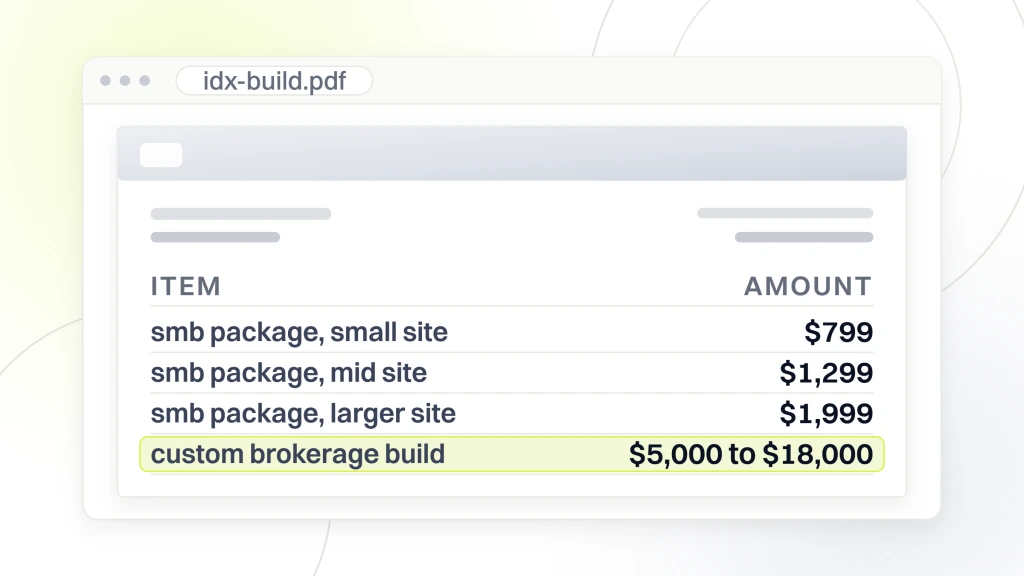
Web design build cost sizes with the scope. At Redefine Web our SMB website design packages sit at $799, $1,299, and $1,999 as one-time build fees for solo agents and small teams that want a launch-ready site. Custom brokerage builds with heavier IDX customization, agent directory pages, and CRM wiring run $5,000 to $18,000+ depending on template count and integration depth.
IDX vendor monthly fees stack on top of the build. Solo agents run $60 to $260 per month across Placester, IDX Broker, Realgeeks, or iHomefinder. Teams run $149 to $525 per month. MLS board dues and initial IDX approval add a $200 to $800 one-time cost at engagement start.
Hosting and CDN round out the monthly stack. Solo WordPress hosting on Kinsta, WP Engine, or SiteGround runs $35 to $65 per month. Team hosting runs $95 to $240. Image CDN at $10 to $80 per month keeps listing photo delivery fast. Total monthly cost lands between $110 and $850 depending on tier and scope, on top of the one-time build.
Named case studies for real estate IDX website design
Abels Residential is a Redefine Web client, a new London lettings agency that briefed a conversion-focused website plus focused SEO from day one. The design brief included a compact property-search block styled the same way an IDX search would appear on a US real estate site. The site produced 20+ qualified rental leads per month, 300+ keywords ranked on Google’s first page, and a sub-2-second fully loaded page speed across every template.
The Abels build is instructive for IDX-adjacent design decisions. Even without a full US-style IDX feed, the search block was reduced to three fields, rendered inline with the site’s brand chrome, and hit the same sub-2-second render benchmark that any IDX build should target. Structured data across every listing gave the search results rich-result treatment in Google, and the mobile-first responsive layout meant the search block worked at 375 pixels the same way it worked at 1440 pixels.
McCarthy Court is a second Redefine Web client, a 7-unit luxury Sidcup development that briefed an immersive virtual showcase site for pre-construction sales. The site sold the development out 100 percent in 3 months pre-completion, produced 60+ qualified buyer leads, and drew 10,000 targeted campaign visits. The lesson for IDX builds sits in the visual grammar. High-spec property renderings, lifestyle content, and prominent lead-capture CTAs move buyers to inquire even before physical tours exist.
Adjacent Redefine Web work with a top-tier Los Angeles luxury real estate team ran a fully custom rebuild across a decade-long partnership. That engagement included IDX integration on a custom build, refreshed brand identity, and SEO-optimized long-form market-insight content. Users doubled (+100 percent), new-user share doubled (+100.1 percent), and pageviews more than doubled (+102.6 percent) against the prior site baseline. The IDX vendor choice on that engagement matched iHomefinder-tier polish. The luxury segment demands portal-grade search UX.
One broker briefed us on his previous IDX integration by describing it as “a search box that took a coffee break.” Every buyer query took 4.5 to 6 seconds to return results, and his bounce rate on the listings page ran 78 percent. His fix? A new IDX vendor and an image CDN. His words at the retrospective: “turns out buyers don’t wait for a coffee break.” No, they do not.
SEO for a real estate website design with MLS integration
SEO for an IDX real estate site earns targeted organic traffic from Google’s non-paid results by pairing three moves. Publish high-value content around neighborhoods and buyer questions, optimize each page for a set search term, and earn backlinks from local media and industry sites. IDX pages alone rarely rank at the top of Google. Portals like Zillow and Redfin have decades of domain authority. Your ranking wedge sits in market-insight blog content, neighborhood guides, and school-district pages that your IDX competitors ignore.
Neighborhood content is the single biggest lever for a solo agent or boutique team. A well-written 1,500-word guide to a single neighborhood, with median price, school ratings, walkability score, and 5 recent transactions, outranks portal city pages for the long-tail buyer queries. Publish 20 to 40 neighborhood guides in year one and organic traffic compounds against the IDX vendor’s default sitemap.
Backlinks matter next. Sponsor a local Little League team and earn a link from the league site. Guest-post on a regional real estate publication. Partner with a mortgage broker on shared content and cross-link. Every backlink from a real estate or local site pushes the site closer to first-page rankings for the core buyer queries.
For the wider retainer motion behind real estate SEO across a brokerage, see our guide to Commercial Real Estate Website Design Services, which covers the multi-market SEO stack alongside the design build.
Pre-launch checklist for your MLS-integrated site
Pre-launch tests catch the issues that would cost months of underperformance if they slip through to production. Every project should run this checklist in the final week before launch.
- Search render benchmark. Mobile 4G test hitting sub-2.5-second LCP on the homepage AND a mid-range listing page.
- Schema validation. Google Rich Results Test passing on 3 to 5 sample listing pages with no warnings.
- MLS attribution rendering. MLS board name, listing brokerage, listing agent, and disclaimer paragraph visible on every listing page.
- Mobile map search test. Pinch-zoom, polygon draw, and pin touch all working on real iOS and Android devices.
- Saved-search alert email test. Signup, confirmation, and first alert delivery all working end-to-end.
- CRM auto-response. Form submit test with response inside 5 minutes to the agent’s phone or Slack.
- Analytics install verification. GA4 events firing on form submit and phone click, Microsoft Clarity capturing sessions, CallRail dynamic numbers rendering.
Skipping any single test line usually produces a post-launch discovery inside the first 4 weeks that costs 4 to 8 hours of remediation dev work. The checklist takes about 6 to 10 hours to run end-to-end. Every project pays back the checklist time inside the first month by avoiding the post-launch fire drills that would otherwise land on the developer’s queue.
For deeper mobile testing patterns, reference Google’s mobile-friendly test guide and pair it with a Lighthouse audit on the mobile emulator. Every listing template should score 90+ on Lighthouse Performance before launch, with LCP under 2.5 seconds and CLS under 0.1. Templates that fail those benchmarks need refactoring before the site goes live, not after.
Ongoing maintenance for an IDX site
Ongoing maintenance for an IDX site covers vendor updates, MLS policy changes, schema drift, and page-speed regressions. Every quarter the IDX vendor pushes a plugin or SDK update. Some updates change the search UX subtly, and if the site relies on custom CSS overrides those overrides break silently. Maintenance retainers should include a quarterly regression test on the search UX.
MLS policy changes happen about twice a year on most boards, usually covering attribution updates, field restrictions, or agent verification steps. Vendors typically communicate the change 30 to 60 days ahead of the enforcement date. Maintenance retainers should include monitoring the vendor’s policy email and updating the site templates within the notice window. Sites that miss the notice window get flagged in the next compliance audit and have to scramble to fix templates in production.
Page-speed regressions happen quietly. A theme update pushes a heavier JavaScript bundle, an image plugin update reverts to non-WebP output, a security patch changes the caching headers. Every maintenance retainer should include monthly Lighthouse checks on 3 to 5 core templates and quarterly LCP benchmarking on mobile. Speed drift is the most common cause of a 6-month conversion decline that agents blame on “the market” when the actual cause is a page-speed regression the maintenance team missed.
Schema drift is another quiet failure mode. Google occasionally updates the schema.org RealEstateListing spec, deprecating some fields and adding others. Vendors usually catch these updates, but custom schema on top of the vendor’s default doesn’t get updated automatically. Maintenance retainers should include a quarterly Rich Results Test on 3 to 5 listing pages to catch schema deprecations before they cost rich-result impressions.
What to check this week on your IDX site
Three actions to finish by Friday. Open your homepage on a mid-range Android phone over 4G and time the search block render. Run Google’s Rich Results Test on 3 of your current listing pages. Pull your IDX vendor’s contract and check the renewal date plus the tier you’re paying for.
Those three inputs shape the entire IDX iteration brief. Projects that skip the render test, the schema test, and the vendor contract review usually spend 3 to 5 months guessing at underperformance, and the actual causes hide inside vendor settings and template configs. Do the audit first, then decide whether the fix is a settings tweak, a vendor upgrade, or a full vendor swap.
Teams that want the IDX audit plus the fixes handled together can hand it to our Real Estate Website Design Services team. We run the render benchmark, schema validation, and vendor comparison across one 2 to 4 week engagement. For the wider retainer motion behind a real estate account, see Real Estate Marketing Agency for Brokerages. Custom IDX builds on WordPress pair with WordPress Website Development Services and Responsive Web Design Services that Convert.