
Write Creative Dental Ads That Stop the Scroll
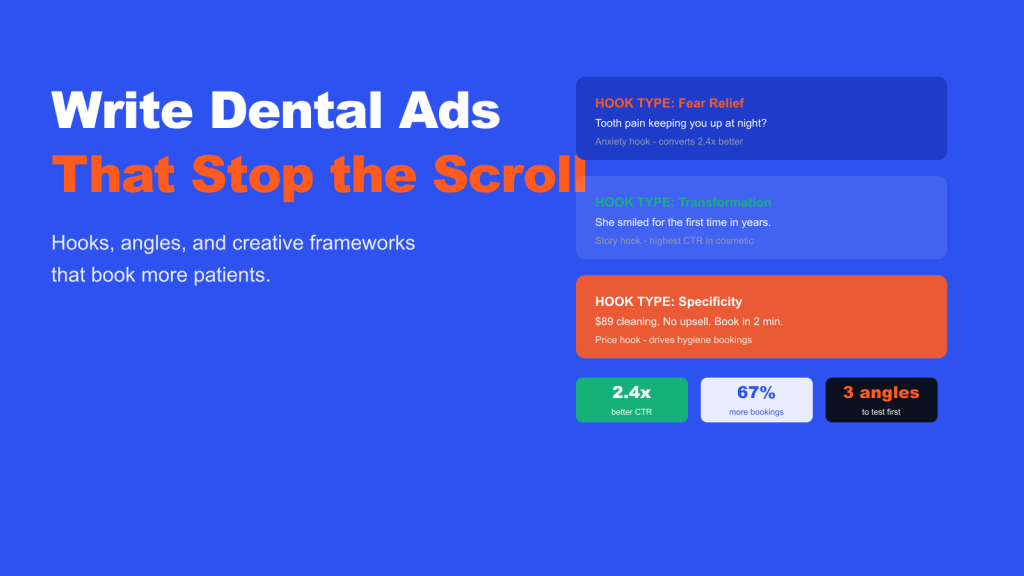
Generic dental ads blend into the background and cost practices thousands in wasted spend each month. Creative dental ads do the opposite. They stop the right patient mid-scroll, make the practice feel instantly trustworthy, and convert that attention into a booked appointment. This guide covers the hooks, angles, and frameworks that drive that result across every major ad platform.
[rdw_takeaways items=”Creative dental ads work by matching the right angle to the right patient intent: fear relief for emergencies, transformation for cosmetic, specificity for routine services.|The hook is the single most important creative decision. A weak headline erases good targeting, a good audience, and a well-built landing page.|Meta video ads with a patient story hook in the first three seconds consistently outperform static creative for high-value dental services.|Testing three ad angles simultaneously shortens the path to finding your top performer from months to weeks.|Creative fatigue hits dental Meta ads in four to six weeks. Fresh creative rotation is not optional.”]
[/rdw_takeaways]
Why Creative Makes or Breaks Dental Ad Performance
Two dental practices can run identical budgets, identical targeting, and identical campaign structures. One books 40 new patients a month. The other books four. The difference, in almost every case we have audited, sits in the creative: the headline, the hook, the visual, and the angle the ad takes to reach the patient.
Targeting gets you in front of the right person. Creative determines whether that person pays attention, clicks, and books. You can fix targeting with audience adjustments and keyword changes. Fixing weak creative requires writing, testing, and iteration. Practices that invest in creative quality consistently outperform those that focus only on bidding and budget.
The dental ads that perform best share a specific creative structure. They open with something the patient is already thinking. They build trust with a proof element that feels specific rather than promotional. They close with a single action the patient can take right now. Every creative decision flows from that structure.
The Four Core Creative Angles for Dental Ads
Every creative dental ad draws from one of four angles. Picking the right angle for the right service and the right audience is the decision that sets the performance ceiling before you write a single word.
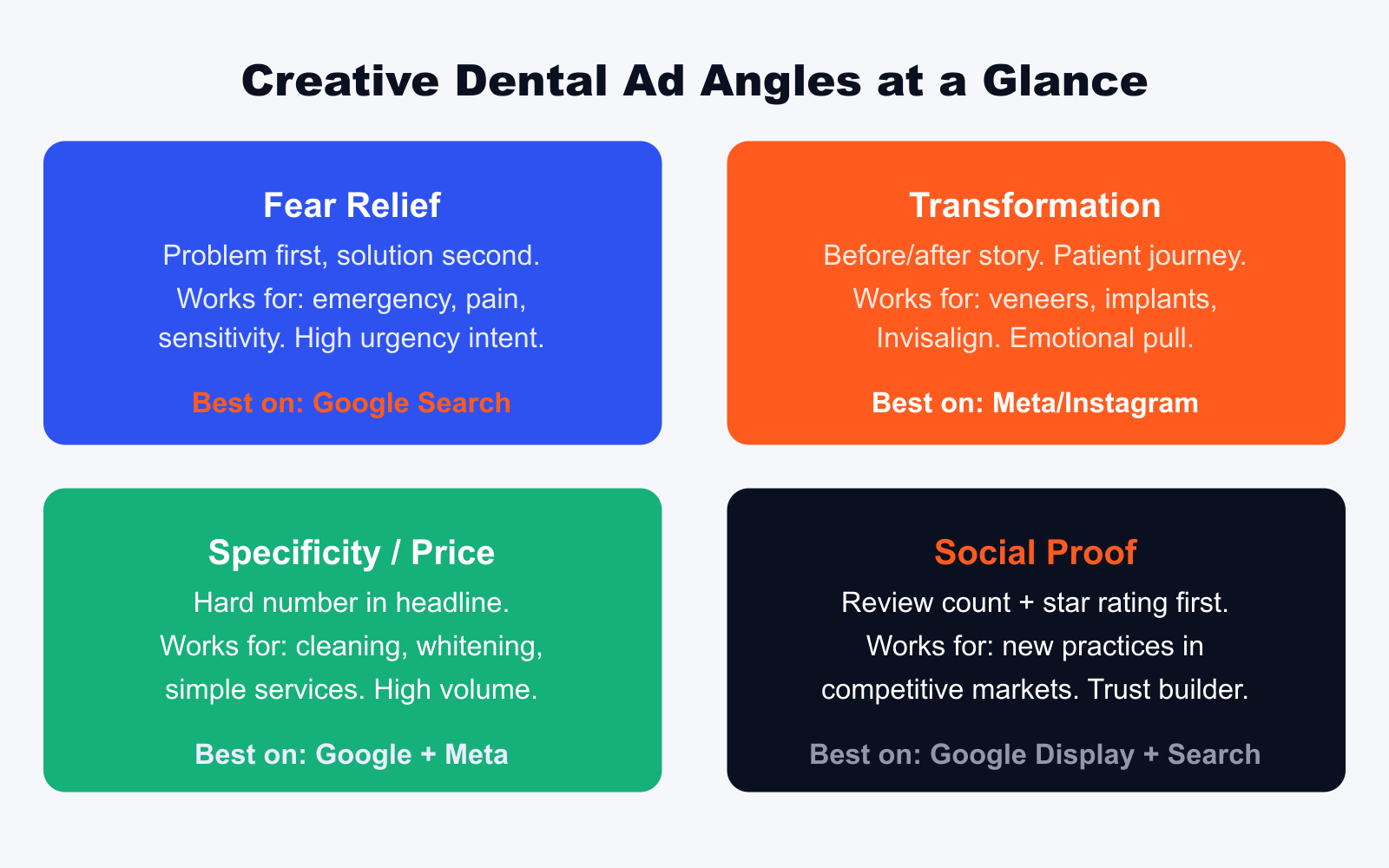
Fear relief. Name the problem the patient is already anxious about, then position your practice as the immediate solution. Tooth pain keeping you up at night? We have same-day appointments available now. This angle drives the highest urgency conversions for emergency dental, pain-related searches, and anything that involves a patient who cannot wait. It works best on Google search where the patient has already typed a problem into the search bar.
Transformation. Show what changes for the patient after treatment. She smiled for the first time in years. He stopped hiding his teeth in photos. This angle works for cosmetic dentistry, implants, Invisalign, and any service where the emotional outcome is as important as the clinical outcome. It requires real patient stories with proper consent documentation and performs best in Meta video and Instagram creative.
Specificity. Replace every vague claim with a number. $89 cleaning. No upsell. Book in under two minutes. This angle works for high-volume routine services where price transparency drives conversion. Patients who are shopping hygiene appointments and whitening respond to specific numbers faster than any other creative signal. It performs on both Google search and Meta.
Social proof. Lead with the review count and star rating. 1,400 Google reviews, 4.9 stars. Family dental care. Same-week availability. This angle works in competitive markets where multiple practices are advertising similar services. It builds instant credibility without requiring the patient to take any faith leap.
| Angle | Best Service Match | Best Platform | Primary Emotion |
|---|---|---|---|
| Fear relief | Emergency dental, pain, sensitivity | Google Search | Urgency |
| Transformation | Implants, veneers, Invisalign, whitening | Meta video, Instagram | Aspiration |
| Specificity | Cleaning, hygiene, simple services | Google Search, Meta | Confidence |
| Social proof | Any service in a competitive market | Display, Google Search | Trust |
Creative Hooks That Stop the Scroll on Meta
On Meta, the hook is everything. You have three seconds to interrupt a patient who is watching a video of someone else baby or reading a news story. If the first three seconds of your video or the first sentence of your caption does not do work, the rest of the ad is invisible.
The best Meta hooks for creative dental ads follow a few proven patterns. Question hooks work because they create an open loop the brain wants to close. Are you still hiding your smile in photos? Is tooth sensitivity ruining your morning coffee? The patient reads the question and their brain immediately evaluates whether it applies to them. If it does, they keep reading.
Contrast hooks open with the old state and pivot immediately to the new state. Two years ago, she avoided every group photo. Today she books one every weekend. The contrast creates narrative tension that pulls the patient into the story. This is one of the highest-performing hooks for cosmetic dental Meta campaigns.
Number hooks front-load specificity. 47 patients in this city replaced their missing teeth last month. 1,200 five-star reviews. $89 cleaning, booked in under two minutes. Numbers override the pattern-matching brain that would normally dismiss an ad as promotional content. The brain registers a number as information, not advertising.
The dental Facebook ads that produce the most booked appointments combine a pattern-interrupt hook with the transformation or fear relief angle. The hook stops the scroll. The angle connects the ad to a specific patient need. The CTA converts the connection into an action.
Creative Hooks That Drive Clicks on Google Search
Google search hooks work differently from Meta hooks. The patient has already named their intent in the search query. Your job is not to stop a scroll but to win a comparison. The patient is looking at three to five ads and deciding which one to click. Creative dental ads win that comparison by matching the search term more precisely and by offering something the other ads do not.
Mirror hooks repeat the patient query back to them with specificity added. If someone searches emergency dentist open now, the winning headline is usually something close to Emergency Dentist. Open Today. Same-Day Appointments. The closer the match, the faster the brain registers the ad as relevant. Google bolds the keywords in results, which makes a precise match visually stand out from adjacent ads.
Qualifier hooks add a detail that pre-screens the patient for fit. Dental Implants from $3,200. Book a Free Consult. The price removes unqualified clicks. The free consult lowers the commitment threshold. The combination drives fewer clicks but a much higher booking rate per click. For high-value services, a lower click volume at a higher conversion rate almost always produces a better cost per booked appointment.
The Google Ads structure that supports creative dental ads best keeps one service per ad group with three to five headline variants per group. Write each headline to test a different element: one tests the service name, one tests the price or availability, one tests the social proof. Rotate them in responsive search ads and let Google identify which combinations produce the highest CTR over three to four weeks.
Creative Frameworks for High-Value Dental Services
High-value dental services need multi-touchpoint creative strategies. A patient considering $8,000 in full-arch restoration is not going to book from a single ad. The creative framework for these services spans awareness, consideration, and decision stages, and each stage needs different creative.
At the awareness stage, the goal is brand familiarity and problem acknowledgment. The creative does not ask for a booking. It opens a conversation. Are you a candidate for dental implants? Take our 60-second quiz. The patient who engages with that touchpoint has self-identified as a potential implant candidate. Retarget that audience with transformation-angle creative at the consideration stage.
At the consideration stage, the creative builds trust with specificity. Show before-and-after results with real patient data (with consent). Include the practice name, the procedure, and the timeline. Patients who are comparing practices need to see proof of capability. Generic before-and-after images from stock libraries do not produce the same trust response as a documented real-patient result.
At the decision stage, the creative removes the last barrier. Free consultation. No commitment needed. We will show you exactly what your result could look like. The patient is close to deciding. The creative removes the perceived risk of taking the next step. This stage converts through low-friction offers, not through more information.
We applied this framework at Trilby Misso Lawyers, one of Queensland’s largest personal injury firms. By building an awareness-to-decision creative sequence on Meta using audience segmentation and stage-specific messaging, we achieved 183% more leads, 8x more clients, and 89% lower cost per acquisition without increasing ad spend. The same sequential creative logic applies to high-value dental services where the patient decision cycle spans weeks, not hours.
Visual Creative Rules for Dental Ads
The visual is the first element a patient processes in a display or social ad. Copy converts. Visuals stop. The best creative dental ads use visuals that communicate the core angle before the patient reads a word.
For fear relief ads, the visual should show the resolution, not the problem. An image of a person holding their jaw in pain is memorable but triggers avoidance. An image of someone smiling after an emergency appointment triggers approach. The ad copy can acknowledge the problem. The visual should show the solution.
For transformation ads, before-and-after composites work when they show a realistic, believable improvement rather than a dramatic magazine-style contrast. Patients respond to results that look achievable, not results that look retouched. The more realistic the before, the more powerful the after feels.
Dentist-to-camera video consistently outperforms stock imagery for both Meta and YouTube pre-roll. A 15-second clip of the dentist introducing themselves, naming the service, and making a specific claim builds more trust than any designed graphic. Patients are choosing a person to put their hands in their mouth. Seeing the actual person matters more than any creative polish.
Before running before-and-after visual creative, review your state dental board advertising rules and the dental advertising compliance requirements for your state. Several states require specific consent language with before-and-after imagery. Running non-compliant creative risks ad disapproval, account suspension, and board complaints.
Testing Creative Dental Ads Efficiently
Most practices test too many creative variables at once and end up with data that does not tell them anything. The efficient approach tests one element at a time, gives each variant enough time to accumulate meaningful data, and makes decisions based on conversion rate, not CTR alone.
Start with the angle. Test fear relief versus transformation on the same audience for the same service over three weeks. Whichever angle produces more booked appointments becomes the control. Then test hooks within that angle. Then test visuals. Never test angle, hook, and visual simultaneously, because you will never know which variable drove the difference.
On Google, use responsive search ads to test headline combinations. Write 10 to 12 headlines that span all four angle categories and let Google’s system identify which combinations produce the highest CTR over three to four weeks. After that data window, pause the underperformers and write three new variants to replace them. This rotation keeps creative fresh and continuously pushes toward higher-performing combinations.
On Meta, run no more than three ad sets simultaneously targeting the same audience. More than that and Meta optimizes for budget efficiency in ways that starve your test variants of data. Three ad sets with three different angles gives you clean comparative data within two weeks.
Track conversions, not impressions or clicks. Creative dental ads that drive booked appointments are good creative, regardless of CTR. Creative that drives a 12% CTR and no bookings is expensive entertainment. Connect your ad platform to real booking events through call tracking or form submissions tied to Google Analytics 4. See the full attribution setup in our guide on dental PPC landing pages.
Creative Dental Ads Across Different Practice Types
Creative angles that work for a boutique cosmetic practice in a wealthy suburb are not the same ones that work for a high-volume general practice in a working-class market. Practice type shapes which angles resonate and which ones alienate.
High-volume general practices perform best with specificity and social proof angles. These patients want to know: is this practice affordable, is it convenient, and does it have good reviews? Answer those three questions in your creative and you capture most of the bookings available in your market.
Boutique cosmetic practices perform best with transformation and social proof angles. These patients want to know: has this practice done this before, what did the results look like, and will I feel uncomfortable here? Real patient transformation content and high-quality visual creative communicate those signals faster than any copy.
Emergency and urgent care dental practices perform best with fear relief angles combined with extreme availability specificity. Open until 9 p.m. today. Same-day slots available. $150 emergency visit, no insurance needed. That combination converts the most distressed patient segment in dental advertising.
For multi-location groups and DSOs, creative needs to vary by location rather than running a single brand ad across all markets. A practice in Seattle and a practice in rural Georgia have different competitive landscapes, different patient demographics, and different price sensitivity levels. Location-specific creative outperforms brand-generic creative even when both are running the same angle. The full channel strategy for multi-location groups is covered in our guide on dental social media ads.
Frequently Asked Questions About Creative Dental Ads
What are the most effective creative angles for dental ads?
The four most effective creative angles for dental ads are fear relief, transformation, specificity, and social proof. Fear relief works best for emergency and pain-related services on Google search. Transformation works best for high-value cosmetic services on Meta video and Instagram. Specificity works for high-volume routine services on both platforms. Social proof works across all platforms for practices in competitive markets with strong review profiles.
How long does a creative dental ad stay effective before it needs to be refreshed?
On Meta, creative dental ads typically show performance decay after four to six weeks with the same audience. On Google search, responsive search ad combinations can stay effective longer since Google rotates headline combinations rather than showing the exact same ad repeatedly. The signal to refresh creative is a rising cost per click with a falling conversion rate, not a calendar date.
Do creative dental ads need to show the dentist on camera?
No, but dentist-to-camera video consistently outperforms stock imagery for Meta and YouTube pre-roll. A 15 to 30 second clip of the dentist introducing themselves and making a specific claim builds more trust than a designed graphic in most markets. Practices that run dentist-to-camera creative alongside static ads typically see the video outperform static by a measurable margin within the first three weeks of a split test.
How many ad variants should a dental practice test at once?
On Meta, run three ad sets simultaneously testing different angles on the same audience. More than three and you risk starving each variant of data. On Google, use responsive search ads with 10 to 12 headline options and let the platform identify top combinations. Test one element at a time to get clean directional data: angle first, then hook, then visual.
Can creative dental ads work for small practices with limited budgets?
Yes. Creative quality has no minimum budget requirement. A dentist recording a 30-second to-camera video on an iPhone costs nothing to produce and often outperforms professionally shot stock imagery. Strong copy in a Google search headline costs nothing extra. The creative advantage available to a small practice is authenticity: a real dentist talking directly to patients in a specific neighborhood is something a corporate DSO cannot replicate at scale.
What creative elements are restricted in dental advertising?
State dental boards restrict outcome guarantees, unsubstantiated superiority claims like best in the city, and before-and-after imagery without appropriate consent documentation in many states. Google and Meta also have platform-level restrictions on certain health claims. The full compliance picture is in our guide to dental advertising compliance.
Want us to audit your current dental ad creative and identify which angle is most likely to move your bookings? See what we do for dental practices at our dental PPC page.
Book your free 30-minute strategy call.
No spam, no sales rep. We use your email to schedule your call with a senior strategist. That is it.
More from the blog
View all articles → PPC
PPC Home Services PPC Marketing: What a Strong Campaign Looks Like
Read article PPC
PPC PPC for Home Service Businesses: How to Lower Cost Per Lead
Read article PPC
PPC