
Custom Web Development Services for Educational Platforms and Other Verticals
- Six verticals with distinct build costs: education, healthcare, fintech, nonprofit, supply chain, print.
- Custom pays back in 12 to 24 months when SaaS coverage drops below 55 percent.
- Compliance work adds 30 to 50 percent to a fintech project timeline.
- Phased modernization ships value every 4 to 6 months instead of at year two.
- Vendor red flags: fixed-price bids, no discovery, no named engineers.
- Custom health services web app modernization developers and what they actually deliver
- Affordable custom web app development services for nonprofits
- Custom supply chain industry web app development services that untangle a real logistics workflow
- Custom web development services security compliance fintech and what a real audit costs
- Custom web to print development services for shops that still run on Adobe files
- Build versus buy across the six verticals
- Case study on Automation Anywhere and vertical acquisition economics
- Pricing custom web development services for educational platforms and other verticals
- How to pick leading providers of custom web development services for healthcare enterprises and other verticals
Custom web development services for educational platforms interactive features are only one slice of a bigger reality. You build software for a hospital network, a fintech startup, a K to 12 district, a nonprofit, a freight brokerage, or a print shop, and every one of those verticals brings a specific compliance stack, user base, and list of things a generic SaaS tool will never solve. Vertical software is where custom development pays back the fastest because the shortcut never existed.
This guide covers what a real industry-specific build looks like in six verticals you probably serve or sell into. Education, healthcare, fintech, supply chain, nonprofits, and web-to-print. Custom web development services for educational platforms sit alongside custom health services web app modernization, custom supply chain web app development services, and fintech security compliance in the same conversation. You get the actual scope of work, the cost band, the compliance stack, and the sequence you build in so the first release lands something useful instead of a shell that needs six more months. Read straight through in about fourteen minutes.
Custom health services web app modernization developers and what they actually deliver
Healthcare software has the longest replacement cycle in enterprise IT. You bought a patient portal in 2014, it runs on a stack nobody supports anymore, and swapping vendors mid-decade would cost $1.4 million and 18 months of clinician retraining. So the app stays in place and gets bolted onto with integrations. The right move is modernization in place, not rip and replace. Custom health services web app modernization developers rebuild the front end on a modern framework, wrap the legacy database in an API layer, and hand you back a system that runs another decade without the annual scare of a vendor sunset.
A modernization project runs in three phases. First, you build a read-only API on top of the legacy database and a new React or Vue front end that mirrors the current screens with better UX. Second, you migrate writes to the new API, keeping the legacy database as system of record. Third, you retire the legacy UI and, optionally, migrate the database itself. Each phase runs 4 to 8 months and each phase is independently useful. Your hospital gets a modern experience in six months without waiting three years for a full replatform.
| Healthcare build type | Timeline | Cost band | Common outcome |
|---|---|---|---|
| Patient portal redesign | 3 to 5 months | $95,000 to $180,000 | Portal usage climbs 40 to 70 percent |
| Legacy app modernization | 10 to 16 months | $280,000 to $620,000 | Support tickets drop 55 to 75 percent |
| HIPAA compliance layer | 6 to 10 weeks | $45,000 to $85,000 | Passes annual audit clean |
| Telehealth integration | 4 to 7 months | $140,000 to $260,000 | Virtual visit share hits 25 to 35 percent |
HIPAA is a scope decision, not a feature
HIPAA compliance touches every layer of the stack. Encryption in transit and at rest. Audit logging on every data access. Role-based access control down to the record level. Business associate agreements with every hosting and analytics vendor. Signed BAA covers about 60 percent of the work. The other 40 percent is code, and it has to be built from day one because retrofitting HIPAA into an existing codebase is where projects go over budget by 90 to 140 percent. See our healthcare web design pillar for the full compliance frame.
Custom health web app redesign development services in practice
A redesign is not a fresh coat of paint. It is a chance to re-examine the information architecture, the auth flow, the appointment booking, and the mobile experience. Custom health web app redesign development services usually start with a two-week discovery, one-week competitor teardown, and a three-week clickable prototype tested with 8 to 12 real patients. Then engineering runs 12 to 20 weeks in parallel with a phased rollout. Leading providers of custom web development services for healthcare enterprises structure the project this way because it lets the hospital see and touch the product every two weeks instead of waiting for a big-bang launch.
Affordable custom web app development services for nonprofits
Nonprofits get the wrong pitch from most agencies. A $180,000 discovery-heavy Salesforce Nonprofit Cloud rollout that solves 30 percent of the mission and burns 40 percent of the annual tech budget for the next three years. Affordable custom web app development services for nonprofits start smaller and land closer to the actual work. Donor management, volunteer scheduling, program impact reporting, and a public grants portal. Four modules, one codebase, $65,000 to $110,000 for a real 40-user launch, plus a $1,500 to $2,800 monthly retainer for maintenance and small feature adds.
The affordability comes from scope discipline, not from cheap labor. You build the four modules the nonprofit uses every day. You skip the reporting engine that nobody will run more than twice a year. You use battle-tested open source components for auth, forms, and reporting instead of paying a vendor for the same code wrapped in a subscription. The board sees a running system in month four instead of a slide deck in month eleven. Grant funders see impact data pulled from the live app instead of a hand-assembled PDF.
Donor CRM that fits the actual gift cycle
Nonprofit donor cycles do not look like B2B sales cycles. You have an annual giving push, a monthly recurring giving base, a lapsed donor reactivation, and a major gifts pipeline that runs on relationship notes more than automation. Salesforce forces you into a stage-based sales pipeline. A custom donor CRM lets you model the four cycles side by side, with the right notification and reporting rhythm for each. Executive directors get a 12-month view they can hand to the board instead of exporting to a spreadsheet every quarter.
What the $65,000 to $110,000 band actually buys
In that range you get a Node or Django backend, a React or Vue front end, PostgreSQL, an S3 file store, Stripe for donations, a Mailchimp integration for email, three custom reports, role-based access for staff and board members, and a simple public donation page. You also get 3 rounds of user testing with real staff, deployment on a $220 per month cloud stack, and 4 weeks of post-launch support. Anything over that budget is either a much bigger feature set or a much bigger nonprofit. Anything under it and something on the list is getting cut.
Custom supply chain industry web app development services that untangle a real logistics workflow
Supply chain software is the vertical where custom pays back fastest because every generic tool assumes a workflow the industry does not run. Load boards move loads. Freight brokers negotiate loads. 3PL warehouses receive inventory, pick, pack, and dispatch orders. Each vertical inside supply chain runs a specific screen set, reporting cadence, and integration list against carriers, WMS, and TMS platforms. Custom supply chain web app development services build the exact stack the operation runs, not the stack the SaaS vendor wishes it ran.
The most common build in this space is a broker or 3PL operations dashboard that ties load tracking, carrier communication, EDI processing, invoicing, and customer notifications into one screen. Supply chain custom web app development services typically deliver this in 16 to 28 weeks at $180,000 to $420,000. The payback shows up as dispatcher productivity, usually 30 to 50 percent more loads moved per person per day, plus a 20 to 35 percent drop in detention and layover charges because the notifications actually go out on time.
- Load tender and acceptance workflow with carrier scorecards
- EDI 204, 210, 214, 990 processing with human-readable exception queue
- Driver check-call automation via SMS with geofenced arrival detection
- Detention and demurrage tracking with real-time customer alerts
- Broker commission calculation with split rules and payout scheduling
- Customer portal with tracking, invoices, and document downloads
- Reporting layer with lane profitability and carrier margin analysis
EDI does not have to be scary
Every carrier and shipper still runs on EDI standards from the 1980s. That is not going to change in the next decade. The modernization move is to accept EDI at the edge and translate it to JSON internally, so your app team writes normal software and only the two integration engineers ever touch a 204 file. Custom supply chain industry web app development services that handle this translation well save the operations team 6 to 12 hours a week on manual data entry and free the dispatchers to actually dispatch. Everybody stops fighting the format.
3PL warehouse workflows that generic WMS never solves
A 3PL warehouse handling four clients has four billing schemes, four labeling rules, four reporting cadences, and four minimum service levels. Off-the-shelf WMS tools model one and force the other three into workarounds. A custom overlay that runs on top of the WMS, or replaces it entirely, models all four cleanly. The build costs $220,000 to $480,000 depending on integration count, and the payback is measured in client retention. 3PLs that lose one client because reporting was too hard to customize burn 8 to 14 months of the build cost in one contract.
Add up license fees plus workaround hours today. If you're past /mo across the stack, custom pays back inside 14 months. Under that, keep the SaaS.
Custom web development services security compliance fintech and what a real audit costs
Fintech is where security scope creep sinks projects. You start with a simple lending workflow, then discover you need SOC 2 Type 2, PCI DSS, GLBA compliance, KYC and AML integrations, tokenized card handling, and a penetration test before the first customer signs. Custom web development services security compliance fintech add 30 to 50 percent to a project timeline versus a comparable non-regulated build. Budget accordingly. A $220,000 build in ecommerce becomes a $310,000 to $340,000 build in fintech for the same feature set.
The way you keep the budget under control is to make security a phase-one architecture decision, not a phase-five retrofit. Encryption libraries, secret management, audit logging, and access controls go in on day one. That way the SOC 2 audit at month nine is a documentation and evidence exercise, not a code rewrite. Firms that treat compliance as a bolt-on at the end pay their auditors twice, once to fail and once to pass. See our custom web application development services post for the phase-one architecture pattern that avoids this trap.
SOC 2 Type 2 on a real timeline
SOC 2 Type 2 requires 6 months of evidence collection before the audit even starts. That means your logging, access review, and change management processes have to be live and generating audit records from month one of the build. If you start collecting evidence in month seven, your first Type 2 audit slips to month thirteen. Fintechs that launch to customers without SOC 2 lose enterprise deals worth 10 to 40 times the audit cost. The audit itself runs $22,000 to $65,000 depending on scope, plus about 200 hours of internal engineering and compliance time.
Penetration testing before launch and after every release
A pre-launch pen test runs $18,000 to $45,000 and takes 2 to 4 weeks, plus another 3 to 6 weeks to remediate the findings and re-test. Post-launch, you schedule pen tests quarterly for the first year and annually after that. Practices that skip the pen test cadence and rely on their own team’s code review get breached inside 18 months on average. The Google security team’s web security learning path is a decent baseline for engineers new to security work, but a real pen test finds the classes of bugs internal review consistently misses.
The best pitch we ever heard from a competing fintech vendor was a promise to run a full SOC 2 audit as a two-day sprint using AI. When we asked the auditor how the AI would handle six months of evidence collection retroactively, the presenter said the AI would generate synthetic logs. Everybody on the client-side call quietly asked us to send the invoice. Meanwhile, the actual audit took nine months and passed clean because we started collecting real evidence in week one. Turns out compliance auditors read logs. Who knew.
Custom web to print development services for shops that still run on Adobe files
Web-to-print is a niche that has kept its own software segment alive for two decades because generic ecommerce tools never modeled the workflow well. Customers upload an Illustrator or InDesign file, or they configure a product inside a browser using a template, or they order variable-data direct mail with a spreadsheet upload. Custom web to print development services handle the file preflight, the price calculation with size and quantity breakpoints, the proofing workflow, the production queue, and the shipping integrations that most Shopify apps never get right.
Print shops that move from a shopping-cart-plus-email quote model to a custom web-to-print app see revenue climb 40 to 90 percent in the first year, and customer service ticket volume drop 50 to 70 percent because the app answers the questions the staff used to field on the phone. The build lands at $85,000 to $220,000 for a real B2B print shop and $180,000 to $380,000 for a shop that also runs consumer self-service and variable data direct mail. Payback is usually inside 14 months on revenue growth alone.
File preflight and proofing loops
Bleed, safety margin, embedded fonts, color mode, resolution. A print job that fails preflight in the shop is a delayed order, a support ticket, and a customer refund risk. A custom web-to-print app runs preflight the moment the file uploads, flags the issues in plain English, and either auto-corrects or sends the file back to the customer with a specific fix list. The preflight step alone cuts production errors by 60 to 80 percent and lets the shop schedule jobs with confidence instead of guessing which jobs will actually run tonight.
Variable data direct mail without a nightmare
Variable data direct mail lets a mortgage broker send 4,200 personalized postcards with different names, rates, and property addresses on each one. Off-the-shelf tools handle this with a CSV upload, a template, and about 40 minutes of clicking. A custom app handles it with an API-driven order that pulls from the broker’s CRM, generates the print file in the background, and lands the shipment tracking back in the CRM. The broker orders 4,200 postcards in 90 seconds instead of an hour, and the print shop gets a repeat customer who runs the same job every month.
Build versus buy across the six verticals
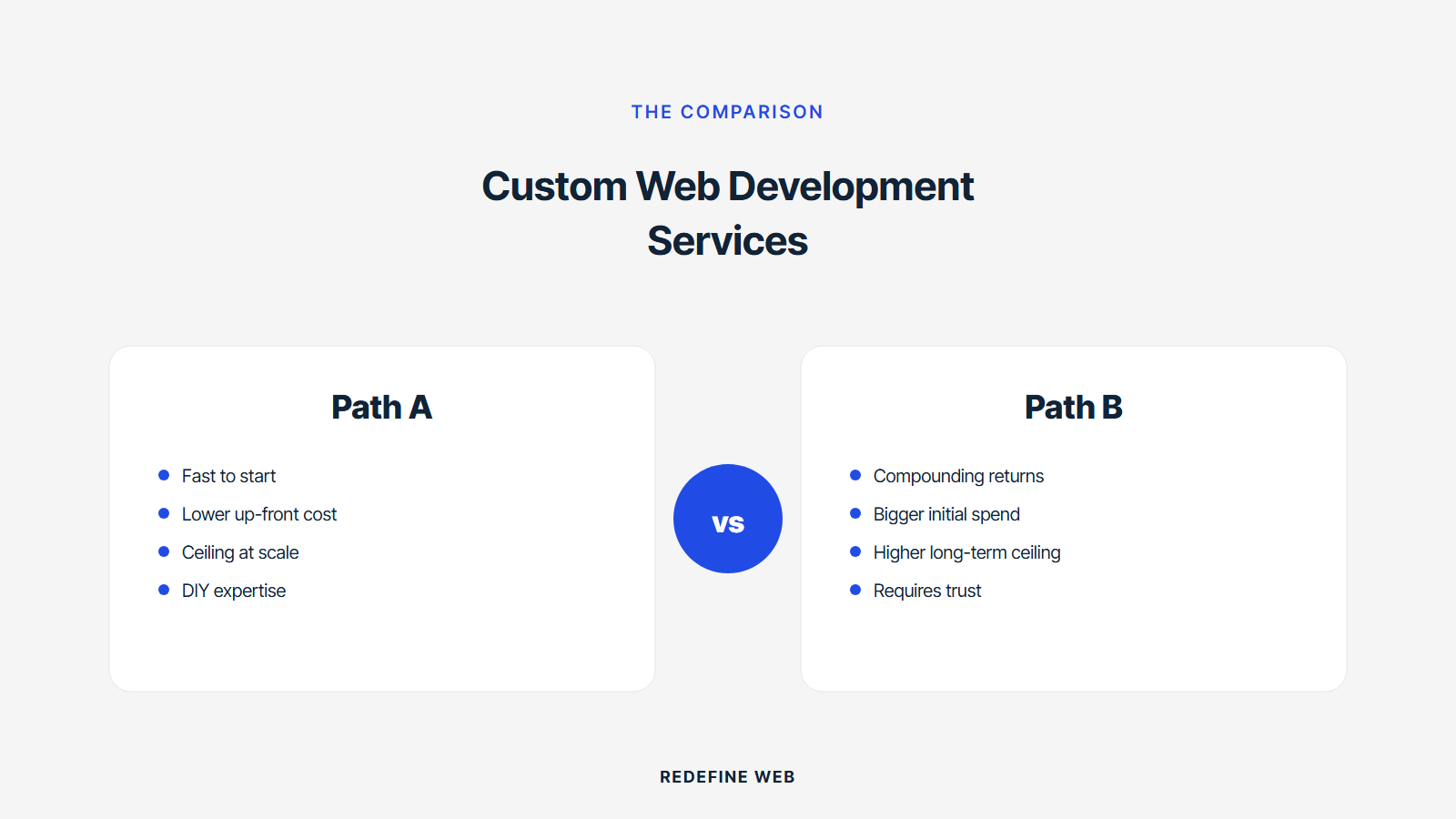
Build-versus-buy is the first honest conversation you should have with any client. The answer is not always build. Sometimes the horizontal SaaS covers 85 percent of the workflow and the remaining 15 percent is not worth $120,000 to solve. Sometimes the horizontal covers 40 percent and the workarounds cost more per year than a full custom build would cost to run. You have to actually count the workarounds before you make the call.
Our rule: if the horizontal SaaS covers 70 percent or more of the workflow and total cost of ownership including workaround labor is under $60,000 a year, keep buying. If coverage drops below 55 percent or total cost of ownership crosses $120,000 a year, custom pays back inside 24 months. Anything in the middle band, you run a 12-week discovery to model the actual usage and decide. See our custom web development cost post for the discovery pricing.
Hybrid builds beat pure custom for most SMBs
The middle path most projects land on: keep the horizontal SaaS for its 60 percent, and build a custom overlay for the 40 percent it never handled. The overlay reads from the SaaS via API, adds the workflow the client actually needs, and writes results back. Cost is $45,000 to $110,000 instead of $200,000 to $380,000. Timeline is 12 to 20 weeks instead of 36 to 60. Risk is lower because the SaaS keeps handling the parts it always did. This pattern is where most B2B custom work sits in 2026.
Every custom build needs an exit plan
What happens if your agency disappears in 2028. That is the question every client should ask before signing a custom build contract. The answers you want to hear: the codebase lives in the client’s GitHub. The infrastructure runs in the client’s cloud account. Documentation is a real README with setup instructions any competent developer can follow in a day. If any of the three fails, the client is locked into the original agency forever, which is the same trap the horizontal SaaS created but with worse pricing power.
Case study on Automation Anywhere and vertical acquisition economics
Automation Anywhere is a global leader in robotic process automation serving 2,800 companies and 1,600 enterprise brands across financial services, healthcare, technology, manufacturing, and logistics. Strong product, strong market fit, and one unsustainable number on the acquisition side. Cost per lead was $1,936 across their global paid program. Horizontal marketing stacks fail against a vertical enterprise buyer that expects vertical proof points. Custom web development services for educational platforms and enterprise SaaS both hit the same wall: generic tools produce generic outcomes.
We rebuilt the acquisition system in four moves. Split campaigns by goal instead of chasing three KPIs in one line item. Introduced a free-trial offer that competed with analyst reports. Built per-region landing pages instead of a single English page. Mapped existing content to the funnel so high-intent traffic landed on pages that matched intent. Cost per lead dropped from $1,936 to $63, a 97 percent improvement. Customer acquisition scaled 100 times over. Ad impressions grew 300 percent as global visibility expanded.
| Automation Anywhere metric | Baseline | After program |
|---|---|---|
| Cost per lead | $1,936 | $63 |
| Customer acquisition | 150 per month | ~8,000 per month |
| Ad impressions | Baseline | +300 percent |
| Language coverage | English only | Multi-region |
Why phased vertical releases beat big-bang
Each of the four moves produced measurable gains before the next one started. Goal-split campaigns alone dropped waste 30 percent. The free-trial offer cut cost per marketing-qualified lead by another 40 percent. Per-region landing pages doubled non-English conversion rate. Content-to-funnel mapping compounded the earlier gains. Custom web development services for educational platforms follow the same pattern: phase one lands the core LMS, phase two adds interactive features, phase three adds accessibility upgrades. Small releases every 4 to 6 months keep the board bought in.
User adoption is a design problem, not a training problem
The Automation Anywhere program treated adoption as a conversion problem, not a documentation problem. Per-region proof points, native-language pages, and a free-trial funnel replaced a contact form and one global English landing page. Enterprise buyers self-served through the trial in their own time, then hit a sales conversation already qualified. The lesson translates directly to internal enterprise software. Custom web development services for educational platforms and enterprise portals both win when the UI does the training work instead of a PDF manual. Related coverage in our healthcare website redesign benefits post.
Pricing custom web development services for educational platforms and other verticals
Vertical-specific software costs different amounts because the compliance, integration, and user complexity shift. A nonprofit build starts at $65,000. A fintech build starts at $260,000. Same amount of code, different amount of ceremony around the code. Understanding those drivers helps you scope a client conversation without overpromising or underpricing.
The four drivers that decide the price band are compliance depth, integration count, user role complexity, and reporting scope. Compliance depth is why fintech costs 40 to 60 percent more than a nonprofit build. Integration count is why supply chain costs more than education. User role complexity is why enterprise healthcare costs more than an SMB print shop. Reporting scope is why every custom project either lands on budget or slips by 30 percent depending on how tight the reporting spec is at signature time.
Compliance is the biggest single line item
SOC 2, HIPAA, PCI DSS, GLBA, GDPR, FERPA. Every one of those adds 8 to 20 percent to the build cost and 6 to 12 weeks to the timeline. Projects that touch two compliance frameworks, like a fintech serving European customers, absorb both. That is why the same feature set that costs $220,000 for a US-only SaaS runs $340,000 to $410,000 for a SOC 2 plus GDPR fintech. You are not paying for more code. You are paying for the discipline that makes the code auditable.
Integration count decides project sanity
Every third-party integration is a project inside your project. A payment integration, a CRM sync, an EDI translator, a shipping API, a document signing service. Each one takes 2 to 6 weeks to implement well including error handling, retry logic, and monitoring. Projects that scope 4 integrations at signature and discover 9 during discovery hit budget overruns of 40 to 70 percent. The fix is to run integration discovery in week one, not week eleven, and quote each integration separately with a fixed price. Sources like the MDN Web API reference and vendor developer portals tell you fast whether an integration is a two-day job or a two-month one.
How to pick leading providers of custom web development services for healthcare enterprises and other verticals
Vendor selection is the highest-impact decision on any custom build. Wrong vendor and you spend 18 months and $400,000 on custom web development services for educational platforms your team refuses to use. Right vendor and you get a system that runs 8 years. Screening takes 3 hours.
Ask for three references in the same vertical. Ask each reference: how many phases did the project run in, how much did the final cost differ from the signed estimate, and would they hire this vendor again. Then look at the actual codebase from a past project, not just the slide deck. A vendor that will not share a redacted repo of past work is either hiding sloppy code or has never actually built the thing they claim to build.
- Three references in your vertical with published contact info
- Actual code samples or a redacted repo tour, not just screenshots
- A phased release plan in the proposal, not a big-bang timeline
- Named engineers on the project, not a bench of TBD resources
- A written exit plan including code ownership and infrastructure handover
- Compliance experience with the frameworks your vertical requires
- A retainer plan for post-launch that scales with your usage
Discovery quality predicts project outcome
Vendors that spend 3 to 6 weeks on discovery land projects 40 to 60 percent closer to the signed estimate than vendors that quote off a one-hour scoping call. Real discovery includes user interviews, a competitor audit, a clickable prototype, and a written architecture document with tradeoffs called out. You pay $8,000 to $22,000 for that discovery and you save $60,000 to $180,000 on the build because scope surprises stay minimal. Vendors that skip discovery to look faster are the same vendors sending change orders in month five.
Red flags that predict a bad project
Fixed-price bids with no discovery. Estimates that come in significantly below three other proposals. No named engineers in the proposal. Marketing pages full of stock imagery and zero case studies with real client names. A pitch that leans on AI or blockchain buzzwords instead of your actual vertical. Vendors displaying any two of those red flags produce projects that overrun budget by 60 to 120 percent on average, and cancel entirely 30 percent of the time. Save the client conversation and walk. See our how to choose a web design and development company guide for the fuller screening rubric.
Frequently asked questions
What does custom web development for industry-specific platforms cost across verticals?
The band lands at $65,000 to $110,000 for a nonprofit donor platform, $95,000 to $180,000 for a healthcare patient portal redesign, $110,000 to $260,000 for a K to 12 education rollout, $180,000 to $420,000 for a supply chain broker or 3PL app, $220,000 to $380,000 for a fintech lending or payments product, and $85,000 to $220,000 for a B2B web-to-print system. The main drivers are compliance depth, integration count, user role complexity, and reporting scope. Two compliance frameworks in the same product typically adds 40 to 60 percent to the build cost versus a single-framework equivalent. Integration count is the second biggest cost driver.
How long does a real custom web app project take from signature to launch?
Nonprofit apps at the $65,000 to $110,000 band run 12 to 20 weeks. Healthcare portal redesigns run 3 to 5 months. Full healthcare modernizations run 10 to 16 months, delivered in three usable phases so users see progress every 4 to 6 months. Supply chain builds land at 16 to 28 weeks. Fintech projects with SOC 2 Type 2 stretch to 12 to 18 months because the audit requires 6 months of evidence collection before it can even start. Web-to-print builds run 14 to 24 weeks for B2B and 22 to 32 weeks for consumer-plus-B2B. Timelines slip most often on integration count and on scope changes to reporting.
Why is a custom build better than a horizontal SaaS for a specific industry?
Horizontal SaaS covers 40 to 70 percent of a vertical workflow. The remaining 30 to 60 percent gets solved with workarounds: hidden formulas, Zapier chains, shared spreadsheets that nobody owns. Those workarounds compound into config debt that costs more to maintain each year than the original license. A vertical custom build models the exact workflow at the code level, which means new hires learn the system faster, feature requests go live in weeks instead of quarters, and total cost of ownership crosses in favor of custom around month 14 to 18. Nonprofits, healthcare enterprises, and 3PLs see the fastest payback because their workflows deviate most from horizontal SaaS assumptions.
What does affordable custom web app development services for nonprofits actually include?
A real $65,000 to $110,000 nonprofit build includes a Node or Django backend, a React or Vue front end, a PostgreSQL database, an S3 file store, Stripe integration for donations, Mailchimp integration for email, three custom reports, role-based access for staff and board, a simple public donation page, three rounds of user testing with real staff, deployment on a cloud stack costing about $220 per month to run, and 4 weeks of post-launch support. The affordability comes from scope discipline, not cheap labor. You build the four modules the nonprofit runs every day and skip the reporting engine nobody ever opens. The build lands closer to actual mission work than a Salesforce rollout at three times the cost.
What do custom health services web app modernization developers actually build?
A modernization project rebuilds the front end on React or Vue while wrapping the legacy database in a new API layer. Phase one delivers a read-only React UI on top of the existing database, giving clinicians a modern experience in 4 to 6 months. Phase two migrates writes to the new API while keeping the legacy database as system of record. Phase three retires the legacy UI and, optionally, migrates the database itself. Total cost lands at $280,000 to $620,000 versus a $1.4 million to $2.8 million rip-and-replace quote, and the hospital gets a running system every 4 to 6 months instead of waiting three years. HIPAA compliance layer, audit logging, and role-based access are phase-one requirements.
How do you keep custom web development services security compliance fintech projects on budget?
Make security a phase-one architecture decision, not a phase-five retrofit. Encryption libraries, secret management, audit logging, and access controls go in from day one. That way the SOC 2 audit at month nine is a documentation and evidence exercise, not a code rewrite. Firms that treat compliance as a bolt-on pay their auditors twice, once to fail and once to pass. Budget 30 to 50 percent extra timeline versus a comparable non-regulated build. A $220,000 non-regulated build becomes a $310,000 to $340,000 fintech build for the same feature set. Pen tests run $18,000 to $45,000 pre-launch and quarterly for the first year.
What is the difference between custom supply chain web app development services and standard TMS software?
Standard TMS software models one workflow across many customers. Custom supply chain web app development services model your exact operation: your load tender flow, your carrier scorecard rules, your EDI 204, 210, 214, and 990 exception handling, your driver check-call automation, your commission calculation logic, your customer portal look and feel. The build cost lands at $180,000 to $420,000 for a broker or 3PL operations dashboard. Dispatchers move 30 to 50 percent more loads per person per day after launch, and detention and layover charges drop 20 to 35 percent because the notifications actually go out on time. Payback typically clears inside 14 to 18 months on productivity alone.
Book your free 30-minute strategy call.
No spam, no sales rep. We use your email to schedule your call with a senior strategist. That is it.
More from the blog
View all articles → Web Design
 Core Web Vitals Healthcare Websites Actually Need to Book Patients
Read article Web Design
 Professional Services Website Design Best Practices for 2026
Read article Web Design