
Dental Content Marketing (EEAT + Topic Clusters)
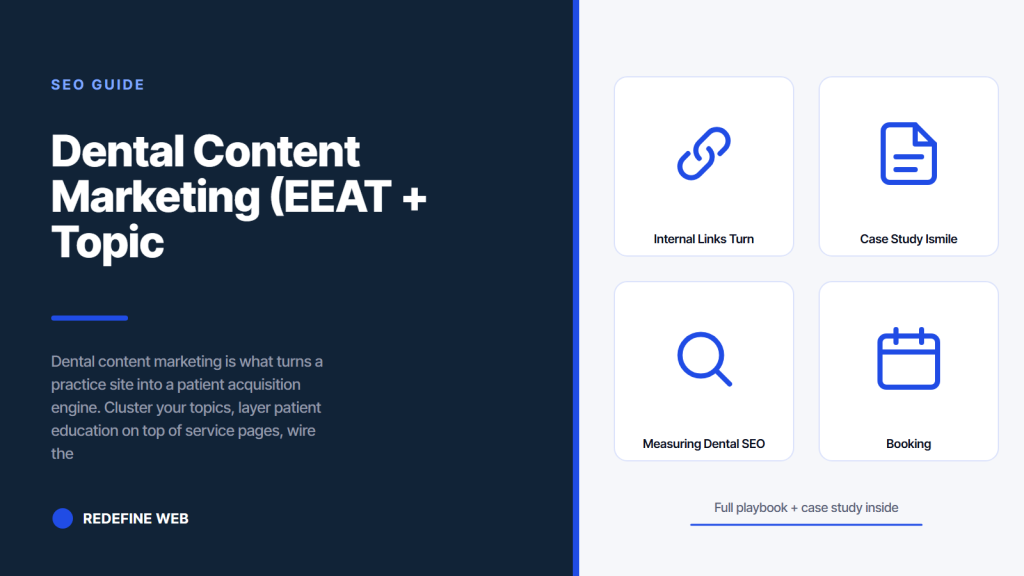
- Six to eight pieces per quarter is the realistic dental content cadence.
- Cluster architecture beats scattered one-off posts every time.
- EEAT signals matter more for dental content than for most verticals.
- Refresh page-2 rankings before writing new posts.
- Internal link graph turns content volume into ranking gains.
- The Dental Marketing Blog That Actually Books Patients
- Internal Links That Turn Dental Content Marketing Into Rankings
- Case Study iSmile Dental Spa and 900 Percent Patient Growth
- Content Refresh in Dental Content Marketing
- Measuring Dental SEO Content Marketing Performance
- Topic Lists That Feed a Dental Marketing Blog
- Where Dental Content Marketing Fits Inside a Retainer
- Common Dental Content Marketing Mistakes
Dental content marketing usually starts as a Google Sheet with 40 blog titles and no owner. Six months later the sheet is untouched, three posts made it live, and the practice owner is wondering why the marketing budget went to a content strategy that produced no patients. That failure mode is common and preventable.
This guide is the working dental content marketing plan we run inside monthly retainers. You will get the topic cluster structure that beats one-off posts, the EEAT signals that satisfy Google’s health content quality standards, the 90-day publishing cadence a busy practice can actually maintain, and the internal linking that turns content into real map pack rank improvements. Read it once and stand up the plan in the next two weeks. The plan works whether you write in-house, hire a specialist writer, or run it inside an agency retainer, at almost any budget level and any practice size.
The Dental Marketing Blog That Actually Books Patients
A dental marketing blog succeeds when every post has a defensible conversion path. Symptom explainers pull top of funnel patients. Cost and insurance posts pull late-funnel patients ready to book. Cluster children reinforce the pillar pages that carry the money keywords. Blog posts that exist purely to hit a monthly quota without a conversion path are the reason most dental blogs produce traffic and no bookings.
Symptom explainer posts
Symptom explainers pull massive search volume because intent is early and anxious. A post on “jaw popping when I chew” pulls patients who may not have known they needed a TMJ evaluation. The post answers the surface question, names the underlying causes, and points to the consult page. That structure converts 1 to 3 percent of readers directly and builds the trust that produces bookings months later.
Cost and insurance posts
Patients search cost and insurance questions in massive volume. “How much does a dental crown cost with insurance.” “Does Delta Dental cover Invisalign.” “How much is a root canal without insurance.” A page that answers honestly with a range and a consult offer converts at 4 to 8 percent because the reader is late funnel by the time they run that search. That is the highest converting content type on a dental site.
Local focused patient education
Blend patient education with local geography. “Is fluoride in Charlotte NC drinking water.” “Best pediatric dentist near South Park.” “Same day dental care near Presbyterian Hospital.” These posts earn both education traffic and local pack rank signals. They serve as connective tissue between service pages and general health content, and they anchor the practice to the local metro in a way pure evergreen content never does. See local seo for dentists for how these posts feed the map pack, and dental seo guide for the underlying SEO architecture.
Internal Links That Turn Dental Content Marketing Into Rankings
The internal link graph tells Google how your site fits together. It also carries readers from education content to service pages where bookings happen. Practices with a strong internal link graph outrank and out-convert practices with identical content volume but weaker linking. Internal links are the single most under-invested part of most dental content strategies.
Hub and spoke structure
Pick a hub for each service area. The implants hub is the primary service page. Every education post about implants links back to the hub with a descriptive anchor. The hub links out to the top three or four education posts inside its cluster. That structure concentrates authority on the hub, which is the page you actually want ranking on the money keyword.
Descriptive anchor text
“Click here” and “read more” waste the internal link signal. Use descriptive anchor text that names the destination. “Dental implants cost guide,” “sedation options for anxious patients,” “same day emergency dental care.” Google reads the anchor text as a hint about the destination page’s topic. Descriptive anchors compound over time into visible ranking gains.
Auditing broken internal links
Once a quarter, run a crawl of the site through Screaming Frog or a similar tool and flag every internal link returning a non-200 response. Broken internal links waste crawl budget and frustrate readers. Fix them at the same cadence as content refreshes so the workload compounds. Broken links are the fastest technical debt to accumulate on a dental site and the easiest to fix if you catch it quarterly.
Case Study iSmile Dental Spa and 900 Percent Patient Growth
iSmile Dental Spa is a premium Carmichael, CA dental practice that hired us with 1 to 2 new patients monthly, zero page-one keywords, and an outdated non-HTTPS site. The rebuild wired dental content marketing into every layer: cluster architecture across five service areas, EEAT-heavy provider bios, and a publishing cadence of 6 pieces per quarter for 12 months.
The 12-month result
Patient volume grew 900 percent, from 1 to 2 new patients monthly to a reliable 12 to 14. Organic traffic grew 800 percent as the content clusters started ranking. Marketing ROI landed at 500 percent across the retainer. The site went from zero page-one keywords to 75 page-one keywords inside 6 months as the cluster architecture consolidated authority on the pillar pages.
What produced the gain
Three specific decisions drove most of the gain. First, we rebuilt every service page as a pillar with 2,000 to 3,000 words of substantive clinical content and provider quotes. Second, we published cluster children at a steady 2 posts per month with clinical review by the practice dentist. Third, we wired every cluster child back to the pillar with a descriptive anchor, and every pillar back to two or three cluster children.
What did not work
The team originally planned 12 posts per quarter for the first 6 months. That volume broke the clinical review pipeline by month two. We cut to 6 pieces per quarter with a longer review cycle and every metric got better. Slower publishing plus tighter review beat faster publishing with review shortcuts. That is a common pattern once you run a real dental content strategy inside a busy practice.
Blogs bring traffic. Service pages book patients. Fix the top 5 service pages this month before adding a single blog post. That's where conversion sits.
Content Refresh in Dental Content Marketing
The plan on day one. Fresh content every week, evergreen updates every quarter, provider bios refreshed annually, testimonials collected monthly. The plan by month four. Whatever the marketing lead can update between morning huddles. If you have run content at a dental practice for more than one quarter you know exactly how this goes, and you know the refresh pipeline is more important than the new content pipeline.
Refresh-first mindset
An old service page ranking on page 2 usually beats a new post starting from zero. Refresh the page-2 rankings first. Update the copy, add sections, expand the FAQ, refresh the internal links. That refresh usually moves the page 3 to 8 positions inside a month, which produces more traffic than a brand-new post would have earned in three months.
The quarterly refresh list
Pull three lists every quarter. Pages that lost traffic in the last 90 days. Pages ranking positions 6 to 20 for a valuable keyword. Pages with high traffic and low conversion. Every page on those three lists is a refresh candidate. Prioritize by potential impact and refresh the top five each quarter.
Refresh signals for Google
Google reads a substantial refresh as a signal that the page is being maintained. Small edits produce small signals. Adding a new H2 section, updating stats, rewriting the intro, refreshing the featured image, and updating the internal links usually produces a large enough delta for the crawler to reindex and re-rank the page. Cosmetic changes without substantive updates do not carry the same weight.
Measuring Dental SEO Content Marketing Performance
Measuring content strategy performance is where most plans quietly fall apart. The marketing lead reports total pageviews and total sessions, the practice owner nods, and nobody surfaces whether the content is actually producing booked patients. Three numbers make the content plan defensible in a quarterly review.
Assisted conversions per piece
Every published piece should appear in at least one assisted conversion path within 90 days of publish. Pieces that never appear in a conversion path across two quarters are candidates for a substantial refresh or a merge into a stronger piece on the same topic. GA4 explorations surface the assisted conversion path for any URL, so the review is a 10-minute exercise per quarter.
Ranking movement per cluster
Track keyword rankings by cluster rather than as a flat list. The implants cluster, the pediatric cluster, the emergency cluster. Cluster level movement tells you whether the internal link graph is working. A cluster that rises together as a whole is a cluster with real topical authority. A cluster where one page ranks and the rest sit still is a cluster with a link graph problem to fix.
Content ROI per retainer dollar
Divide the total attributed booked patients across a quarter by the content portion of the retainer. That produces a rough cost per attributed booking, which is the number the practice owner actually cares about. Most retainers land at $150 to $600 per booked patient across the content channel once the flywheel is spinning. Numbers outside that range point to either an under-invested plan or a plan that has drifted from the practice’s real revenue drivers. See our dental marketing roi post for the full math.
Topic Lists That Feed a Dental Marketing Blog
Topic ideas run out fast for practices that generate content from a keyword tool alone. The good sources are more prosaic. Front desk questions, Google Search Console queries producing impressions but no clicks, and competitor content audits. Pull 20 candidate topics from those three sources every quarter and pick the 6 to 8 that best match retainer budget and provider availability.
- Front desk phone questions from the last 30 days
- GSC queries ranking positions 11 to 30 with 100+ impressions
- Competitor blog posts ranking top 3 that you have not covered
- Reddit and Quora threads with 50+ upvotes on dental topics
- Insurance provider blog posts that lack a patient-friendly summary
- Seasonal patterns (summer whitening, back-to-school pediatric checkups)
Front desk questions
Front desk questions are the highest signal source. Every question the front desk fields is a question a patient just searched Google for and did not find a good answer to. Track questions for 30 days in a shared Google Doc, then convert the top 8 into content briefs. Those posts often outperform “researched” topics because the intent is real and immediate.
Search Console mining
Filter GSC queries by pages ranking positions 11 to 30. Those are the near-misses. Adding 400 to 800 words of depth to a page ranking position 14 often moves it to position 5 to 8, which is where clicks start. This tactic is under-used because it looks like refresh work, not new content, and marketing leads default to publishing new posts. Refresh usually wins on effort-to-outcome.
Competitor gap analysis
Pull the top 3 competitors in your metro and audit every blog post they have ranking top 5 for a valuable keyword. Topics they cover well and you do not are your immediate content gaps. Skip anything they cover with 3,000 word tour-de-force posts unless you can genuinely beat the depth. Focus on gaps where a 1,500 word post from your named clinical author can compete on EEAT alone.
Where Dental Content Marketing Fits Inside a Retainer
Running a real dental content marketing plan inside a monthly retainer takes 8 to 20 specialist hours per month for a single-location practice. Multi-location groups need 25 to 60 hours. That work spans strategy, writing, provider interviews, editing, clinical review coordination, publishing, internal link updates, and quarterly reporting.
Roles inside the retainer
The content strategist runs the quarterly plan and prioritization. The writer produces the copy. The editor handles fact-checking and clinical review coordination. The SEO specialist wires internal links and monitors search console signals. On a smaller retainer, one specialist may cover multiple roles, and the roles themselves exist regardless.
Retainer pricing
Retainer starts at $599 per month for a single-location practice and scales with location count and content volume. Most single-location practices bundle content with SEO and CRO work in the same retainer because the specialist time is hard to hire in-house for the volume a single practice needs. Our dental marketing plan post covers scope decisions across the full mix.
How the retainer changes as the site matures
In year one, the retainer skews toward new content and service page rewrites. In year two, the balance shifts to refresh work and cluster expansion. In year three, most specialist time goes into competitive response and topical authority defense. That evolution is normal and the retainer scope should bend with the site. Practices that keep pushing new content in year three without a refresh discipline usually plateau in ranking.
Common Dental Content Marketing Mistakes
The common failure modes cluster in three areas. Anonymous or generic bylines that ignore the EEAT bar. Content plans sized for ambition rather than capacity. Publishing without a clinical review step. Each mistake is fixable inside 60 days and each one is a common reason practice owners lose faith in the content strategy.
Anonymous bylines
“Posted by Admin” is the single fastest way to sink a health post in rankings. Google’s quality raters flag anonymous health content as low EEAT by default. Fix this in one sprint: create three real author bios (typically the practice dentist, the office manager or hygienist, and a named content writer), assign every existing post to a real author, and add a byline block to the theme.
Plans sized past capacity
A 40-post annual plan for a single-location practice is a shame document. The plan breaks in month two, and the marketing lead defends a shrinking output against the original ambitious plan. Size the plan to real capacity from day one. Six to eight pieces per quarter for a solo practice, scaling with the retainer.
Skipping clinical review
Publishing dental content without dentist review invites clinical errors that damage the practice reputation and get flagged by Google’s quality raters. Every clinical post needs 20 to 40 minutes of dentist review before publish. That review is a fixed cost of running a defensible content program. Skip it and the content channel becomes a liability.
Dental content marketing works when the plan is smaller than the ambition suggests, the EEAT bar is honored, and the internal link graph consolidates authority on the pages that book patients. Six to eight pieces per quarter, real bylines, dentist review, and the site starts pulling weight on both patient acquisition and SEO fronts.
Frequently asked questions
How many blog posts should a dental practice publish per month?
Two to three posts per month is the realistic range for a solo dental practice with a working clinical review pipeline. Multi-location groups can support 4 to 8 posts monthly across the network. Practices trying to publish weekly usually break the clinical review pipeline inside 8 weeks and then the entire content plan quietly collapses. Slower publishing with proper dentist review consistently outranks faster publishing with review shortcuts. Six to eight substantive pieces per quarter is the plan that produces both traffic growth and defensible clinical accuracy, and it matches how a busy dental practice actually operates without burning out the marketing lead.
What are topic clusters in dental content marketing?
A topic cluster is a pillar page (usually a full service page or definitive guide) surrounded by 8 to 15 supporting posts that all link back to the pillar with descriptive anchor text. For a dental implants cluster, the pillar is the implants service page, and the supporting posts cover implant cost, healing timeline, candidate criteria, alternatives, and specific patient scenarios. Google reads that architecture as topical authority. Sites with strong cluster discipline outrank sites with identical content volume but scattered one-off posts. A general dental practice usually needs 5 to 8 clusters covering the main service areas.
Does EEAT matter more for dental content than other topics?
Yes. Dental content falls in Google's YMYL (Your Money or Your Life) category, which Google's quality raters hold to the highest EEAT bar. Every clinical post needs a named author with credentials (DDS, DMD, RDH), a real bio linked to a dedicated author page, and ideally a medical review disclosure with the reviewing dentist's name and date. Anonymous bylines drop dental content in rankings by default. Practices that meet the EEAT bar outrank practices with more content and stronger backlinks but weak EEAT signals, because health content ranking is filtered through the quality rater guidelines before other signals apply.
Which content types convert best on a dental site?
Cost and insurance posts convert at 4 to 8 percent because the reader is late funnel by the time they run those searches. Service pages themselves convert at 3 to 6 percent when written with real content, provider photos, and clear CTAs. Symptom explainers convert at 1 to 3 percent directly, but build the trust that produces bookings months later through email nurtures and remarketing. Local-focused patient education converts at 2 to 4 percent. Pure evergreen top-of-funnel content converts under 1 percent directly. The mix should skew toward conversion-heavy formats without ignoring the traffic-heavy ones.
How does dental content marketing support local SEO rankings?
Content strengthens local rankings in three ways. First, service pages target the service-plus-city queries that make up the bulk of local dental search intent. Second, local-focused education content ("pediatric dentist near South Park") earns links from local sources and pushes local relevance signals. Third, cluster architecture consolidates authority on the money keyword pages, which pushes them into the map pack. A dental practice with strong content ranks higher on local queries than a competitor with a stronger Business Profile but weaker content. Both layers reinforce each other, and the strongest local rankings come from practices running both together.
How long before dental content marketing produces measurable results?
First rank movement on new content usually shows in weeks 6 to 12 after publish. Meaningful traffic growth from the content plan compounds across months 4 to 9. Attributed booked patients from content typically start showing at month 3 for cost and insurance posts, month 5 for cluster children, month 7 for pillar pages if built fresh. Practices that hire an agency and expect first-page rankings at day 60 will cancel by day 90 and miss the compounding phase where the content channel becomes the cheapest patient acquisition source in the marketing mix. The 6 to 9 month horizon is the realistic window.
Should a dental practice hire a specialist writer or use ChatGPT?
ChatGPT drafts fail Google's EEAT bar for health content when published without substantive editing and clinical review. A trained dental writer or a healthcare-specialist agency writer produces content that clears the EEAT signals and matches the practice voice consistently. Practices using AI as a first draft with a real writer editing every piece and a dentist reviewing every clinical claim can accelerate the workflow while meeting the bar. Practices publishing raw AI drafts sink in rankings inside 90 days. The tool is fine as a starting point; the review layer is where the content plan actually earns rankings.
Book your free 30-minute strategy call.
No spam, no sales rep. We use your email to schedule your call with a senior strategist. That is it.
More from the blog
View all articles → SEO
SEO Organic Search Engine Optimization Services That Grow Real Traffic
Read article SEO
SEO SEO for Pet Groomers That Fills the Appointment Book Weekly
Read article SEO
SEO