
How Dental DSO Structure and Business Models Actually Work
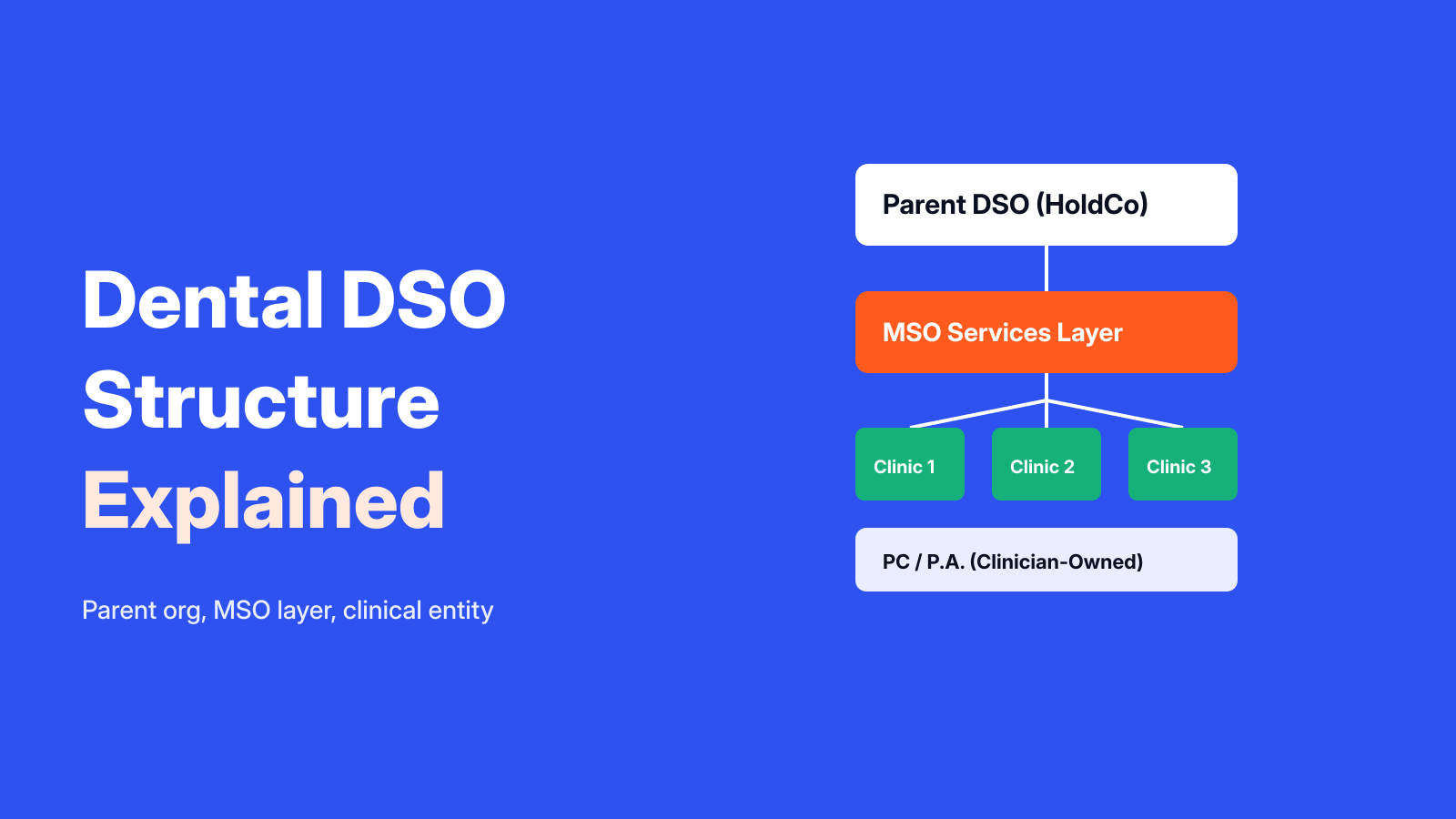
- A dental DSO splits the practice into two entities. A dentist-owned professional corporation holds the clinical work, and a DSO-owned management services organization handles marketing, billing, HR, IT, and supply chain under a management services agreement.
- DSOs earn money through a 6% to 12% management fee, group purchasing rebates across 40 or more locations, and an EBITDA multiple gap that puts a 20-location DSO at 10x to 16x versus a solo practice at 4x to 6x.
- Affiliated dentists land in one of three tiers at sale. Full acquisition trades every equity dollar for cash, joint venture rolls 20% to 40% of equity into the parent for a second exit at year 4 to 7, and affiliate-only keeps 100% ownership under a management agreement.
- The seven shared services a DSO runs are revenue cycle, marketing, HR, supply chain, IT, compliance, and finance. Revenue cycle and marketing are the two dentists feel first, and they are where the DSO usually pays for its fee inside year one.
- A growing solo group can install DSO-grade operating discipline through a fractional stack for $8K to $18K a month, keep 100% of the equity, and skip the PE hold period. The trade-off is speed, and the model breaks past 20 locations.
A dental DSO is a support company that owns the non-clinical side of a group of practices so dentists can treat patients without running billing, marketing, HR, and supply chains. The structure gets confusing fast. Clinical ownership stays with the dentist, and everything else routes through a parent org. Here is how a real dental DSO structure and business model works, where the money moves, and why a growing group hits a wall around 6 to 10 locations without one.
What a dental DSO actually is at the corporate level
A dental service organization is a corporate parent that provides administrative, financial, and operational services to a set of affiliated dental practices. The dentists still own the clinical entity in the states that require it. The DSO owns the management company that runs everything a dentist should not spend clinical hours on.
Think of it as two companies stacked together. On top sits the professional corporation, a PC or PLLC, licensed under a dentist. That entity owns the clinical work, employs the providers, and holds the malpractice policy. Underneath sits the management services organization, the MSO, which handles staffing, purchasing, real estate, marketing, IT, revenue cycle, and finance. The two companies sign a management services agreement, or MSA, that lets the MSO run the practice for a fee.
Around 32% of US dentists are now affiliated with a DSO, and the ADA projects that share climbs past 42% inside the next decade. The reason is not clinical. It is that a solo dentist spends 12 to 18 hours a week on non-clinical work, and a well-built dental DSO structure drops that to under 4 hours.
The business model that pays for the shared services
A dental DSO earns money three ways, and every affiliated dentist should know which levers are pulling on their revenue. First is the management fee, usually 6% to 12% of net collections, charged by the MSO to each affiliated practice. Second is the equity roll-up, where the DSO buys some or all of the practice at a multiple of EBITDA and holds it inside a portfolio. Third is the vendor rebate stack, where the DSO negotiates supply pricing across 40 to 400 practices and keeps part of the savings.
The math on that last point is quieter than most people realize. A group with 60 offices buying gloves, composite, aligners, and imaging plates through one contract cuts unit cost 14% to 22% versus a solo practice, and the DSO often keeps 3 to 6 points of that as the operator’s cut. That is real money at scale, and it is the reason DSO gross margins compress if the group cannot get its supply chain centralized in the first 90 days after acquisition.
The bigger prize is the EBITDA arbitrage. A solo dental practice trades at around 4x to 6x EBITDA. A dental DSO with 20 or more locations trades at 10x to 16x EBITDA when a private equity firm exits. That gap is where the DSO’s cash actually lives, and it drives every decision about which practices to buy, which to fold, and which to sunset.
Three ownership tiers a dentist can sit inside
Not every DSO relationship is a sale. When a practice joins, the dentist lands in one of three tiers, and the tier decides how the money moves for the next 5 to 10 years.

Full acquisition. The DSO buys the practice at 5x to 8x EBITDA. The dentist stays on as a W-2 clinical director for 3 to 5 years, often with a productivity bonus tied to collections. No equity in the parent. Clean exit for the dentist, but no roll-up upside.
Joint venture. The DSO buys 60% to 80%. The selling dentist keeps 20% to 40% and rolls that equity into either the local entity or the parent DSO. When the DSO exits to a new PE sponsor 4 to 7 years later, the dentist’s rolled equity re-values at the new multiple. This is where dentists actually build wealth inside a DSO.
Affiliate-only. The DSO does not buy the practice at all. The dentist signs an MSA and pays a management fee for shared services. Common with faster-growing regional DSOs like MB2 Dental. Lower cash up front, more flexibility, and the dentist keeps 100% of clinical ownership.
The shared-services stack a DSO actually runs
A dental DSO earns its management fee by running seven functions the affiliated practices no longer touch. When any one of these lags, the affiliated dentists start asking why they signed the MSA in the first place, and the DSO’s growth rate stalls.
Revenue cycle is where the DSO usually pays for itself in year one. A solo practice writes off 4% to 8% of net production to bad debt and denied claims. A centralized DSO billing team drops that to 1.5% to 3% by running claim scrubs, insurance verification 48 hours ahead of every visit, and a denials queue that gets worked daily instead of monthly. On a $2M practice, that gap is $50K to $100K a year, and it recovers straight to the bottom line.
Marketing is the other lever the dentists feel. A DSO runs a centralized DSO dental marketing engine that pushes leads to every location, tracks calls at the source, and re-books no-shows through automated recall. Solo practices lose 18% to 24% of booked patients to no-shows. A DSO with a working recall stack drops that to 8% to 12%.
The revenue metrics DSOs actually manage against
DSO operators do not run their business on revenue alone. They watch six metrics, and every affiliated dentist reports to the same dashboard. The gap between a $600K solo office and a $1.8M DSO location is almost always inside these numbers.
| Metric | Solo practice benchmark | Dental DSO benchmark |
|---|---|---|
| Patients per clinic per year | 1,400 to 1,800 | 2,600 to 3,800 |
| New-patient CAC | $180 to $260 | $84 to $140 |
| Chair utilization | 52% to 64% | 72% to 84% |
| Provider retention (12 mo) | 68% to 74% | 82% to 88% |
| Insurance claim denial rate | 4% to 8% | 1.5% to 3% |
| Practice EBITDA margin | 18% to 24% | 22% to 30% |
Chair utilization is the one that quietly drives everything. A solo practice with three ops running at 58% utilization is leaving 40% of its capacity idle. A DSO location running the same three ops at 78% utilization books 34% more patients on the same rent, same staff, same equipment. That is not a marketing story. That is a scheduling and recall story that the shared-services team owns.
Private equity backing and why the exit horizon shapes every decision
Most large dental DSOs are backed by private equity. The sponsor buys the DSO at one multiple, grows it for 4 to 7 years, then sells to a larger sponsor or takes it public. Heartland Dental sits inside KKR. Aspen Dental sits inside Ares. Smile Brands has cycled through multiple sponsors. Pacific Dental Services is one of the rare exceptions that stayed founder-owned.
The PE horizon changes how the DSO invests. Marketing budgets get front-loaded in year 1 and 2 to hit the growth curve the sponsor underwrote. Practice acquisitions accelerate in year 2 and 3. By year 5, the DSO is optimizing for margin and preparing the data room for exit. Affiliated dentists who joined at year 4 sit inside a very different operating rhythm than dentists who joined at year 1, and the difference shows up in how much marketing spend backs their location.
This is where some dentists get burned. A DSO acquired in year 4 might see its marketing budget cut, its supply prices renegotiated, and its provider comp structure changed inside 18 months of a new PE sponsor arriving. Read the MSA carefully, ask when the current sponsor entered, and ask how the DSO handled the last transition.
How Delicate Dental Group built the operating floor a DSO usually installs
Not every practice needs to sell to a DSO to get the operating advantage a DSO provides. Delicate Dental Group, led by Dr. Monica Ponce, opened as a scratch practice in 2020 with 27 years of clinical experience but zero digital footprint. The competitive market looked exactly like the one that traps solo practices before a DSO acquires them.
The Redefine Web team installed the shared-services layer any DSO would have installed on day one. Automated post-appointment SMS review requests, centralized NAP consistency across every medical directory, GBP category set to General dentist, weekly Map Pack tracking. The reputation flywheel started spinning in month one.
Inside the first year, Delicate Dental generated 700+ verified Google reviews, tripled Maps impressions, and grew calls from Google Maps by 280%. Read the full Delicate Dental Group case study for the exact reputation stack we built. The playbook is the same one a well-run DSO uses across 40 locations. The difference is that Delicate Dental owns 100% of the equity and 100% of the roll-up upside.
When a solo practice does not need a DSO at all
The DSO model is not the only path to the operating advantage described above. A growing group of independent practices runs the same shared-services stack through a fractional model. One office manager, one billing lead, one marketing partner covering 3 to 6 practices. Total spend runs $8K to $18K a month all in, versus a 6% to 12% management fee on collections.
On a $2M practice, a 9% DSO fee costs $180K a year. The same functional coverage from a fractional stack costs $110K to $190K but the dentist keeps 100% of the practice equity and 100% of the future sale multiple. The trade-off is speed. A DSO buys the operating layer in one deal. A fractional stack takes 6 to 9 months to build and the dentist has to project-manage it.
If the goal is to grow to 3 to 6 locations and sell at year 7 to 10, the fractional path usually wins the math. If the goal is to grow to 20+ locations in 3 years, a DSO or joint venture is the only realistic path.
DSO structure and business model FAQs
How does a dental DSO make money if the dentist keeps clinical ownership?
A dental DSO makes money through three channels. It charges a management fee of 6% to 12% of net collections to every affiliated practice, it earns supply chain rebates from group purchasing across 40+ locations, and it captures the EBITDA multiple gap when it sells the roll-up to a private equity sponsor at 10x to 16x versus a solo practice sale at 4x to 6x.
The clinical corporation still bills patients and insurance. The DSO’s management services organization then invoices the clinical corp under the management services agreement. That is what keeps the model compliant with corporate practice of dentistry rules in states like California, New York, and Texas.
What is the difference between a DSO and a group practice
A group practice is 2 to 6 offices under common clinical ownership, usually with one dentist or a small partner group holding equity across every location. A dental DSO is a corporate structure that separates clinical ownership from non-clinical operations across dozens or hundreds of offices, and almost always includes outside capital from private equity or debt.
The line gets blurry once a group grows past 6 or 7 locations. At that point the group either builds a DSO-style shared-services layer internally, hires a fractional stack, or sells to an existing DSO. Running 8 locations without one of those three options usually breaks the model on billing errors and provider turnover.
Does joining a dental DSO change how patients experience the practice
Most affiliated practices keep the local brand, the local phone number, and the local dentist. Patients rarely notice a DSO transaction on the front end. What changes is the back end. Scheduling moves to a centralized platform, billing goes through the DSO’s revenue cycle team, and marketing runs through a centralized engine that pushes calls back to the local office.
The dentist decides how much of the local voice to keep. Some DSOs enforce brand consistency across every location. Others let each practice keep its own name, logo, and website. Pacific Dental Services runs the first model. MB2 Dental runs the second.
How long does it take a dental DSO to close on a practice
The full timeline from letter of intent to close usually runs 90 to 150 days for a single practice acquisition. Due diligence takes 45 to 60 days and covers clinical charts, insurance contracts, staff files, real estate, and 3 years of tax returns. Legal drafting of the MSA and asset purchase agreement takes another 30 to 45 days. Wire and clinical transition take the final 15 to 30 days.
Multi-location deals stretch to 6 to 9 months so the DSO can normalize accounting across every office before it commits capital.
What multiple should a dental practice expect when selling to a DSO
A single-location practice with $400K to $700K of EBITDA usually sells at 5x to 7x EBITDA. Multi-location groups with $1.5M+ of EBITDA sell at 7x to 9x. Regional DSOs with 20+ locations exit to a larger sponsor at 10x to 16x. The gap between those tiers is what drives the roll-up strategy that every dental DSO runs.
Read the DSO vs independent practice breakdown for the full financial trade-off, and if the goal is to sell inside the next 24 months, the dental service organization post covers what to fix in the practice first.
See how Redefine Web builds the DSO-grade marketing and revenue-cycle stack for dental practices growing past their first three locations.
Book your free 30-minute strategy call.
No spam, no sales rep. We use your email to schedule your call with a senior strategist. That is it.
More from the blog
View all articles → Marketing Strategy
 How Dental DSOs Grow Through Marketing. Tactics That Scale
Read article Marketing Strategy
 Dental DSO Marketing Services. What to Expect From an Agency Partner
Read article Marketing Strategy