
Dental PPC Management vs DIY Google Ads
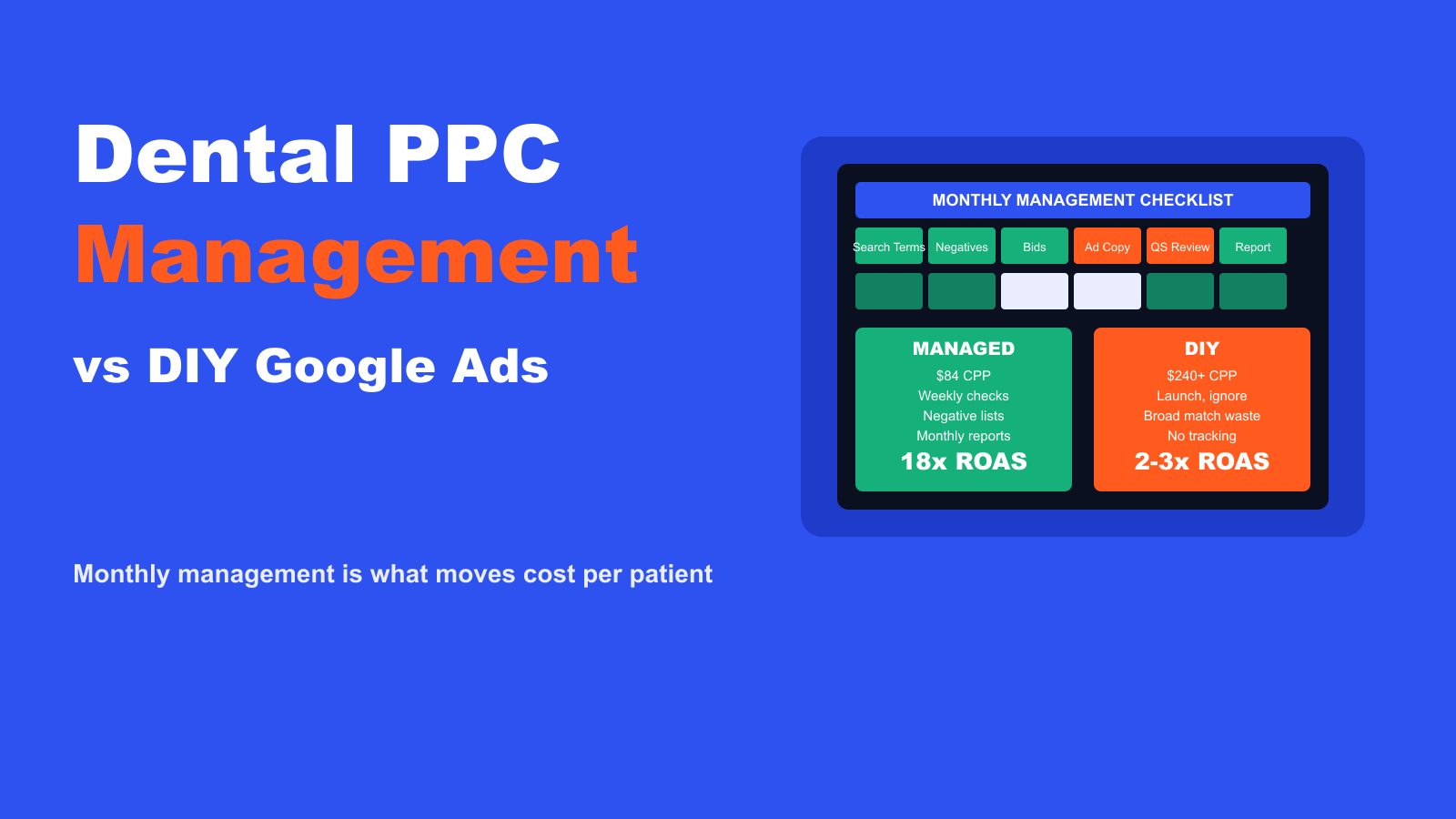
Dental PPC management is what happens after a campaign launches. Most practices either manage their own ads inconsistently or hand them to an agency and never hear the details of what changed. This guide covers what monthly dental PPC management actually includes, what managed campaigns outperform DIY setups, and which tasks move the cost per patient number most.
[key_takeaways]
Dental PPC management is not a one-time setup. It is a monthly cycle of search term audits, negative keyword additions, bid adjustments, ad copy testing, Quality Score monitoring, and budget reallocation. Unmanaged dental Google Ads accounts drift toward higher costs over time as competition, Quality Scores, and Google algorithm changes erode performance. The most impactful monthly tasks are the search terms report review and bid adjustments based on actual conversion data. Practices that run managed dental PPC consistently for 90 days typically see 25 to 40 percent lower cost per patient than at launch. DIY dental PPC management works at small budgets with simple campaigns, but falls short above $2,000 per month where the optimization complexity exceeds what most non-specialists can manage weekly.
[/key_takeaways]
Dental PPC Management vs DIY Google Ads
The difference between managed dental PPC and DIY Google Ads is not just who logs in. It is what gets done, how often, and whether the decisions are driven by data or gut feel.
| Task | Managed PPC | DIY Average |
|---|---|---|
| Search terms report review | Weekly | Monthly or never |
| Negative keyword additions | Weekly from search terms | At setup only |
| Bid adjustments | Monthly from conversion data | Rarely |
| Ad copy testing | New variation every 30 to 60 days | Original ad runs indefinitely |
| Quality Score monitoring | Monthly with action plan | Not tracked |
| Landing page updates | Tied to ad test results | Never |
| Budget reallocation | Quarterly based on campaign ROI | Fixed at launch |
| Reporting | Monthly with conversion metrics | None or impressions only |
DIY dental PPC management can work for simple, low-budget campaigns if the practice owner is willing to check the search terms report weekly and has a basic understanding of match types. At budgets above $2,000 per month, the optimization complexity grows faster than the available time most dentists can realistically commit. Missed optimizations in a month compound into wasted spend over a quarter.
For the foundation that makes management decisions easier, see our guide on dental PPC campaign structure and why the account architecture determines what is manageable month to month.
The Monthly Dental PPC Management Workflow
Effective dental PPC management follows a repeatable monthly cycle. Each step feeds the next. Skipping a step creates blind spots that compound into budget waste.
Week 1: Search terms audit. Pull the search terms report from the past 30 days. Every search that triggered your ad, whether it matched a keyword or not, appears here. Sort by cost. Find the searches that spent money without generating a phone call or form fill. Add them as negative keywords. Also flag any new high-intent searches you haven’t targeted yet and add them as keywords in the appropriate ad group.
Week 2: Bid review. Check cost per conversion by keyword and campaign. Keywords producing conversions above your target cost per lead get a bid reduction. Keywords below your target and still generating leads get a bid increase to capture more volume. Keywords with 50+ clicks and zero conversions over 90 days get paused pending a landing page audit.
Week 3: Ad copy review. Check Responsive Search Ad strength ratings. Combinations rated Low or Poor need replacement headlines. Run at least one A/B test per ad group per quarter, testing a different headline approach: social proof versus urgency versus procedure specificity. Record which variation wins and keep it. Google also reviews ad copy for policy compliance. Dental ads with health claims, before-and-after imagery, or guaranteed outcomes can get disapproved. The full list of what dental ads are allowed to say is in our dental ads compliance guide.
Week 4: Quality Score and reporting. Pull Quality Score for your top 20 keywords. Any keyword below 6/10 gets a review of the three components: expected click-through rate, ad relevance, and landing page experience. Fix the lowest-scoring component first. Compile the monthly report: clicks, conversions, cost per conversion, and cost per booked appointment if you track through to the front desk. Compare to the prior month and the 90-day trend.
The Search Terms Report and Why It Drives Dental PPC Management
The search terms report is the most important tool in dental PPC management. It shows what patients actually typed before clicking your ad, not just the keyword you bid on. The two are different, sometimes very different.
Google’s matching algorithms, particularly broad match and phrase match, will trigger your “dental implants” ad for searches like “dental implants covered by insurance,” “dental implant failure stories,” and “dental implant courses.” You pay for every click. Some of those lead to patients. Many do not.
Practices that review the search terms report weekly catch these mismatches early. A term that gets 10 clicks without a conversion is a signal. If it runs unaddressed for three months, it burns hundreds of dollars. The comprehensive guide on dental Google Ads keywords covers negative keyword list building in detail, including a starter list of 80+ terms that most dental practices should exclude from day one.
When Automation Anywhere came to us, they were paying $1,936 per lead on enterprise PPC campaigns that had never been properly optimized. Through strategic audits, competitive offer development, and precise campaign restructuring, we brought their cost per lead down to $63, a 97 percent reduction. Customer acquisition scaled 100x, from 150 per month to nearly 8,000 leads monthly. The specific optimization steps that drive those results in B2B PPC apply directly to dental PPC management: audit first, cut waste, improve landing pages, then scale what converts.
Bid Strategy Management for Dental PPC
Bid management is where monthly dental PPC management earns its keep. Google Ads bidding has two modes: manual, where you set each bid, and automated, where Google adjusts bids to hit a target you define.
New dental PPC campaigns should run on manual CPC or enhanced CPC for the first 30 to 60 days. Automated bidding strategies like Target CPA need conversion data to operate correctly. Without at least 30 monthly conversions per campaign, the algorithm optimizes toward noise rather than signal.
Once a campaign passes the 30-conversion threshold, test switching to Target CPA bidding. Set your Target CPA at your current actual CPA, not a wishful lower number. The algorithm needs time to find conversions at that rate. After 14 days, review. If actual CPA holds at or below target, gradually lower the Target CPA by 10 to 15 percent per month to push the algorithm toward more efficient conversions. For the full monthly workflow, see our dental Google Ads management guide.
Ad Copy Testing in Monthly Dental PPC Management
Ad copy directly affects click-through rate, which feeds Quality Score, which affects cost per click. Monthly dental PPC management includes systematic ad copy testing, not just running the original launch ads indefinitely.
Each Responsive Search Ad in Google Ads allows up to 15 headlines and 4 descriptions. Google tests combinations automatically. Your job as a manager is to audit which headlines are rated Low and replace them with stronger variants monthly.
Test categories for dental PPC ad copy:
- Social proof headlines: “500+ Five-Star Google Reviews,” “4.9 Stars, 300+ Patients Served”
- Urgency headlines: “Same-Day Appointments Available,” “Call Now: Emergency Slots Open”
- Procedure-specific headlines: “Dental Implants Starting at $2,999,” “Clear Aligners, No Braces Needed”
- Offer headlines: “New Patient Exam + X-Ray: $79,” “$0 Down Financing Available”
Track click-through rate by headline type. Over time, you’ll find that certain practice types respond better to social proof while others get more clicks from urgency. This is real data about your market, not generic best practices.
Quality Score Management and Why It Compounds Over Time
Quality Score is the single metric that compounds most in dental PPC management. A keyword with a Quality Score of 8 versus 4 on the same bid can mean paying 50 percent less per click for the same ad position. That savings compounds month over month.
Monthly Quality Score management works at three levels:
- Expected click-through rate: fix by improving headline relevance to the keyword
- Ad relevance: fix by tightening ad groups so the keyword and ad copy share specific language
- Landing page experience: fix by ensuring the landing page matches the keyword intent and loads fast on mobile
Most dental practices have landing page experience as their weakest Quality Score component because they send all traffic to the homepage. Fixing that single issue, sending procedure-specific traffic to a procedure-specific page, often moves Quality Scores from 4 to 7 and cuts CPC by 20 to 35 percent in the following 30 days.
Reporting That Actually Tells You What Dental PPC Management Produced
Monthly dental PPC reporting should tell you three things: cost per lead, cost per booked appointment, and return on ad spend. Impressions, reach, and awareness metrics are fine for brand campaigns. For patient acquisition campaigns, the only numbers that matter connect back to revenue.
A clean monthly dental PPC report covers: total spend by campaign, total conversions (calls + forms) by campaign, cost per conversion by campaign, change versus prior month, and the quarter-to-date trend on cost per conversion. If your agency sends you a report full of impressions and click-through rates without cost per booked appointment, ask for the one number that matters.
The full picture of how dental Google Ads campaign structure supports good reporting starts at the account architecture level. And when you want to see what this looks like as a managed service, our dental PPC services page covers the scope of what we manage monthly, including reporting, for every client. For the full patient acquisition picture, visit our dental marketing hub.
Frequently Asked Questions
What does dental PPC management include each month?
Dental PPC management includes weekly search terms audits with negative keyword additions, monthly bid adjustments based on conversion data, ad copy testing and replacement of low-performing headlines, Quality Score monitoring for all active keywords, budget reallocation across campaigns based on return, landing page performance checks, and a monthly report showing cost per lead and cost per booked appointment. Each task builds on the prior month’s data, which is why managed accounts compound their improvement over time.
How much does dental PPC management cost from an agency?
Dental PPC management fees typically run $500 to $2,000 per month depending on the number of campaigns, locations, and monthly ad spend. Some agencies charge a percentage of ad spend (15 to 20 percent is common). Others charge a flat monthly fee. For a practice spending $2,000 per month on ads, expect to budget $500 to $800 per month in management fees on top of ad spend. The fee is worthwhile if the agency drives your cost per patient below what you’d achieve managing it yourself.
How long before dental PPC management shows improvement?
The first 30 days of dental PPC management typically reduce wasted spend through negative keyword additions and match type tightening. Cost per lead usually improves 10 to 20 percent in month one from these housekeeping changes alone. Months two and three see larger improvements from bid optimization and ad copy testing. By day 90, well-managed accounts typically show 25 to 40 percent lower cost per patient than at launch. The compounding effect continues into month six and beyond.
Can a dental practice manage their own Google Ads?
Yes, with caveats. A dental practice can manage its own Google Ads effectively at budgets under $1,500 per month if the owner or office manager commits to reviewing the search terms report weekly, understands keyword match types, and has set up conversion tracking properly. Above $2,000 per month, the optimization work grows to several hours per week. Most dentists find that time better spent on patient care. The alternative is allowing the account to run at suboptimal settings, which at $2,000 per month typically means $400 to $800 in monthly waste that a managed account would have caught.
What is the biggest difference between managed dental PPC and a set-and-forget approach?
The biggest difference is the search terms report review frequency. A set-and-forget dental PPC account generates new irrelevant searches every week that drain budget without producing patients. In an unmanaged account, these irrelevant clicks accumulate for months. In a managed account, they get cut within days. The practical result over a 90-day period is typically $1,000 to $3,000 in recovered budget that was previously going to non-patient searches, redirected to the keywords that actually produce appointment bookings.
Strong management processes also feed the ROI numbers. Read why dental Google Ads campaigns fail to hit a strong return for the benchmarks and diagnostic framework that tie management to measurable patient acquisition costs.
Book your free 30-minute strategy call.
No spam, no sales rep. We use your email to schedule your call with a senior strategist. That is it.
More from the blog
View all articles → PPC
PPC Home Services PPC Marketing: What a Strong Campaign Looks Like
Read article PPC
PPC PPC for Home Service Businesses: How to Lower Cost Per Lead
Read article PPC
PPC