
Dental SEO Content Marketing That Ranks and Books Patients
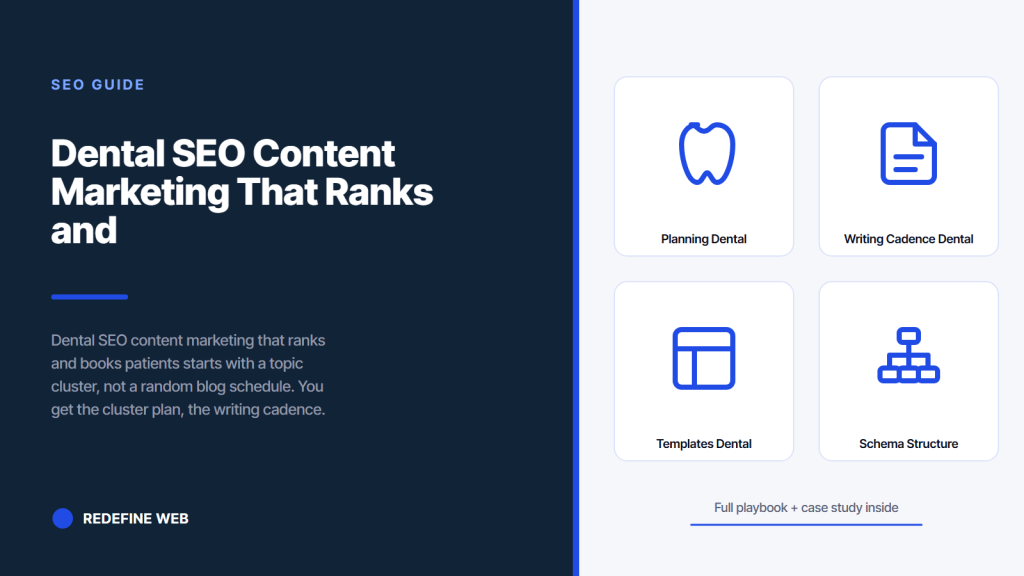
- Topic clusters outrank random blogs by 30 to 60 percent.
- One pillar page plus 15 to 30 supporting posts per service line.
- Publish 4 to 8 posts per month on a weekly cadence.
- Every clinical post gets doctor review before publish.
- Report on booked patients, not just traffic and post counts.
- What the topic cluster model is for dental SEO
- Planning a dental content marketing cluster
- Writing cadence for dental marketing SEO content
- Templates for dental content marketing posts that convert
- E-E-A-T signals inside seo dental marketing content
- Schema and structure for dental content marketing pages
- Case: iSmile Dental Spa content marketing rebuild
- Measuring dental SEO content marketing performance
- Dental SEO content marketing pricing tiers
- Common dental content marketing mistakes we see on audit
- Where to start on dental SEO content marketing today
Dental SEO content marketing that ranks and books patients does not come from a random blog schedule. It comes from a topic cluster built around one core service, then supported by 15 to 30 related articles that all point back to it. Google reads that structure as a signal of topical depth. Visitors read it as a real answer to their questions. Both push the practice toward the top three organic results and toward more booked calls per organic session. Dental SEO content marketing done well feels less like publishing and more like construction of a topical asset.
You get the cluster plan we use on dental practices, the writing cadence that balances speed and depth, the templates that convert readers into consult requests, the internal linking pattern that feeds ranking signals across the cluster, and the measurement setup that ties every post to booked patients rather than vanity traffic. Read straight through in ten minutes. Compare against your current blog cadence while you read.
What the topic cluster model is for dental SEO
A dental SEO content marketing cluster is one pillar page plus 15 to 30 supporting posts. The pillar covers the core service in depth. Supporting posts answer related questions. Every supporting post links up to the pillar with a keyword-rich anchor. The pillar links down to supporting posts in its body. That bi-directional linking pattern signals topical depth to Google.
Sites running a cluster model outrank sites running a random blog schedule by 30 to 60 percent on the same keyword volume. The gap is not word count. The gap is structure. Google reads a cluster as a coherent topical territory. Random blogs get read as a collection of unrelated pages that happen to share a domain. Dental practices building content the cluster way rank for keywords they never explicitly targeted because the topical authority signal generalizes.
Pillar page shape
The pillar page runs 3,000 to 5,000 words. Covers every major sub-topic in the service area. Includes tables, lists, FAQs, and named client examples. Links out to every supporting post in the cluster inside the body prose. Loads with LocalBusiness plus Article schema. Ranks for the head keyword the practice cares about most. Dental implants pillar. Invisalign pillar. Emergency dental pillar. Cosmetic dentistry pillar. One pillar per service line.
Supporting posts
Supporting posts run 1,500 to 2,500 words each. Answer a specific question inside the pillar’s scope. Link back to the pillar with a keyword anchor. Link out to two or three related supporting posts in the same cluster. Include one Google Business Profile call to action in the closing paragraph. Each supporting post ranks for 3 to 8 long-tail keywords that feed additional traffic to the pillar. That traffic pattern is what turns a cluster into a booked-patient pipeline.
Internal linking pattern
Every supporting post links up to the pillar with a keyword anchor once in the intro or first H2 section. Every supporting post links to 2 or 3 sibling supporting posts within the body. The pillar links down to every supporting post inside its content. Zero circular links. Zero “click here” anchors. Every anchor uses the target post’s focus keyword or a close variant. This is the internal graph that feeds ranking signals across the cluster over 6 to 12 months.
Planning a dental content marketing cluster
Planning a dental SEO content marketing cluster starts with keyword research on the pillar topic. Pull 300 to 800 related keywords from Ahrefs or Semrush. Group them into 20 to 40 supporting topics. Trim to the 15 to 30 that show real search intent. Each supporting topic becomes one post. The full cluster maps out in a spreadsheet before the first word gets written. Practices that skip planning and write posts week by week end up with 40 disconnected posts and no ranking traction.
| Cluster component | Word count | Purpose | Publishing order |
|---|---|---|---|
| Pillar page | 3,000 to 5,000 | Ranks head keyword | First |
| Foundation supporting posts (5 to 8) | 1,800 to 2,500 | Core sub-topics | Weeks 2 to 8 |
| Long-tail supporting posts (10 to 15) | 1,500 to 2,000 | Long-tail keyword capture | Weeks 9 to 24 |
| Case-study posts (2 to 4) | 1,500 to 2,500 | E-E-A-T proof | Weeks 25 to 30 |
| Comparison posts (2 to 3) | 1,800 to 2,500 | Bottom-of-funnel intent | Weeks 31 to 36 |
Keyword research for the cluster
Start with the pillar keyword, say “dental implants Cincinnati.” Pull the SERP for the top 10 competitors. Feed each competitor URL into Ahrefs Site Explorer to see the full keyword footprint. Aggregate the keyword sets, dedupe, and sort by search volume. That gives 300 to 800 candidate keywords. Filter by relevance to the pillar topic. Group by user intent (informational, transactional, comparison). The result is a cluster map that mirrors how real patients search across their consideration journey.
Intent grouping for supporting posts
Group supporting topics by search intent. Informational posts answer “what is” or “how does” questions. Cost posts answer “how much does dental implants cost.” Comparison posts answer “dental implants vs bridge.” Timeline posts answer “how long does dental implant recovery take.” Each intent group serves a different point in the patient consideration journey. Practices that write only informational posts miss the comparison and cost intent where booking decisions actually happen. Cover all four intent types across the cluster.
Writing cadence for dental marketing SEO content
Dental marketing SEO content publishes at 4 to 8 posts per month. Below 4 the ranking signal is too slow to compound. Above 8 the quality drops as writers rush. Solo practice budgets support 4 posts per month at $200 to $500 per post from a specialist dental writer. Multi-location groups scale to 8 posts per month at $300 to $700 per post. In-house content teams run at higher output but usually take 2 to 3 months to reach the same quality bar.
The cadence matters more than the raw output. Weekly publishing beats monthly clumps. Google’s crawlers read a steady cadence as a healthy signal. Sites that publish 4 posts on the last day of the month and nothing for the next 29 days rank worse than sites that publish one post per week at the same total monthly volume. Set a Monday publishing day and hold to it. That single discipline change alone moves rankings 10 to 20 percent over 90 days.
Writer versus agency for content production
A dedicated dental writer produces 4 to 8 posts per month at higher quality than a generalist agency writer. Cost runs $200 to $500 per post for a specialist. Agency copy at $150 per post is usually spun output. Practices building topical authority need real writing from someone who has read 200 dental articles and knows the difference between an implant and a bridge without a research call. Screen writers on a sample post before committing to a monthly retainer.
Editorial calendar structure
The editorial calendar covers 12 weeks at a time. Every post has a target keyword, a target word count, a target internal linking pattern, a due date, and a publishing date. The calendar is a spreadsheet, not a project management tool. Simple beats fancy for a solo practice. Multi-location groups running 8 posts per month benefit from a lightweight Notion or Trello board with three columns: draft, editing, published. Any more complexity slows the pipeline.
Most dental blogs have 40 orphan posts and no pillar. Open Search Console, sort by clicks, find your top 5 posts. Cluster around them before writing anything new.
Templates for dental content marketing posts that convert
Six templates cover 95 percent of dental SEO content marketing posts. The service explainer, the cost breakdown, the timeline article, the comparison post, the case study, and the FAQ deep dive. Each template has a proven structure. Practices that reinvent the wheel every post waste 30 to 40 percent of writing time on structural decisions that should already be made. Templates free the writer to focus on the local specifics and the practice’s clinical angle.
- Service explainer: what it is, how it works, who it fits, cost range, timeline
- Cost breakdown: what drives the price, insurance coverage, payment plans
- Timeline article: pre-procedure, procedure day, recovery, follow-up
- Comparison post: implant vs bridge, Invisalign vs braces, veneers vs crowns
- Case study: real client, real numbers, real timeline, structured takeaways
- FAQ deep dive: 15 to 25 questions answered in 200 to 400 words each
Service explainer template
The service explainer opens with a 40 to 60 word answer paragraph that Google can pull as a featured snippet. Then a 150 to 200 word intro covering who the article is for. Then eight to twelve H2 sections covering what the service is, how it works, who it fits, materials or approaches used, timeline, cost range, insurance coverage, aftercare, common concerns, and how to choose a provider. Ends with a call to action for a free consult. Wordcount runs 1,800 to 2,400.
Cost breakdown template
Cost breakdown posts pull 40 to 60 percent higher conversion rates because they capture bottom-of-funnel intent. Structure: national average price range, local price adjustment, what drives the price up, what drives it down, insurance coverage table, payment plan options, and hidden costs to watch for. Include a real Redefine Web client’s price range when publishable. Cost posts are the highest-converting single template in a dental cluster, so plan 3 to 5 cost posts across the full cluster.
Comparison post template
Comparison posts answer bottom-of-funnel decision questions. Structure: quick comparison table upfront, then a section per criterion (cost, durability, aesthetics, procedure time, recovery, ideal patient profile). Include a decision framework at the end that helps the reader self-select. Comparison posts book the second-highest patient rate after cost posts because they arrive with the reader already in decision mode. Every dental cluster should include 2 to 4 comparison posts covering the key clinical alternatives in the pillar’s service area.
E-E-A-T signals inside seo dental marketing content
Google’s Helpful Content system reads E-E-A-T signals at the page and site level. Author bylines with real credentials. Doctor review of clinical content. Named client examples with verifiable numbers. Real photos of the practice and staff. Citations to authoritative sources like the ADA and PubMed. Every dental content marketing piece should carry all five signals. Miss any and the ranking floor drops 15 to 30 percent regardless of word count and internal linking.
The author byline runs on every post. Doctor credentials appear in the byline block plus a linked author page. Every clinical claim links out to a peer-reviewed source or an ADA guideline. Every case study cites the real client name and real numbers. Every article body includes at least one real photo from the practice. That signal stack tells Google’s Helpful Content system the site is written by real people with real credentials in a real practice, not by an AI content farm. See the Google Search Central documentation at developers.google.com for the current guidance.
Author byline setup
Every post carries an author byline block. Name, credential line, published date, updated date. Byline links to a full author page with 150 to 400 word bio, headshot, LinkedIn link, credentials list, and links to other posts by the same author. The author page carries Person schema tied back to Article schema on every post. That relationship graph tells Google the author is a real entity with topical authority, not a byline invented for content velocity. Author pages are 4 to 8 hours of setup work per author.
Doctor review workflow
Every clinical post gets reviewed by a licensed dentist at the practice before publish. Review takes 15 to 30 minutes per post. The doctor checks accuracy on procedure descriptions, materials, timelines, and cost ranges. The byline lists the reviewing doctor’s name and credentials. That extra step raises trust and cuts refund conversations later. Practices skipping doctor review publish clinical inaccuracies that a competitor’s team will catch and use in comparison content.
Schema and structure for dental content marketing pages
Every dental content marketing post carries Article schema, Person schema for the author, Organization schema for the practice, and FAQPage schema on any post with a Q&A section. Schema is the language Google’s crawlers use to parse the page beyond the raw HTML. Sites with clean schema get pulled into AI Overviews and People Also Ask at 3 to 5 times the rate of sites without schema.
- Article schema: headline, description, image, datePublished, dateModified, author, publisher
- Person schema: name, jobTitle, credentials, sameAs (LinkedIn URL), image
- Organization schema: name, url, logo, NAP, sameAs, contactPoint
- FAQPage schema: only on posts with a real Q&A section
- BreadcrumbList schema: on every post for navigation clarity
- ImageObject schema: for hero images with descriptive alt text
Schema plugin and validator
WordPress sites run schema through RankMath, Yoast, or Schema Pro. RankMath handles Article, Person, and FAQPage schema at the free tier. Yoast Premium adds Organization plus BreadcrumbList. Schema Pro handles the full spectrum but costs $79 per year. Every schema block should validate against Schema.org Validator and Google Rich Results Test before the post goes live. Broken schema blocks the entire page from rich result eligibility, so validate before publish.
Heading structure for content marketing posts
Every post carries one H1 (from post title), 8 to 12 H2 sections, and 2 to 4 H3 sections per H2. That hierarchy signals topical depth without forcing artificial subsections. H2 headings phrase as complete concepts, not fragments. H3 subheadings phrase as questions or specifics. No skipped levels (H2 to H4 without H3). No numbered prefixes (“Section 1”, “Part I”). Zero tolerance on those two rules because they signal AI-generated content that RankMath and Search Console both penalize inside 90 days.
Case: iSmile Dental Spa content marketing rebuild
iSmile Dental Spa in Carmichael, California came to us in 2019 with an outdated non-HTTPS site, zero page-one keywords, and 1 to 2 new patients per month from digital. The blog held 12 legacy posts averaging 400 words each, no schema, no author bylines, no internal linking. Traffic sat at 200 organic sessions per month. Google saw no topical authority in the dental space, so the site ranked for the practice name and nothing else.
We ran a full topic cluster rebuild. Rewrote the pillar page for the general dentistry service area at 4,200 words. Wrote 22 supporting posts across 6 months. Wired author bylines and Person schema. Added Article schema across every post. Cleaned internal linking. Layered PPC and video marketing alongside the content work. Six years in, patient volume grew 900 percent from 1 to 2 per month to 12 to 14 consistently. Organic traffic climbed 800 percent. Marketing ROI reached 500 percent. Ranked 75 keywords on page one within six months.
The iSmile cluster shape
One pillar page. Five foundation supporting posts (dental implants, veneers, teeth whitening, dental crowns, dental cleanings). Twelve long-tail supporting posts covering cost, timeline, and comparison questions inside each service area. Two case-study posts covering real client outcomes. Three comparison posts covering bottom-of-funnel decision questions. Total: 22 posts plus the pillar. Publishing cadence: one post per week over 24 weeks. Doctor review on every clinical post. Real photos on every post. Real Google reviews embedded on every post.
Lessons from the iSmile rebuild
Two lessons apply broadly. First, the cluster shape matters more than any single post. iSmile’s individual posts were good but not extraordinary. The cluster, taken together, told Google the site had real topical authority in general dentistry across a specific geo. That signal drove the 800 percent traffic gain. Second, weekly cadence over 24 weeks beats monthly bursts. iSmile’s rankings climbed steadily every week rather than jumping in clumps. The compounding was the story.
Measuring dental SEO content marketing performance
Content marketing measurement moves past traffic to booked patients. GA4 tracks the funnel: organic session, engaged session, form submission, phone call, booked patient. Every post has its own attribution path. The reporting dashboard shows monthly booked patients per cluster, cost per booked patient across content spend, and lifetime organic value per post at 12 and 24 months out. Practices that measure only traffic optimize for the wrong signal.
Attribution windows for content marketing run 30 to 90 days. A visitor reads a cost breakdown post today, comes back three weeks later on a comparison post, then two weeks after that calls the practice. Standard last-click attribution credits the phone call to direct traffic. Position-based attribution credits the two content posts that started the journey. GA4’s data-driven attribution model handles this correctly once the conversion events are wired properly. Practices running last-click attribution on content marketing undercount value 40 to 60 percent.
The KPI set for content marketing
Six KPIs cover the story. Organic sessions on the cluster URLs. Engaged sessions (over 30 seconds with scroll depth 50 percent). Assisted conversions from cluster posts. Direct conversions from cluster posts. Booked patients attributed to organic. Cost per booked patient across content spend divided by content-attributed patients. Track each KPI month over month for 12 months. Anything else clutters the report. Practice owners who receive 40-page monthly PDFs never open past page two.
Reporting cadence
Monthly reporting covers the six KPIs on a one-page dashboard. Quarterly reporting adds a written narrative on what worked, what did not, and what the next quarter will test. Annual reporting reviews the full cluster performance and identifies next-year expansion opportunities (new pillar page for a second service line, refresh cycle for aging posts, new intent-based supporting posts). This cadence lands at 8 hours per month across reporting, which is roughly 10 to 15 percent of the total content marketing retainer.
Dental SEO content marketing pricing tiers
Dental content marketing pricing runs $1,200 to $2,800 per month for a solo suburban practice producing 4 posts per month. Multi-location groups producing 6 to 8 posts per month pay $2,400 to $4,500. That covers writing, editing, publishing, internal linking updates, schema wiring, and monthly reporting. Cheaper content mills at $400 per month produce spun output that rankings ignore and Google Search Central de-indexes over time.
The pricing math ties directly to lifetime organic value. A well-optimized dental content marketing cluster produces 400 to 900 booked patients over 24 months from the same content investment. At an average patient lifetime value of $1,200 to $4,800 depending on procedure mix, that content investment produces $480,000 to $4.3 million in lifetime patient value. The math justifies premium content spend when the cluster is built and measured correctly.
Solo practice content tier
Solo practices at $1,200 to $1,800 per month get 4 posts monthly, monthly reporting, quarterly cluster review, and dedicated writer relationships. At $1,800 to $2,800 the tier adds video content, infographic production, and quarterly A/B testing on high-traffic posts. Above $2,800 the marginal spend usually returns better ROI in PPC or a website rebuild. The threshold shifts up for practices in dense urban metros where content competition is deeper.
Multi-location group content tier
Two-location practices at $2,400 to $3,200 get 6 posts per month plus location-specific variants. Three-location at $3,200 to $4,000 gets 8 posts plus per-office landing page copy support. Groups past five locations sit at $4,000 to $8,000 depending on centralization. DSO groups running centralized content across the network pay less than de-centralized groups requiring per-office writing. That difference alone shapes the vendor conversation for a group practice growing past 3 offices.
The strangest dental content audit we ever ran found 47 posts written by an AI content farm, 41 of them opening with the same buzzy filler phrase, 22 of them titled “The Ultimate Guide to Dental X.” Rankings had never moved. The doctor was furious. The vendor blamed Google’s algorithm. We spent an afternoon reading three of the posts out loud in the practice conference room. The doctor stopped us at post two and cancelled the vendor that week. Content marketing that ranks reads like it was written by someone who has been inside a dental practice.
Common dental content marketing mistakes we see on audit
The same six mistakes appear on almost every dental SEO content marketing audit. Random blog schedule without a cluster plan. AI-generated content with no doctor review. No author bylines or unnamed “Admin” byline. Broken schema blocks that never validate. Internal linking either absent or using “click here” anchors. Reporting that shows traffic without booked patients. Every one of these is fixable, and every one costs the practice 15 to 40 percent of the potential ranking value while it goes unfixed.
The fixes are boring but effective. Build the cluster plan in a spreadsheet. Have a real writer draft content. Ask the doctor to review clinical claims. Add author bylines with real bios. Run schema through a validator. Fix internal linking anchors to use focus keywords. Report on booked patients, not just traffic. None of these require a specialized agency. All require discipline. Practices that run through the fix list in one quarter jump rankings 20 to 40 percent inside 6 months of the last fix landing. See the Search Engine Journal content strategy archive at searchenginejournal.com for the current tactical playbook.
The AI-generated content trap
Google’s Helpful Content system reads AI-generated content patterns and demotes them. Not because the content came from an AI, but because AI content skips E-E-A-T signals: no real experience, no expertise beyond training data, no authoritativeness inside the practice, no trust markers. Practices publishing 80 posts of pure AI output in 60 days often rank for nothing because the whole cluster reads as thin content to Google’s crawlers. Human-written or heavily human-edited AI content works. Raw AI output does not.
The reporting-vanity trap
Reports leading with “we published 8 posts this month” and no ranking or booking data hide the truth. Practice owners nod along at those calls for months before asking what changed. The fix is to lead with booked patients per cluster and use post count as a supporting metric, not the headline. Vendors that resist this reporting change are protecting a productized model that measures its own inputs instead of client outcomes. Push back on the format and the reports get better fast.
Where to start on dental SEO content marketing today
Start with a dental SEO content marketing cluster plan for one service line. Pick the service that generates the highest lifetime patient value: implants, Invisalign, cosmetic, or sedation. Pull 300 keywords from Ahrefs on that topic. Group into 20 supporting topics. Sketch the pillar outline at 3,000 words and the 20 supporting posts at 1,800 words each. That single afternoon of planning replaces 6 months of random blog output with a coherent content investment plan tied to a real business outcome.
When you are ready to run the full dental SEO content marketing cluster, our dental seo services covers the writer team, the schema wiring, and the monthly reporting rhythm. For the broader marketing view, see our dental marketing playbook, our dental content marketing hub for the tactical patterns, and our dental seo keywords writeup for the keyword research step. External references worth reading: the Ahrefs pillar-cluster guide at ahrefs.com covers the mechanics in depth.
Frequently asked questions
What is dental SEO content marketing exactly?
Dental SEO content marketing is the discipline of publishing blog posts, pillar pages, and cluster content specifically to rank in Google for the queries dental patients search across their consideration journey. The output is 15 to 30 posts organized around a pillar page for one core service, all linking back to that pillar. The goal is topical authority in Google's ranking system plus a steady flow of organic booked patients per month. It differs from generic blog writing because every post is planned against a keyword, mapped into a cluster, and measured against booked patients. Random blog schedules do not qualify. Content mills producing spun output do not qualify. Real dental SEO content marketing is planned, written by dental writers, and reviewed by a licensed doctor before publish.
How many posts per month should a dental practice publish?
Publish 4 to 8 posts per month on a weekly cadence. Below 4 the ranking signal compounds too slowly to matter. Above 8 the quality tends to drop as writers rush or the cluster loses coherence. Solo suburban practice budgets support 4 posts per month at $200 to $500 per post from a specialist dental writer. Multi-location groups scale to 8 posts per month. The cadence matters as much as the raw output. Weekly publishing beats monthly clumps because Google reads a steady cadence as a healthy site signal. Sites that publish 4 posts on the last day of the month and nothing for 29 days rank worse than sites publishing one post per week at the same total volume. Set a Monday publishing day and hold to it.
Can I use AI to write dental content marketing posts?
AI can accelerate research and outline but should not produce final copy without heavy human editing. Google's Helpful Content system reads AI-generated content patterns and demotes them. Not because the content came from an AI, but because AI copy skips E-E-A-T signals: no real experience, no expertise beyond training data, no authoritativeness inside the practice, no trust markers. Practices publishing 80 posts of pure AI output in 60 days often rank for nothing because the whole cluster reads as thin content to Google's crawlers. Human-written or heavily edited AI content works when a real dental writer restructures the AI output, adds practice specifics, cites real cases, and clears doctor review before publish. Raw AI output published under a made-up byline rarely works past 90 days.
How long before dental content marketing shows ranking results?
Individual posts index inside 3 to 10 days. Rankings on long-tail keywords move inside 6 to 12 weeks. Rankings on the pillar keyword move inside 4 to 9 months as the cluster compounds. Traffic to the full cluster reaches steady state around month 9 to 12 after the last supporting post publishes. Booked patients attributed to organic content follow the traffic curve with a 2 to 4 week lag. Practices expecting week-two ranking movement are misled about the mechanics. Practices that stay disciplined through the 90 day dip when content is still indexing and Google is still weighing the cluster usually see the full ranking payoff by month 9 and the full booked patient payoff by month 12. Compounding is the story.
How much does dental content marketing cost per month?
Dental content marketing pricing runs $1,200 to $2,800 per month for a solo suburban practice producing 4 posts per month. Multi-location groups producing 6 to 8 posts per month pay $2,400 to $4,500. DSO or group practices past five locations run $4,000 to $8,000 depending on centralization. The price covers writing, editing, publishing, internal linking, schema wiring, and monthly reporting. Below $1,200 per month the vendor usually delivers spun output that rankings ignore. Above $2,800 for a solo practice, the marginal dollar returns better ROI in PPC or a website rebuild. The math ties to lifetime organic value: a well-optimized cluster produces 400 to 900 booked patients over 24 months at an average patient lifetime value of $1,200 to $4,800 per patient.
Do I need a topic cluster or can I just write good blog posts?
Standalone posts rank for a handful of keywords at best. Clusters rank for hundreds of keywords through topical authority signals Google gives to sites showing depth in one topical area. A cluster with a pillar page plus 20 supporting posts outperforms 40 unrelated blog posts on the same monthly cost. The gap is not word count. The gap is structure. Google reads a cluster as a coherent topical territory. Random blogs read as a collection of unrelated pages sharing a domain. Practices building content the cluster way rank for keywords they never explicitly targeted because the topical authority signal generalizes across the cluster. The cluster is the difference between content marketing that compounds and content marketing that stalls at 12 posts and no ranking movement.
Book your free 30-minute strategy call.
No spam, no sales rep. We use your email to schedule your call with a senior strategist. That is it.
More from the blog
View all articles → SEO
SEO Organic Search Engine Optimization Services That Grow Real Traffic
Read article SEO
SEO SEO for Pet Groomers That Fills the Appointment Book Weekly
Read article SEO
SEO