
Dental SEO Cost Breakdown and What Every Tier Includes in 2026
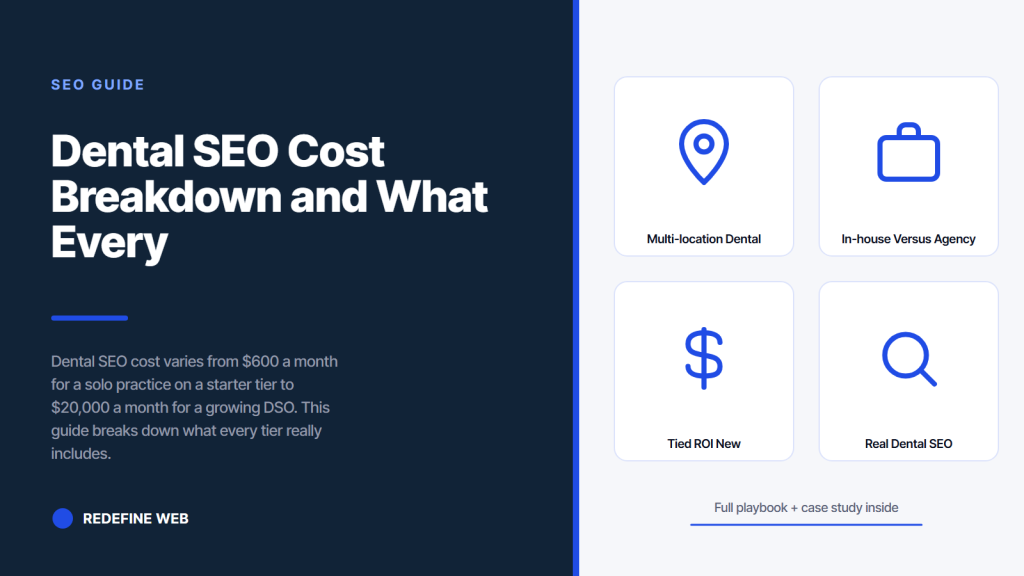
- Starter tier fits maintenance at $600 to $1,500 per month.
- Growth tier fits real single-office ambition at $1,500 to $3,500.
- Aggressive tier fits specialty and small groups at $3,500 to $7,000.
- Compare quotes on unit counts, not on vague scope language.
- Payback typically arrives at month 4 to 7, so budget 6 months minimum.
- Dental SEO cost by practice size and ambition
- Multi-location dental SEO pricing
- What dental SEO pricing should include at every tier
- How much does dental SEO cost when scope gets padded
- Dental SEO contract terms that affect the true cost
- How much does dental SEO cost in-house versus agency
- Dental SEO cost tied to ROI and new patient value
- A real dental SEO cost example from a live account
- Dental SEO cost differences by specialty
- Planning a dental SEO budget for the next year
- Wrapping up the dental SEO cost question
Dental SEO cost sits between $600 and $20,000 per month depending on your practice size, market, and ambition. That is a wide range, and every dentist who has ever compared quotes knows the range gets wider once you factor in what each agency really delivers behind the retainer number. This guide breaks the pricing into three honest tiers, tells you what each tier should include, and points out the padded scopes that make one $2,500 retainer far weaker than another $2,500 retainer.
You get the tier structure most US dental marketing agencies quietly use, the deliverables that actually move rankings versus the ones that only fill a monthly report, and a set of questions that let you stress-test any quote before you sign the contract. Read the section that matches your practice situation right now, or read the whole thing if you are shopping around and want the honest map of the market as of 2026.

Dental SEO cost by practice size and ambition
Dental SEO cost tracks two variables. Practice size covers how many offices you run, and how big a keyword footprint each office needs. Ambition covers whether you want to hold ground, grow steadily, or dominate the local search fight. The right retainer matches the ambition, not the ego. A single-office family practice trying to hold ground can pay $900 a month and be fine. That same practice trying to dominate a 3-mile radius in a competitive metro cannot do it under $2,500 without cutting corners.
The bands below cover what the honest US market pays as of 2026. Sub-$600 offerings exist. They are almost always automated citation packages, template blog content, or offshore work that does not move rankings for a real dental practice in a real market. Anything under $600 is a marketing decoration budget, not an SEO budget.
Solo practice starter tier: $600 to $1,500 per month
The starter tier fits a single-office general practice in a non-competitive market, a rural or suburban zip code, or a practice already ranking that just needs maintenance. You get a Google Business Profile setup and monthly optimization, a citation cleanup pass, review workflow, 1 blog post per month, and basic on-page work on 4 to 6 pages. This tier will hold you in the map pack if you already earned your position, and it will slowly move you if the market is not crowded.
Growth tier: $1,500 to $3,500 per month
The growth tier fits a single-office practice with real local ambition in a suburban or urban market, or a specialty practice like cosmetic, implants, or orthodontics anywhere. You get everything in the starter tier, plus 2 to 4 blog posts per month, dedicated procedure page builds every quarter, technical audits, schema markup, and a review response service. This is the tier where you actually gain ground in a competitive market. Most single-office practices we work with sit somewhere in this range. Our dental seo services pillar covers what the growth tier looks like end to end.
Aggressive tier: $3,500 to $7,000 per month
The aggressive tier fits a specialty practice fighting a dominant competitor, a practice launching a second location, or a multi-office group of 2 to 5 practices. You get everything in the growth tier, plus faster content velocity at 4 to 8 posts per month, active link earning, quarterly technical deep-dives, video and photo asset creation, and per-office GBP management with location-level reporting. This is the tier where you win the local search fight for a competitive category in a competitive metro. Our dental seo strategies post covers the strategy pattern at this level.
Multi-location dental SEO pricing
Multi-location dental SEO pricing does not scale linearly. Ten offices do not cost ten times a single office because central work like technical audits, schema patterns, and design system upkeep runs once for the whole group. What does scale is per-office GBP management, per-office citation cleanup, per-office review workflow, and per-office reporting. Those roughly multiply per location.
Expect around $700 to $1,200 per location per month for well-run multi-location SEO, plus a $2,000 to $5,000 central retainer for the shared systems. A 15-office group at the mid-band comes out around $17,500 per month all-in. Groups that centralize too aggressively pay less but lose 12 to 18 percent of organic visibility over 24 months because local voice gets flattened. Our dso dental marketing post covers the group model in depth.
DSO pricing at scale
A mid-market DSO of 25 to 60 locations typically pays $12,000 to $35,000 per month for full-service SEO. That covers a dedicated account lead, per-location GBP management, central content velocity, technical infrastructure, and reporting that segments per location and per region. Below that band you get thin per-location coverage and the tail-end offices drop out of the map pack. Above that band you should be running a hybrid in-house plus agency model to avoid overspending on scale that internal talent can handle.
Mega DSO pricing beyond 100 locations
Mega DSOs beyond 100 locations usually run a hybrid model with a lean internal SEO team and one or two agency partners for content velocity and technical work. Total SEO spend across the group can climb into $50,000 to $150,000 per month, but the per-location cost drops well below the mid-market DSO band because of internal team economics. If you are hiring a full-service agency for a 150-office group without in-house SEO leadership, the retainer is going to be higher than it needs to be. Build the in-house first.
What dental SEO pricing should include at every tier
Dental SEO pricing should include specific deliverables at each tier, not a vague list of services. If your quote reads ongoing SEO optimization and monthly reporting with no unit numbers, you cannot compare it to anything. Ask for specific counts, then compare the counts side by side.
Number of blog posts per month. Number of pages optimized per quarter. Number of citations cleaned per month. Number of hours of technical work per quarter. Number of link-earning outreach touches per month.
Below is a table showing what should appear at each tier. Use it to line up quotes side by side. If two quotes at the same price point deliver different unit counts, the higher-count quote is not automatically better. Sometimes the lower-count quote spends more time per unit and delivers better content. But you cannot judge without unit numbers to compare.
| Deliverable | Starter tier | Growth tier | Aggressive tier |
|---|---|---|---|
| Blog posts per month | 1 | 2 to 4 | 4 to 8 |
| Procedure or service page builds per quarter | 0 to 1 | 1 to 2 | 2 to 4 |
| Citation cleanup pace | 20 per month | 40 to 60 per month | 60 to 100 per month |
| Google Business Profile updates | Monthly | Bi-weekly | Weekly |
| Link earning outreach | Not included | 4 to 6 per month | 8 to 15 per month |
| Technical audit cadence | Annual | Semi-annual | Quarterly |
| Review response service | Not included | Included | Included plus escalation |
| Reporting cadence | Monthly one-pager | Monthly plus quarterly review | Monthly plus real-time dashboard |
Core deliverables every tier should include
Every tier, even the starter tier, should include Google Business Profile management, monthly reporting, and at least some on-page work. A quote that skips any of the three is not really a dental SEO retainer. It is a content-only package or a citation-only package, which are fine as add-ons but do not move dental rankings on their own. Ask specifically about GBP work. Ask specifically about on-page rewrites. Ask specifically about reporting format.
Stretch deliverables that separate good from great
The deliverables that separate the top agencies from the middle of the market are earned link outreach, dedicated author bios with schema, real photography and video for the practice, and a review response service that goes beyond templates. Those five items rarely show up in a starter tier and appear inconsistently even at the growth tier. When you see them together at any tier, you are looking at a serious operator. When you see none of them at the aggressive tier, you are looking at a retainer padded with easy deliverables.
Two 2500 retainers can be worlds apart. Ask the agency for a monthly deliverables list with hours by task. If they refuse, the scope is padded.
How much does dental SEO cost when scope gets padded
How much does dental SEO cost when the scope gets padded. About the same headline number as an honest retainer, but with 30 to 60 percent less real work. Padded scopes let an agency justify a growth-tier quote while delivering starter-tier value across the board.
The tell is unit-less deliverables that read as busywork. Ongoing keyword research. Continuous competitive analysis. Monthly SEO health monitoring. Content strategy consulting. Backlink profile monitoring. Every one of those can be a real deliverable if it has an output that ships. Every one of those becomes filler when it does not. The question to ask on every line of the scope is what does that produce that I can see this month.
Scope filler flags to watch for
- Ongoing keyword research with no monthly keyword map delivered
- Content strategy consulting with no content brief or editorial calendar
- Continuous competitive analysis with no monthly write-up
- Technical SEO monitoring with no quarterly audit report
- Link building strategy with no monthly outreach volume commitment
- Reputation management with no review response guarantee time
- Schema optimization with no schema types committed to
How to audit your current retainer
Take your last 3 months of reports from your current SEO agency. Count the tangible outputs. Blog posts published. Pages rewritten. Citations corrected. Links earned. Reviews responded to. GBP updates posted. Now divide your retainer by the number of outputs. That is your effective cost per deliverable. If a $2,500 retainer produced 8 tangible outputs, your effective cost per output is $312. If a $1,500 retainer produced 12, your effective cost per output is $125. Same market, same category, wildly different value.
Dental SEO contract terms that affect the true cost
The retainer number is only part of the total cost. Contract terms shape what you actually pay over 12 to 24 months, and some of the padded-scope agencies quietly raise the total cost through onboarding fees, cancellation clauses, and content licensing terms. Reading the contract before signing is not optional.
The three contract terms that matter most are the onboarding or setup fee, the minimum term with early-termination language, and the content ownership clause. A $2,500 monthly retainer with a $6,000 setup fee, a 12-month minimum, and a clause that says the agency retains ownership of blog content is functionally a $2,600 monthly retainer for the first year. Compare on total year-one cost, not headline retainer.
Setup and onboarding fees
Legitimate setup fees exist. A serious technical audit, a full citation baseline, keyword mapping across 40 to 200 target queries, and a content strategy plan take real work and often justify a $2,000 to $6,000 one-time fee. Fees that look inflated relative to the deliverables are usually margin padding. Ask what the setup fee covers, expect a document deliverable within 45 days, and ask to see a redacted example of the setup deliverables from a prior client.
Content ownership and portability
If you cancel your agency, you should keep everything they wrote for your site. Blog posts, procedure pages, schema, and design assets should all transfer with the domain. Some agencies quietly retain ownership of blog content and require you to remove it if you cancel. That is a bad clause, and a real red flag about how the agency views the relationship. Push for a work-for-hire clause that assigns all content to your practice on payment.
How much does dental SEO cost in-house versus agency
In-house dental SEO is not free. A part-time coordinator who owns SEO alongside 4 other tasks runs $18,000 to $30,000 per year plus benefits, roughly $2,500 per month all-in. A dedicated in-house specialist runs $60,000 to $110,000 in salary and benefits.
Plus you pay for content creation, whether that is a freelancer or another in-house writer. Plus you pay for tools like Ahrefs, Semrush, or Moz at $200 to $600 per month. The total in-house budget rarely undercuts an equivalent agency retainer for smaller practices.
The math typically favors agency for practices with 1 to 5 offices, favors hybrid for practices with 6 to 25 offices, and favors majority in-house for practices with 30-plus offices. Single-office practices almost never justify a full-time in-house SEO role, and multi-office groups almost always benefit from at least a fractional in-house SEO lead who owns strategy while the agency delivers execution. Our dental marketing agency vs in-house post covers the decision framework.
Tool costs that add to the true SEO budget
Whether you go agency or in-house, tools cost money. Ahrefs or Semrush at $200 to $600 per month. A local rank tracker at $30 to $100 per month. Call tracking at $50 to $200 per month per location. A schema plugin or CMS module at $0 to $200 per year. Content editing tools at $30 to $100 per month. Some agencies include tool costs in the retainer, some pass them through. Ask which model the agency uses so you do not double-pay for tools you thought were included.
Content costs at each production tier
Dental blog content costs $150 to $600 per 1,000 words for good freelance work, and $600 to $1,500 per post for agency-produced content with strategy, editing, and imagery. Cheap dental content at $30 to $80 per post from content mills is functionally worthless for ranking, because the E-E-A-T signals are absent. If your agency includes 4 blog posts per month in a $2,500 retainer, that is roughly $625 per post allocation, which is a fair number if the posts are dentist-bylined and well-researched. Below $200 per post is a red flag.
Dental SEO cost tied to ROI and new patient value
Dental SEO cost is a cost only if you look at it in isolation. Tied to new patient value, it is almost always the most cost-effective marketing channel a dental practice can run. The average lifetime value of a new dental patient in a general practice runs $3,000 to $6,000. A specialty practice like implants or orthodontics can see lifetime values of $8,000 to $25,000.
A $2,500 per month growth-tier SEO retainer that produces 12 new patients per month at $4,500 lifetime value generates $54,000 in revenue against $2,500 in cost. That is a 21x return. Even at half the patient volume, the ROI still clears 10x. The math almost never fails at the growth tier when the retainer is spent well. Where it fails is at the starter tier for a specialty practice, or at the aggressive tier for a rural single-office practice. Match the tier to the market. Guidance on measurement from the ADA practice management resources reinforces the ROI framework.
Tracking ROI on a dental SEO retainer
Every retainer should report on calls, form fills, and new patient appointments attributable to organic search. Call tracking with dynamic number insertion by traffic source is the industry standard. GA4 events for form submissions. GBP call tracking for map pack calls. A monthly report that ties those numbers to organic ranking and traffic tells you whether the retainer is working. If your agency cannot show that connection, they are not tracking ROI. They are tracking activity. Our dental marketing roi post covers the tracking pattern.
Payback timing on the retainer
Dental SEO payback typically arrives at month 4 to 7 for the growth tier, month 6 to 10 for the aggressive tier in competitive markets, and month 3 to 5 for the starter tier in non-competitive markets. Before payback, you are paying to build assets that will earn back the retainer many times over across the following 12 to 24 months. Practices that cancel at month 3 because they have not seen ROI are cancelling right before the compounding curve turns up. Budget for at least 6 months of retainer before you evaluate.
A real dental SEO cost example from a live account
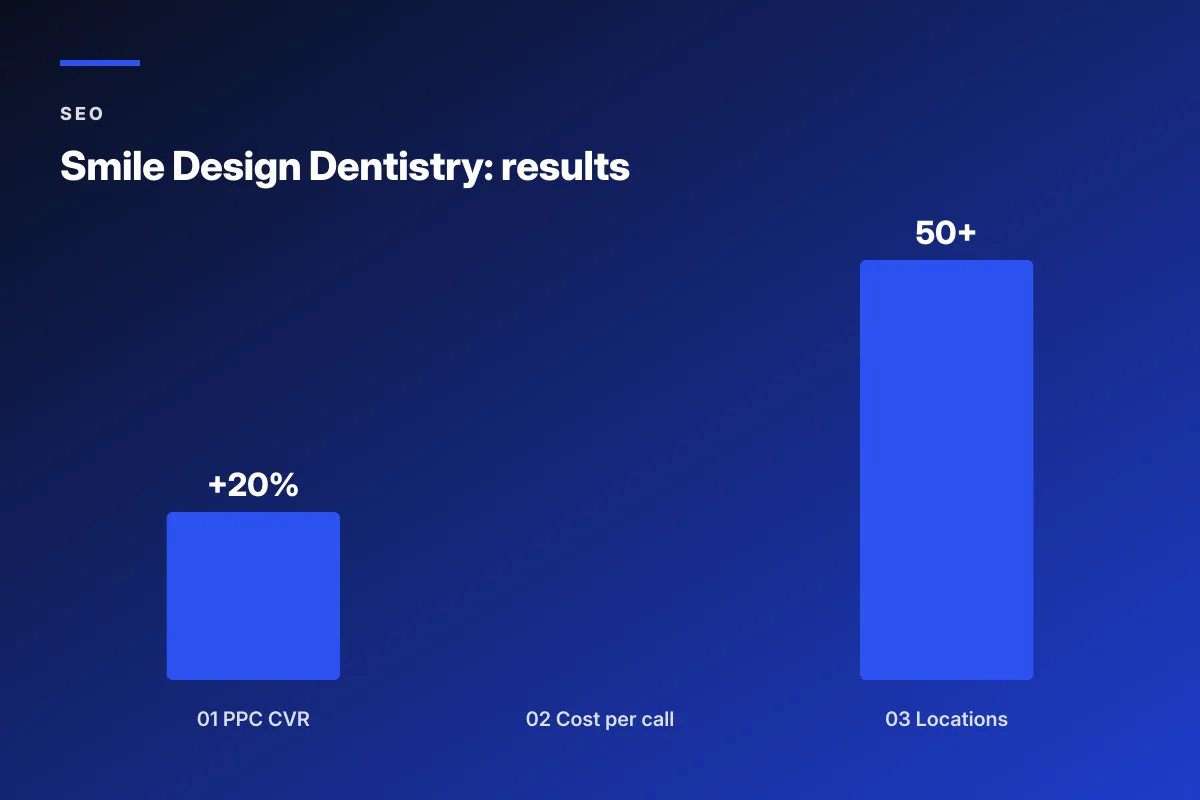
Smile Design Dentistry runs 50-plus offices across the US. Before we engaged, their marketing spend was fragmented across office-level vendors, tracking was thin, and paid social was not running. The organic side had inconsistent GBP work and citation drift across locations. Total marketing spend across the group was higher than the industry benchmark for their office count, but the ROI was hard to measure because of the fragmentation.
We restructured the paid accounts, added full-funnel paid social, and built tailored per-location landing pages, then layered organic map pack fixes across the group. Cost per call dropped 30 percent. PPC conversion rate climbed 20 percent. Fifty-plus locations went live on the unified system, which paid for itself inside the first quarter because the cost per call reduction alone covered the retainer many times over. The pattern held across markets and location types.
Every dentist we talk to has a story about the SEO agency that charged $3,000 a month for two years and never explained what actually happened. Usually the story ends with the practice hiring a new agency, doing an audit, and discovering the previous agency published 4 blog posts total. Divided across 24 months and $72,000, that is $18,000 per post for content the practice does not remember approving. If you cannot list what your agency did last month, they are not doing anything worth listing.
Dental SEO cost differences by specialty
Specialty practices pay more for SEO than general practices, and the reason is competitive intensity. Cosmetic dentistry, dental implants, and orthodontics are among the most competitive local dental categories in most metro markets. Winning a top 3 map pack position for cosmetic dentist in a competitive city can require 24 months of work at the aggressive tier. Winning the same position for family dentist in a suburban market can happen in 9 months at the growth tier.
Endodontics, periodontics, oral surgery, and pediatric dentistry sit in the middle. Less competitive than cosmetic, more competitive than general family practice. Sedation dentistry and emergency dentistry are highly competitive on paid but have moderate organic competition, which shifts the SEO retainer math. Match the tier to the specialty and the market together, not to either one alone.
Implant dentistry SEO cost
Dental implant SEO typically starts at the growth tier because the case value justifies aggressive marketing and the competition demands it. Expect $2,500 to $5,500 per month for a single-office implant practice in a competitive market. The math works easily because a single implant case runs $3,500 to $7,000 and a full-mouth reconstruction runs $30,000 to $60,000. Even at 2 new implant patients per month attributable to organic, the retainer pays back many times over.
Orthodontic and Invisalign SEO cost
Orthodontic and Invisalign SEO in a competitive market runs $2,500 to $6,000 per month for a single-office practice. Multi-location ortho groups often run $8,000 to $20,000. Case values of $4,000 to $8,000 for full ortho and $3,500 to $6,500 for Invisalign make the payback math strong at the growth and aggressive tiers. Watch for agencies that quote ortho SEO at the starter-tier price. The competitive intensity makes those quotes almost impossible to fulfill on the promised outcomes.
Planning a dental SEO budget for the next year
A one-year SEO budget for a dental practice needs a retainer allocation, a content production line item, a tool budget, a photography and video budget, and a contingency line. The contingency exists because market shifts, algorithm updates, and competitive moves sometimes require extra spend inside a 12-month window. Skipping the contingency leaves you scrambling when the map pack shakes up.
The rule of thumb we use is 70 percent of the SEO budget on the retainer, 15 percent on content production if not fully included, 5 percent on tools, 5 percent on photography and video assets, and 5 percent on contingency. For a $30,000 annual SEO budget, that is $21,000 on retainer, $4,500 on content, $1,500 on tools, $1,500 on photography, and $1,500 on contingency. Adjust the mix if your retainer already includes some of the sub-line items.
Quarterly budget review
Every quarter, review the SEO budget against the results. Calls, form fills, appointments, and revenue tied to organic. If the numbers are climbing on schedule, keep the budget. If they are climbing faster than expected, consider adding to the retainer to accelerate. If they are flat 6 months in with no clear cause, meet with the agency to renegotiate scope or replace them. Budget reviews without cancellation threat rarely fix underperforming agencies. Budget reviews with clear performance criteria tied to renewal decisions do fix them, or trigger the switch you need.
Annual planning cycle
Every year, rebuild the SEO budget from the ground up rather than defaulting to last year’s number plus inflation. Market position changes. Competitive intensity changes. Content backlog changes. The right budget for year 2 might be smaller than year 1 if the initial asset-building push is done, and it might be larger if a new location opened or a new competitor entered. Guidance from Google Search Central on E-E-A-T evolution and from the web.dev Core Web Vitals guide both feed into what the next-year budget needs to cover.
Wrapping up the dental SEO cost question
Dental SEO cost varies with practice size, ambition, market intensity, and specialty. The starter tier at $600 to $1,500 fits maintenance and non-competitive markets. The growth tier at $1,500 to $3,500 fits real ambition in single-office practices. The aggressive tier at $3,500 to $7,000 fits specialty practices and small multi-office groups fighting for competitive positions. Multi-location and DSO pricing scales from there with hybrid in-house economics at the top end.
The right retainer matches the ambition and the market. Compare quotes on unit-count deliverables, not on vague scope language. Read the contract terms as carefully as the retainer number. Track ROI on calls, form fills, and appointments tied to organic. If you want the whole system quoted for your specific market and practice, our dental SEO services lays out what a full engagement includes.
Frequently asked questions
How much does dental SEO cost for a single-office general practice?
For a single-office general practice with real local ambition in a suburban or urban US market, dental SEO cost typically runs $1,500 to $3,500 per month at the growth tier. That range covers Google Business Profile management, monthly content publishing, procedure page builds, citation cleanup, technical audits, and a review workflow. Practices in less competitive rural markets can sometimes hold ground at the starter tier of $600 to $1,500 per month. Practices in the most competitive urban zip codes may need to move to the aggressive tier of $3,500 to $7,000 per month to actually win top map pack positions against established competitors. The right number tracks the ambition.
What does dental SEO pricing include at the growth tier?
The growth tier at $1,500 to $3,500 per month should include monthly Google Business Profile updates, citation cleanup at 40 to 60 sites per month, 2 to 4 blog posts per month with dentist bylines, quarterly procedure page builds, semi-annual technical audits, schema markup implementation, a review request and response workflow, and a monthly report tied to calls and form fills. Watch out for quotes at this price point that only include content and reporting with no on-page or citation work. Those are content packages priced at growth-tier levels. Ask for specific unit counts on every deliverable before signing.
Why does dental SEO cost more for specialty practices?
Specialty practices like cosmetic dentistry, implants, and orthodontics face higher competitive intensity in most metro markets because the case values are high and the marketing budgets of competitors are higher. Winning a top 3 map pack position for cosmetic dentist in a competitive city can require 18 to 24 months of aggressive tier work. The retainer runs higher, but the math still works because a single implant case at $3,500 to $7,000 or a smile makeover at $8,000 to $25,000 pays back the retainer many times over. Specialty SEO usually starts at the growth tier and scales up as competition demands.
Is in-house dental SEO cheaper than an agency?
For single-office and small multi-office practices, agency SEO is usually cheaper than in-house. A part-time marketing coordinator who owns SEO alongside other tasks costs around $2,500 per month all-in, roughly the same as a growth-tier agency retainer but with less specialized capacity. A dedicated in-house SEO specialist costs $6,000 to $9,000 per month in salary, benefits, and tools. Practices with 6 to 25 offices often run a hybrid model, and practices with 30-plus offices typically favor majority in-house with agency partners for content velocity and technical work. The right mix depends on office count and complexity.
How long before dental SEO pays for itself?
Payback timing on a well-run dental SEO retainer typically arrives at month 4 to 7 for the growth tier, month 6 to 10 for the aggressive tier in competitive markets, and month 3 to 5 for the starter tier in non-competitive markets. Before payback, you are paying to build assets that compound across the following 12 to 24 months. Practices that cancel at month 3 because they have not seen ROI are cancelling right before the curve turns up. Budget for at least 6 months of retainer before evaluating, and expect year 2 economics to be dramatically better than year 1 because the assets built in year 1 keep working.
What is a red flag in a dental SEO quote?
The biggest red flag is unit-less scope language. Ongoing SEO optimization and monthly reporting with no specific numbers means the agency is not committing to anything measurable. Other red flags include content quotes below $200 per post, setup fees above $8,000 without a clearly defined deliverable, minimum contract terms longer than 12 months, content ownership clauses that let the agency retain your blog content, and any promise of specific ranking positions within specific timeframes. Legitimate dental SEO agencies quote in specific deliverable counts, avoid promising rankings, own their work only until you pay for it, and stay flexible on contract terms.
Book your free 30-minute strategy call.
No spam, no sales rep. We use your email to schedule your call with a senior strategist. That is it.
More from the blog
View all articles → SEO
SEO Organic Search Engine Optimization Services That Grow Real Traffic
Read article SEO
SEO SEO for Pet Groomers That Fills the Appointment Book Weekly
Read article SEO
SEO