
Dental Website SEO That Turns Your Site Into a Booking Machine
- Speed, schema, and page-per-service architecture drive early wins.
- Every service and neighborhood needs its own dedicated page.
- Schema must match the on-page content or Google ignores it.
- Redirect maps prevent ranking loss during a site rebuild.
- Measure organic booked appointments, not just impressions.
- Dental Website SEO Foundations That Still Matter
- On-Page SEO for Dental Websites
- Technical SEO for Dental Practice Websites
- Schema Markup for Dental Website SEO
- Content Depth for Dental Website SEO
- Conversion Optimization on Ranked Dental Pages
- Tracking Dental Website SEO Performance
- Dental Website SEO Mistakes That Cost Rankings
- Dental Website SEO Roadmap for the First 90 Days
- How NC Dental Clinic Rebuilt Organic Visibility
Dental website SEO is the difference between a practice site that pulls appointments from search every day and one that quietly loses ground to competitors who fixed their basics last year. Ranking is only the first half of the work. Turning a ranked page into a booked patient is the second half, and most practice sites get it wrong. This guide walks through the on-page structure, technical performance, schema, content depth, and the small conversion moves that turn organic visitors into scheduled appointments. Every recommendation here is something we’ve deployed on live dental accounts and watched produce results inside a quarter.
The short version. If your dental website loads in more than four seconds on mobile, has no schema markup, and lists services on a single crammed page, three fixes will produce more impact than a full rebuild. Speed, schema, and page-per-service architecture together typically drive a 40 to 80 percent grow in organic sessions inside 12 weeks. Everything else in this guide sits on top of those three.

Dental Website SEO Foundations That Still Matter
Dental website SEO in 2026 still runs on the same foundations that mattered in 2020, but with tighter thresholds. Speed matters more. Mobile matters more. Schema matters more. Content depth matters more. The following three foundations catch the biggest wins for practices that have not touched their site in years.
Core Web Vitals on mobile
Google’s Core Web Vitals are pass or fail. Largest Contentful Paint under 2.5 seconds. Interaction to Next Paint under 200 milliseconds. Cumulative Layout Shift under 0.1. Most dental sites fail one or more on mobile. Optimizing hero images to WebP, preloading web fonts, and stripping unused JavaScript typically pushes a site from failing to passing inside two weeks. That single move grows organic rankings across a dozen queries.
Mobile-first structure and layout
Google indexes the mobile version of the site first. If your desktop site has content the mobile site hides behind an accordion, you’re penalizing yourself. Every service page should render the full content on mobile. The design should read cleanly on a 375-pixel viewport. Touch targets should sit at 44 pixels or larger. These aren’t design preferences. They’re ranking factors.
HTTPS and clean site architecture
Every practice site should run on HTTPS with a valid SSL certificate. Sub-three-click depth from the homepage to every service page. Clean URL structure with lowercase, hyphens, and no trailing parameters. No orphan pages. No 404s on internal links. These fundamentals are cheap to fix and remove friction the crawler otherwise hits.
On-Page SEO for Dental Websites
On-page SEO for dental websites means giving each page a specific job and a specific query set. One page per core service. One page per city or neighborhood served. A homepage that anchors the practice’s brand and links out to the deeper pages. This structure works because it matches how patients actually search.
Page-per-service architecture
Every service you offer should have its own page. Implants. Whitening. Invisalign. Sedation. Emergency dentistry. Cramming five services onto one page dilutes ranking potential across all five. A dedicated 1,200 to 1,800-word page per service, with proper H1, H2, and internal links, outperforms a crammed page by 3 to 5 times on organic traffic.
Location pages for multi-neighborhood practices
If your practice serves multiple neighborhoods or cities, build a page for each with real localized content. Not templated copy with the city name swapped. Real content covering local landmarks, local patient demographics, and directions from that neighborhood. Templated location pages get filtered by the algorithm. Distinct location pages rank.
Title tags and meta descriptions
Every page needs a unique title tag under 60 characters and a unique meta description between 145 and 160 characters. The focus keyword goes at the front of the title. The meta description sells the click without overpromising. Bare templates like “Home | Practice Name” waste one of the highest-value SEO fields on the page.
Technical SEO for Dental Practice Websites
Technical SEO on dental practice websites often gets neglected because it’s invisible to the owner. The crawler cares deeply. The following technical hygiene items separate sites that rank easily from sites that fight for every position.
XML sitemap and robots.txt
Every dental site needs a clean XML sitemap submitted to Google Search Console. Include every service page, location page, and blog post. Exclude thin pages, thank-you pages, and admin routes. Robots.txt should allow crawling of all indexable pages and block administrative routes. Both files take an hour to build correctly and produce faster and cleaner indexing.
Canonical tags and duplicate content
Every page should have a self-referencing canonical tag. Duplicate content across similar service pages needs handling with canonical tags or clear content differentiation. Practices with several location pages that duplicate 80 percent of the content across pages usually see the algorithm choose one page and suppress the rest. Rewrite for actual differentiation to earn the ranking potential.
Internal linking structure
Internal links pass authority between pages. Every service page should link to related services and to the New Patients page. Every location page should link to the relevant service pages. The homepage should link out to the top service and location pages. A tight internal link structure amplifies the ranking of every page connected to the network. Audit internal links quarterly to catch orphan pages and broken links after any redesign.
Run PageSpeed on your homepage. If LCP is over 2.5s on mobile, no schema plugin saves you. Speed pulls more organic wins than 3 months of content work.
Schema Markup for Dental Website SEO
Schema markup gives search engines a machine-readable version of your practice information. Dentist schema, LocalBusiness schema, MedicalBusiness schema, FAQ schema, and Article schema each serve a purpose. Together they help the practice claim rich results, sitelinks, and local pack visibility.
| Schema Type | Where It Goes | What It Enables |
|---|---|---|
| Dentist | Homepage and service pages | Practice recognition and richer snippets |
| LocalBusiness | Homepage and contact page | Local pack signals and rich contact display |
| FAQPage | Service and location pages | FAQ rich results and long-tail visibility |
| Review | Homepage and service pages | Star ratings in rich results where eligible |
| BreadcrumbList | All internal pages | Cleaner sitelink display |
| Article | Blog posts | Article rich results and Discover eligibility |
Implementing schema without a plugin nightmare
Schema can go through a plugin like Rank Math or Yoast, but the cleanest implementation puts JSON-LD directly in each page template. Plugin-generated schema is fine for baseline coverage. Custom JSON-LD gives you tighter control over property values and easier debugging in Search Console.
Validating schema in Search Console
After publishing, validate every schema type in Google’s Rich Results Test. Fix warnings. Fix errors. Any schema type showing errors will not produce rich results. Practices that skip validation often think their schema is working when Google is quietly ignoring it. Ten minutes of validation per page saves months of missed opportunity.
Keeping schema aligned with reality
Schema needs to match what appears on the page. If the FAQ schema lists a question the page does not actually answer, Google penalizes the trust signal. If the LocalBusiness schema lists hours that differ from the visible hours block, the algorithm ignores the schema. Keep them in sync every time you edit the page.
Content Depth for Dental Website SEO
Content depth is the biggest missed opportunity on most dental practice sites. Service pages with 300 words rarely rank against competitors publishing 1,500 to 2,500-word service pages. Depth means covering the query completely, not padding for word count.
What complete service page content covers
A complete service page answers what the procedure is, why patients choose it, what happens during a visit, what recovery looks like, how much it costs or how pricing works, insurance and financing options, common patient questions, and how to book. That’s 1,200 to 1,800 words if written cleanly. Patients read what they need. The rest sits below the fold and feeds the ranking algorithm.
Blog content that supports service pages
Every core service should have three to five supporting blog posts that answer long-tail questions patients ask before booking. Cost, recovery time, comparison against alternatives, insurance coverage, aftercare tips. These posts drive top-of-funnel traffic and pass internal link authority to the money service page. Together they form a topic cluster the algorithm rewards.
Content freshness and quarterly updates
Update service pages at least quarterly. Refresh pricing bands. Add a new FAQ from patient questions. Refresh the intro paragraph. The algorithm rewards recency signals on service pages and treats stale content as a soft signal that the practice may not be operating. Small, honest updates keep the freshness signal alive.
Conversion Optimization on Ranked Dental Pages
Dental website SEO is only half the job. The other half is turning organic visitors into booked appointments. Ranked pages that fail to convert waste the SEO investment. The conversion moves below cost little and produce measurable results within a month.
Above-the-fold booking CTA
Every service page should have a booking CTA above the fold on mobile. A clear button. A specific action. “Book your consultation.” “See available times.” Not “Learn more.” Patients on a service page already learned enough to search. Ask for the appointment.
Click-to-call on mobile
Mobile visitors book by phone more often than by form. Every service page needs a tap-to-call button that’s clearly visible on mobile. Practices that adopt a persistent tap-to-call bar on mobile typically see a two to three times boost in inbound calls from organic traffic within 30 days.
Trust cues that reduce hesitation
Star ratings from Google. Recent review quotes. A photo of the doctor. Insurance logos. Same-day appointment badge if applicable. These trust cues sit close to the booking CTA and remove hesitation for patients who are ready but nervous. Small design choices at the CTA area produce real booking rate gains.
Form length and friction
Booking forms with more than five fields cut conversion rate almost in half. Keep the initial form short: name, phone, preferred time. Follow up with the rest during the front-desk confirmation call. Every extra field on the first form drops conversion two to four percentage points on mobile.
Tracking Dental Website SEO Performance
Dental website SEO performance needs measurement across three layers. Rankings for target queries. Organic traffic to the money pages. Booked appointments from organic traffic. Skipping any layer produces a partial picture. All three together give a defensible view of what the SEO program is producing.
Search Console for query and page data
Google Search Console gives you the raw impressions, clicks, and average position for every query and page. Check weekly. Flag queries dropping more than 10 percent in impressions. Flag pages losing more than 15 percent in clicks. Fixes usually center on content freshness, internal linking, or a technical error the crawler surfaced.
GA4 for organic traffic behavior
GA4 tells you what organic visitors do after landing. Bounce rate on service pages. Time on page. Scroll depth. Conversion events for form submissions and click-to-call. Segment by organic source and by device. Mobile bounce rate above 65 percent on a service page usually points to a slow load time or a mismatched CTA.
Call tracking for booked appointments
CallRail or a similar tool ties phone calls back to the specific page and organic query that produced them. Score each call for patient quality. The conversion picture on organic traffic goes from foggy to sharp within 30 days of installation. Practices that never install call tracking never see the full ROI of their SEO investment.
Dental Website SEO Mistakes That Cost Rankings
Dental website SEO goes wrong in a handful of predictable ways. Learn from the mistakes below rather than repeating them. Every mistake here has cost real practices real ranking positions.
- Publishing 20 service pages with 200 words each instead of five with 1,500 words each.
- Copying location pages across neighborhoods with only the city name swapped.
- Skipping schema entirely because the developer said it wasn’t necessary.
- Ignoring Core Web Vitals because the site looks fine on the developer’s laptop.
- Blocking indexing on service pages by accident during a site redesign.
- Adding a chatbot pop-up that covers the primary CTA on mobile.
- Forgetting to redirect the old URLs after a site rebuild.
Redirect maps during rebuilds
Every site rebuild needs a 301 redirect map from every old URL to the closest new URL. Skipping this step wipes years of accumulated ranking authority. The rebuild launches, rankings crater, and the practice spends six months clawing back what was already earned. Build the map before pushing the new site live.
Design decisions that fight SEO
Full-screen video backgrounds, heavy JavaScript animation libraries, and hidden content behind accordions all fight Core Web Vitals and content indexing. Every design decision has an SEO cost. Weigh both sides before signing off on a heavy design pattern. Beautiful sites that fail to rank produce no patients.
Content decisions that fight SEO
Publishing thin, template-based content across service pages fights ranking harder than any technical issue. The algorithm evaluates content depth. Templates fail that test. Invest the writing time upfront rather than trying to compensate with backlinks or technical polish later.
Dental Website SEO Roadmap for the First 90 Days
The first 90 days of a dental website SEO program set the tone for the whole engagement. The roadmap below walks through what should happen in each 30-day block. Skip a phase and the program builds on a weak foundation. Follow the sequence and the rankings compound predictably from month four onward.
Days 1 to 30: audit and quick wins
Full technical audit. Core Web Vitals fixes. Schema baseline across the homepage and top service pages. Search Console and GA4 verified. Redirect audit for any past URL changes. This block produces the fastest visible ranking movement because it removes friction the crawler was already hitting.
Days 31 to 60: content depth on the top service pages
Rewrite the top three revenue-driving service pages to 1,200 to 1,800 words each. Add FAQ blocks feeding FAQ schema. Add internal links from the homepage and blog. Refresh title tags and meta descriptions. This block sets the pages up for the ranking gains that show up in month three.
Days 61 to 90: location pages and content cluster launch
Build or rebuild location pages for every neighborhood the practice serves. Publish the first two supporting blog posts per top service. Wire the internal linking between the service pages, the location pages, and the blog. By day 90, the topic clusters look coherent to the crawler and rankings start climbing across long-tail queries.
How NC Dental Clinic Rebuilt Organic Visibility
NC Dental Clinic, a 20-year family practice in Vista, California, had a strong offline reputation and almost no online presence. The site was outdated, slow, and invisible on the queries that mattered. The rebuild focused on the same dental website SEO foundations covered in this guide.
Rebuilt the site on a mobile-first, secure foundation
The site rebuild started with mobile-first design, HTTPS, and Core Web Vitals that pass on mobile. Service pages gained the depth needed to rank against competitors. Location content covered the actual Vista service area with real localization. Schema markup went in across the homepage, service pages, and blog posts. Every foundation piece got addressed before any content marketing kicked in.
Local SEO paired with the site rebuild
Advanced local SEO on the Google Business Profile paired with the rebuilt site. NAP consistency across major directories. Structured local content on service pages tied to the neighborhoods the practice served. GMB-driven PPC ran on top of the fixed foundation rather than fighting a broken one.
The compounding outcome
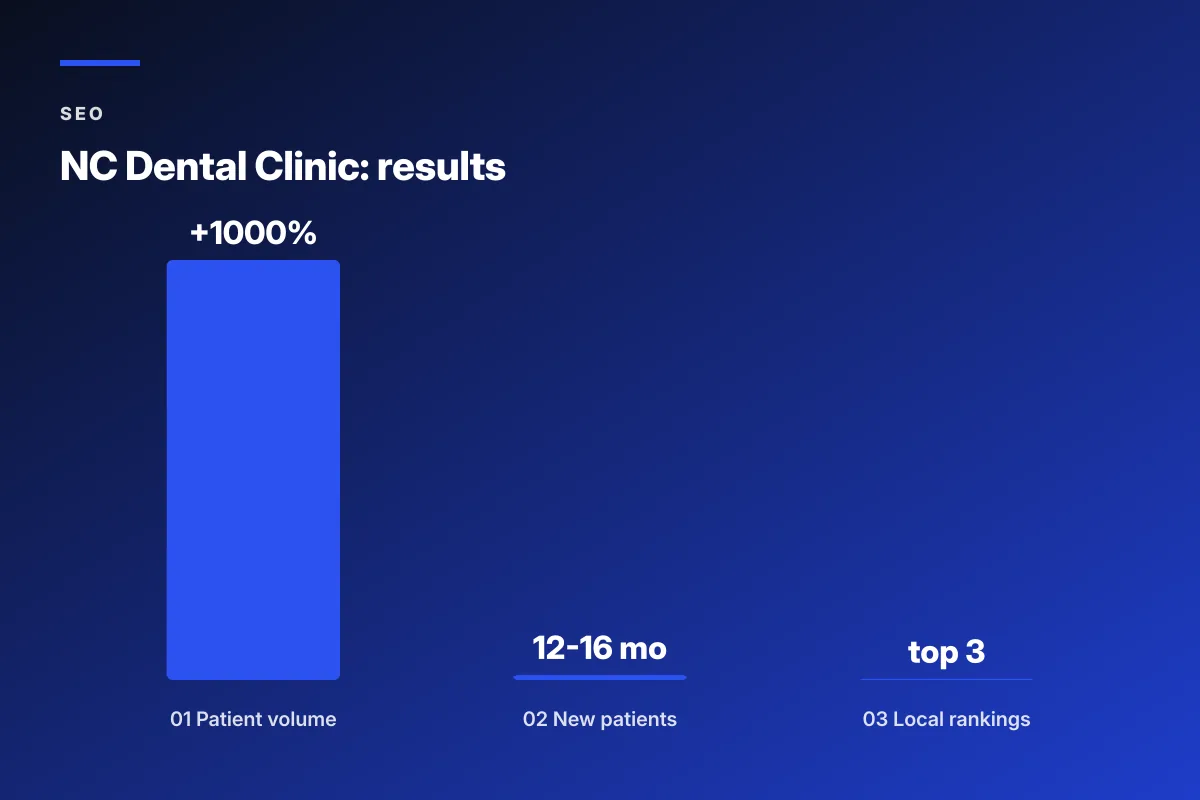
The rebuilt program generated 12 to 16 new patients monthly and a 1,000 percent jump in patient volume against the pre-engagement baseline. Local search rankings moved into the top three for the practice’s core services in the Vista service area. The SEO foundation and the site rebuild together produced compounding organic growth that a paid-only program could not.
Dental website SEO earns its return when the foundation, the on-page work, the schema, and the conversion moves all run together. If you’d like help auditing the current state and building a 12-week roadmap, our team at Redefine Web supports practices through dental marketing for dentists. Related reads: dental SEO guide, local SEO for dentists, dental SEO audit, and schema for dental websites. External references: Google Core Web Vitals reference, Google’s LocalBusiness structured data guide, and Search Console documentation.
Frequently asked questions
What is dental website SEO?
Dental website SEO is the discipline of shaping a dental practice site to rank in Google and Bing for the queries patients use before booking. Core work covers technical foundations like Core Web Vitals, HTTPS, and clean site architecture, on-page structure with dedicated pages per service and neighborhood, schema markup across the homepage and service pages, content depth of 1,200 to 1,800 words per service page, and conversion optimization that turns ranked visitors into booked appointments. Dental website SEO is not a one-time project. Rankings compound with monthly updates, content freshness, and internal linking maintenance. Practices that invest consistently over 12 months usually see 40 to 100 percent organic session growth against a stagnant baseline site.
What are the biggest dental website SEO ranking factors?
Three ranking factors move the needle most on dental website SEO. Core Web Vitals on mobile, which Google treats as pass or fail with strict thresholds on Largest Contentful Paint, Interaction to Next Paint, and Cumulative Layout Shift. Content depth on service and location pages, where 1,200 to 1,800 well-written words per page consistently outperform 300-word service pages. Schema markup that helps search engines interpret the practice information, especially Dentist, LocalBusiness, FAQPage, and Review types. Other factors include HTTPS, clean URL structure, internal linking, content freshness with quarterly updates, and NAP consistency across major directories. Sites that address these fundamentals usually see rankings grow across a dozen queries within a quarter.
How long does dental website SEO take to show results?
Dental website SEO typically shows early results within 8 to 12 weeks and compounding results between month four and month twelve. Technical fixes like Core Web Vitals and schema markup produce visible impact within two to four weeks because they influence indexing speed. Content work on service pages takes longer because the algorithm needs several weeks of impression data to evaluate depth and relevance. Local pack ranking movement usually lands between week eight and week sixteen after schema and citation work. Organic traffic growth of 40 to 100 percent against a stagnant baseline is realistic inside 12 months of consistent SEO work. Practices that expect ranking changes in 30 days are usually pointed at bought traffic rather than earned organic visibility.
How much does dental website SEO cost?
Dental website SEO cost varies by practice size and scope. Single-location practices typically pay $1,000 to $2,500 per month for local SEO, Google Business Profile management, content refreshes, and schema maintenance. Growth practices with active blog publishing and multi-neighborhood location pages pay $2,500 to $5,000 per month. Multi-location practices and DSOs pay $5,000 to $15,000-plus per month depending on the location count and the depth of custom content per location. Ad spend and third-party tool costs like Search Console verification, GA4, and CallRail sit separate from the retainer. Beware of retainers under $800 for a single location because the strategist hours behind that number rarely cover real SEO work.
Do dental websites need schema markup?
Yes. Dental websites need at least Dentist, LocalBusiness, FAQPage, and BreadcrumbList schema across the homepage, service pages, and contact page. Blog posts should carry Article schema. Where reviews are visible on the site with the practice's own aggregated rating, Review schema qualifies for star display in rich results. Schema gives search engines a machine-readable version of your practice information, which supports local pack visibility, sitelinks, and richer snippet display. Implementation can go through a plugin like Rank Math or Yoast for baseline coverage, or through custom JSON-LD embedded in each page template for tighter control. Every schema type must be validated in Google's Rich Results Test after publishing and kept aligned with the visible content on the page.
How does dental website SEO differ from local SEO for dentists?
Dental website SEO and local SEO for dentists overlap heavily but focus on different surfaces. Dental website SEO shapes the site itself: architecture, page content, schema, technical performance, and conversion. Local SEO for dentists shapes the practice's visibility in the local pack and Google Maps, which runs on the Google Business Profile, NAP consistency across directories, review volume and velocity, and proximity-based ranking signals. Both work together. A well-optimized site with a neglected GBP will underperform. A polished GBP paired with a slow, thin site will also underperform. The practices that grow fastest run both disciplines together with a coordinated content and citation strategy that feeds both surfaces.
What dental website SEO mistakes cost the most rankings?
Three dental website SEO mistakes cost more rankings than any others. First, skipping a 301 redirect map during a site rebuild wipes years of accumulated ranking authority overnight and forces the practice to earn every position again. Second, publishing 20 template-based service pages with 200 words each instead of five dedicated service pages with 1,500 words each dilutes ranking potential across every page. Third, copying location pages across neighborhoods with only the city name swapped triggers the algorithm's duplicate content filter and suppresses all copies. Other common mistakes include ignoring Core Web Vitals because the site looks fine on the developer's laptop, blocking indexing on service pages during a redesign, and adding chatbot pop-ups that cover the primary CTA on mobile. Each mistake is preventable with a proper audit before launch.
Book your free 30-minute strategy call.
No spam, no sales rep. We use your email to schedule your call with a senior strategist. That is it.
More from the blog
View all articles → SEO
SEO Organic Search Engine Optimization Services That Grow Real Traffic
Read article SEO
SEO SEO for Pet Groomers That Fills the Appointment Book Weekly
Read article SEO
SEO