
Dentist Near Me SEO That Actually Books Local Patients
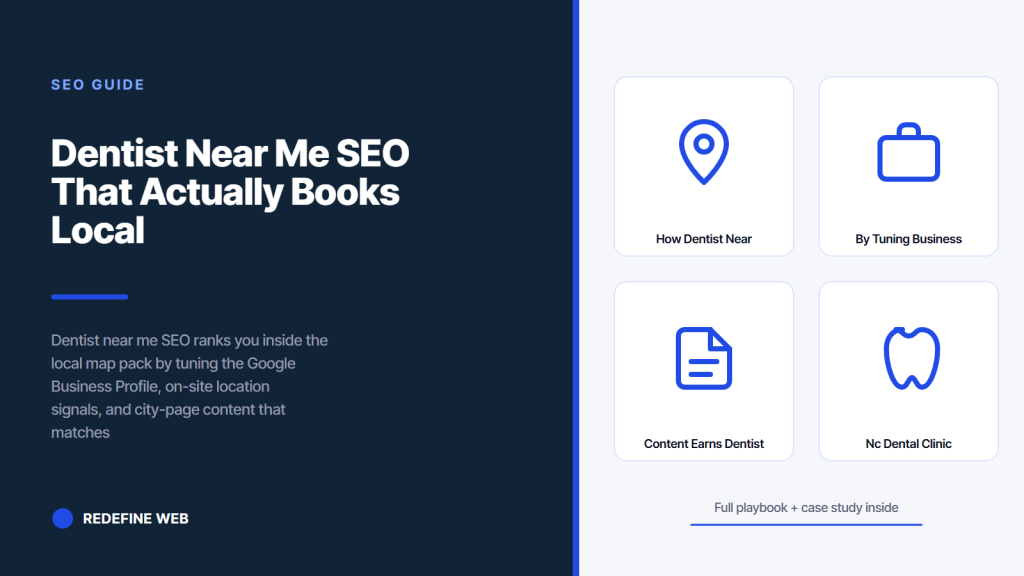
- Google rewrites near me queries, so a near-me page targets zero real searches.
- Prominence, relevance, and distance are the three ranking signals to move.
- Business Profile tuning outweighs onsite work in the first 30 days.
- NC Dental grew patient volume 1,000 percent over six years on the stack.
- Ten new reviews per month moves the map pack inside 90 days.
- How dentist near me SEO actually works in 2026
- Rank for dentist near me by tuning the Business Profile first
- Onsite location signals for near me dental seo
- Citations, directories, and cleanup for the near-me stack
- Content that earns the dentist near me slot
- NC Dental Clinic case study on dentist near me seo
- Tracking whether the dentist near me seo work is working
- Backlinks that move near me dental seo
- The 90 day dentist near me seo plan
- Common mistakes on dentist near me seo
- Where to start on your practice today
Dentist near me SEO is not a keyword you target on a page. Google rewrites near me queries on the fly using the searcher’s coordinates and the local map pack, so a page titled dentist near me is a wasted URL. You rank for those searches by strengthening the three signals Google uses to decide who fills the three map slots on a phone screen at 8:14 in the morning. Prominence. Relevance. Distance. Get all three right and your practice sits in the top three, seven days a week.
You get the exact stack we run on solo practices and two-provider offices to earn the near-me slot without a spam page. Google Business Profile tuning that moves prominence. Onsite location signals that raise relevance. NAP consistency and citation cleanup that fixes distance ambiguity. A real case pulled from a Vista, California practice where we grew booked patients 1,000 percent over six years. Read straight through in about ten minutes and start on the fixes tomorrow.
How dentist near me SEO actually works in 2026
Dentist near me seo works by feeding Google three location signals. Prominence, relevance, and distance. The engine rewrites the near me tokens into a local pack query using the searcher’s coordinates, then ranks nearby businesses by review count, category fit, and mileage. You compete for the three map slots, not a keyword.
The phrase dentist near me is a proxy query. Google reads the searcher’s geolocation, drops the near me tokens, and matches the intent against local businesses inside a two to five mile radius. The result: three map pack slots, then a small stack of blue-link organic results. Ninety percent of the click volume on a phone lands inside those three map slots. Dentist near me seo is a slot competition, not a keyword competition.
The three ranking signals Google uses
Prominence is your reputation footprint. Review count, review recency, backlink profile, and mentions across the local web. Relevance is how tightly your Business Profile category, services, and site content match the query. Distance is straight-line miles from the searcher to your listed address. Only distance is out of your hands. Everything else moves with focused work over 60 to 120 days. Most losing practices lose on prominence, not distance.
Why building a near-me page fails
A page titled Dentist Near Me in Austin ranks for zero searches. Google rewrites the query into the local pack before the SERP renders, so your onsite page never enters the ranking pool for that exact phrase. Sites that build near-me pages waste their sitemap budget and dilute keyword focus across their real service pages. The fix is to invest that same content effort into a solid city page, a strong service page, and a well-tuned Google Business Profile.
Rank for dentist near me by tuning the Business Profile first
Your Google Business Profile pulls more weight in the map pack than your website. Every time we audit a practice stuck outside the top three, the Profile is 40 to 70 percent optimized. Categories missing. Services empty. Photos six years old. Product tiles blank. Fix the Profile before you touch the site and rankings often move inside three weeks with zero domain-level work.
- Set primary category to Dentist. Add secondary categories for every service you actually offer (Cosmetic Dentist, Pediatric Dentist, Emergency Dental Service)
- Fill the Services section with 15 to 25 line items, each with a 200-word description containing the service name
- Upload 20 to 40 real photos of the office, the operatory, the staff, and the exterior signage
- Publish a Google Post every 7 to 14 days with a real update, offer, or clinical explainer
- Respond to every review within 48 hours using the reviewer name and one service-specific detail
- Add the full appointment booking URL that points to your own site, not a third-party page
- Enable messaging and answer inside 4 hours during business days
Category selection moves prominence
Practices that list only Dentist as the primary category leave 4 to 7 secondary category slots empty. Each empty slot is a query set you cannot rank for. A practice offering sedation, veneers, implants, and pediatric care should list Cosmetic Dentist, Pediatric Dentist, and Dental Implants Provider as secondaries. Google shows the practice for queries tied to each category. Missed categories equal missed impressions. Filling them takes 20 minutes and moves impressions 30 to 60 percent inside a month.
Photos and posts feed the prominence signal
Profiles with fresh photos uploaded in the past 30 days rank higher than profiles that last updated in 2022. The signal is engagement recency. Twenty real photos beat a hundred stock images every time. Add exterior shots taken during daylight, interior operatory photos, doctor headshots, and one shot of the front desk. Google Posts published weekly signal an active listing. Skip stock language. Write two sentences about a real update, tag one service, add one photo.
Onsite location signals for near me dental seo
The website still matters for near me dental seo because Google verifies the Profile against your onsite content. When your homepage says one thing and your Profile says another, the ranking system flags the mismatch and lowers relevance. You fix this with a consistent Name, Address, Phone footprint across every page, LocalBusiness schema on the homepage, and city-specific content on your primary service pages.
The Name, Address, and Phone number visible on the homepage must match the Business Profile character for character. Suite numbers matter. Punctuation matters. If the Profile says 425 Main St and the site says 425 Main Street, the citation system reads them as two different addresses. Cleanup takes an hour, and the payoff is measurable inside 30 days. Dentist near me seo starts here because Google verifies every citation against your onsite NAP before scoring the pack. Layer local seo for dentists tactics beyond the map pack basics once the NAP is clean.
NAP consistency across the site
Every page footer carries the exact same NAP string. Every location page repeats the address in schema. The About page adds the year founded, the years in service, and the neighborhood or metro. Sites with fragmented NAP data across pages fall out of the local pack because Google cannot decide which address is authoritative. One canonical NAP string, hardcoded in the theme footer, ends the ambiguity in one deploy.
LocalBusiness schema and Google Maps embed
LocalBusiness schema on the homepage tells Google the exact latitude, longitude, phone number, opening hours, and accepted insurance list. An embedded Google Maps iframe with the practice’s Place ID reinforces the same coordinates and signals the site owner controls the Business Profile. Both are 20-minute additions. Both move relevance. Skip them and you leave 10 to 20 percent of the ranking signal on the table.
Google rewrites near-me on the fly using coordinates. If you've got a page titled Dentist Near Me, delete it and 301 to your city page today.
Citations, directories, and cleanup for the near-me stack
Citations are mentions of your practice on other sites. Yelp, Healthgrades, Vitals, Zocdoc, WebMD Care, and the two or three local business directories your city runs. Each citation reinforces the address in Google’s index. Consistency across the citation set feeds prominence and distance signals. Inconsistent citations, where an old suite number or a legacy phone number lingers, drag rankings down for months. Cleanup is not glamorous. It works.
| Directory | Priority | Effort to fix | Ranking impact |
|---|---|---|---|
| Google Business Profile | Critical | 2 hours setup, 30 min weekly | Highest, moves in 3 weeks |
| Yelp | High | 1 hour claim and update | High, moves in 6 weeks |
| Healthgrades | High | 1 hour claim | Medium, moves in 8 weeks |
| Zocdoc | Medium | 2 hours full profile | Medium plus direct bookings |
| Apple Business Connect | Medium | 30 minutes | Growing, still moderate |
| Bing Places | Low | 20 minutes | Low, still worth doing |
Citation tools worth paying for
Whitespark, BrightLocal, and Yext each scan the 50 to 80 citation sources dentists actually appear on and produce a list of mismatches. Cost runs $20 to $99 per month depending on tier. Manual cleanup on the top 15 citation sources takes about six focused hours and covers roughly 90 percent of the ranking signal. Automation on the long tail buys you the last 10 percent for practices in dense metros with two or three chain competitors. For solo suburban practices, manual cleanup is often enough.
Review generation feeds prominence
Practices with 250 reviews at 4.8 stars sit in the top three of the map pack. Practices with 42 reviews at 4.6 stars sit in the second page. The gap is not the star count. It is the review count and the review recency. Ask every patient at checkout using a printed handoff card with a short URL to the review form. Ten new reviews per month moves rankings inside 90 days. Use text and email review requests only if you have opt-in on file. See our full dental citations playbook for the citation cleanup order.
Content that earns the dentist near me slot
You never target dentist near me directly. You target the queries that share the intent. Dentist in Vista. Family dentist Vista California. Emergency dentist Vista. Best pediatric dentist Vista. Each of those queries is a real search string that Google matches against real onsite content, not a rewritten local pack query. Build a page per service, a location page per office, and a homepage that reinforces the primary geo, and the near-me traffic follows.
Every service page carries the city or metro name inside the H1, the URL slug, the first 100 words, the meta description, and two H2 headings. The city name does not read as spam because the visitor searching for a dentist in Vista wants confirmation the practice is actually in Vista. Practices that hide the city in the footer alone bleed rankings to competitors who put it in the title tag.
Service pages that carry the city
Sedation Dentistry in Vista, California. Dental Implants in Carmichael. Pediatric Dentist in Dade City. That is the H1 pattern. The page runs 900 to 1,400 words with an intro that names the city inside the first sentence, a body that describes the specific procedure, an FAQ that answers three to five questions, and a booking CTA in the sticky header. Add LocalBusiness schema on every service page pointing to the same Place ID. That reinforces relevance for the geo plus the service pairing.
Location pages for multi-office practices
Two-location and three-location practices need a dedicated page per office. Each page repeats the address, the phone number, the operating hours, the doctor bio, and photos of that specific office. Not a template. Sites that publish two identical location pages with a swapped address rank neither. Google treats duplicate location pages as thin content and lowers relevance for both. Real photos and real copy per location fix the problem inside one indexing cycle.
NC Dental Clinic case study on dentist near me seo
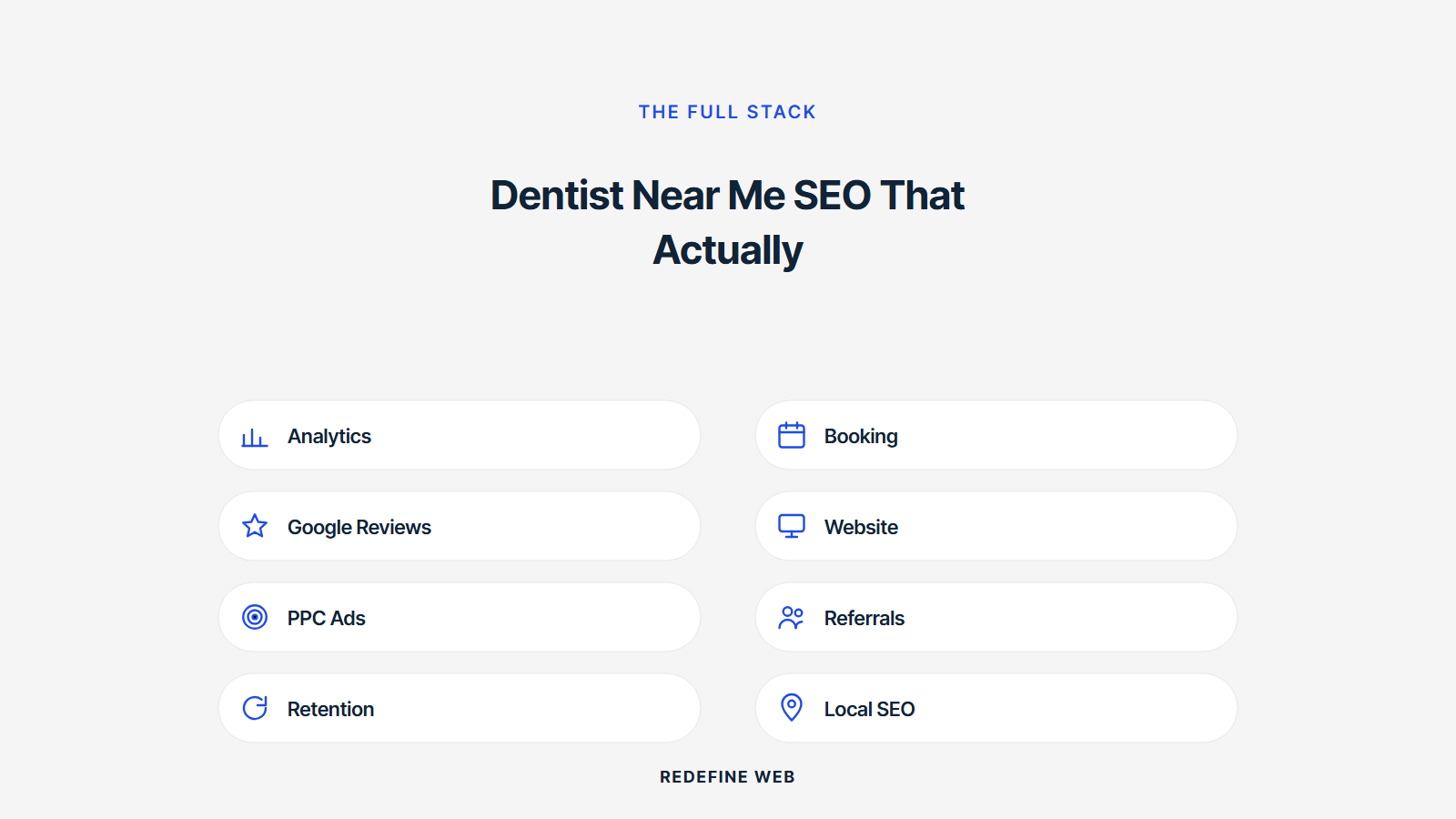
NC Dental Clinic in Vista, California is a 20-year family practice with a strong offline reputation and almost zero digital footprint when they came to us. Zero top-10 search positions. Inconsistent directory listings. Weak Business Profile with 42 reviews and stale photos. Fragmented marketing spread across three agencies with no accountability. Monthly new patients from digital sat at fewer than four. The practice was invisible on the map pack for every query inside a three-mile radius of the office.
We ran the near-me stack described above. Rebuilt the Business Profile with 26 photos, 18 service line items, and weekly posts. Cleaned NAP inconsistencies across 47 citation sources. Added LocalBusiness schema to the homepage. Rebuilt three service pages with the city carried through the H1 and URL. Layered a Google Business Profile PPC campaign for high-intent queries. Six years in, monthly new patients moved to 12 to 16. Organic traffic climbed 385 percent. Marketing ROI grew 500 percent. Total patient volume up 1,000 percent since launch.
The NC Dental numbers
Monthly new patients from fewer than 4 to 12 to 16. Organic traffic up 385 percent as citation cleanup and schema paid back. Marketing ROI up 500 percent across the same six-year window. Practice volume up 1,000 percent from the 2019 baseline. Every number came from the local pack rebuild plus a targeted GBP-linked PPC campaign that fed the reworked landing pages. The design and site rebuild was the multiplier. The Profile tuning was the volume dial.
Lessons from the NC Dental rebuild
Two lessons apply to almost every practice reading this. First, most owners think their Profile is fine because it exists. Existence is not tuning. Open the Profile on your phone right now. Count the photos. Read the service list. If either lags, that is where the map pack ranking is stuck. Second, citation cleanup pays back slower than Profile tuning but compounds for years. Manual work on the top 15 citation sources took our team six focused hours on NC Dental and drove rankings for the next four years.
Tracking whether the dentist near me seo work is working
You cannot optimize what you cannot measure. Every near-me stack needs three tracking pieces in place before the first fix ships. Local rank tracking that reads pack positions from a specific set of coordinates. Call tracking with a dedicated number in the Profile and a matched number on the site. GA4 tied to the Business Profile so you see profile clicks alongside organic sessions in one report.
Local Falcon and BrightLocal both offer geo-grid rank tracking that reads your position from a matrix of coordinates around the office. You see the exact zip codes where you rank one to three and the coordinates where you sit outside the pack. That map is the roadmap for the citation cleanup priority order. CallRail or CallTrackingMetrics track which channel drives the phone calls. GA4 rounds out the picture with organic session data.
Geo grid tracking with Local Falcon
Local Falcon runs $24 to $79 per month and drops a grid of 25 to 121 coordinate pins around the office. Each pin reports your map pack position for the query you specify. The grid updates weekly. You see the 3-mile ring where you sit at position one, the 5-mile ring where you fall to position four, and the 8-mile ring where you drop out of the pack entirely. That data drives every citation, backlink, and content decision for the next 90 days.
Call tracking on the Profile and the site
The Business Profile carries a dedicated tracking number that forwards to the real practice line. The site carries a matched tracking number wired to the same forwarding rule. Every call routes through a call tracker so you know whether the near-me search closed the loop. Practices that skip call tracking spend six months rebuilding the map pack and never know which channel delivered the calls. Fix that before you spend a dollar on the stack.
The worst near-me setup we ever audited was a solo dentist who built a page titled Dentist Near Me in a five-mile radius of downtown Charlotte and stuffed the phrase into the meta description 11 times. The page ranked for exactly nothing. The Business Profile was 32 percent filled out. The doctor blamed Google. We deleted the page, spent four hours tuning the Profile, cleaned 12 citations, and added LocalBusiness schema. Six weeks later the practice sat at position two in the map pack for real queries. The lesson is not that dentists are bad at SEO. The lesson is that keyword stuffing a page titled after a query Google rewrites is like painting a bullseye on a wall inside a locked room and hoping the dart hits.
Backlinks that move near me dental seo
Local backlinks feed the prominence signal harder than any generic link from a national site. A link from the chamber of commerce, a link from the little league sponsorship page, a link from the local news outlet covering a school event you sponsored, a link from the dental hygiene program at the community college where you offer externships. Each one signals real embedding in the local community, which is what Google’s local ranking system is designed to reward.
The link building math for a solo practice is simple. Ten strong local links over 12 months moves you from position 8 to position 3 in the map pack for most competitive metros. Twenty strong local links pushes you to position 1. Skip the guest-post-on-random-blogs playbook. Every hour spent on that is an hour not spent sponsoring a local team or writing a real byline for the local news outlet. The Ahrefs local link building guide at ahrefs.com/blog/local-seo lays out the same math.
Community sponsorships that come with a link
Local little league, high school football, community 5K runs, and neighborhood watch groups all offer sponsor tiers that come with a link on the sponsor page. Cost runs $250 to $1,200 per year per organization. Each one earns you a low-competition local link Google reads as a real community signal. Two or three sponsorships a year over three years builds a link profile the corporate chains cannot buy. That is the moat. That is why national franchises struggle to unseat well-embedded solo practices in the map pack.
Local press coverage as a link source
The local newspaper and local news TV site publish community-interest stories every week. Practices that donate services, offer free clinics, or run patient events during Dental Health Month earn coverage that comes with a link. Cost is the donation and one afternoon of your time. Return is a link Google trusts more than 50 directory citations combined. Pitch the reporter once a quarter with a real story. Two out of eight pitches turn into coverage in most metros.
The 90 day dentist near me seo plan
Dentist near me seo does not require a nine-month engagement to move rankings. The first 30 days handle Profile tuning and citation cleanup. Days 31 to 60 handle onsite schema, service page rewrites, and location page builds. Days 61 to 90 handle review generation, local link outreach, and geo-grid measurement to calibrate the next quarter. That is the shape every practice we run through the near-me stack follows. Rankings move inside 30 days. Booked patients follow inside 60.
- Days 1 to 10 tune the Business Profile completely, categories, services, photos, posts
- Days 11 to 20 clean the top 15 citation sources for NAP consistency
- Days 21 to 30 add LocalBusiness schema and Maps embed on the homepage
- Days 31 to 45 rewrite three service pages with city carried through H1 and URL
- Days 46 to 60 build one location page per office with real photos and copy
- Days 61 to 75 launch review generation via checkout handoff cards and text opt-in
- Days 76 to 90 pitch three local link opportunities via sponsorship or press
Days 31 to 60, onsite content work
The onsite content phase is where solo practices tend to underinvest. A single service page rewrite costs 2 to 4 hours of writing time or $180 to $400 outsourced. Three rewrites cover 60 to 80 percent of the near-me query volume the practice actually cares about. Skip the temptation to rewrite 15 pages in this window. Three deeply optimized pages beat 15 shallow ones every ranking cycle. Do the work on the pages that drive the highest-value services first.
Days 61 to 90, review and link work
Review generation is a checkout habit, not a marketing campaign. Every patient at checkout hears one sentence and receives a printed card with a short URL. Ten new reviews per month across a 30-week window moves the review count from 42 to 340. Local link outreach is one pitch per week, five weeks running. Two or three land inside the 90-day window. Rankings compound as review count and local link count both climb. By day 90 the geo-grid readouts show a materially different map than day 1.
Common mistakes on dentist near me seo
The mistakes repeat across almost every audit we run. Building a dedicated near-me page and stuffing the phrase into the H1. Ignoring the Business Profile for 18 months and blaming the website. Chasing directory listings on 300 low-quality sources instead of nailing the top 15. Buying followed backlinks from a foreign directory network. Copying an existing service page for a second location and swapping the address. Every one of these is a self-inflicted ranking drop that shows up 60 to 90 days after the mistake.
The fixes are cheap. Delete the near-me page. Spend an afternoon on the Profile. Clean the top 15 citations manually. Skip the paid link networks. Write real copy per location page. None of these require a specialized agency. All of them require the discipline to do the work in the order that matches how Google’s local ranking system actually functions. Practices that skip the boring work stay stuck. Practices that grind through it climb.
Reputation management as a ranking lever
A 4.8 star rating with 340 reviews beats a 4.9 star rating with 42 reviews in the map pack every time. Review count is the dominant signal above 4.5 stars. Below 4.5 stars, the star average matters more, and negative review recency drags rankings hard. The playbook is to generate 6 to 12 new reviews per month at scale and respond to every review inside 48 hours. Our dental reputation management playbook covers the response templates and the escalation path when a negative review lands.
Quarterly Profile audits keep the ranking stable
Rankings decay when the Profile stagnates. Google reads recency signals from every field. Photos not updated in six months. Posts not published in three weeks. Services list not touched in a year. Each stale field is a signal that the listing is dormant, and dormant listings lose to fresh ones. Set a quarterly audit calendar. Refresh photos. Publish a fresh post. Add a new service line item. Twenty minutes per quarter buys you 5 to 10 percent stable ranking over the year.
Where to start on your practice today
Dentist near me seo starts with the Profile audit. Open your Business Profile on a phone right now. Count the primary category. Count the secondary categories. Count the photos posted in the last 90 days. Count the reviews from the last 30 days. If any of those counts sit below the numbers we listed above, that is your day-one fix. Book the two hours to tune the Profile before you touch a citation, a schema block, or a link. That is the single highest-return use of two hours in a solo practice’s SEO calendar.
When you are ready to run the full stack across the practice, our dental marketing services covers the Profile tuning, citation cleanup, onsite content, and geo-grid measurement in one engagement. For a full technical breakdown of the local ranking mechanics, see the Google Search Central ranking systems guide and the Google Maps product blog for updates on how the local pack is scored.
Frequently asked questions
Can you actually rank for the phrase dentist near me?
You do not rank for the literal phrase dentist near me because Google rewrites the query into a local pack request using the searcher's coordinates before the SERP renders. You rank for the underlying intent by strengthening prominence, relevance, and distance signals tied to your Business Profile and onsite content. A tuned Profile with 250 reviews and consistent NAP data lands you in the top three map slots for every real query in the near-me bucket. The three-slot local pack captures 80 to 90 percent of the click volume on a phone. So while you never see dentist near me in a rank tracker, you see the booked appointments that come from those searches. That is the actual outcome that matters.
How long does dentist near me seo take to move rankings?
Google Business Profile tuning shows results inside 3 weeks in most metros. Citation cleanup takes 6 to 8 weeks to compound. Onsite content rewrites take 8 to 12 weeks to be indexed and ranked. Local link building compounds over 6 to 12 months. The full stack running together moves a solo practice from outside the top 20 to inside the top 3 in about 90 days for a suburban market with moderate competition. Dense urban metros with three chain competitors take 120 to 180 days. Rural markets often move inside 45 days because the citation and review baseline of competitors is thin. The variables are your starting position, competitor strength, and how consistently you ship the work each week.
How much does dentist near me seo cost per month?
For a solo practice serving one metro, expect $1,400 to $2,800 per month for a real engagement covering Profile tuning, monthly citation checks, monthly service page updates, review generation workflow, and geo-grid measurement. Below $1,400 you get automated citation software with no strategic thinking, and rankings stall inside 60 days. Above $2,800 you get link building and content at scale, which fits practices in competitive urban markets. Multi-location practices scale roughly $400 to $700 per additional office because each office needs its own Profile and location page. DIY is possible if you have 10 to 15 hours per month and a willingness to grind through citations. Most practice owners hire out because those 15 hours are more valuable in the chair.
Does building city landing pages help near me dental seo?
Yes, but only when built as real service pages for a real service in a real geo. Dentist in Vista, California with a 900-word body and unique local content ranks. A page titled Dentist in Vista with 200 words of thin copy and a stock photo does not. The rule is one geo per page, real content per page, and internal linking that reflects a real service network. Practices with three offices build three location pages plus five service pages, for eight geo-targeted URLs total. Practices that build 40 city pages for surrounding suburbs where they have no office get penalized for doorway pages inside 90 days. Stay honest to the geographic footprint the practice actually serves.
What is the fastest single fix for near me dental seo?
Fill out the Business Profile completely today. Set the primary and 3 secondary categories. Add 15 service line items with 200-word descriptions. Upload 20 fresh photos taken in the last 30 days. Publish a Google Post today and schedule the next three. That single afternoon of work moves impressions 30 to 50 percent inside 21 days on almost every audit we run. It costs nothing except the time. It requires no citations, no schema, no link building, no content agency. The Profile is the highest-return single fix in local SEO. Do this before anything else on the near-me stack. Everything else compounds on top of a tuned Profile, and stalls without one.
Do backlinks matter for dentist near me seo?
Local backlinks matter more than the same number of generic links. A link from the chamber of commerce, a link from the local high school sponsorship page, a link from the community news outlet covering an event you sponsored, and a link from the dental hygiene program at the community college all feed prominence signals tied to the local geography. Twenty of those over 12 months move a practice from position 8 to position 1 in the map pack for most suburban metros. Generic guest posts on marketing blogs move nothing. Paid link networks trigger algorithmic penalties inside 90 days. The math is that a handful of real local links beats hundreds of low-signal links every time.
Book your free 30-minute strategy call.
No spam, no sales rep. We use your email to schedule your call with a senior strategist. That is it.
More from the blog
View all articles → SEO
SEO Organic Search Engine Optimization Services That Grow Real Traffic
Read article SEO
SEO SEO for Pet Groomers That Fills the Appointment Book Weekly
Read article SEO
SEO