
DSO Dental Meaning for Practice Owners
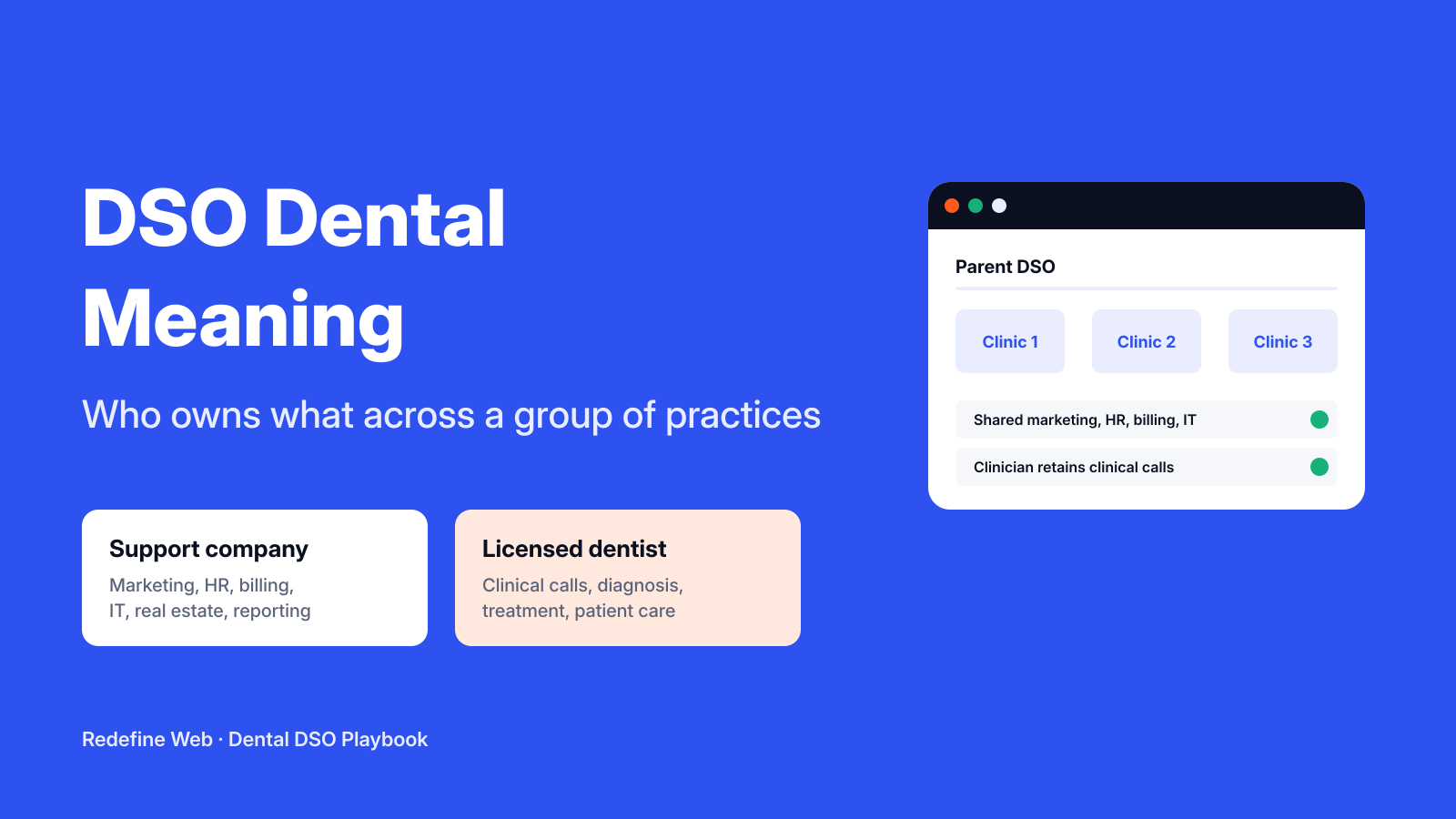
- DSO stands for Dental Service Organization, a support company that runs the non-clinical side of a group of affiliated dental practices.
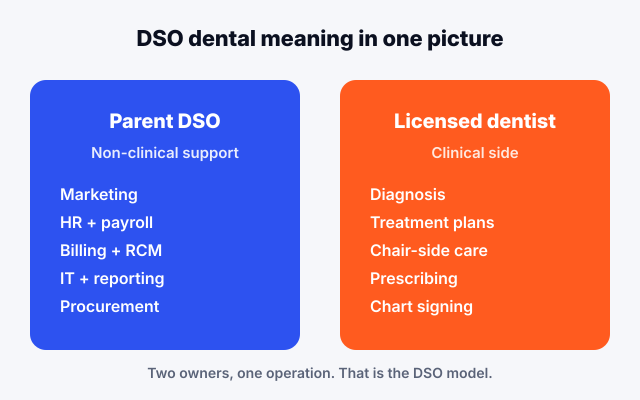
- The dentist keeps every clinical call including diagnosis, treatment, and chart signing, and the DSO handles marketing, HR, payroll, billing, IT, and reporting.
- The dso dental meaning is written into a Management Services Agreement between the dentist-owned PC and the DSO parent company.
- 32% of US dentists now work inside a DSO structure, up from 8% a decade ago, and 44% of dentists under age 35 are DSO-affiliated.
- The clean way to tell a DSO clinic from a solo practice is to check the parent name in the website footer, the state PC filing, or which billing office receives the copay.
The DSO dental meaning is simpler than most dental trade press makes it sound. A DSO, short for Dental Service Organization, is a support company that owns the non-clinical side of a group of affiliated dental practices. The dentist keeps every clinical call. The DSO takes the marketing, HR, payroll, billing, IT, real estate, and rollup reporting off the dentist’s plate so they can spend their day in the chair instead of in a spreadsheet. That is the whole model in two sentences. The rest of this guide walks through what that actually looks like day-to-day, how the ownership split gets written into the contract, and why 32% of US dentists have already chosen this structure over full independence.
DSO dental meaning in plain English
DSO stands for Dental Service Organization. In the dental industry, that acronym points to one specific business structure. A parent support company signs a services agreement with a group of dental clinics, and from that day forward the clinics keep clinical ownership under the licensed dentist. The parent handles every non-clinical function. Marketing, HR, payroll, billing and revenue cycle, IT, procurement of supplies, real estate leases, and the analytics layer that rolls every clinic’s numbers into one dashboard the executive team reads Monday morning.
The dso dental meaning matters legally too. In roughly 30 US states, corporate practice of dentistry laws block a non-dentist from owning the clinical side of a practice. The DSO structure exists to route around that. The clinical practice, called a PC or professional corporation, stays dentist-owned. The DSO owns only the back-office support and licenses the brand, systems, and technology to the PC. Same building, same team, two owners, one operation. That is the boring truth behind the acronym.
What the DSO actually does day to day
We work with dental groups running anywhere from three to two hundred clinics, and the day-to-day pattern is consistent. The parent DSO runs a shared services team out of a central office, and every clinic pulls from that team the way a franchisee pulls from corporate. The dentist at each clinic focuses on chair time. The regional director handles the operating rhythm. The DSO shared services handle everything else.
Here is what a typical shared-services roster looks like inside a mid-market DSO of 25 to 60 clinics. Marketing runs one master brand plus per-clinic Google Business Profiles, one master Google Ads account with per-clinic campaigns, and a content calendar tied to the group’s SEO plan. HR posts jobs to Indeed and specialty dental boards on behalf of every clinic, runs onboarding paperwork, and manages benefits enrollment. Payroll runs weekly on ADP or Paychex across the entire group. Billing and revenue cycle run through a centralized RCM team who cleans insurance claims and chases outstanding aged AR. IT manages the practice-management software, the imaging systems, and the network. The reporting layer rolls every clinic’s production, collections, new-patient count, and no-show rate into one dashboard.
The dentist does not touch any of that. The dentist sees patients, signs charts, prescribes, and holds clinical calls. That split is what makes the model attractive to a lot of clinicians who love dentistry but never wanted the small-business owner life.
The ownership split the acronym actually describes
The clearest way to read the dso dental meaning is to look at who signs what. Two entities, two sets of duties, one contract binding them. The clinical practice, structured as a PC, stays owned by a licensed dentist. Under state law that entity holds the dental license, employs the clinical team, and takes on the malpractice risk. The DSO is a separate corporation, owned by whoever the investors are, and it signs a Management Services Agreement with the PC. That MSA is where the whole model lives.
| Who owns it | The PC (dentist) | The DSO (support company) |
|---|---|---|
| Dental license | Yes | No |
| Clinical decisions | Yes | No |
| Chart signing + prescribing | Yes | No |
| Employs clinical staff | Yes | No |
| Employs front desk + admin | Often no | Often yes |
| Marketing, SEO, ads | No | Yes |
| Billing + RCM | No | Yes |
| IT + software | No | Yes |
| Real estate leases | Sometimes | Usually yes |
| P and L reporting | Sees own clinic | Sees group + roll-up |
| Sale to a buyer | PC shares | DSO equity |
Read that table twice. The dentist owns everything a dentist has to own by state law, and nothing else. The DSO owns everything a support company can legally own, and nothing more. When you hear the phrase “affiliated with a DSO” on a clinic’s website, that MSA is what the affiliation refers to.
Why the DSO model exists at all
Solo dental ownership is hard in 2026. The average general dentist coming out of school carries $304,000 in student loan debt per ADA Health Policy Institute data, and starting a scratch practice adds another $500,000 to $750,000 for build-out, equipment, and working capital. Buying an established practice runs $600,000 to $1.5 million depending on production. The DSO structure lets a young dentist skip the owner risk and step into a chair on day one with a salary plus production bonus. For a mid-career dentist ready to slow down, selling to a DSO turns twenty years of practice equity into cash without walking away from patients they still want to see.
The economics work for the DSO side too. Once shared services fund one clinic, the marginal cost to add the second clinic is small. Marketing runs one brand plan across both locations. RCM cleans claims for both with the same billers. The payroll system already exists. That scale advantage is why private equity has committed roughly $1.15 billion into dental rollups since 2020, and why the mid-market DSO tier grew fastest of any dental structure over the last five years.
For dentists thinking through what this actually looks like on the marketing side, our dental DSO marketing playbook for multi-location groups walks through the shared-services stack most 20+ clinic DSOs run.
Common structural variants of the DSO
Not every DSO looks the same. The dso dental meaning covers a range of structures that differ mostly in who owns the parent equity and how tightly the shared services are enforced across clinics. Four structural variants show up most often.
PE-backed DSO. A private equity firm owns the DSO equity. Growth targets tend to be aggressive, roll-up acquisitions are frequent, and the exit is usually a sale to a larger PE firm or a strategic buyer within 5 to 7 years. Heartland Dental, Aspen Dental, and Pacific Dental Services fit this pattern.
Dentist-founded DSO. A working dentist built the group over decades, kept controlling equity, and never took outside capital. Growth is steadier and clinical culture tends to stay front and center. MB2 Dental is the widely-cited example, though the line between dentist-founded and PE-backed blurs once outside capital comes in.
Specialty DSO. Focused on one dental specialty rather than general dentistry. Orthodontic DSOs, pediatric DSOs, oral surgery DSOs. The shared services model is the same, the clinical focus is narrower. If your group is specialty-focused, our note on specialty dental marketing covers how the acquisition math shifts.
Mid-market regional DSO. The fastest-growing tier. 10 to 60 clinics, often built by a single dentist-founder plus a growth-capital minority partner, focused on a defined geographic region. These groups look more like operating companies and less like PE portfolios. Most of the DSOs we work with day-to-day sit in this tier.
What “affiliated with a DSO” means for the patient
Patients rarely see the parent DSO. They see the clinic brand, the receptionist, the dentist, the hygienist, and the treatment plan. The DSO layer stays invisible to most patients. Only patients who read the fine print on the treatment consent form or spot the parent name on a Better Business Bureau filing know it exists. That is the design. The parent DSO wants the clinic-level brand to feel local and independent, since a local brand is what patients trust when they book a new-patient exam.
What changes for the patient is usually invisible but real. The online booking flow tends to work smoothly with centralized IT. The insurance claim gets filed faster through a professional RCM team. The new-patient exam runs to a script the parent group standardized across clinics. If the patient ever calls the front desk with a billing question, they may reach a shared billing team rather than the front desk person they saw last week. That is the tradeoff patients accept in exchange for a modern operating layer.
Take Delicate Dental Group, a scratch dental practice founded in 2020 by Dr. Monica Ponce with 27 years of clinical experience but zero digital footprint on day one. We built the reputation management layer for their launch. Automated post-appointment SMS review requests, GBP optimization, NAP cleanup across every medical directory, and staff review-culture coaching. Within months, the group had 700+ Google reviews from zero, 280% more Map Pack calls, and 3x Google Maps impressions. That is the kind of marketing infrastructure a shared-services layer bakes in from day one, and it is a big part of why a scratch dental group affiliating with a DSO ramps faster than a solo practitioner going it alone.
DSO vs group practice vs franchise vs solo
The dso dental meaning gets clearer once you set it against the three adjacent structures. Group practices share ownership across a small number of dentists who all remain clinically active. Franchises license a brand and a playbook but leave ownership and operations with each franchisee. Solo practices are one dentist, one clinic, one entity.
| Attribute | DSO | Group practice | Franchise | Solo |
|---|---|---|---|---|
| Owner of clinical side | PC (dentist) | 2+ dentists | Franchisee dentist | Solo dentist |
| Owner of back office | DSO parent | Same dentists | Franchisee | Solo dentist |
| Typical clinic count | 10 to 1,000+ | 2 to 8 | Varies widely | 1 |
| Shared marketing team | Yes | Sometimes | Corporate assets | No |
| Shared RCM team | Yes | Sometimes | Usually no | No |
| Roll-up reporting | Yes | Optional | Franchise fees | Own P and L |
| Sale of business | DSO equity | Buy out partners | Sell franchise | Sell practice |
The core differentiator is the shared-services layer. Group practices sometimes centralize a bookkeeper. Franchises sell a brand and training. Only the DSO structure moves every non-clinical function to a professional parent team and reports every clinic’s numbers into one place. That is the meaning that matters when a dentist is choosing between structures, and it is the meaning most trade press papers over.
If you want the operating detail on what that looks like inside a full multi-location marketing stack, our dental DSO rollout playbook walks through the shared-services setup we run with DSO clients. For the reverse angle from a solo dentist thinking through the ownership question, our explainer on what DSO means in dental practice ownership covers the sell-side view.
How to tell if a dental practice is inside a DSO
Not every clinic tells you plainly. Consumer-facing brand names rarely mention the parent, and a “family owned” tagline can sit on the homepage of a clinic whose back office runs out of a parent DSO in another state. Four quick signals give it away most of the time.
Check the footer of the clinic’s website for a corporate parent name or a line like “part of the X family of practices.” Check the state business-entity database for the clinic’s PC and look at the registered agent. If a management corporation shows up in filings, that is usually the DSO. Search the dentist’s LinkedIn for a title like “Managing Dentist” or “Owner Dentist” rather than “Owner,” which often signals the DSO ownership structure sitting behind them. Call the front desk and ask which billing office receives the copay. If the answer is a shared services team in another city, the clinic sits inside a DSO.
For our marketing side, the tell is usually the Google Business Profile stack. A single-location practice has one GBP with the dentist’s name in the About section. A DSO clinic has one GBP per location, all rolled up to the same brand account, and the About section reads to a shared template. When we audit a group’s dental marketing strategy, that GBP roll-up pattern is one of the first things we look at.
What the DSO trend means for the industry
The ADA’s 2024 Dentist Workforce Report puts DSO-affiliated dentists at 32% of the US workforce, up from 8% a decade ago. Younger dentists are the biggest driver. The 2024 report shows 44% of dentists under age 35 work in a DSO structure, compared with only 12% of dentists over 55. That generational gap tells you where the industry is heading. New dentists coming out of school do not want the small-business owner life at the same rate their predecessors did.
The other force is private equity. Bain Capital, KKR, and dozens of mid-market PE firms have committed billion-dollar checks into dental rollups since 2018. The trade group ADSO now tracks 400+ US DSOs, up from about 200 five years ago. Consolidation slows in credit crunches but never fully reverses. Once a DSO builds shared services at scale, that scale advantage makes it very hard for a solo practice to compete on marketing spend, front-desk speed, or insurance credentialing turnaround.
That does not mean the solo practice is dead. It means the solo practice needs a marketing partner who runs the same operating layer a DSO does. That is a lot of what we help independent dental groups build. A shared marketing operating system on their own P and L instead of somebody else’s. For a broader take on where dentistry sits inside the overall healthcare-marketing rollup wave, our healthcare SEO strategy piece covers the same pattern across adjacent verticals.
FAQ
What does DSO stand for in the dental industry?
DSO stands for Dental Service Organization. In the dental industry, the dso dental meaning points to a specific business structure where a parent support company owns the non-clinical side of a group of affiliated dental clinics and the licensed dentist retains full clinical ownership at each location.
The acronym has been consistent since the late 1990s when the first modern dental support organizations formed. Some groups now prefer the phrase Dental Support Organization to distance from the “service” wording, but the structure and meaning are identical. The ADA and the American Dental Support Organizations trade group both use DSO as the standard reference term.
Is a dental office affiliated with a DSO still owned by a dentist?
Yes. The clinical practice, structured as a PC or professional corporation, stays owned by a licensed dentist under state law. The DSO owns a separate management corporation that provides shared non-clinical services under a Management Services Agreement.
In roughly 30 US states, corporate practice of dentistry laws require the clinical entity to be dentist-owned. The DSO structure was built to comply with those laws. If somebody tells you a clinic is “owned by a DSO,” what they usually mean is that the DSO owns the parent equity and the affiliated PC signs a long-term MSA that routes cash flow to the parent. The clinical license itself never leaves the dentist.
How is a DSO different from a group practice?
A group practice is a small partnership of clinically active dentists who share a building and split ownership. A DSO is a support company that runs shared services across many affiliated clinics under a Management Services Agreement.
The clean way to tell them apart is the shared-services layer. Group practices sometimes share a bookkeeper. DSOs run a full central team covering marketing, HR, payroll, billing, IT, and reporting for every affiliated clinic. Group practices usually top out at 2 to 8 partners. DSOs range from 10 clinics to 1,000-plus. The dso dental meaning implies that professional shared-services layer, which is the reason the label matters when a dentist is comparing structures.
Are DSOs good for dentists?
It depends on where a dentist sits in their career and what they want from the next decade. For a new grad carrying $300K+ in student debt who wants to focus on clinical work, joining a DSO removes the owner risk and offers a salary plus production bonus on day one.
For a mid-career dentist ready to slow down, selling to a DSO turns equity into cash and keeps clinical time on the calendar. The downsides are real too. DSO clinicians report less autonomy on treatment planning, higher production targets, and less latitude over hiring their own team. The 44% of dentists under 35 who now work inside a DSO tell you younger dentists find the tradeoff worth it more often than the previous generation did.
Which are the largest DSOs in the United States?
By clinic count, the five most-cited large US DSOs are Heartland Dental, Aspen Dental, Pacific Dental Services, Smile Brands, and MB2 Dental. Together they account for well over 3,000 US clinics, with several hundred more mid-market and regional DSOs sitting behind them on the ADSO industry roster.
The mid-market tier, the 10-to-60-clinic regional DSOs, is where growth has been fastest over the last five years. Most acquisitions and marketing partnerships we see day-to-day sit in that tier. The name-brand DSOs get the trade press coverage, but the industry is broader and more regional than a top-five list suggests.
Does a DSO change how patients experience the dental office?
Usually not in ways the patient notices at the chair. The clinical experience stays with the licensed dentist. What patients feel is the operating layer working smoother in the background.
Online booking tends to work. Insurance claims get filed faster. Text-message appointment reminders arrive on time. The tradeoff, if there is one, is that a billing question sometimes routes to a shared services team rather than to the front-desk person the patient saw at the last visit. Most patients trade that for the operational polish and never think twice about the parent structure.
Ready to build the shared-services marketing layer for a growing group? See how we help dental groups run a professional multi-location stack at our dental DSO rollout page.
Book your free 30-minute strategy call.
No spam, no sales rep. We use your email to schedule your call with a senior strategist. That is it.
More from the blog
View all articles → Marketing Strategy
 How Dental DSOs Grow Through Marketing. Tactics That Scale
Read article Marketing Strategy
 Dental DSO Marketing Services. What to Expect From an Agency Partner
Read article Marketing Strategy