
Ecommerce Maintenance and Support SLA and Ticket Workflow
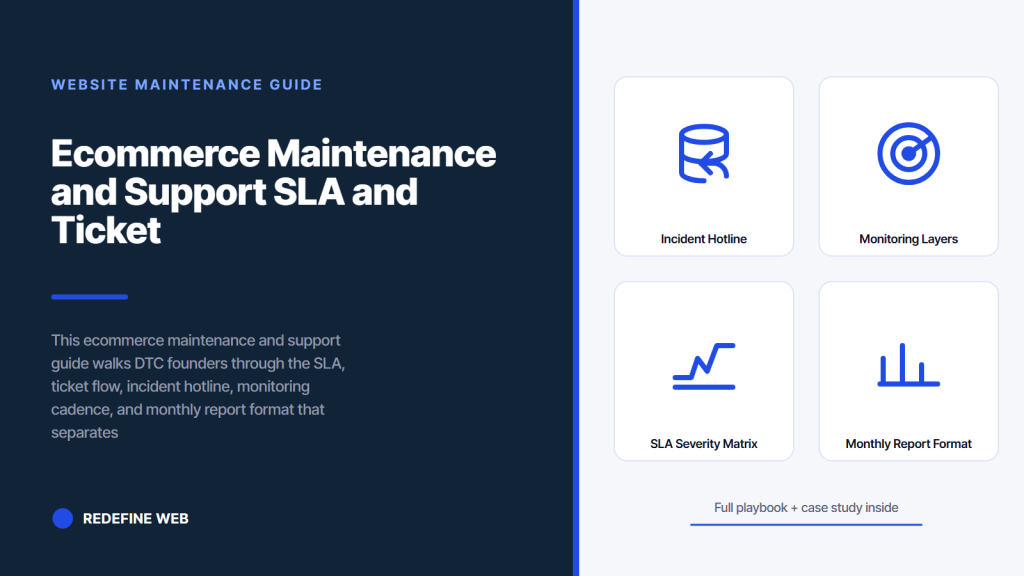
- SLA sets response and resolution times per severity.
- Ticket flow routes incidents to on-call developers.
- Monthly report proves the retainer against caught failures.
- Hotline pays back inside one full-day outage.
- Retainers start at $599 monthly on six-month contracts.
- Incident hotline coverage windows for ecommerce website support and maintenance
- Monitoring layers behind ecommerce website maintenance and support work
- SLA severity matrix inside ecommerce maintenance and support retainers
- Escalation path for Severity 1 events on a support retainer
- Monthly report format for managed maintenance for ecommerce
- Who owns what inside an ecommerce maintenance agency support team
- A real ecommerce maintenance and support engagement in production
- Where ecommerce maintenance and support fits the broader stack
A DTC skincare brand doing $3.4M annual revenue on Shopify Plus called our team at 11:47 pm on a Saturday last October because checkout had been failing on Apple Pay for 90 minutes during a paid campaign push. Their prior maintenance vendor had a shared inbox that rolled to voicemail on weekends and a written SLA that promised next-business-day response on any severity. The founder had burned $8,200 in Meta spend into a broken funnel before anyone answered. A real ecommerce maintenance and support retainer would have paged an on-call developer within 15 minutes and had a rollback deployed inside two hours. The gap between the two operating models is the difference between a managed retainer and a rebranded break-fix invoice.
This guide walks the ecommerce maintenance and support question the way our team scopes it for DTC founders. Real SLA numbers by severity. Ticket flow from submission through resolution. Incident hotline coverage and after-hours paging. Monitoring layers that open tickets before the founder notices. Monthly report format that proves the retainer against the contract every 30 days.
Incident hotline coverage windows for ecommerce website support and maintenance
The incident hotline is the escalation path for Severity 1 events that need immediate human response outside the standard ticket queue. Retainers without a hotline handle Severity 1 through the same queue as Severity 3, which produces the exact operating gap the DTC skincare brand from the intro walked into.
Coverage window options by tier
Starter tier retainers include a shared hotline number that rolls to voicemail outside business hours, which is honest scoping for stores under $500K annual revenue where the founder can absorb an overnight outage without heavy revenue impact. Growth tier retainers include hotline coverage during North American business hours 9 am to 7 pm plus after-hours paging to the on-call developer for Severity 1 events only. Scale tier retainers include 24/7 hotline coverage with two on-call developers on rotation and a documented 15-minute paging SLA on any Severity 1 page. Coverage windows should match the store’s actual revenue timing. A store running paid campaigns that push the peak sales window to Saturday evening needs after-hours coverage that a store running 9-to-5 B2B wholesale does not. Our ecommerce website maintenance checklist covers the monitoring cadence that feeds the hotline queue for founders scoping the coverage window.
What the hotline actually gets used for
Hotline calls should be rare on a healthy retainer. Most Severity 1 incidents open automatically through monitoring before the founder notices, and the on-call developer receives the page from the monitoring layer rather than a phone call. The hotline exists for two specific scenarios. The founder discovers an incident the monitoring layer missed because it sits inside a customer-facing edge case the synthetic checks do not exercise. A third-party incident hits the store from outside (payment processor outage, ESP outage, hosting incident) and the founder needs coordination on the response. Retainers that get hotline calls three times a week are running monitoring that is too shallow, and the fix is deeper monitoring rather than more hotline coverage.
Monitoring layers behind ecommerce website maintenance and support work
Monitoring is the layer that opens tickets before the founder notices. Retainers with shallow monitoring push the discovery burden onto the founder, who then finds out about incidents from angry customer emails rather than the vendor’s automated systems. Real ecommerce website maintenance and support runs five monitoring layers in parallel.
The five monitoring layers every real retainer runs
Uptime monitoring runs at 1 to 5-minute intervals against the store URL, checkout URL, and any critical API endpoints, with alerts firing on two consecutive failures to prevent noise. The WP Rocket rundown of website monitoring tools covers the specific platforms most vendors run underneath the alerting layer. Core Web Vitals monitoring tracks Largest Contentful Paint, Interaction to Next Paint, and Cumulative Layout Shift against the top 20 revenue-driving templates using a synthetic runner like SpeedCurve or Calibre. Payment gateway monitoring runs synthetic transactions every 15 minutes against Stripe, Shopify Payments, PayPal, or the store’s processor to catch gateway failures before real customers hit them. Flow-send monitoring on Klaviyo, Postscript, or the ESP watches send counts, deliverability metrics, and revenue attribution inside the flow reports to catch silent send failures that would otherwise burn revenue for weeks. Feed monitoring on Google Shopping, Meta catalog, and TikTok Shop catches product rejections and disapprovals that would drop the store from the surface without warning. Each layer feeds the ticket queue automatically so the vendor is working on the incident inside the SLA response window regardless of when the founder logs in.
Where monitoring depth pays back inside the first quarter
Flow-send monitoring alone pays back the Growth tier retainer inside the first quarter for most $1M annual revenue stores because a silent Klaviyo abandonment flow failure catches inside 24 hours instead of running for 3 weeks unnoticed. The math is straightforward. An abandonment flow producing 4 to 8 percent of monthly revenue on a $120,000 monthly revenue store is worth $4,800 to $9,600 per month. A three-week silent failure costs $3,600 to $7,200. A caught 24-hour failure costs under $200. The Klaviyo ecommerce benchmarks report covers the flow revenue distribution for founders modeling the recovery math on their own store.
SLA severity matrix inside ecommerce maintenance and support retainers
The table below is the shortest honest version of the three-severity, three-tier SLA matrix our team runs on real DTC retainers. Every cell reflects the actual response and resolution numbers the vendor commits to on the signed contract, not a marketing document. The prices carry through six-month contracts because the monitoring, ticket flow, and reporting cadence all need two full quarters to prove the operating model against the store’s real incident pattern.
| Severity | Starter ($599/mo) | Growth ($899 to $1,899/mo) | Scale ($2,400 to $5,900/mo) |
|---|---|---|---|
| Sev 1 response | 2 hours business | 15 min business, 1 hour after | 15 min 24/7 |
| Sev 1 resolution | Same business day | 2 hours business, 4 hours after | 2 hours 24/7 |
| Sev 2 response | 1 business day | 1 hour business | 30 min business, 2 hours after |
| Sev 2 resolution | 3 business days | Same business day | Same business day |
| Sev 3 response | 2 business days | 1 business day | 4 business hours |
| Sev 3 resolution | 10 business days | 5 business days | 3 business days |
| Hotline coverage | Voicemail outside hours | Business hours + after-hours paging (Sev 1) | 24/7 with 2-developer rotation |
| Monthly report | Standard template | Standard + saved failures | Custom + integration health |
The matrix assumes six-month contracts because a shorter commitment window prices in vendor churn risk and pushes monthly rates 20 to 35 percent above the six-month numbers. Founders comparing SLA matrices across vendors before signing should ask for the specific staffing model that supports each response time. A vendor promising 15-minute after-hours response needs at least two on-call developers on rotation, and the founder should ask to be shown the rotation schedule as part of the vendor evaluation. Our detailed writeup on ecommerce website maintenance cost benchmarks covers the pricing math behind the tier bands for founders modeling the annual spend.
'Next business day' on a Saturday checkout break costs in wasted spend. Ask your maintenance vendor for on-call paging in writing, not a shared inbox.
Escalation path for Severity 1 events on a support retainer
The escalation path is the specific set of steps the vendor runs the moment a Severity 1 ticket opens. Retainers without a documented escalation path handle every incident through improvisation, which produces inconsistent response times and long resolution windows because the team is figuring out the process during the incident instead of running a rehearsed play.
The six-step escalation on Severity 1
Step one is the monitoring alert or founder call opens a Severity 1 ticket inside the helpdesk. Step two pages the on-call developer via SMS and phone with a 2-minute retry loop until acknowledgment. Step three notifies the account lead in parallel so the founder gets a single point of contact for status updates. Step four opens a shared Slack or Teams channel for the incident where every action gets logged. Step five deploys the fix or workaround with founder sign-off on the workaround when the root-cause fix will take longer than the resolution SLA. Step six writes a post-incident review inside 48 hours documenting root cause, timeline, and preventative work committed to the following month’s rhythm. The six steps run on every Severity 1 incident regardless of tier because the discipline drives resolution quality more than the tier price.
Post-incident review discipline
The post-incident review is the single deliverable that separates a maintenance retainer that gets better over time from one that repeats the same incidents. Every review covers what broke, what the customer impact was, how the team responded, what the root cause was, and what preventative work goes into the following month. Reviews get shared with the founder within 48 hours of resolution and the preventative work items roll into the ticket queue as Severity 3 tickets with scheduled due dates. Retainers that skip post-incident reviews usually replay the same three or four incidents across the year because the underlying cause never gets addressed. That is the specific operating pattern our team fixes on most inbound audits when founders come from a prior vendor with a shallow review discipline.
Monthly report format for managed maintenance for ecommerce
The monthly report is the deliverable the founder reads to know what the retainer produced against the contract commitment. Reports that stop at uptime percentage miss the important half of the picture. Reports that run 40 pages of dashboards miss the point because the founder does not have 90 minutes to read them.
The eight sections inside a real monthly report
Section one covers uptime percentage against the SLA target with any downtime windows explained. The Kinsta reference on website uptime benchmarks gives founders a solid outside read on what a healthy uptime percentage looks like on managed hosting. Section two covers ticket count by severity with response and resolution times measured against the SLA numbers for the month. Section three covers Core Web Vitals trend per template against the prior month with any regressions flagged. Section four covers caught silent failures with dollar impact estimates the retainer saved. Section five covers security patches applied across the platform, apps, and plugins with the change log for founder review. Section six covers backup restore test results when the month included one, plus disaster recovery testing on Scale tier. Section seven covers preventative work planned against the following month’s rhythm from the post-incident reviews. Section eight covers hours used against the contract with the carryover balance for the following month. The report runs 4 to 6 pages when produced well and gives the founder a single document to evaluate the retainer against the invoice.
Why the caught failures section matters more than the uptime line
Uptime is a lagging indicator that reads as a flat 99.9 percent number for most months regardless of what the vendor caught underneath. The caught failures section is where the retainer justifies itself because it lists the specific silent incidents the monitoring layer caught before customers noticed. A month where the vendor caught two silent Klaviyo failures worth $4,200 in preserved revenue, one product feed rejection worth $1,800, and one payment gateway health warning worth an estimated $6,000 in prevented outage cost shows the founder $12,000 of retainer justification against the $1,299 monthly Growth tier price. That math is the retention story that keeps a retainer running past the first six-month contract into a multi-year partnership.
Who owns what inside an ecommerce maintenance agency support team
The team structure behind a managed retainer sets whether the SLA numbers hold under real load. A single-developer vendor cannot commit to 15-minute response outside business hours regardless of what the contract says because there is no second person to take the page when the first is asleep. Real ecommerce maintenance agency staffing runs three roles at minimum.
The three roles behind every real retainer
- Account lead owns the relationship, runs the monthly report meeting, and holds the founder relationship across the contract window.
- Primary developer handles the day-to-day ticket queue and owns the workstreams inside the retainer scope.
- On-call rotation developer covers after-hours pages and Severity 1 escalations outside business hours.
- Platform specialist for stores on Shopify Plus, headless BigCommerce, or heavy WooCommerce plugin stacks where deeper platform knowledge is required.
- QA reviewer for Scale tier retainers where every production deploy goes through a second pair of eyes before promotion.
- Accounting owner on the vendor side who handles contract renewals, hours reporting, and any scope adjustment conversations.
The roles compress on Starter tier where the account lead and primary developer sit inside the same person, and the on-call rotation covers business hours only. Growth tier splits the account lead from the primary developer for a proper 2-person team plus after-hours paging. Scale tier runs the full 5-role structure because the coordination overhead across multi-system integrations demands it. Founders that sign retainers without asking how many named humans sit inside the retainer usually discover the structure is thinner than expected during their first real incident, when the single-developer vendor is unavailable and no backup exists.
A real ecommerce maintenance and support engagement in production
Topps Tiles, a UK home improvement retailer with a heavy digital storefront alongside physical locations, came to our team in 2023 with a maintenance retainer running on a shared inbox with no severity classification and a monthly report that stopped at uptime percentage. Their site had experienced two full-day checkout outages in the prior 12 months, both discovered by customer emails rather than monitoring. Their prior vendor charged hourly for incidents on top of the retainer, which produced surprise invoices during the outage months.
Our team rolled the retainer onto a Growth tier structure at $1,499 monthly with a written SLA, three-tier severity model, ticket workflow inside Freshdesk, hotline coverage during business hours plus after-hours paging on Severity 1, and the five-monitoring-layer stack running in parallel. The account lead ran monthly report meetings the first Tuesday of each month, walking through the eight-section report with the retailer’s marketing operations lead. Post-incident reviews shipped inside 48 hours on every Severity 1 event with preventative work rolled into the following month’s Severity 3 queue.
Across the following 12 months on the retainer, uptime held at 99.94 percent against a 99.9 SLA target, mean time to resolution on Severity 1 events sat at 1 hour 43 minutes against the 2-hour target, and monitoring caught 11 silent failures across the year with a combined preserved revenue estimate near $47,000 documented on the monthly reports. The retainer paid back inside its first quarter on caught failures alone. The two full-day checkout outages that had happened in the prior year did not repeat. That is the pattern real ecommerce maintenance and support should produce for growing DTC and retail brands.
Where ecommerce maintenance and support fits the broader stack
An ecommerce maintenance and support retainer sits at the operational floor of the DTC marketing stack. Every acquisition dollar spent on paid, organic, and email depends on a store that stays fast, buyable, and safe. Founders that fund acquisition without funding support usually run into an incident inside 12 months that undoes a quarter of paid spend, which is when the retainer conversation gets forced by an outage rather than chosen at planning time.
How support ties into the retainer stack alongside SEO and paid
Most DTC brands past $1M annual revenue run three retainers side by side. A support retainer covering the store health. A paid media retainer covering Google Shopping, Meta, and TikTok Shop. An SEO retainer covering category pages, comparison content, and technical hygiene. The three retainers share monthly reporting so the paid manager knows what the support vendor is patching, the SEO team knows what the support vendor is deprioritizing, and the support vendor knows what the paid team is scaling into that might change the store’s traffic mix. Our ecommerce maintenance hub covers the combined retainer scope for founders running all three under one shop.
What honest scoping looks like at signing
Honest scoping at signing includes a written SLA per severity, a documented ticket workflow, a hotline coverage window, a monitoring layer list, a monthly report format, and a named account owner. Retainers start at $599 per month on Starter for stores under $500K annual revenue, scale into the mid-four-figures on Growth for stores between $500K and $3M, and reach $2,400 to $5,900 monthly on Scale for stores past $3M. Six-month contracts are standard because the monitoring, ticket flow, and reporting cadence all need two full quarters to prove the operating model against the store’s real incident pattern. Founders comparing scopes across vendors before signing should ask for the SLA document, the ticket workflow diagram, and three referenceable current clients from the vendor’s active roster.
Every DTC quarterly review eventually reaches the moment where the founder asks the maintenance vendor to prove the retainer, and the vendor pulls up a monthly report showing 11 silent failures caught, 47 thousand in preserved revenue, and a 99.94 percent uptime line. The finance lead stares at the report for a full 30 seconds and then asks why nothing dramatic happened this month. Somewhere in every ecommerce operations meeting, a quiet monthly report full of prevented incidents fails to feel as important as one dramatic outage, and the founder has to explain that the boring report is the entire point. Founders scoping custom PHP work alongside platform-native maintenance should read our sister writeup on laravel ecommerce maintenance services for the Composer, migration, and CI CD side of the retainer.
See our fashion website maintenance guide for the apparel-specific playbook that pairs with this framework.
Frequently asked questions
What does ecommerce maintenance and support include at the SLA level?
Ecommerce maintenance and support at the SLA level includes response time commitments per incident severity, resolution time targets, monitoring cadence, and reporting frequency. Severity 1 incidents (checkout down, store offline, payment failure) get a 15-minute response and a 2-hour resolution target on Growth tier retainers. Severity 2 (slow pages, flow send failures, feed rejections) get a 1-hour response and same-day resolution. Severity 3 (small edits, non-blocking bugs) roll into the monthly work hours pool. Every SLA line ties back to a written commitment the vendor produces on the monthly report so the founder can measure delivery against the contract.
How does the ticket workflow run inside an ecommerce maintenance and support retainer?
The ticket workflow starts with a shared inbox or a portal like Freshdesk or Zendesk where the founder submits requests. Every ticket gets a severity tag, an owner, and a due date inside 30 minutes of arrival. Severity 1 tickets escalate to a phone hotline and page the on-call developer. Severity 2 tickets route to the account lead for same-day scheduling. Severity 3 rolls into a weekly work block. The vendor writes a resolution note and a root-cause line on every closed ticket so the monthly report shows the pattern of what broke and why, which drives the following month's preventative work.
What monitoring runs behind ecommerce website maintenance and support work?
Monitoring behind ecommerce website maintenance and support work covers five layers. Uptime checks at 1 to 5-minute intervals across the store, checkout page, and API endpoints. Core Web Vitals monitoring against the top 20 revenue-driving templates. Payment gateway health checks running synthetic transactions on Stripe, Shopify Payments, or the store's processor. Flow-send monitoring on Klaviyo, Postscript, or the ESP checking send counts, deliverability, and click-through rate. Feed health checks on Google Shopping, Meta catalog, and TikTok Shop catching product rejections. Each monitoring line feeds the ticket queue automatically so incidents open before the founder notices them on the storefront.
How does ecommerce website support and maintenance handle the incident hotline?
Ecommerce website support and maintenance handles the incident hotline as a separate phone line the founder calls for Severity 1 events. The line rolls to the on-call developer during business hours and pages the developer via SMS outside business hours. Growth tier retainers include hotline coverage during North American business hours plus after-hours paging for Severity 1 only. Scale tier retainers include 24/7 hotline coverage with two on-call developers on rotation. Founders that skip hotline coverage on their retainer usually discover the gap during a Saturday checkout outage, which is when the coverage tier upgrade conversation gets forced by an incident rather than chosen at signing.
What sits inside a managed maintenance for ecommerce monthly report format?
A managed maintenance for ecommerce monthly report includes eight sections. Uptime percentage against the SLA target for the month. Ticket count by severity with response and resolution time versus SLA. Core Web Vitals trend against the prior month per template. Caught silent failures with dollar impact estimate saved. Security patches applied with change log. Backup restore test results if the month included one. Preventative work planned against the next month's rhythm. Hours used against contract with carryover balance. The report gives the founder a single document to read in ten minutes and know what the retainer produced against the contract commitment.
Book your free 30-minute strategy call.
No spam, no sales rep. We use your email to schedule your call with a senior strategist. That is it.
More from the blog
View all articles → Website Maintenance
 WordPress Website Maintenance Packages That Keep the Site Safe and Fast
Read article Website Maintenance
 Pet Website Maintenance Checklist for Ecommerce Pet Brands
Read article Website Maintenance