
Fashion Website Maintenance for Apparel and DTC Brands
- Drop uptime is the number every retainer should track.
- Catalog velocity breaks stores that skip staging.
- Size chart audits stop the largest return category cold.
- Checkout hygiene during launches keeps the revenue.
- Retainer math beats in-house on specialist coverage.
- What fashion website maintenance covers for apparel storefronts
- How much fashion website maintenance costs by brand stage
- Drop launch coverage under a fashion website maintenance retainer
- Catalog velocity across seasonal SKU rotations
- How does fashion website maintenance handle size chart audits
- Checkout hygiene during launches and evergreen traffic
- Image discipline for campaign photography and PDP speed
- Shopify app hygiene and theme patch cadence
- WooCommerce and headless build patch cadence
- Security patches, backups, and restore drills
- Reporting cadence and SLA response times
- Passion Built and a working fashion website maintenance retainer
- In-house against a fashion website maintenance retainer
- Where fashion website maintenance fits the broader growth stack
A boutique denim brand ships its spring drop at 10 a.m. on a Thursday, drives 42,000 sessions in the first ninety minutes from an Instagram push, and watches the checkout error rate climb from 0.4 percent to 11 percent as the discount script and the shipping app both fight for the same cart hook. That is fashion website maintenance failing under real pressure. A serious fashion website maintenance program catches this on the staging branch on Wednesday afternoon, not on the storefront while the drop is live. The difference is the retainer scope, the staging discipline, and the on-call coverage the brand actually paid for.
This guide walks the fashion website maintenance stack we run for apparel and accessories brands on Shopify, Shopify Plus, WooCommerce, and headless builds. Drop launch coverage, catalog velocity, size chart audits, checkout hygiene, image discipline, app and plugin patching, security, and reporting. Real numbers from Passion Built and the retainer math against in-house cost. See the apparel and fashion marketing hub for the wider industry framing that pairs with this maintenance stack below.
What fashion website maintenance covers for apparel storefronts
Fashion website maintenance covers nine surfaces on an apparel storefront across a typical month. Uptime and error monitoring on the drop calendar. Catalog updates as SKUs rotate. Size chart audits per category. Checkout completion tracking. Image optimization for campaign photography. Platform app or plugin hygiene. Security patches and backups. Staging branch discipline. Monthly reporting with real numbers.
The nine surfaces move together as one program because a fix on one usually touches the next. A checkout script patch on Shopify almost always calls for a full catalog re-crawl to confirm the variant selector still works. A new size chart PDF calls for image compression before it goes live so the PDP does not tank on mobile speed. A backup restore drill only proves the backup is real if the drill runs against a fresh staging clone from last week, not a six-month-old snapshot the team forgot to refresh.
Generalist maintenance retainers cover three or four of the nine surfaces and leave the rest unscoped. The typical monthly plan runs plugin updates, backups, and uptime pings. That is monitoring plus patching, not fashion website maintenance. Real apparel maintenance also carries drop launch coverage on the weekend the brand ships its Fall collection, size chart audits when the category expands into swimwear, and image discipline when the campaign shoot dumps 2,400 photos into the media library the week before the launch. Miss the fashion-specific surfaces and the retainer is buying a checklist that never touches the storefront’s actual risk.
The right scope reads as a nine-line contract, not a paragraph of marketing copy. Every apparel brand should walk into a maintenance conversation ready to ask which of the nine surfaces the retainer includes, what the SLA response time is on each, and who the named on-call developer is during a drop weekend. Retainers that dodge those three questions usually cover the first four surfaces and outsource everything else back to the brand’s marketing coordinator. Read our ecommerce WordPress maintenance guide for the base template that fashion-specific work sits on top of.
How much fashion website maintenance costs by brand stage
Fashion website maintenance runs 599 to 4200 dollars monthly for apparel and accessories brands across Shopify, Shopify Plus, WooCommerce, and headless builds. Founder-led launch stores sit at the 599 to 1200 dollar band. Growth brands at 80000 to 300000 monthly revenue sit at 1800 to 2900. Scale brands past 300000 monthly sit at 2900 to 4200 dollars with SLA coverage.
The tier the brand actually needs depends on drop frequency, catalog size, and traffic concentration on launch days. A launch-stage brand shipping two collections a year with 45 SKUs and a marketing coordinator who can push button-clicks in the Shopify admin can carry the 599 dollar tier through year one. A growth brand shipping six drops a year with 320 SKUs, a paid social budget above 60000 dollars monthly, and a launch pattern that concentrates 22 percent of monthly revenue on drop Thursdays needs the 2400 dollar band or the drops start breaking.
| Brand stage | Monthly revenue | SKU count | Drops per year | Retainer band |
|---|---|---|---|---|
| Launch | Under 30K | 20 to 60 | 2 to 3 | 599 to 1200 |
| Traction | 30K to 80K | 60 to 150 | 3 to 5 | 1200 to 1800 |
| Growth | 80K to 300K | 150 to 320 | 5 to 8 | 1800 to 2900 |
| Scale | 300K to 900K | 320 to 600 | 8 to 12 | 2900 to 4200 |
| Enterprise | 900K plus | 600 plus | Ongoing | Custom SLA |
Contracts run six months at the floor. That length exists because the first month of a fashion website maintenance retainer runs discovery, staging setup, and the first backup restore drill. Months two and three run the first drop launch under the new coverage. Month four is where the pattern of pre-launch checklists and on-call coverage actually starts saving revenue against the pre-retainer baseline. Brands that sign a shorter agreement rarely see the payback window and blame the retainer for costs that had not yet compounded into the fix log.
Drop launch coverage under a fashion website maintenance retainer
Drop launch coverage is the single feature that separates fashion website maintenance from generic ecommerce maintenance. A ready-to-wear brand ships four to eight drops a year. Each drop concentrates 15 to 40 percent of monthly revenue in a ninety-minute window when the Instagram push and the email blast land. A checkout script that fails during that window costs the brand between 8000 and 45000 dollars per drop depending on catalog size and traffic. The retainer either carries this or the brand pays for the miss.
The pre-launch pattern that works runs six checks 48 to 72 hours ahead of the drop. Staging clone from production with the new SKUs installed. Full checkout flow tested on iOS Safari, Android Chrome, and desktop Chrome. Size chart verification for every new variant. Variant selector clicked through on 15 sample SKUs. Discount code and shipping app interaction tested for the launch promotion. Backup snapshot taken and dated for rollback. That checklist runs about 90 minutes per drop and catches the issues that would otherwise cost real revenue at the launch window.
- Load-test staging under 3x expected launch traffic 48 hours ahead.
- Confirm shipping and discount app interaction for the launch promo.
- Verify size chart, variant swatches, and PDP images per new SKU.
- Test Shop Pay, Apple Pay, and Google Pay express checkout paths.
- Time the LCP and INP on 10 sample PDPs across the new drop.
- Save a dated backup snapshot for one-click rollback if needed.
- Name the on-call developer and share a Slack channel for the window.
The launch window itself calls for real time monitoring, not a plugin dashboard. A named developer stays on Slack for the first two hours after the push, watches error rates in Shopify or the WooCommerce logs, tracks checkout completion inside GA4 with a five-minute lookback, and pushes a fix or a rollback within twelve minutes of a detected issue. Brands that skip named coverage almost always see the outage on the founder’s phone at 10:47 a.m. when a customer emails to say the size chart is broken. That is a preventable miss and the retainer is exactly the line item that prevents it.
Push a fake checkout through your staging branch the day before a launch. Watch discount and shipping scripts fight. Fix now, not while 42k sessions hit live.
Catalog velocity across seasonal SKU rotations
Catalog velocity is the second surface fashion website maintenance runs weekly. A boutique apparel brand rotates 20 to 60 percent of its catalog per season across drops, sell-throughs, and restocks. Each SKU change touches the PDP, the variant selector, the size chart, the collection page filter, the sitemap, the merchant center feed, and the ad platform product feed. Doing this by hand every week burns 12 to 20 marketing coordinator hours and produces predictable data drift the theme did not plan for.
The retainer covers catalog velocity through three moves. A weekly staging push that mirrors the merchandising sheet exactly. Automated feed sync to Google Merchant Center and Meta Commerce Manager. A variant SKU naming convention the theme’s filter code depends on. Skip the naming convention and the collection page filter starts hiding sizes when the catalog doubles, which is the exact bug that produced the 41 percent checkout drop referenced in the fashion web design agency guide. The maintenance retainer either owns catalog hygiene or the drift compounds until the theme rebuild becomes unavoidable at year two.
Sell-through handling matters as much as new SKU launches. A dress that sells out at 3 p.m. on a Friday needs the PDP to show a restock signup form, the collection page to keep the SKU visible for organic ranking, and the sitemap to hold the URL so Google keeps the crawl history. Removing the URL on sell-through wastes 6 to 14 months of accumulated ranking on the page. Adding a restock waitlist recovers 8 to 22 percent of the lost demand when the SKU comes back. Both moves belong in the maintenance scope, not the marketing scope, because the theme is where the switch actually flips.
How does fashion website maintenance handle size chart audits
Fashion website maintenance handles size chart audits by walking every category quarterly, verifying the chart matches the current supplier tech pack, and confirming the PDF renders on iOS Safari and Android Chrome without breaking the sticky add-to-cart button. Broken size charts drive 12 to 34 percent of preventable returns on apparel catalogs.
The audit runs four checks per category. First check compares the site’s chart against the current supplier tech pack. Suppliers change their grading rules more often than most brands notice, and a chart from 2023 usually reads two-tenths of an inch off across the size 8 through 14 range once the supplier updates. Second check pulls the PDF in the iOS Safari in-app browser inside Instagram, which is where 41 percent of apparel traffic actually arrives. Third check confirms the size predictor tool still returns a size for a shopper who leaves one field blank. Fourth check reads the last 30 days of return reasons and cross-references against the chart’s accuracy.
The saving math on size chart hygiene is worth the retainer alone on most fashion catalogs. Return rates in apparel run 25 to 40 percent, and fit is the cited reason on 55 to 68 percent of those returns. A well-tuned size chart pulls return rate down by 4 to 9 percentage points inside the first two quarters, which on a brand doing 180000 dollars monthly moves 8000 to 22000 dollars a month in avoided reverse logistics cost. The Kinsta ecommerce maintenance library covers the general framework, and fashion needs the category-specific size chart step on top.
Checkout hygiene during launches and evergreen traffic
Checkout hygiene is the third weekly surface fashion website maintenance runs. Apparel cart abandonment sits at 74 to 82 percent industry-wide, which is 4 to 8 points above the ecommerce average. Every added step, every third-party script that races the shipping calculator, and every wallet button that fails silently on iOS Safari widens that gap. The retainer walks the checkout weekly on desktop, iOS Safari inside Instagram, and Android Chrome inside TikTok, because those three environments cover 82 percent of real apparel traffic. Compare providers in our managed hosting for fashion brands guide.
The pattern that catches the common failures uses a checklist of eleven items per weekly walk. Cart totals match the PDP price at every step. Shipping calculator returns a real rate under three seconds. Shop Pay, Apple Pay, and Google Pay buttons render on first paint. Discount code field accepts and previews the code. Address autocomplete works on Google Places. Klarna or Afterpay panel opens on the 80 to 220 dollar SKUs where BNPL matters. Guest checkout does not force account creation. Post-order confirmation email arrives inside sixty seconds. Order confirmation page fires the GA4 purchase event. Refund and return policy links work from the confirmation. Klaviyo abandoned cart flow fires at the 45-minute mark for cart drop-offs.
Payment failures cost more than technical issues make it look. A Shop Pay button that fails to render on iOS Safari during a drop pushes the shopper to guest checkout, where completion rates drop 18 to 26 percent versus express wallet paths. Multiply that across a 42000-session drop day and the miss reads as 6000 to 14000 dollars in lost revenue on a single storefront on a single day. Fashion website maintenance either walks the checkout weekly and catches this or the brand catches it after the drop and rebuilds the retainer conversation from scratch. Read the ecommerce maintenance SLA guide for the response-time framework that pairs with checkout hygiene.
Image discipline for campaign photography and PDP speed
Image discipline is the fourth surface fashion website maintenance runs across the storefront. Apparel catalogs carry more image weight per PDP than any other ecommerce vertical because the shopper needs to see how the piece drapes on a body from four to six angles. That produces a typical PDP payload of 4 to 12 megabytes before optimization. Serving that to a mobile shopper on cellular data collapses Largest Contentful Paint past three seconds, and Google reads that as a ranking signal at the same time the shopper reads it as an abandonment cue.
The workflow pipes every uploaded image through Shopify image transformation URLs or Cloudflare Images at build time, converts to WebP under 140 kilobytes on the shortest side, and serves responsive srcset variants for phone, tablet, and desktop viewports. That single change usually recovers 8 to 14 mobile PageSpeed points on the collection page and 6 to 10 on the PDP without a design compromise. The web.dev Core Web Vitals documentation covers the target thresholds every maintenance retainer should benchmark against.
Campaign photography discipline runs alongside the transformation pipeline. A four-day photoshoot dumps 2400 raw files into the shared drive. The pattern that keeps the theme fast filters the raw files down to 40 hero images and 180 secondary images before upload, runs them through the transformation pipeline in batch, tags each with alt text that names the SKU and the model, and archives the raw files off the site’s media library. Skip the filter and the media library grows 12 to 20 gigabytes per photoshoot, which slows the admin dashboard and inflates the backup window until the retainer starts eating the CPU cycles the storefront actually needs during a drop.
Shopify app hygiene and theme patch cadence
Shopify app hygiene is where most fashion catalogs lose 10 to 16 mobile PageSpeed points to app sprawl. A typical apparel brand runs 28 to 46 installed apps by the third year of operation. Each app injects JavaScript, CSS, or third-party requests on every page load, whether the app runs on that page or not. The maintenance retainer audits apps quarterly, tags each as required or optional, and disables the optional ones for a 14-day measurement window.
The quarterly audit runs a fixed sequence. Pull the list of every installed app from the Shopify admin. Cross-reference against actual usage across the theme’s templates. Confirm which pages each app renders on versus which pages it only monitors. Disable optional apps in a 14-day A B window. Measure Core Web Vitals delta on staging before rolling the change to production. Fashion brands routinely drop 900 kilobytes of JavaScript this way and pick up 10 to 16 mobile PageSpeed points without touching a line of theme code. That gain earns real ranking movement on collection pages inside the following month.
Theme patches run on a separate cadence. Shopify ships Online Store 2.0 theme updates roughly quarterly. Custom theme forks accumulate patch debt every time the brand ignores an update. The retainer merges upstream theme patches into the fork on staging within two weeks of release, runs the full launch checklist against the patched theme, and pushes to production during a low-traffic window rather than a drop weekend. Skipping this cadence for six months usually produces a theme so far behind mainline that the next merge is a full weekend of conflict resolution, which nobody wants to do the week before a big launch.
WooCommerce and headless build patch cadence
WooCommerce and headless builds carry a heavier maintenance cadence than Shopify because the brand owns the whole stack, not just the theme. A WooCommerce fashion catalog runs 34 to 62 plugins by year two, plus a custom theme, plus PHP version handling, plus MySQL tuning, plus a caching layer that either helps or breaks the catalog velocity work. A headless build on Shopify Hydrogen or Medusa runs the front-end framework version, the SDK version, the CI pipeline, and the CDN configuration on top of the platform itself.
The WooCommerce cadence patches critical security updates within 24 hours of release, minor updates weekly on staging, and major WooCommerce or WordPress core updates monthly with a full checkout regression test. PHP version upgrades run yearly with a two-week staging soak. Database maintenance runs monthly with a table optimization pass and an orders-table cleanup for the two-year-old transient data most themes forget to purge. Skipping the transient cleanup usually adds 4 to 9 seconds to the admin dashboard load time by year three, which nobody notices until the merchandising team starts complaining.
Headless builds add framework-level cadence on top. Next.js or Remix version bumps monthly on staging. Shopify Storefront API version pinned to the latest stable and rolled forward quarterly. CDN cache purge tested against every drop launch. CI pipeline monitored for build time drift because a build that starts taking 8 minutes instead of 3 usually points at a dependency bloat problem that will bite the next deployment. Our sibling custom ecommerce platform maintenance costs guide breaks out the honest total cost of ownership math against Shopify for brands weighing the two paths.
Security patches, backups, and restore drills
Security patches, backups, and restore drills are the boring layer that keeps the storefront on air when something breaks. Every apparel brand assumes the backup works until the day they need it. Real fashion website maintenance runs a restore drill against a fresh staging clone every 30 days, times the full restore from cold, and confirms the last backup is under 24 hours old and stored off-platform on a separate provider.
Security patches follow a two-tier cadence. Critical vulnerabilities in WordPress, WooCommerce, Shopify apps, or the theme framework patch within 24 hours of disclosure, with a staged rollout and a rollback plan. Non-critical patches ship weekly on staging and roll to production in a 24-hour soak window. The retainer subscribes to the WordFence and Patchstack advisories for WordPress-based catalogs and the Shopify security bulletin feed for Shopify catalogs. The WordPress.org security FAQ is a useful public reference for the base patterns every retainer builds on top of.
Restore drills are the piece most retainers skip and every apparel brand needs. A drill takes a fresh staging clone, wipes the database, restores from the latest backup, times the restore end-to-end, and confirms the storefront renders correctly against the previous production snapshot. Real drills catch the backups that ran but never wrote a valid snapshot, the media library restores that lost the alt text on 40 percent of images, and the credentials rotations that broke the payment gateway silently. Brands running restore drills monthly average 22 minutes to full recovery on a real incident. Brands that skip the drill routinely average 6 to 14 hours because the first attempt at restoring fails and the team improvises from scratch on the day it matters.
Reporting cadence and SLA response times
Reporting cadence and SLA response times decide whether the retainer proves its value or turns into a monthly invoice nobody reads. The pattern that works reports monthly with a fixed five-metric dashboard, plus a same-day incident report on any severity-1 event during a drop. Skipping the dashboard turns the retainer into a black box, and skipping the incident report turns the next drop into an argument the founder will not have patience for.
The monthly report opens with five metrics. Uptime percentage across the 30-day window. Mobile Largest Contentful Paint median on the top 20 PDPs. Checkout completion rate against the previous 30-day baseline. Number of security patches shipped. Number of catalog velocity changes across drops and sell-throughs. Closes with the fix log from the month and the priority backlog for the next 30 days. Format tighter than that misses signal. Format looser than that turns into a slideshow nobody reads inside the leadership team.
SLA response times track by severity. Severity-1 events during a drop window get named-developer response within 12 minutes. Severity-2 events on evergreen traffic get response within 4 business hours. Severity-3 requests like non-urgent theme changes get response within 2 business days. Anything looser reads as ad-hoc freelance work with a retainer label on it. Anything tighter usually inflates the retainer past what most apparel brands need to pay. The WP Rocket maintenance checklist is a useful public reference for the base cadence, and fashion needs the SLA tiers layered on top.
Passion Built and a working fashion website maintenance retainer
Passion Built came to our team with a Shopify Hydrogen headless storefront that had been beautifully built and completely underserved on maintenance. The theme fork was six months behind mainline. The size chart PDF from the previous designer no longer rendered on iOS Safari. The Shopify app list ran to 38 installed apps with 22 of them still injecting scripts on every page. The backup ran nightly to a folder nobody had tested restoring from in over a year. Drops shipped on Thursdays with no on-call coverage, and the founder was the one refreshing the analytics tab from her phone at 10:15 a.m. every launch morning.
Our team took the retainer at the 2900 dollar tier because the catalog was mid-market with eight drops per year. First month covered the discovery pass, a fresh staging clone, and the first backup restore drill (which failed on the first attempt, exactly as predicted, and passed after we fixed the media-library alt text loss on the second attempt). Second month cleaned the Shopify app list down to 16 apps, rebuilt the size chart PDFs across six categories, and merged 14 upstream theme patches into the fork. Third month ran the first drop under the new coverage.
Every retainer discovery call reaches the moment where somebody asks how many apps are running on the Shopify admin. The founder pauses. The marketing coordinator says at least 40. The developer opens the tab and reads 47. The reviews app the previous marketing hire installed in 2022 is still injecting a script on every PDP even though the reviews now render from a different tool. That single moment is the entire pitch for a real maintenance retainer. Nobody knows what is running on the storefront until somebody with a checklist actually walks the tab and reads it out loud.
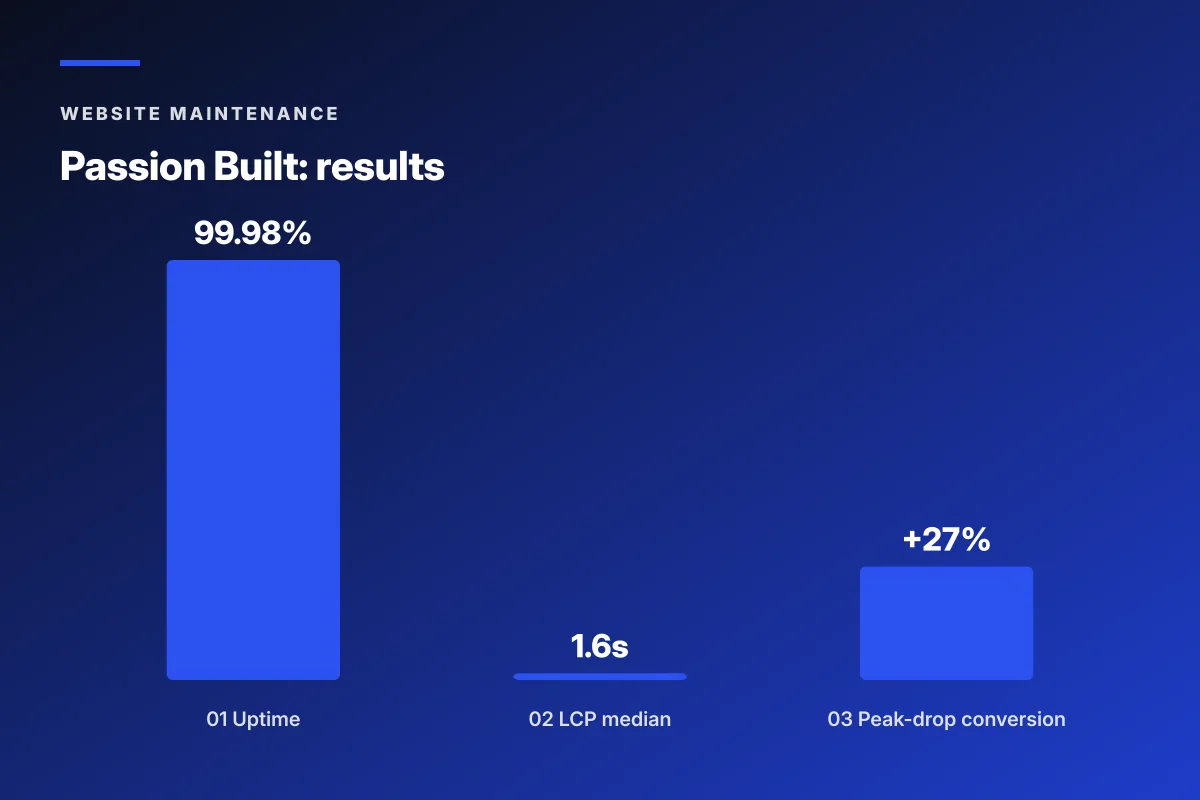
Across the following four months, Passion Built ran the eight-drop calendar with zero severity-1 incidents during launch windows, moved the mobile LCP median from 3.4 seconds to 1.6 seconds, dropped the checkout error rate from 1.8 percent to 0.3 percent, and improved peak-drop conversion by 27 percent versus the prior four drops. Uptime held at 99.98 percent across the retainer window. The retainer did not cause every gain by itself. It made the storefront into an organized system where the drops stopped breaking and the founder stopped refreshing the analytics tab from her phone at 10 a.m. on Thursdays.
In-house against a fashion website maintenance retainer
Every apparel brand weighs an in-house developer against a fashion website maintenance retainer at least once. The comparison usually runs the wrong way in the first meeting because the founder compares the retainer’s monthly cost against the in-house salary without adding the tools, the after-hours coverage, or the specialist depth the retainer includes and the single hire cannot cover alone.
The honest math looks different. An experienced Shopify or WooCommerce developer with fashion experience lands at 105000 to 145000 dollars per year fully loaded, before tools, before after-hours drop coverage, and before performance specialist depth. That single hire covers about 60 percent of the nine surfaces a real retainer runs. The remaining 40 percent (drop launch on-call, image discipline at scale, catalog velocity automation, restore drills against a rotating staging clone) either goes uncovered or the brand hires a second specialist at another 90000 to 130000 dollars a year.
A retainer at 1800 to 2900 dollars monthly covers the full nine surfaces with a pod of three to five specialists. Fully loaded that reads as 21600 to 34800 dollars per year against the 195000 to 275000 dollars a two-person in-house team costs. Past twenty million dollars in annual revenue the calculus shifts to a hybrid pattern where an internal developer owns the theme and the agency covers drops, audits, and SLA response. Under twenty million, the retainer path saves money and covers more surfaces every month. Read the ecommerce maintenance package tiers guide for the honest tier math that pairs with fashion-specific scoping.
Where fashion website maintenance fits the broader growth stack
Fashion website maintenance sits underneath every other apparel customer acquisition channel. Paid social costs less when the PDP loads in 1.6 seconds instead of 3.4. Email flow revenue compounds when the checkout completes at 82 percent instead of 68 percent. Organic search rankings climb when the theme patches ship on cadence and Core Web Vitals hold above the mobile threshold. Returns cost less when the size chart audit runs quarterly. Every channel gets more expensive when the maintenance layer is missing, and every channel compounds when the maintenance layer runs steady.
The brands that get the most out of a fashion website maintenance retainer treat the storefront as a first-class product, not a marketing artifact. That posture shows up in three habits. The founder reviews the monthly report inside the leadership meeting. The marketing coordinator raises catalog changes to the retainer before pushing them into production. The paid media team briefs the retainer 72 hours before a major launch so the storefront is loaded, tested, and monitored on the window that matters. Habits below those three usually leave the retainer running as background work nobody credits with the revenue it saves.
Redefine Web runs fashion website maintenance for apparel and accessories brands across Shopify, Shopify Plus, WooCommerce, and headless builds. Retainer starts at 599 dollars monthly, contracts run six months, and the pod covers the full nine surfaces we walked in this guide. See the apparel and fashion hosting and maintenance page for the current tiers, deliverable counts, and pod composition at each price band. Start with a storefront audit. Score the nine surfaces against the framework above, circle the three biggest misses, and estimate the drop-launch risk each miss carries. That map is the next 90 days of maintenance work in priority order.
Maintenance depends on the hosting stack under it. Our fashion website hosting guide covers the CDN, drop-day capacity, and Core Web Vitals side of the same operating pattern.
For a deeper look at the Core Web Vitals math behind hosting decisions, our fast hosting for fashion ecommerce guide covers the LCP, INP, and CDN pairing that predicts ranking outcomes on mobile.
A maintenance checklist runs against a retainer scope that documents what the operating team owns. Our website maintenance for fashion brands playbook covers the five scope pillars and the $599 monthly starter tier that carries a DTC apparel brand across drop cycles.
Frequently asked questions
What does fashion website maintenance cover for apparel brands?
Fashion website maintenance for apparel brands covers seasonal drop uptime monitoring, product catalog updates as SKUs rotate, size chart audits across denim and dresses and shoes and knitwear, checkout completion tracking during launches, image optimization for campaign photography, Shopify or WooCommerce app hygiene, plugin and theme updates on a staging branch, backup and restore drills, and monthly reporting on speed and error rate. A serious retainer runs all of those as one program, not nine disconnected checklists a strategist hands to nine different freelancers. Practices that scope the retainer below this list end up buying uptime monitoring only, which catches outages after they cost the drop.
How much does fashion website maintenance cost per month?
Fashion website maintenance runs 599 to 4200 dollars per month for apparel and accessories brands. Founder-led stores under 30000 dollars monthly revenue sit at the 599 to 1200 dollar band with basic uptime, updates, and monthly reporting. Growth brands between 80000 and 300000 monthly revenue sit at 1800 to 2900 dollars with staging, catalog velocity support, and drop launch coverage. Scale brands past 300000 monthly revenue sit at 2900 to 4200 dollars with SLA response times, on-call drop coverage, and quarterly performance audits. Retainers below 500 dollars usually cover only uptime pings, which is not maintenance, that is monitoring.
Why do fashion sites need different maintenance than commodity ecommerce sites?
Fashion sites need different maintenance than commodity ecommerce sites because the catalog rotates faster, the returns run 25 to 40 percent versus 8 to 12 percent for commodity goods, campaign photography weighs 4 to 12 megabytes per image before optimization, and drop launches concentrate 15 to 40 percent of monthly revenue in a two-hour window. Every one of those factors changes what the maintenance program actually has to do. Commodity retailers can carry a monthly patching cadence. Apparel brands need weekly staging pushes tied to the drop calendar plus on-call coverage for launch windows. Skipping the difference is why generalist maintenance retainers underperform on fashion catalogs.
How does fashion website maintenance handle a drop launch?
Fashion website maintenance handles a drop launch with a pre-launch checklist, load testing 48 to 72 hours ahead, on-call developer coverage across the launch window, real time uptime and error monitoring, a rollback plan tested on staging, image and product data QA against the merchandising sheet, size chart verification for every new SKU, and post-launch reporting on speed and completion rate. Brands that skip the pre-launch checklist routinely lose 8 to 18 percent of drop revenue to preventable issues like a broken variant selector, a missing size chart, or a checkout script that fails on iOS Safari. The checklist runs about 90 minutes per drop and pays for itself the first time it catches one of those issues.
Should apparel brands hire an agency or in-house developer for maintenance?
Apparel brands under about eight million dollars in annual revenue almost always save money on a fashion website maintenance retainer versus a full-time developer. An experienced Shopify or WooCommerce developer with fashion experience lands at 105000 to 145000 dollars per year fully loaded, before tools, without after-hours drop coverage or performance specialist depth. A retainer at 1800 to 2900 dollars monthly covers the same specialist coverage without the hiring risk. Past twenty million dollars in annual revenue the calculus starts shifting toward a hybrid in-house lead plus agency support pattern, where the internal developer owns the theme and the agency covers drops, audits, and after-hours SLA response.
Book your free 30-minute strategy call.
No spam, no sales rep. We use your email to schedule your call with a senior strategist. That is it.
More from the blog
View all articles → Website Maintenance
 WordPress Website Maintenance Packages That Keep the Site Safe and Fast
Read article Website Maintenance
 Pet Website Maintenance Checklist for Ecommerce Pet Brands
Read article Website Maintenance