
Search Engine Optimization Services for Small Business That Book Real Growth
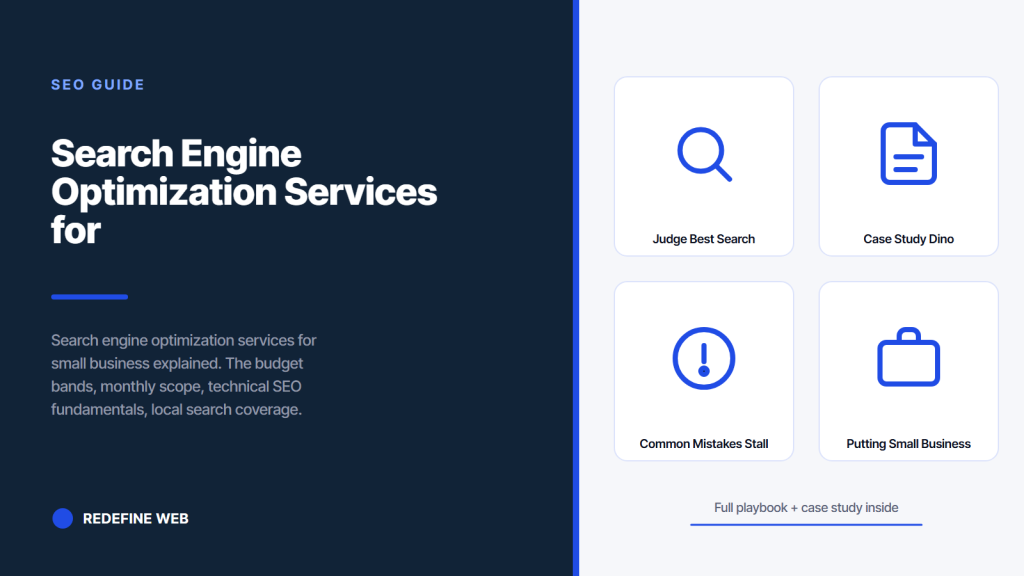
- Real SEO scope starts at $599 monthly for solo owners.
- Technical fundamentals come before content every time.
- One geo page beats five thin service pages.
- Reviews and citations move small business rankings fastest.
- Monthly reporting keeps the retainer aligned to revenue.
- What Search Engine Optimization Services for Small Business Include
- How to Judge the Best Search Engine Optimization Services for Small Business
- Case Study: Dino Decking Small Business SEO Program
- Comparing Small Business SEO Tactics on Speed and Cost
- Common Mistakes That Stall Small Business SEO for Months
- DIY In-House SEO Versus Hiring Small Business SEO Services
- Putting Small Business Search Engine Optimization Services Together
Search engine optimization services for small business is what an owner types into Google when the referral flow slowed and the paid ads bill jumped past $3,000 a month. Organic traffic looks flat for six quarters. The site ranks page two for the primary service and page five for everything else. Meanwhile a competitor across town books daily because their SEO retainer started paying back 14 months ago. You want the same math on your side, without lighting cash on fire.
This guide is the working playbook for search engine optimization services for small business in 2026. The budget bands that reflect real work, the monthly scope you should get for what you pay, the technical fundamentals every provider should touch first, and the mistakes that stall growth for months. Written for the owner or office manager who wants to know exactly what a real retainer covers before signing anything. Plain language, real numbers, no funnel diagrams.
What Search Engine Optimization Services for Small Business Include
Search engine optimization services for small business include seven ongoing workstreams that run every month of the retainer. Technical SEO. On-page optimization. Google Business Profile management. Citation cleanup. Review acquisition. Content publishing. Monthly reporting tied to booked calls, not vanity metrics.
Every workstream produces a monthly deliverable your retainer should name in numbered form. A real scope document reads like a project plan, not a brochure. Anything that lists “strategy” and “optimization” without hours or counts is billing padding, and you will pay for it either way. Ask for the numbered deliverables before signing.
Technical SEO comes first, always
Site speed, crawlability, mobile responsiveness, structured data, HTTPS, canonical tags, XML sitemaps, robots.txt, broken link cleanup. Every small business SEO engagement starts with a technical audit in the first 30 days because content optimization on a broken site does nothing. Google cannot rank pages it cannot crawl or that time out on mobile. A Lighthouse score above 90 is table stakes. Below 80 costs you rankings you never see.
On-page optimization aligned to money-earning keywords
Title tags, meta descriptions, H1s, H2s, internal linking, image alt text, and page copy on your top five money-earning pages. The homepage, the main service page, the top three secondary service pages. Small business SEO gets outsized returns from working these six pages hard for 90 days versus writing 30 mediocre blog posts. Focus beats volume every time on a small business budget, and every provider that leads with content volume is padding invoices.
Google Business Profile plus citations plus reviews
Local SEO is roughly 40 percent of the small business SEO stack. Google Business Profile category, service items, service area, hours, photos, and weekly posts. Citation consistency across 60 to 80 major directories. Review acquisition automation that produces 8 to 15 new reviews per month with response inside 24 hours. Local SEO moves fast, and any small business scope that skips it is leaving the fastest ranking lever on the table.
How to Judge the Best Search Engine Optimization Services for Small Business
The best search engine optimization services for small business provider brings three things every time: vertical case studies matching your industry, a numbered scope document naming monthly hours per deliverable, and reporting tied to booked calls or form fills, not just keyword rankings.
Providers that lead with domain authority scores and estimated traffic are optimizing for the wrong signal. Providers that name GBP calls, direction requests, form fills, and booked appointments are aligned with revenue. Ask any candidate provider for three references in your exact vertical inside 48 hours, and one raw GBP insights export from an active client. Their willingness or hesitation on those two asks tells you what you need to know.
Vertical case studies matter more than agency size
A specialist that has ranked 30 dental practices or 20 home services businesses will outrank a large generalist agency at your specific vertical. Vertical depth beats agency size on every small business account, every time. The specialist has the playbook, the citation lists, the review scripts, the GBP category patterns. The generalist is figuring it out on your budget. Judge by portfolio depth in your vertical, not by employee count.
Scope documents that name deliverables per line
Every real scope document lists monthly deliverables in numbered form. Four GBP posts. Two landing pages. 15 citations audited. Monthly reporting call. If the scope reads like buzzword bingo (strategy, optimization, deep-dive analysis) walk away. Real small business SEO delivery is structured and boring, and any provider hiding the structure is hiding that they have none.
Reporting that leads with revenue signals
The monthly dashboard your provider hands over should lead with booked calls, form fills, GBP direction requests, and organic traffic to money pages. If it leads with impressions, keywords tracked, and DA scores, the provider is optimizing for signals that do not pay the bills. Small business SEO retainers survive by producing measurable revenue signals inside 90 days, and reporting is where that story lives.
Case Study: Dino Decking Small Business SEO Program
Dino Decking Ltd, a small UK composite decking specialist, worked with our team on an SEO-first program that combined technical SEO audits, pillar-cluster content aligned to commercial URLs, and digital PR for backlink authority. Organic clicks grew 206 percent year over year at peak season. Conversion rate grew 74 percent. Referring domains grew 101 percent. Forecast performance beat targets by 114 percent. The playbook was standard fundamentals executed in the right order.
Dino Decking’s baseline was weak: low domain authority, sparse keyword pool, broken tracking. The competitive set (Neotimber, Cladco) held the top positions for high-value commercial keywords. Seasonality made every mistake more expensive because demand compressed into warmer months. Our team fixed the GA4 tracking first, then prioritized high-revenue commercial URLs already ranking page two, then built pillar-cluster content around the commercial URLs. Digital PR grew referring domains 101 percent in 12 months.
What worked and why
Three moves produced most of the gain. First, fix analytics before optimizing anything else. GA4 was undercounting, so every prior optimization was flying blind. Second, prioritize commercial URLs already ranking page two so small pushes moved them into the top 10 where clicks compound. Third, structure content in pillar clusters so authority flowed across the commercial set instead of hoarding in one page.
What this means for a solo small business
The math scales down to a single-location dental practice, a chiropractor, or a med spa. Fix your GBP first (equivalent to GA4 audit). Prioritize your top three service pages already ranking for something (equivalent to commercial URL prioritization). Build supporting blog content that links to them (equivalent to pillar clusters). A solo practice on a $1,500 retainer running this same sequence sees 15 to 40 percent growth in booked new customers inside 90 days.
If the SOW says 'strategy and optimization' without a count of pages, links, or reports per month, you're paying padding. Demand numbers before you sign.
Comparing Small Business SEO Tactics on Speed and Cost
Different tactics move different levers on different timelines and cost different hours per month. Small business SEO service teams sequence the tactics based on what a market needs most, not on what a template says. The table below covers the seven core tactics, the monthly hour investment, and the realistic time-to-impact for a solo or small-team business in a mid-competition market.
| Tactic | Monthly hours | Time to impact |
|---|---|---|
| Technical SEO audit + fixes | 4 to 8 (first month) | 30 to 60 days |
| On-page optimization of top 5 pages | 4 to 6 | 30 to 90 days |
| Google Business Profile management | 2 to 4 | 15 to 45 days |
| Citation cleanup | 2 to 3 | 15 to 30 days |
| Review acquisition automation | 1 to 2 | 30 to 60 days |
| Content publishing (1 to 3 posts) | 4 to 12 | 90 to 180 days |
| Link building outreach | 6 to 10 | 90 to 180 days |
Sequence the fast wins in month one
Month one always covers technical fixes, GBP setup, and citation cleanup. All three produce visible movement in 30 to 45 days on minimal budget. Month two adds the review acquisition automation and the on-page work on top five pages. Month three adds the first landing page and blog content. That sequencing stacks wins each month so the owner sees the retainer paying back before invoice three.
Do not chase link building in month one
Link building is the slowest lever, taking 90 to 180 days to produce ranking impact. Small business retainers that lead with link building in month one are showing off the hardest tactic instead of the smartest sequence. Save link work for months four through 12, when the technical foundation and content structure can absorb the earned authority. Early link building on a broken site wastes half the earned equity.
Content volume beyond 3 posts monthly is padding
Publishing 8 to 12 blog posts per month on a small business retainer is invoice padding. Small business sites rank on 20 to 30 well-optimized pages, not on 400 thin blog posts. Focus content on money-earning topics that support the commercial pages. A single 2,000-word post per month on a topic your customers search for beats four 800-word posts on filler topics every quarter.
Common Mistakes That Stall Small Business SEO for Months
The mistakes below cost small businesses months of ranking momentum. Every small business SEO service audit uncovers the same six errors, and fixing them is the fastest path to visible movement. You could keep hoping a mystery Google update will move you back into the pack, or you could check the six below and fix whichever ones apply this quarter.
- Duplicate homepage content from a page builder, especially when the drag-and-drop builder creates hidden archive URLs Google indexes as thin duplicates.
- Missing or wrong LocalBusiness schema on the homepage and services pages, which costs rich SERP treatment your competitors are getting.
- Blog posts targeting broad head-terms (like “SEO”) instead of the long-tail commercial phrases customers actually search for before booking.
- No internal linking strategy, so authority pools on the homepage and never flows to money-earning service pages that need it.
- Title tags that read as brand-first (“Smith Dental | Home”), instead of keyword-first (“Family Dentist in Beverly Hills | Smith Dental”) that Google indexes for rankings.
- Trying to rank 25 service pages when the business really offers 5 core services, which dilutes ranking signal across too many thin pages.
The 90-minute discovery audit catches every mistake
Every real search engine optimization services engagement for small business starts with a 90-minute discovery audit against a documented checklist. Technical health, on-page structure, GBP, citations, reviews, backlinks, content coverage. That single session catches 95 percent of the ranking blockers on any small business site. Skipping the audit means the provider guesses at the fix, and guessing is what turned three prior engagements into wasted retainer.
The 90-day proof-of-work window
A real small business SEO engagement produces visible ranking movement inside 90 days on the priority keywords. Not full ranking. Not full booked-visit growth. Visible movement in the top 3 to 5 priority keywords identified in the audit. If nothing moves in 90 days, the diagnosis was wrong and the plan needs a reset conversation with the provider.
When to swap providers versus rework the scope
Sometimes the provider is doing the right work and the market simply requires more budget. Sometimes the provider is doing the wrong work. The way to tell is to review the monthly work log against the seven ranking signals. If the log covers all seven and rankings are flat, the market is competitive and the budget needs to grow. If the log skips citations, reviews, and GBP hygiene while focusing on blog posts, the provider is doing the wrong work.
DIY In-House SEO Versus Hiring Small Business SEO Services
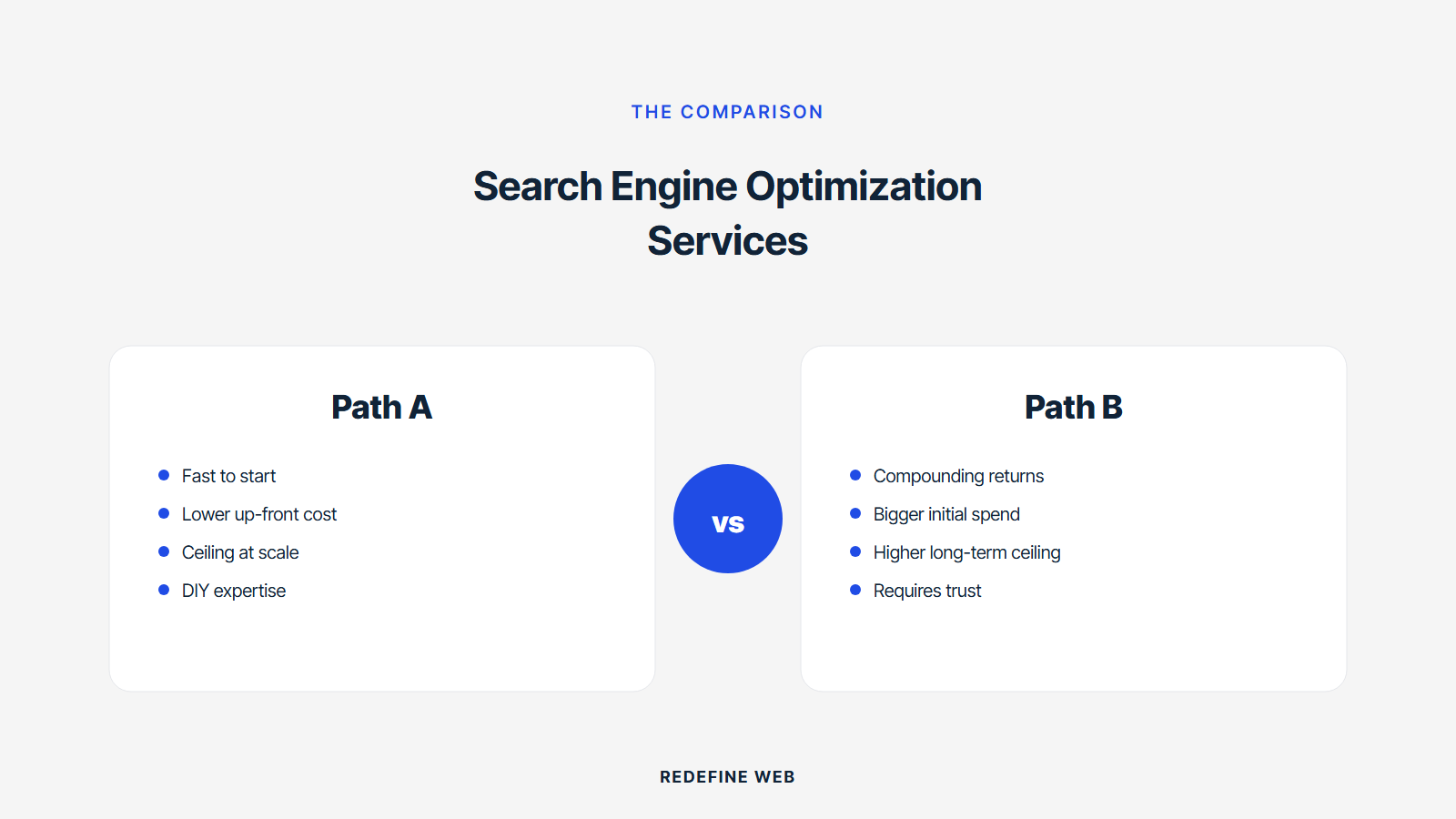
A small business can handle SEO in-house when the owner can commit 8 to 12 hours per month to the work and has the technical comfort to touch the website. In-house SEO works for solo operators in low-competition markets. The math usually favors hiring by month three because the opportunity cost of the owner’s time exceeds the retainer cost. Every hour an owner spends on citations is an hour they are not spending on booked patients or clients.
What the owner can realistically do in 4 hours a week
Four hours a week covers weekly GBP posting, monthly review requests, quarterly citation review, and one landing page per quarter. That is enough to hold ranking in a rural or suburban market with two or fewer competitors. It is not enough to gain ranking against three or more active competitors in a suburban or city market. Owners in competitive markets who try DIY end up flat for a year, then hire.
Tools an in-house owner needs
Google Search Console (free), Google Business Profile Manager (free), BrightLocal or Whitespark for citation tracking ($40 to $79 monthly), and either Semrush or Ahrefs for keyword and competitor research ($99 to $200 monthly). Total tool budget: $150 to $280 per month plus 12 to 18 hours of owner or staff time. Compared to a $1,500 retainer, the tool tier saves money on paper and costs owner time in reality.
The hybrid model that works for growth-stage businesses
Many small businesses run a hybrid model: office manager handles GBP posts and review requests, agency handles technical SEO, content, and reporting. That split saves 4 to 6 hours of agency time per month and puts the local touchpoints closer to the customer. Hybrid works when both sides communicate weekly and the split is documented so nothing falls through.
Putting Small Business Search Engine Optimization Services Together
Search engine optimization services for small business are a stack, not a single fix. Technical SEO cleans the foundation. On-page work aligns the money pages. GBP, citations, and reviews build the local pack presence. Content and links compound authority over 6 to 12 months. Reporting keeps everyone honest. Every layer compounds against the next, and small business owners who stack the full playbook see booked calls and organic traffic grow inside two quarters and keep growing for the life of the retainer.
First 30 days: audit, technical fixes, GBP
Days one through 30 cover the 90-minute discovery audit, the top five technical fixes, the Google Business Profile category and service-item build-out, and the citation cleanup on the top 20 directories. Visible movement often appears by day 30 on the priority keywords, and the owner sees the retainer paying back before invoice two arrives.
Days 30 to 90: on-page work and review flow
Days 30 to 90 cover the on-page optimization of the top five money pages, the review acquisition automation, and the first landing page or blog post. Review volume climbs from 2 per month to 10 or 12 per month. Rankings gain 2 to 4 positions on priority keywords. Booked calls start climbing around day 75 as the compounding effect kicks in.
Months four through 12: content, links, compounding
Months four through 12 are where small business SEO earns its long-term reputation. Content ranks. Links land. Reviews stack. The rankings stabilize at the top of page one for money keywords, and booked calls compound 5 to 10 percent per quarter without any retainer increase, because the foundation built in months one through three is now doing the work on autopilot.
Search engine optimization services for small business come down to picking a provider who names the scope, produces the monthly deliverables, and reports revenue signals. For the working stack our team runs, our search engine optimization services handle the audit, execution, and monthly reporting end to end. When you are ready to run this in a dental, med spa, or home services vertical, the dental marketing retainer starts at $599 a month. Related reads: local search engine optimization services, organic search engine optimization services, and search engine optimization audit services. External references: Google Search Central SEO starter guide, Moz’s SEO learning center, and Ahrefs SEO tips.
Frequently asked questions
What do search engine optimization services for small business include?
Search engine optimization services for small business include a discovery audit, technical SEO fixes (site speed, crawl errors, schema markup), on-page content optimization, Google Business Profile management, citation cleanup, review acquisition automation, and monthly reporting tied to booked calls or form fills. Real scopes list monthly hours per deliverable. Real reporting names GBP calls, form fills, and organic traffic to money pages, not vanity metrics. Providers that skip the audit and jump straight into publishing content are guessing at what actually moves your rankings for the money-earning keywords your business needs to book.
How much do search engine optimization services for small business cost?
Search engine optimization services for small business cost between $499 and $2,500 per month depending on market density, competition, and current baseline. A rural or suburban solo business with a claimed Google Business Profile and a decent website can grow rankings on a $599 monthly retainer. A city business fighting three chains inside a two-mile radius often needs $1,500 to $2,500 per month to make real ground against them. Multi-location and multi-service businesses pay more. Anyone quoting $99 to $199 per month is selling a citation-submission tool with a marketing pitch, not real SEO work.
How fast do small business SEO services show results?
Small business SEO services show visible movement inside 60 to 90 days when the starting baseline includes a claimed Google Business Profile, a functioning website, and no active Google penalties. Businesses starting from scratch or recovering from a manual action take 120 to 180 days for the first visible pack movement. Review acquisition, citation cleanup, and GBP category fixes are the fastest levers, producing measurable movement in the first 30 to 60 days. Backlink work and content ranking compound over 6 to 12 months. Anyone promising first-page rankings in 30 days is selling paid ads dressed as SEO work.
What is the best search engine optimization service for small business?
The best search engine optimization service for small business is the one with case studies in your exact vertical, a scope document that names monthly deliverables in numbered form, and a reporting dashboard tied to booked calls or form fills, not just keyword positions. Rankings without booked calls are decoration. Vertical experience matters more than agency size. A specialist boutique that has ranked 30 dental practices or 20 home services businesses will outrank a large generalist agency at your specific vertical every time. Ask for three references in your vertical before signing anything.
Can a small business handle SEO in-house instead of hiring services?
A small business can handle SEO in-house if the owner or office manager can commit 8 to 12 hours per month to the work and has the technical comfort to touch the website. In-house SEO works for solo operators in low-competition markets. It stops working the moment you enter a market with three or more real competitors, because DIY SEO cannot match the tool stack and workflow that a specialist runs across 20 clients. The math usually favors hiring by month three because the opportunity cost of the owner's time exceeds the retainer cost.
Do small business SEO services still work in 2026?
Small business SEO services work in 2026, and the fundamentals still book new customers reliably. Google's local three-pack, organic map results, and AI overviews all pull from the same underlying signals: GBP accuracy, citation consistency, review flow, on-page content, technical performance, and backlink authority. AI-powered local packs feature roughly 68 percent fewer businesses than the traditional three-pack according to Sterling Sky research, which means the top spots are worth more visibility than ever before. The strategy has evolved but the money-earning work remains the same.
Should a small business pay monthly or per-project for SEO services?
A small business should pay monthly for SEO services because SEO work compounds and needs consistent effort across multiple months to produce results. Per-project SEO (a one-time audit or a batch of pages) delivers a report but not the ongoing GBP management, review flow, and content publishing that actually moves rankings over time. Monthly retainers align the provider's incentives with your growth. Six-month agreements are standard. Providers pushing one-time SEO packages are usually selling audits, not real ranking work that produces booked calls.
Book your free 30-minute strategy call.
No spam, no sales rep. We use your email to schedule your call with a senior strategist. That is it.
More from the blog
View all articles → SEO
SEO Organic Search Engine Optimization Services That Grow Real Traffic
Read article SEO
SEO SEO for Pet Groomers That Fills the Appointment Book Weekly
Read article SEO
SEO