
Local Search Engine Optimization Services That Book Real Foot Traffic
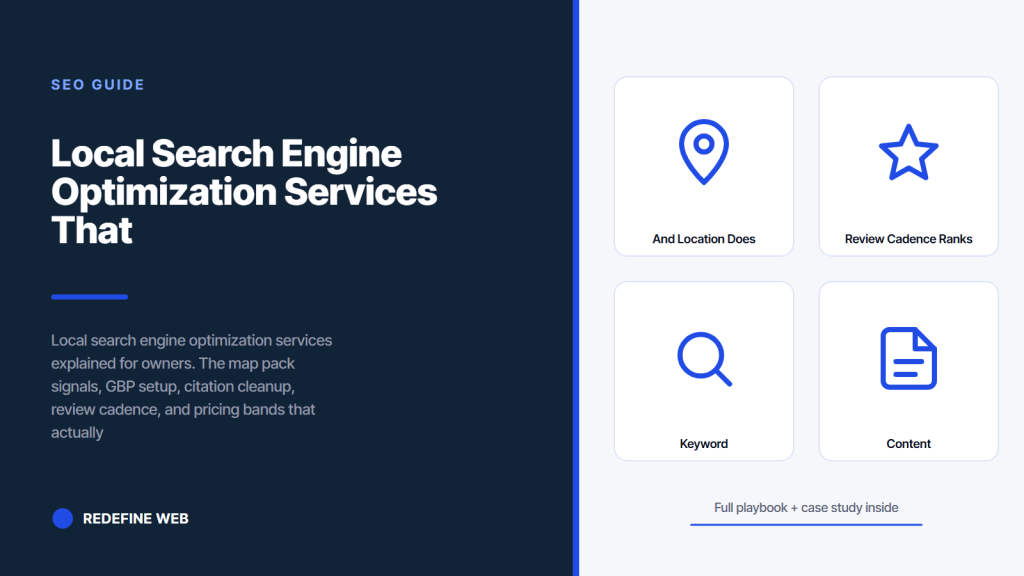
- Map pack ranks on GBP signals more than backlinks.
- Every citation needs the same NAP or rankings stall.
- Reviews with keywords grow service rankings fast.
- Geo-modified pages beat one generic services page.
- Callback speed converts local searchers into visits.
- What Local Search Engine Optimization Services Actually Cover
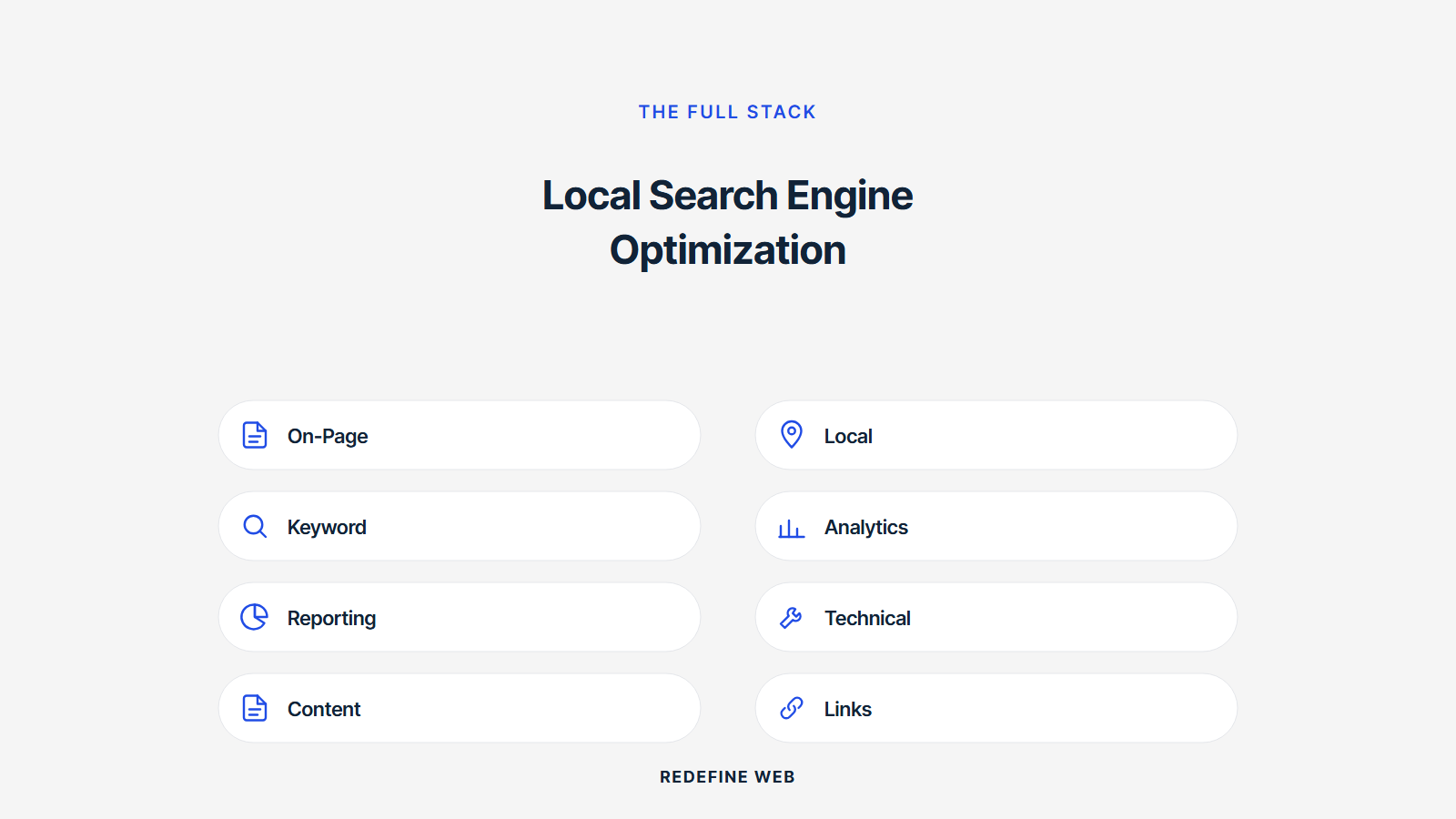
- Local Search Engine Optimization Services Near Me and Why Location Does Not Matter
- Citation Cleanup Playbook for the First 30 Days
- Geo-Modified Landing Pages That Rank Beyond the Homepage
- Review Cadence That Ranks and Books Real Visits
- Case Study: How Local SEO Structure Drove 206% Organic Clicks for Dino Decking
- Comparing Local SEO Tactics on Speed and Impact
- Local SEO Mistakes That Stall Rankings for Months
- Putting Local Search Engine Optimization Services Together
Local search engine optimization services are what a business searches for when the phone stopped ringing and the map pack shows three competitors nobody has heard of. You show up on a search for your own service inside your own zip code and land on page two. The Google Business Profile is claimed but half the categories are wrong. Reviews trickle in at one a month. Directions requests are flat for six quarters. Meanwhile a competitor three miles away books daily because their pack ranking never dropped.
This guide is the working playbook for local search engine optimization services in 2026: the seven signals that move the map pack, the fixes that pay back inside 60 days, the pricing bands that reflect real work, and the mistakes that stall growth for months. Written for the owner, the office manager, or the marketing lead who wants to know exactly what a real engagement covers before signing a retainer. No fluff, no funnel diagrams, just the moves that produce booked visits and phone calls.
What Local Search Engine Optimization Services Actually Cover
Local search engine optimization services cover the seven signals Google uses to rank a business in the map pack. Google Business Profile accuracy leads. Citation consistency comes second. Reviews third. Geo-modified content, local backlinks, mobile speed, and behavioral signals round out the set.
Any provider that jumps into a scope without auditing all seven signals is guessing at what actually moves your rankings. The audit is the first 90 minutes of a real engagement, and it decides which two levers get worked in the first 30 days versus which three wait for month two or three. Skipping the audit costs you two full quarters of momentum, every time.
Google Business Profile is the foundation, not the finish line
Your Google Business Profile is where local SEO starts. Primary category, secondary categories, service items, service area, hours, holiday hours, products, photos, posts, Q&A, messaging. Every field is a ranking signal. A profile with three of those filled out ranks below a competitor with 22 filled out, even if your business has been open longer. Local search engine optimization service teams treat GBP like a live product, not a set-and-forget listing. New posts weekly. New photos monthly. Service items updated when the practice adds a new procedure.
Citation consistency is boring and non-negotiable
Your business name, address, and phone number must match exactly across 60 to 80 directories. Yelp, Bing Places, Apple Maps, Facebook, Yellow Pages, Superpages, Manta, Foursquare, industry directories, chamber of commerce sites. One old citation with a former suite number confuses Google. Your rank slips two spots. You do not know why. A real citation audit catches every inconsistent record and cleans it in the first 30 days of the engagement. Providers that skip citations because it feels boring are the same ones your rankings stall under.
Reviews carry keywords, not just star ratings
Google scans every review your customers leave for keywords. A review that says “great cleaning at Smith Dental” reinforces your ranking for “cleaning near me.” A review that says “the doctor was so nice” is a nice sentiment and a wasted keyword opportunity. Local SEO service teams script the review request to gently prompt service-specific language without violating Google’s review policy. Volume matters (10 to 20 new reviews per month for a competitive market). Response cadence matters (owner replies inside 24 hours on 100 percent of reviews).
Local Search Engine Optimization Services Near Me and Why Location Does Not Matter
Local search engine optimization services near me is a phrase business owners type into Google, not a delivery requirement. A remote SEO team in another state can rank your business in the local pack as well as a provider in your city, because ranking signals live in Google’s systems, not in your provider’s mailing address. What matters is whether the provider has experience with your vertical and market density, not whether they can drive to your office. A remote specialist beats a local generalist almost every time.
Why the “local agency” pitch does not hold up
Local agencies pitch that they know your market. In reality, market knowledge lives in the case studies and the vertical depth, not in the office address. A New York agency with 40 dental practice case studies in secondary metros will outrank a hometown generalist agency for a dental practice in Ohio, because the New York team has the playbook and the hometown team is figuring it out on your budget. Judge providers by portfolio depth, not by their zip code.
Communication and time zones matter more than distance
What matters is whether the provider is responsive, communicates in your business hours, and delivers on time. A remote team that operates in your time zone and picks up calls inside two hours is more useful than a local team that takes three business days to answer email. Ask about the reporting cadence, the communication channel, and the response SLA. Those are the levers that decide whether the engagement runs smoothly, not the office pin on a map.
The one exception: hyper-local link building
The only reason a local provider offers a real advantage is if their team can drive to your city and earn links from local newspapers, chambers of commerce, and neighborhood associations by walking in the door. That work is real, and it does move rankings. If your engagement needs hyper-local link building and your provider is 2,000 miles away, ask how they source local links. If they cannot answer, the gap is real. Otherwise, distance is a non-factor.
Citation Cleanup Playbook for the First 30 Days
Citation cleanup is the fastest lever in the first 30 days of any local SEO engagement. Most businesses have between 40 and 80 citations scattered across directory sites, and 15 to 30 of them carry outdated information. Wrong suite number. Old phone. Former business name. Each stale citation is a Google confidence hit. Clean them and rankings often move inside 30 days without any other change.
Audit tools that surface the full list
BrightLocal, Whitespark, and Semrush Listing Management each pull a citation audit in under 10 minutes. The report names every directory where your business is listed, flags the ones with mismatched NAP, and identifies gaps in high-authority directories where a citation should exist but does not. Any provider running local SEO without one of those tools is doing it by hand and missing 30 to 40 percent of the record.
Prioritize the top 20 directories first
Not every directory carries the same ranking weight. The top 20 (Yelp, Bing Places, Apple Maps, Facebook, Yellow Pages, Better Business Bureau, industry-specific directories, chamber of commerce) drive 80 percent of the citation signal. Clean those first. The long tail of 40 to 60 smaller directories gets cleaned in the second month once the high-authority ones are correct. Prioritization is the difference between meaningful movement and busy work.
Duplicate listings hurt more than missing ones
The single biggest citation problem is duplicate listings. Two Yelp records for the same business under slightly different names. Two Google Business Profiles created by different staff members over the years. Every duplicate confuses Google. Every duplicate needs to be merged or claimed and closed. That work takes hours per directory and cannot be skipped. Local SEO service providers that promise a full audit but do not touch duplicates leave the biggest lever untouched.
Search your service from 3 zip codes around your business using a VPN. If you rank differently in each, you have a proximity problem no on-page work fixes fast.
Geo-Modified Landing Pages That Rank Beyond the Homepage
One generic services page will not rank you for every neighborhood you serve. Local search engine optimization services teams build geo-modified landing pages: one page per service per neighborhood or town. “Dental cleanings in Beverly Hills” is a different page from “dental cleanings in West Hollywood,” and both are different from the main services page. Google rewards specificity. Each page targets one intent, one geography, one call to action.
How many pages, and where to start
Start with three to five geo-modified pages in the first 90 days, targeting your top service in your top three service-area zip codes. Each page needs 600 to 900 words of real content, a testimonial from a patient or client in that neighborhood, a photo of the exterior if it is nearby, and a specific call-to-action. Templated pages with only the city name changed are worse than useless because Google flags them as thin content. Every page needs a real reason to exist.
Content that reads like a local, not a template
Geo-modified pages read best when they name real landmarks, real streets, real events. “Two blocks from the Farmers Market on Wednesday mornings” beats “conveniently located in downtown.” A page that names three specific neighborhood details signals to Google (and to the reader) that the business actually serves that geography. Content that could apply to any city gets ranked like content for no city.
Internal linking that spreads authority
Each geo-modified page links up to the main services page and across to two or three sibling neighborhood pages. That internal linking spreads authority across the local footprint and helps every page rank for its target neighborhood. Isolated geo pages that only link back to the homepage compete with each other. Well-linked geo pages compound. The linking structure is the difference between 15 pages of dead content and 15 pages that all rank.
Review Cadence That Ranks and Books Real Visits
Review acquisition is the single fastest lever a business owner controls in local SEO. Local search engine optimization services teams script the review request into the appointment confirmation text or the post-visit email, so every satisfied customer gets asked. Volume climbs from 1 to 2 per month to 10 to 20 per month inside 60 days. The pack ranking follows within a quarter. Nothing else you do in local SEO produces movement this fast.
Scripts that produce keyword-rich reviews
A review request that says “please leave a review” gets you a review that says “great service.” A review request that says “we would love to hear about your Invisalign visit” produces a review that mentions Invisalign. The request scripts the response. Local SEO services write vertical-specific review-request scripts and A/B test them for keyword capture. Reviews that name your services boost your rankings for those services, and that is a signal you can influence directly.
Owner replies inside 24 hours on 100 percent
Google measures owner response rate and response time. Businesses that reply to 100 percent of reviews inside 24 hours rank higher than businesses that reply to 60 percent inside a week. Replies are also a chance to reinforce keywords (“thanks for the Invisalign feedback, Sarah, we’re glad the treatment went smoothly”) and to earn back a customer who left a three-star review. Silent owners lose ranking and lose the recovery opportunity in one move.
Never buy or trade reviews. Ever.
Bought reviews get detected and stripped by Google’s review filter. Traded reviews (I’ll review yours if you review mine) violate Google policy and can suspend the entire Google Business Profile. Six months of clean review acquisition beats one week of paid reviews that all disappear at once. The temptation is real when a competitor jumps from 40 to 400 reviews overnight, and the fix is patience and process, not shortcut vendors.
Case Study: How Local SEO Structure Drove 206% Organic Clicks for Dino Decking
Dino Decking Ltd, a UK composite decking specialist, worked with our team on an SEO-first program that combined technical SEO audits, pillar-cluster content aligned to commercial URLs, and digital PR for backlink authority. Organic clicks grew 206 percent year over year at peak season. Conversion rate grew 74 percent. Referring domains grew 101 percent. Forecast performance beat targets by 114 percent. The playbook was not exotic. It was fundamentals executed in the right order.
Dino Decking’s baseline was weak. Low domain authority, sparse keyword pool, broken tracking. The competitive set (Neotimber, Cladco) held the top positions for high-value commercial keywords. Seasonality made every mistake more expensive because the demand window was compressed into warmer months. A GA4 audit fixed the tracking inaccuracies first, then commercial URL prioritization brought high-revenue product pages from page two to page one, then pillar-cluster content built topical authority. Digital PR grew referring domains 101 percent in 12 months.
What worked and why
Three moves produced most of the gain. First, fix analytics before optimizing. You cannot improve what you cannot measure, and their GA4 was undercounting. Second, prioritize commercial URLs that were already ranking page two. Small pushes moved them to page one, where clicks compound. Third, structure content in pillar clusters so authority flowed across the commercial set instead of hoarding in one page. The whole engagement was priced against measurable outcomes, and every quarterly review scored the plan against the peak-season demand window.
What this means for a local business
The same math scales down to a single-location dental practice or med spa. Fix your GBP first (equivalent to GA4 audit). Prioritize your top three service pages already ranking for something (equivalent to commercial URL prioritization). Build supporting content that links to them (equivalent to pillar clusters). The playbook is the same. The scope compresses to fit a single-location budget. A dental practice on a $1,800 monthly retainer running this same sequence sees 15 to 40 percent gain in booked new-patient exams inside 90 days. The multiplier at 50-plus locations is what makes the Dino Decking case dramatic. The mechanics are identical.
Comparing Local SEO Tactics on Speed and Impact
Different tactics move different levers on different timelines. Local search engine optimization service teams sequence the tactics based on what a market needs most, not on what a template says. The comparison below covers the seven core tactics, the time each takes to show impact, and the realistic magnitude of the gain for a single-location business in a mid-competition market.
| Tactic | Time to impact | Impact on map pack rank |
|---|---|---|
| Citation cleanup on top 20 directories | 15 to 30 days | 1 to 3 pack positions |
| Review acquisition automation | 30 to 60 days | 2 to 4 pack positions |
| GBP category and service item build-out | 15 to 45 days | 1 to 2 pack positions |
| Geo-modified landing pages | 60 to 120 days | Broader keyword coverage, indirect pack gain |
| Local backlink building | 90 to 180 days | 1 to 2 pack positions |
| On-page technical SEO fixes | 30 to 60 days | Indirect gain via crawl and speed |
| GBP posting cadence (weekly) | 60 days ongoing | Engagement gain, indirect pack gain |
Sequence the fast wins in month one
Month one always covers citation cleanup and GBP build-out. Both produce visible movement in 30 days and cost minimal budget. Month two adds the review acquisition automation and the first geo-modified landing page. Month three adds the second landing page and the first round of local backlink outreach. That sequencing produces stacked wins each month and lets the owner see the retainer paying back before the third invoice hits.
Do not chase backlinks in month one
Backlink building is the slowest lever. It takes 90 to 180 days to show impact, and it takes budget away from the fast wins that could be earned in the same period. Local SEO services that lead with backlinks in month one are showing off the hardest tactic instead of the smartest sequence. Save backlinks for months four through 12, when the foundation is solid and every new link compounds against a clean profile.
Reporting cadence keeps the sequence honest
Monthly reporting reviews what got done, what moved, and what comes next. Owners who see progress against a plan stay bought in through the compounding months. Owners without reporting drop the retainer at month three because the ranking has not moved yet, missing the payoff that lands in month five. Consistent reporting is what turns a 90-day trial into a 24-month engagement.
Local SEO Mistakes That Stall Rankings for Months
The mistakes below cost businesses months of ranking momentum. Local search engine optimization services teams see the same five errors in almost every audit, and fixing them is the fastest path to movement. You could keep hoping a mystery Google update will move you back into the pack, or you could just check the five below and fix whichever ones apply. Owner honesty is the first prerequisite.
- Wrong primary Google Business Profile category. Every vertical has a specific category that outranks the general one. “Dentist” beats “Health consultant” for a dental practice, and yet three in ten dental GBPs use the wrong primary.
- Address changes never propagated to citations. A practice moves suites, updates the sign, and forgets 40 directories that still list the old address. Six months of ranking damage before someone catches it.
- Review requests going to unhappy customers first. Front desk asks the patient who complained the loudest, hoping to smooth it over. That request generates a two-star review with detail. Ranking drops.
- Multiple GBP listings under variations of the business name, created by different staff over the years. Each one dilutes signal. None gets the full ranking weight.
- Landing pages targeting cities the business does not actually serve. Google catches the mismatch and treats the whole domain as unreliable. The fix is either deleting the pages or opening a real service extension in those areas.
The audit that catches every mistake in 90 minutes
Every good local search engine optimization service starts with a discovery audit. Ninety minutes with a checklist against the seven ranking signals and the five common mistakes above. That audit catches 95 percent of the ranking blockers. The remaining 5 percent surface during the first 30 days of active work. Skipping the audit means the provider guesses at the fix, and guessing is what turned three prior engagements into wasted retainer.
The 90-day proof-of-work window
A real local SEO engagement produces visible movement inside 90 days. Not full rankings. Not full booked-visit growth. But visible movement in the top 3 to 5 keywords the audit prioritized. If nothing moves in 90 days, the diagnosis was wrong and the plan needs a reset. Owners should judge the retainer against that 90-day mark, not the 30-day one and not the 12-month one.
When to swap providers versus rework the scope
Sometimes the provider is doing the right work and the market simply requires more budget. Sometimes the provider is doing the wrong work. The way to tell is to ask for the monthly work log and compare it against the seven ranking signals. If the log covers all seven and rankings are flat, the market is competitive and the budget needs to grow. If the log skips citations, reviews, and GBP hygiene while focusing on blog posts, the provider is doing the wrong work.
Putting Local Search Engine Optimization Services Together
Local search engine optimization services are a stack, not a single fix. GBP hygiene cleans the foundation. Citations remove the friction. Reviews compound the signal. Geo-modified pages spread the coverage. Backlinks add authority. Reporting keeps everyone honest. Every layer compounds. Businesses that pick one lever and stop see modest gains. Businesses that stack the full playbook grow booked visits, calls, and direction requests inside two quarters, and keep growing them for the life of the engagement.
First 30 days: audit and fast wins
Days one through 30 cover the 90-minute discovery audit, the citation cleanup on the top 20 directories, and the Google Business Profile category and service-item build-out. Visible pack movement often appears by day 30. Owners see the retainer paying back before the second invoice arrives, and the engagement gets the momentum it needs to run for the year.
Days 30 to 90: review flow and content foundation
Days 30 to 90 install the review acquisition automation, publish the first geo-modified landing pages, and start the local backlink outreach. Review volume climbs from 2 per month to 12 per month inside 60 days. Pack rankings gain another 2 to 4 positions. Booked visits start climbing measurably around day 75 as the pack ranking compounds with the improved review flow.
Months four through 12: compounding
Months four through 12 are where local SEO earns its long-term reputation. Backlinks land. Content ranks. Reviews stack. The map pack ranking stabilizes at the top 3 for your primary service, then broadens to secondary services. Booked visits keep growing 5 to 10 percent per quarter without any budget increase, because the foundation you built in months one through three is now compounding on autopilot.
For a working stack our team runs for single-location and multi-location businesses, our search engine optimization services handle the audit, execution, and monthly reporting end to end. When you are ready to run this across a dental, med spa, or home services practice, the dental marketing retainer starts at $599 a month. Related reads: search engine optimization services for small business, organic search engine optimization services, and search engine optimization audit services. External references: Google Search Central on Google Business Profile, Moz’s local SEO learning hub, and Search Engine Land’s local coverage.
Frequently asked questions
What do local search engine optimization services actually cover?
Local search engine optimization services cover the seven signals Google uses to rank a business in the map pack: Google Business Profile accuracy, citation consistency across the 60+ major directories, review volume and cadence, on-page geo-modified content, local backlinks from real neighborhood sources, mobile page speed, and behavioral signals like calls and directions requests. A real engagement runs a discovery audit against those seven signals, prioritizes the two or three with the widest gap, and works them for 90 days before layering the next. Anything that skips the audit and jumps straight to publishing content is guessing at what actually moves your rankings.
How much do local search engine optimization services cost per month?
Local search engine optimization services run between $500 and $3,500 per month for a single-location business, depending on market competition and current baseline. A rural solo practice with clean citations and a decent Google Business Profile can grow the pack ranking on a $599 retainer. A city practice fighting five chains inside a three-mile radius often needs $1,800 to $2,800 per month to make real ground. Multi-location businesses pay per location, usually $300 to $700 per site once shared strategy costs get spread across the network. Anyone quoting $99 per month is selling a citation-submission tool and calling it SEO.
How fast do local search engine optimization services produce results?
Local search engine optimization services produce visible map-pack movement inside 60 to 90 days when the starting baseline includes at least a claimed Google Business Profile and a live website. Businesses starting from scratch (unclaimed GBP, no citations, no reviews) take 120 to 180 days to break into the local three-pack. The three fastest levers are review acquisition (weeks), citation cleanup (30 days), and geo-modified landing page work (60 days). Backlink work and behavioral signals compound slower, over 6 to 12 months. Any provider promising first-page results in 30 days is selling a paid ads report dressed as SEO.
Are affordable local search engine optimization services worth it?
Affordable local search engine optimization services in the $499 to $899 per month band work for solo owners in low-competition markets, and produce nothing in dense metro competition. The math is honest: at $599 per month a provider can fit six to nine hours of actual work into your account. That is enough to run GBP hygiene, add 10 to 15 citations per quarter, and publish two geo-modified pages a quarter. In a rural or suburban market that budget lifts the pack. In a downtown market with five aggressive competitors it does not. Match the retainer to your competition, not your comfort.
Can you buy local search engine optimization services near me?
Local search engine optimization services near me is a search phrase, not a delivery requirement. A remote SEO team in another state can rank your business in the local pack as well as a provider in your city, because ranking signals live in Google's systems, not in your provider's mailing address. What matters is whether the provider has experience with your vertical and market density. A team that has ranked 40 dental practices in secondary metros will outrank a local generalist agency, even if the local agency owns a storefront two blocks away. Judge by case studies, not zip code.
What is the best local search engine optimization services provider?
The best local search engine optimization services provider for your business is the one with documented case studies in your vertical, a scope document that names deliverables per month, and a reporting dashboard tied to booked visits or calls, not just rankings. Ranking reports are decoration if no calls land on the schedule. Providers that report GBP calls, direction requests, form fills, and booked appointments are aligned with revenue. Providers that lead with domain authority and estimated traffic are optimizing for the wrong signal. Ask any candidate provider for three references in your vertical and one raw GBP insights export.
Do local search engine optimization services still work in 2026?
Local search engine optimization services still work in 2026, and the map pack is more concentrated than ever. Sterling Sky data shows AI-powered local packs feature roughly 68 percent fewer businesses than the traditional three-pack, which means the top three positions are worth even more visibility than before. Local search intent has grown as Google's mobile results lean harder on nearby signals. Businesses that skip local SEO in 2026 lose ground to competitors who ranked in 2023 and kept working the signal. The strategy has evolved (GBP posts, service items, AI overview inclusion) but the fundamentals still book patients, clients, and customers.
Book your free 30-minute strategy call.
No spam, no sales rep. We use your email to schedule your call with a senior strategist. That is it.
More from the blog
View all articles → SEO
SEO Organic Search Engine Optimization Services That Grow Real Traffic
Read article SEO
SEO SEO for Pet Groomers That Fills the Appointment Book Weekly
Read article SEO
SEO