
GEO for Healthcare Websites and Visibility in AI Search
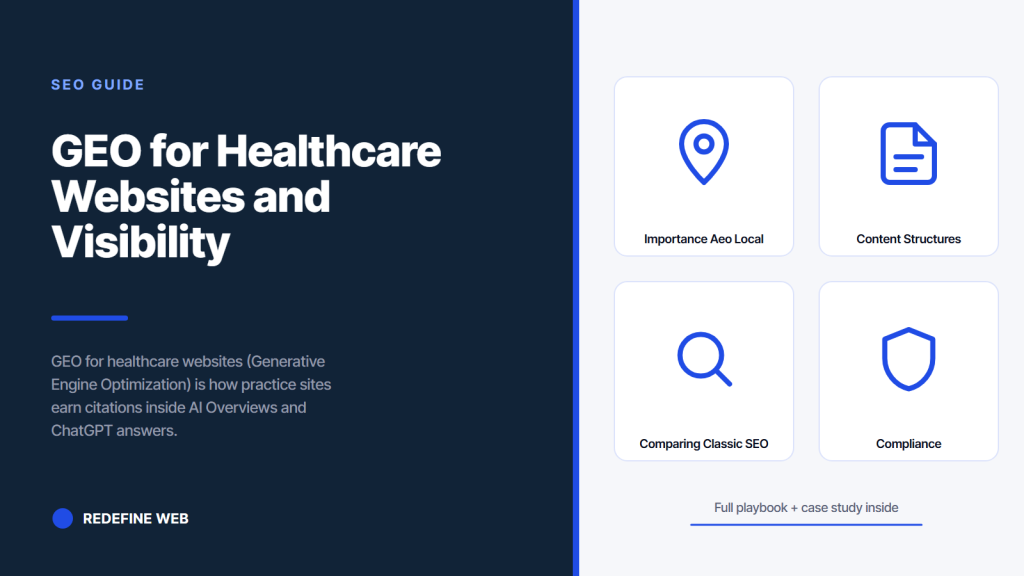
- GEO earns citations inside AI-generated answers.
- Q and A blocks with 40-60 word answers get cited most.
- MedicalWebPage schema is table stakes for GEO.
- Reviews feed the local AI answer selection.
- Classic SEO still owns booking-query rankings.
- The importance of AEO in local SEO for healthcare services
- Content structures that earn citations
- Healthcare SEO trends driving GEO adoption
- Comparing classic SEO and GEO for healthcare websites
- How a multi-location practice earned AI citations
- Tracking GEO performance on healthcare website SEO
- Common GEO mistakes on healthcare websites
- Where GEO for healthcare websites is heading
GEO for healthcare websites (Generative Engine Optimization) is the practice of earning citations inside AI-generated answers on Google AI Overviews, ChatGPT, Perplexity, Claude, and Gemini rather than only ranking in the ten blue links. Patients now ask AI assistants about symptoms, procedures, insurance coverage, and provider comparison before ever landing on a practice site. The AI answer is what steers the click. Practices that structure content for AI citation win outsized visibility. Practices that keep writing for 2020-era SEO stay stuck on page 2 while AI Overviews eat the top-of-page real estate.
This guide covers what GEO for healthcare websites actually changes from classic SEO, which content structures earn AI citations reliably, how AI in healthcare SEO reshapes keyword strategy, the importance of AEO in local SEO for healthcare services, the healthcare SEO trends that matter through 2027, and the tracking approach that separates AI-driven traffic from classic organic. Every recommendation comes from real client accounts we work on today, not vendor sales sheets.
The importance of AEO in local SEO for healthcare services
Answer Engine Optimization (AEO) and Generative Engine Optimization (GEO) overlap heavily. Both target AI-generated answers. AEO focuses on the featured snippet and People Also Ask boxes on classic Google. GEO focuses on AI Overviews, ChatGPT, Perplexity, and Gemini answers. For local healthcare services the importance of AEO in local SEO for healthcare services is that the AI answer often includes the practice name, address, phone number, and star rating pulled from Google Business Profile.
How local AI answers get assembled
The AI model pulls the answer body from the practice website content and the location details from Google Business Profile. If either half is weak, the answer defaults to a competitor. A practice with a strong site but a stale Google Business Profile loses the citation. A practice with a great Google Business Profile but generic site content loses the citation to a competitor with better site content. Both halves need to be strong. The importance of AEO in local SEO for healthcare services is that neither half survives on its own.
Reviews as citation signal
AI models weight Google review count, average rating, and review recency into the local answer selection. A practice with 200 reviews averaging 4.7 gets cited over a practice with 60 reviews averaging 4.5, even when the site content is comparable. Review request automation and response workflow become GEO infrastructure, not just marketing hygiene. The review layer feeds the citation layer directly, and every review request earns future AI visibility.
Content structures that earn citations
Certain content structures reliably earn AI citations. They share four properties: factual, short, structured, and attributed. Practices that convert every service page and every blog post to these patterns typically see AI Overviews mentions climb inside 90 days.
- Q&A blocks with 40 to 60 word answers. One question per H3, one clear factual answer, one source citation.
- Numeric ranges with attribution. “Invisalign treatment averages 12 to 18 months per the American Association of Orthodontists.”
- Comparison tables with clear column headers. Braces vs Invisalign. In-office vs at-home whitening. AI models extract table rows cleanly.
- Named entity mentions. Provider names with credentials, procedure names with clinical terminology, insurance carrier names.
- Step-by-step numbered lists. “How to prepare for a wisdom tooth removal” with clear steps 1-5, each 25-40 words.
- FAQ schema on every page. Structured data helps AI models parse the question-answer pairs cleanly for citation.
The MedicalWebPage schema on schema.org covers the healthcare-specific structured data AI models expect. Practices skipping the structured data layer lose citations to competitors who invest 4-6 hours implementing it correctly. That schema work is one of the highest-return GEO investments a healthcare site can make this quarter. Most practices can implement MedicalWebPage and FAQPage schema across the top 20 pages in a single week of engineering time, then compound the citation gains every month after that. Rank Math and Yoast both auto-generate acceptable schema on WordPress sites.
Healthcare SEO trends driving GEO adoption
The healthcare SEO trends of 2025 and 2026 all converge on GEO. AI Overviews rolled out to health queries in mid-2024 and now show on 40 to 60 percent of health searches. ChatGPT hit 200 million weekly active users in 2025 and roughly 12 percent of those queries touch health topics. Perplexity’s health vertical grew 400 percent year over year. Every trend line points at AI-mediated healthcare search overtaking classic search inside 24 months.
What patients ask AI instead of Google
Symptom research (“why does my jaw pop”). Comparison research (“invisalign vs clear correct”). Insurance research (“does aetna cover pediatric dermatology”). Recovery research (“how long after wisdom tooth surgery can I eat”). Provider research (“pediatric dentist accepting medicaid manhattan”). Roughly 40 percent of these queries now move to AI assistants first, then to Google for the specific practice booking. Practices that own the AI citation layer own the top-of-funnel demand and feed the classic booking funnel with pre-qualified patient intent.
Where classic ranking still wins
Commercial booking queries (“invisalign near me”, “emergency dentist manhattan”) still convert primarily on classic Google results. AI Overviews cite the top comparison content, but the actual booking click happens on a classic ranking. GEO does not replace classic SEO. It adds a top-of-funnel layer that feeds the classic funnel. Skipping either half wastes the other half’s investment. The right split through 2027 is roughly 60 percent GEO-friendly content patterns and 40 percent classic long-form content for practices building fresh.
AI cites specific numbers with named sources. Replace 'takes some time' with '12 to 18 months per the AAO' on your top 5 service pages. That's your AI citation edge.
Comparing classic SEO and GEO for healthcare websites
The table below breaks down how GEO for healthcare websites differs from classic SEO across the axes that matter to a practice marketer. Both channels share technical fundamentals but diverge in content structure, measurement, and where the traffic actually lands.
| Dimension | Classic SEO | GEO for healthcare websites | Shared |
|---|---|---|---|
| Target result | Top-10 blue link | Citation inside AI answer | Google Index |
| Content pattern | Long-form pages | Q&A blocks, tables, ranges | Original data |
| Measurement | Rankings, clicks, CTR | Impression share, referrer | Conversions |
| Timeline to impact | 6 to 12 months | 60 to 120 days | Compounds |
| Schema focus | Article, LocalBusiness | MedicalWebPage, FAQPage | Organization |
| Primary channel | Google search | AI Overviews, ChatGPT, Perplexity | Bing (both) |
Where the two channels reinforce
Every Q&A block that earns AI citation also earns a featured snippet on classic Google. Every numeric range with attribution earns citation on both. MedicalWebPage schema helps both channels. The content investment amortizes across both search surfaces rather than being paid for twice.
Where the two channels diverge
Long-form thought leadership content still earns classic SEO rankings but gets ignored by AI models that cannot cite a 400-word paragraph cleanly. Comparison tables earn AI citations but do not typically win featured snippets. The divergence matters when prioritizing the next 90 days of content investment. Practices split budget 60/40 in favor of GEO-friendly patterns through 2027 because the citation-share upside compounds faster than the classic ranking upside on the current 24-month horizon.
When to prioritize GEO over classic SEO
Prioritize GEO when the practice serves conditions with heavy research volume (cosmetic dentistry, orthodontics, dermatology, fertility). Prioritize classic SEO when the practice serves booking-driven demand with short research cycles (emergency dental, urgent care, pharmacy). Balance both when the practice sits somewhere in between, which covers most primary care, pediatric, and specialty practices in general commercial markets.
How a multi-location practice earned AI citations
Pelvic Rehabilitation Medicine runs 14 locations treating pelvic pain and endometriosis. The site rebuild included content restructuring specifically for GEO for healthcare websites: 40 to 60 word Q&A blocks on every service page, numeric ranges with clinical attribution, comparison tables between treatment options, MedicalWebPage schema across the top 30 pages.
The result was 174 percent keyword growth and 166 percent organic traffic growth within the 12-month engagement window. AI Overviews mentions grew from single-digit citations at rebuild time to consistent citation on 30+ commercial pelvic pain and endometriosis queries by month 9. The patient community platform launched alongside the rebuild fed the citation layer with fresh long-tail content the AI models cited more frequently than static clinical pages.
The compound effect was noticeable in the analytics. Organic traffic on classic Google searches grew steadily. AI-referred traffic (visible through referrer tracking on ChatGPT clicks and through Search Console’s AI Overview impression data) grew faster. Combined, the site now earns roughly 30 to 40 percent of its net-new patient discovery through AI-mediated channels, up from under 5 percent at rebuild time. GEO investment paid back inside the first 6 months on citation share alone.
Georgia Behavioral Health Professionals, a LifeStance Health Inc. division, ran a similar GEO-informed content strategy across 10+ Georgia clinics. Combined with paid campaigns, the practice hit $19 cost per lead against a $25 target and tripled patient acquisition volume with full impression share on niche services like TMS therapy. GEO content targeting TMS-related questions captured citation share on AI answers that classic SEO alone would have missed.
Tracking GEO performance on healthcare website SEO
Tracking GEO for healthcare website SEO requires a different measurement stack than classic organic tracking. Classic organic tracks rankings, clicks, and impressions from Google Search Console. GEO tracks AI Overview impressions from Search Console (added in late 2024), referrer traffic from ChatGPT, Perplexity, and Gemini, plus citation share estimates from third-party AI citation trackers. The measurement gap between the two channels drives most of the reporting mistakes practices make when they try to fold AI tracking into their existing SEO dashboards without adjusting.
The four metrics that matter
AI Overview impression share from Search Console. Referrer traffic from ChatGPT, Perplexity, and Gemini (visible in GA4 with proper referrer group setup). Citation count on tracked queries from third-party tools like Otterly.ai or Peec.ai. Assist-conversion patterns where AI-referred traffic touched the funnel before booking. All four combine into one weekly report the practice owner reads Monday morning.
Reporting cadence
Weekly reports track impression share and referrer traffic movement. Monthly reports track citation share on the top 30 commercial queries. Quarterly reviews rebalance the content roadmap based on which patterns earned citations and which did not. That cadence keeps the GEO investment honest. Practices skipping the tracking layer typically overinvest in low-citation-return content and underinvest in the patterns AI models actually pull from. The tracking stack itself costs $200 to $500 monthly, which is trivial compared to the citation-share upside a well-tracked program earns.
Common GEO mistakes on healthcare websites
The mistakes we see across GEO audits repeat. None of them are dramatic. All of them cost citation share. Fixing three of the six below moves the AI Overviews impression share meaningfully within 60 to 90 days.
- Long-form paragraphs without extractable answers. AI models cannot cite a 400-word paragraph. Break it into Q&A blocks.
- No MedicalWebPage or FAQPage schema. Structured data helps AI models parse questions cleanly. Add it to every page.
- Stale Google Business Profile. Half of the local AI answer comes from GBP. Update photos, hours, and services monthly.
- Chasing head terms only. The 40 to 80 patient questions each head term fans out into are where GEO citation lives.
- Ignoring reviews as citation signal. Review count and recency feed local AI answer selection.
- No tracking on AI referrer traffic. Without measurement, you cannot tell what is working.
Every quarter a practice owner reads a LinkedIn post claiming SEO is dead because ChatGPT ate Google. Panics. Cancels the SEO contract. Three months later organic traffic drops 60 percent, competitors are winning both the AI citations and the classic rankings, and the practice owner writes a LinkedIn post about how SEO is more important than ever. Somewhere in San Francisco a LinkedIn influencer is writing the third “SEO is dead” post of the year and getting 4,000 likes for it.
That joke lands because it maps to what most practice SEO decisions actually look like. GEO for healthcare websites did not kill SEO. It added a citation layer on top of the ranking layer. Both matter. The practices that adapt content structure for both win. The practices that panic and cancel win nothing. Boring, structural changes to how content is written compound into real citation share year after year.
Where GEO for healthcare websites is heading
Google AI Overview rollout continues to expand through 2026 and 2027. Voice search on Google Home and Alexa devices gets more AI-mediated answers. ChatGPT’s search feature (launched late 2024) captures a growing share of health research queries. Perplexity’s health vertical continues its growth curve. Every trend line makes GEO for healthcare websites more important, not less.
The Google AI features documentation covers the classic-side integration. The OpenAI blog on ChatGPT search covers the ChatGPT side. HIPAA compliance on AI-referred traffic still applies: consent gates, PHI-safe analytics, BAAs with any AI vendor the practice integrates with. The compliance work does not go away because the traffic comes from an AI assistant instead of Google.
The practical next step for most practices is a two-week GEO audit against the six mistakes above. Restructure the top 20 service pages for citation-friendly content patterns. Add MedicalWebPage schema. Set up AI referrer tracking in GA4. Ninety days from audit to measurable AI citation share is a realistic timeline on most practice sites. Content changes compound from there.
Ready to run the GEO audit and rebuild the content stack. Our Healthcare SEO Services engagement covers GEO as part of the working plan. For related reading see our AI in Healthcare SEO and AEO for Healthcare guides. For the broader trends, our Healthcare SEO Trends deep dive covers the surrounding shifts. For keyword-level detail our Healthcare SEO Keywords piece is the practical playbook. The healthcare marketing agency hub ties GEO into the broader acquisition side.
Frequently asked questions
What is GEO for healthcare websites?
GEO for healthcare websites (Generative Engine Optimization) is the practice of earning citations inside AI-generated answers on Google AI Overviews, ChatGPT, Perplexity, Claude, and Gemini rather than only ranking in the ten blue links. The mechanics differ from classic SEO. GEO optimizes for structured, factual, quotable passages an AI model can extract with attribution. Patients now ask AI assistants about symptoms, procedures, insurance, and provider comparison before ever visiting a practice site. Winning that citation slot drives outsized visibility.
How does GEO for healthcare websites differ from classic SEO?
Classic SEO chases a top-10 keyword ranking through title tags, meta descriptions, and body copy against 200+ Google signals. GEO chases citation inside an AI-generated answer through short, factual, structured passages an AI model can extract cleanly. Q&A blocks with 40 to 60 word answers get cited most. Numeric ranges with source attribution work. Comparison tables work. Long-form paragraphs get skipped. Both classic SEO and GEO share technical fundamentals: page speed, structured data, E-E-A-T signals. Skipping either half loses citations and rankings both.
What is AI in healthcare SEO?
AI in healthcare SEO refers to the shift from Google's ten blue links to AI-generated answer boxes that summarize content from multiple sources. Google AI Overviews now show on 40 to 60 percent of health queries. ChatGPT search launched in late 2024 and captures a growing share of health research. Perplexity's health vertical grew 400 percent year over year. Practices structuring content for AI citation win outsized top-of-funnel visibility. Practices writing 2020-era SEO content stay stuck on page 2 while AI Overviews take the top slot.
Why is AEO important in local SEO for healthcare services?
The importance of AEO in local SEO for healthcare services is that AI-generated local answers pull from two sources: the practice website content and Google Business Profile data. If either half is weak, the answer defaults to a competitor. A practice with strong site content but a stale Google Business Profile loses the citation. Reviews weight heavily in local AI answer selection: a practice with 200 reviews at 4.7 stars gets cited over a practice with 60 reviews at 4.5 stars. Both content and profile data need investment.
What healthcare SEO trends drive GEO adoption?
The healthcare SEO trends converging on GEO include Google AI Overviews rolling out to health queries in mid-2024 (now showing on 40-60 percent of health searches), ChatGPT reaching 200 million weekly active users with roughly 12 percent of queries touching health, Perplexity's health vertical growing 400 percent year over year, and voice search on Alexa and Google Home increasingly delivering AI-mediated answers. Every trend line points at AI-mediated healthcare search overtaking classic search inside 24 months. GEO investment now avoids catch-up spending later.
How do I track GEO performance on healthcare website SEO?
Four metrics matter. AI Overview impression share from Google Search Console (added late 2024). Referrer traffic from ChatGPT, Perplexity, and Gemini visible in GA4 with a proper referrer group setup. Citation count on tracked queries from third-party tools like Otterly.ai or Peec.ai. Assist-conversion patterns where AI-referred traffic touched the funnel before booking. Weekly reports track impression share and referrer movement. Monthly reports track citation share on top 30 commercial queries. Quarterly reviews rebalance the content roadmap.
Does GEO for healthcare websites replace classic SEO?
No. GEO adds a top-of-funnel citation layer on top of the classic ranking layer. Commercial booking queries like "invisalign near me" and "emergency dentist manhattan" still convert primarily on classic Google rankings. Research and comparison queries increasingly move to AI assistants first, then to Google for the specific booking. Practices need both. Skipping classic SEO loses the booking-query traffic. Skipping GEO loses the research-query top-of-funnel. The right investment covers both channels with a shared content strategy.
Book your free 30-minute strategy call.
No spam, no sales rep. We use your email to schedule your call with a senior strategist. That is it.
More from the blog
View all articles → SEO
SEO Organic Search Engine Optimization Services That Grow Real Traffic
Read article SEO
SEO SEO for Pet Groomers That Fills the Appointment Book Weekly
Read article SEO
SEO