A healthcare website design agency has one job. Build a site patients trust inside 8 seconds, load it under 2 seconds on a phone, pass ADA review without a demand letter, and route traffic into scheduled visits. Most vendor pitches cover one of those goals. This guide gives you the scope, pricing bands, timeline, and compliance framework to pick a partner and get a build that earns back its cost inside 12 months.
Inside you get the build patterns that convert on healthcare sites, pricing bands from solo practice up to multi-location group, the 90-day rebuild timeline Redefine Web runs, the compliance guardrails that keep you out of ADA and HIPAA exposure, and a Pelvic Rehabilitation Medicine case study where a 14-location group grew organic keywords 174% and organic traffic 166% inside a year. Read straight through in 11 minutes, pull the 2 sections that fit your stage, and skip the rest.
Healthcare website design company pricing bands you can trust
Pricing for a healthcare website design company runs from $4,500 on a solo-provider replatform to $180,000 on a multi-state group with 40 plus provider pages. The bands below cover the 4 common project shapes and what sits inside each. Numbers reflect what Redefine Web delivers at each tier and what mainstream competitors quote in the same range. Anything under the floor is a template shell or a build that skips compliance and needs replacing inside 18 months.
| Project shape | Price band | Timeline | What is included |
|---|---|---|---|
| Solo-provider practice | $4,500 to $12,000 | 4 to 8 weeks | 10 to 18 pages, 1 provider page, ADA pass, booking form |
| Small group (2 to 6 providers) | $12,000 to $32,000 | 8 to 14 weeks | 20 to 40 pages, provider pages with schema, insurance logic, GBP setup |
| Multi-location (7 to 25 providers) | $32,000 to $85,000 | 14 to 22 weeks | Location pages per site, provider pages, CRM integration, telehealth flow |
| Enterprise health system | $85,000 to $180,000 | 20 to 36 weeks | Design system, 40+ providers, referral portals, staging, load testing |
What drives cost up honestly
Provider count is the single biggest driver. Every added clinician page adds 2 to 4 hours of write, photograph, schema, and QA time. Location count is the second driver. Every added office adds a location page, unique Google Business Profile setup, and local-schema markup. Third is insurance logic. Practices that accept 15 plus payers need dynamic insurance filters on service pages, which adds 20 to 40 development hours. If a healthcare website design company quotes you a flat number without asking for those 3 inputs, they’re guessing.
Where you save without cutting corners
You save honest money on 3 swaps. Use real practice photography instead of stock, which cuts photo licensing from $2,400 to $600. Adopt a proven design system on the second and third location build so each new site takes 40 to 60% less time. Bring your own copy for provider bios if your marketing team can write to the WCAG readability standard. Every other cost-cutter, template themes, offshore development, cheaper hosting, tends to bounce back as rework inside the first year.
Pricing patterns that signal a rebuild in 18 months
Watch for 3 pricing patterns that quietly guarantee a rework. First, a flat fixed price with no provider or location count on the intake form. Second, a hosting bundle where the shop refuses to hand over credentials on request. Third, a suspiciously low year-one number paired with a mandatory 12-month monthly retainer that carries the real cost. Each of those pricing shapes shifts risk onto you and keeps the shop’s revenue steady even if the site underperforms. Ask for the year-one total in writing and compare shops on that number, not on the sticker.
Compliance guardrails every healthcare web design agency covers
Compliance on a healthcare site is not a bolt-on. Every design decision, form endpoint, tracking script, and hosting choice is a compliance decision. The 2 frameworks that matter are WCAG 2.2 AA for accessibility and HIPAA for PHI handling. Get one wrong and you’re looking at demand letters, class-action exposure, or a data-breach report. Get both right at build time and the site stays clean for its full lifespan.
The rule we run at Redefine Web is that compliance is written into the build ticket, not audited after. Every ticket references the WCAG success criterion it must clear. Every form ticket references the BAA-covered endpoint it must post to. This slows the build down by roughly 8 to 12%, and it saves you from the rebuild that happens 12 to 18 months later on sites that skip the discipline. For an outside benchmark on ADA plaintiff activity, the Department of Justice web accessibility guidance is the reference you want on file.
WCAG 2.2 AA build checklist
The WCAG items that trip healthcare sites most often. Color contrast on small text hitting 4.5 to 1. Keyboard navigation across every form and menu. Focus states visible on every interactive element. Alt text on every content image, empty alt on decorative ones. Form labels programmatically tied to inputs. Video captions and transcripts on every clip. Skip-to-content link at the top of every page. Semantic heading order with no skipped levels. That 8-item list catches roughly 85% of plaintiff complaints we’ve reviewed.
HIPAA-safe form and tracking rules
Any form that collects a symptom, condition, or health history counts as PHI intake. That form cannot post to a generic Contact Form 7 endpoint or route to a Gmail inbox. It posts to a BAA-covered form vendor, stores encrypted, and delivers via a HIPAA-compliant email or ticketing system. Tracking follows the same rule. Standard Google Analytics on a page that displays a patient portal or specific condition content risks a breach. Use a HIPAA-compliant analytics vendor for those pages or exclude them from tracking. See our Accessibility (ADA/WCAG) guide for the full compliance breakdown.
Third-party embeds that create hidden risk
Chat widgets, appointment plugins, review pixels, and heatmap tools each open a data-flow that needs a review. Any tool that touches a form field, a URL parameter with a condition name, or a logged-in patient area is a HIPAA question. Keep a running inventory of every third-party script on the site with the vendor, the data it collects, and the BAA status. Review the list every quarter. That single spreadsheet is the fastest way to catch the marketing pixel someone added last month that quietly logs symptom keywords on your intake page.
Case study on a healthcare website design agency rebuild that worked
Pelvic Rehabilitation Medicine came to us as a 14-location specialist group covering pelvic-pain and endometriosis care. The existing digital footprint was scattered across three domains, provider pages were thin, service content was buried, and no page ranked in the top 20 for the core condition keywords in any of their 14 metros. Patient acquisition depended entirely on physician referrals, which capped growth at the pace of physician outreach.
We ran a single-domain consolidation, a condition-first content architecture, provider pages with schema for every clinician across all 14 locations, a rebuilt community platform for pelvic-pain and endometriosis patients, and a technical SEO pass covering Core Web Vitals, internal linking, and mobile UX. 12 months later, organic keyword rankings expanded 174% year over year, organic traffic climbed 166%, and the community platform launched as a dedicated support hub that now drives a significant share of new-patient inquiries directly.
| Metric | Baseline | After 12 months |
|---|---|---|
| Organic keyword rankings | Scattered | +174% YoY |
| Organic traffic | Limited | +166% |
| Patient community platform | None | Launched, active |
| Provider pages with schema | Thin | Full coverage across 14 locations |
Single-domain consolidation
Consolidating 3 fragmented domains into one authoritative property recovered link equity that was scattered and diluted. Every location and provider page mapped to a URL structure that stayed stable, and we redirected the retired domains with 301s straight to the closest matching page. Consolidated authority is why the organic ranking climb showed up inside 6 months instead of the 12 to 18 most healthcare replatforms take. If you’re running multi-domain today, this is often the single highest-value move in a healthcare rebuild.
Condition-first content architecture
Old healthcare sites organize around services or departments. Patients search around conditions. The rebuild flipped the architecture so that every condition, pelvic pain, endometriosis, interstitial cystitis, vulvodynia, got a dedicated hub with the symptoms, treatment options, provider list, and community resources on one page. That structural change is why 174% keyword growth showed up. Patients typing symptom queries landed on pages that answered them directly instead of bouncing off a generic services list.
Timeline for healthcare web design services from kickoff to launch
A healthcare website design agency timeline runs longer than a comparable services or B2B build. The compliance layer and the provider-page volume are why. A small-group rebuild lands at 8 to 14 weeks. A multi-location group runs 14 to 22 weeks. An enterprise health system takes 20 to 36 weeks. Compressing those timelines is almost always a mistake. The rushed sites are the ones that come back for accessibility remediation the following quarter.
The 4 phases below are the phase gates we run at Redefine Web. Each one has a deliverable and a sign-off before the next starts. Skipping a phase gate is how projects go 40 to 60% over budget on scope creep. Sticking to the gates is how they land on time and on the number quoted at kickoff.
- Discovery and audit. 2 to 4 weeks, includes provider inventory and compliance baseline.
- Architecture and design. 3 to 6 weeks. Sitemap, wireframes, brand system, prototype.
- Build and content. 4 to 12 weeks. Page development, provider content, form endpoints.
- QA and launch. 2 to 4 weeks. WCAG audit, HIPAA form review, load testing, staged migration.
Discovery and audit phase
Discovery is where you name every provider, every location, every service line, and every insurance carrier the practice accepts. You audit the current site for accessibility failures, PHI exposure in forms, and structured-data gaps. You pull baseline metrics for organic traffic, paid cost per lead, phone volume, and appointment conversion. Every downstream design decision refers back to this document. Skipping discovery is the single most common reason healthcare sites relaunch and then underperform the site they replaced.
Architecture and design phase
Architecture starts with the sitemap. Every provider page, every service, every condition hub, every location page, mapped once so the URL structure stays stable at launch and through the next 2 rebuilds. Wireframes come next, then a full prototype of the 5 highest-traffic pages. Sign-off on the prototype locks the visual system, the copy blocks, and the interaction patterns. Practices that skip prototype sign-off and jump to full build hit change-order fatigue by week 10 and the launch slides 4 to 6 weeks.
QA and launch phase
QA runs 3 parallel tracks. Accessibility QA with a full WAVE and axe-core scan plus manual keyboard and screen-reader testing. HIPAA QA with a form-endpoint review and tracking-script audit. Performance QA with Lighthouse and WebPageTest on the 10 highest-traffic pages. Only when all 3 tracks clear does the launch go live. Redirect maps for every retired URL land in the same phase so you don’t lose organic rankings on the transition. See our Core Web Vitals for healthcare websites guide for the speed benchmarks we hold.
Choosing the right healthcare website design agency for your practice
Every agency claims healthcare expertise. Very few can produce a recent accessibility audit report, a HIPAA BAA with their form vendor, and 3 provider references from the same size and specialty as your practice. Ask for those 3 artifacts before you sign anything. The answer separates the shops that talk healthcare from the ones that deliver it. Everything else on the sales call is theater.
The second filter is the size fit. A solo-provider practice hiring an agency that runs enterprise health systems pays for overhead that never touches their build. An enterprise system hiring a solo-freelancer risks the freelancer burning out mid-project. Match your project shape to the agency’s most recent 5 projects. Ask for the last 5, not the greatest hits. What they built this quarter is what they’ll build for you.
10 questions to ask every finalist
- Show me your last 3 accessibility audit reports.
- What form vendor do you use and do you sign a BAA with them?
- Who writes provider bios, you or us?
- What Core Web Vitals do you commit to at launch?
- How do you handle redirects on the domain migration?
- What is your average build time for a practice our size?
- Who owns the site and hosting after launch?
- What is included in post-launch maintenance?
- Show me the last 5 sites you launched.
- What happens if the site fails an ADA plaintiff scan post-launch?
Red flags to walk away from
Any agency that calls accessibility a plugin. Any agency that refuses to sign a BAA. Any agency that quotes a flat number without asking about provider count, location count, and insurance count. Any agency whose recent portfolio is restaurants and boutiques with a single dental case pasted in. Any agency that promises page-one rankings inside 30 days. Any agency that owns your hosting and refuses to hand over credentials. Any of those 6 answers and you keep shopping.
Conversion drivers a healthcare web design agency measures
You’re not buying a site. You’re buying a patient-acquisition engine, and every design decision is a conversion decision. The 4 numbers you track after launch are appointment conversion rate on the primary booking form, phone-call volume tagged by source, organic sessions on service and provider pages, and paid cost per booked appointment. Any agency that cannot report those 4 numbers monthly is measuring the wrong things.
Benchmarks for a healthy healthcare site. Appointment conversion sits at 4 to 9% on the primary booking form. Phone-call volume grows 25 to 60% inside 90 days of launch on the same traffic. Organic sessions climb 60 to 180% inside 6 months. Paid cost per booked appointment drops 20 to 40% since the landing pages now convert better. Anything worse and the agency owes you a diagnosis and a fix, not another sprint on features.
Appointment conversion rate
Appointment conversion is the number that pays for the rebuild. A primary booking form should convert at 4 to 9% of the visitors who reach it. Below 4% means the form is too long, the copy is fuzzy, or the trust signals near the form are weak. Above 9% usually means paid targeting is too narrow, which is a good problem for a different team. If the form sits at 2% post-launch, the fix is almost always shortening it to 3 fields and pulling reviews closer to the CTA.
Phone-call volume tagged by source
Call tracking swaps the phone number on the site by traffic source so you know whether the caller found you through Google Ads, organic search, direct traffic, or a referral. Tools like CallRail and CallTrackingMetrics run $45 to $180 per month depending on volume. Every healthcare website design agency worth hiring includes call tracking as a launch requirement. Without it, half your paid budget attributes to “direct” and you can’t tell which channel booked which patient. See the WHO guidance on digital health services and the HHS HIPAA for professionals library for compliance context.
Closing the attribution loop on booked patients
Call tracking and form conversions only get you halfway. The other half is tying a booked appointment back to the marketing source that generated it. Practices that stop at form fills over-invest in top-of-funnel content and starve the booking channel. Send every booking, kept or no-show, back to the analytics layer with the source captured on the form. Once the loop closes, the cost per booked patient shows up next to the cost per lead, and the paid budget shifts fast to the channels that convert to kept appointments, not just the ones that fill the form.
Post-launch care after your healthcare web design services engagement
A healthcare site is not a static asset. Search algorithms shift. Compliance rules tighten. Providers join and leave. Insurance carriers change. Without a monthly maintenance rhythm, the site drifts from launch condition into a state that needs rebuilding 2 years later. Post-launch care is the difference between a 5-year site and a 2-year site.
The monthly cadence we run at Redefine Web covers content updates for new providers or locations, WCAG spot audits on newly added pages, plugin and CMS updates on a staging environment before production, backup verification, uptime monitoring, and quarterly Lighthouse and axe-core scans. That work runs $199 to $499 per month depending on scale. Most practices land on the $299 tier and stay there for years. For the full picture on ongoing care see our Website Maintenance pillar.
Monthly maintenance checklist
- WordPress core, theme, and plugin updates on staging then production.
- Full backup verification with a test restore once per quarter.
- WAVE and axe-core scan on the highest-traffic 10 pages.
- Lighthouse performance check with Core Web Vitals report.
- Uptime and SSL certificate check.
- Provider bio and headshot refresh as staff changes.
- Insurance carrier list update as payer contracts change.
- Google Business Profile post cadence at once per week per location.
Quarterly deep work
Once a quarter you run a heavier pass. A full WCAG 2.2 AA audit against the current site. A HIPAA form-endpoint review to catch any tracking script or third-party embed added since the last review. A content audit that flags provider pages, service pages, and location pages that haven’t been updated in 6 months. A Search Console review, plus a GEO check for AI Overview visibility, for pages that lost impressions or clicks. Practices that skip the quarterly pass are the ones where organic traffic silently slides 8 to 15% per year until someone notices.
Website design for healthcare trends worth adopting in 2026
Not every design trend translates to healthcare. Dark-mode primary pages hurt readability for older patient demographics. Full-screen video heroes hurt Core Web Vitals and mobile data plans. Chatbot popups without a BAA risk PHI capture. The trends worth adopting in 2026 are the ones that improve trust, speed, or accessibility without adding compliance risk.
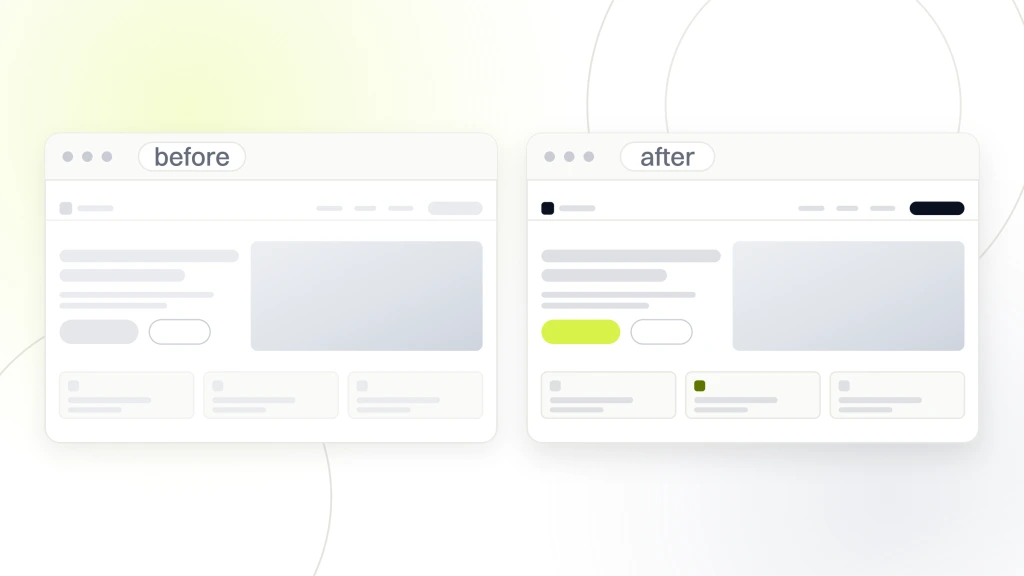
The 4 we deploy this year on new builds. Warm, high-contrast typography that clears WCAG at 18 pixel body size. Static hero imagery with real practice photography instead of stock video. Provider grids rendered server-side for instant LCP. Progressive-fallback booking flows that work even when JavaScript fails. Each one maps to a measurable improvement in Core Web Vitals or accessibility scores without adding new compliance surface area.
Typography that clears WCAG at scale
Body copy at 18 pixel with a 1.6 line height reads cleanly for a 65-year-old patient on a 6-inch phone screen. That single choice does more for accessibility scores than any plugin. Pair it with a heading font that carries character but stays highly legible, and you clear the typography portion of a WCAG audit without added remediation. Practices that launch at 14 or 15 pixel body copy see time-on-page drop 20 to 35% on mobile since older patients bounce before they read past the first paragraph.
Progressive-fallback booking forms
Progressive fallback means the booking form works with plain HTML if JavaScript fails. The JavaScript layer adds nice-to-haves like inline validation and calendar pickers, but the base form still submits and the patient still gets an appointment. Sites that launch JavaScript-only forms lose 3 to 7% of bookings on flaky networks and older browsers. On healthcare traffic that skews older-device, that loss compounds fast. Progressive fallback is a 2-day engineering investment that pays back inside 30 days.
Trust blocks near every booking CTA
Reviews, credentials, and insurance logos placed within 100 pixels of the booking CTA lift form-completion rates 15 to 30% on healthcare sites. Patients hesitate before sharing symptoms with a stranger, and the trust block is the signal that decides the click. Pull 3 review quotes with real patient names or initials, add the top 4 insurance logos the practice accepts, and mount both blocks tight against the CTA. Don’t hide them in a testimonials page 2 clicks away. The moment the patient decides is the moment they see the form.
Working with Redefine Web as your healthcare website design agency
Redefine Web runs healthcare rebuilds on a phased model. Discovery and audit in weeks 1 through 4. Architecture and prototype in weeks 5 through 10. Build and content in weeks 11 through 22 on a mid-size group. QA and launch in the final 2 to 4 weeks. Every phase carries its own sign-off and a locked deliverable. You never enter a phase without knowing exactly what leaves it.
Our engagement bundles the design, the build, the compliance work, and the first 90 days of post-launch care into one price. After that first quarter, most practices move onto a monthly maintenance retainer that runs $299 to $499 for a small-to-mid-size group. Our Healthcare Marketing Hub covers the wider stack, and our Healthcare Web Design (Pillar) post covers the trust, UX, and conversion patterns in depth. When pricing is next, our Website Redesign Benefits post walks through what to fix first.