
Healthcare website redesign benefits break down into five categories that matter to the P&L: more booked patients, faster mobile speed, cleaner intake, stronger local rankings, and lower ad cost per patient. Every real rebuild moves at least three of those numbers. The rest of the pitch is decoration. So the first question is not what the site should look like. It is which of those five outcomes your practice needs most in the next 90 days.
This guide covers the real benefits by category, the fix-first triage that saves SEO equity before you spend a dollar, cost brackets by scope, the healthcare website redesign process end to end, and the migration sequence that avoids a ranking cliff. It closes with the iSmile Dental Spa engagement behind 900% patient growth on a proper rebuild. Plan on about twelve minutes to read straight through.
Healthcare website redesign benefits, ranked by revenue impact
The healthcare website redesign benefits that move the needle sit in five buckets. Patient trust that converts (first-time booking rate up 15 to 30%). Mobile speed (an LCP under 2.0 seconds usually cuts bounce 20 to 40%). Cleaner HIPAA-eligible intake (front-desk callback volume down 30 to 50%). Structured service pages (organic traffic up 40 to 200% over 12 months). Paid ads that convert 20 to 40% better on matching landing pages. Add those up and the rebuild pays for itself in six to nine months, not three years.
Benefits you should not expect from a rebuild alone
A rebuild is not a marketing plan. Practices that redesign the site and then wait for the phone to ring get a flat month one. You still need Google Business Profile work, review generation, one or two paid channels, and quarterly content refresh. Rebuilds without a launch marketing plan land at a 5 to 10% booking-rate gain instead of the 25% target. The site did its job. The plan around it did not exist.
Fix-first triage before you scope a healthcare website redesign
Before you scope a rebuild, run the fix-first triage. Open a Google Sheet. Run PageSpeed Insights on your top ten URLs. Run WAVE for accessibility. Note every issue. Rank each one as fix-first (targeted sprint) or rebuild-required (structural). That single sheet saves $10,000 to $40,000 on practices where a sprint would move the same numbers as a full rebuild.
The fix-first list runs short. Broken forms. Missing click-to-call on mobile. Slow homepage LCP that an image swap and lazy-load would solve. Missing service-page schema. Outdated staff photos. Any of those get done in a two-week sprint for $2,000 to $6,000. Rebuild-required items are different. Legacy CMS with no security updates. Fragmented content architecture. HIPAA-noncompliant intake. Those need the full healthcare website redesign process.
Triage scoring that keeps you honest
Score each issue on two axes. Business impact 1 to 5 (does it block bookings). Fix effort 1 to 5 (hours to production). Impact 4 or 5 with effort 1 or 2 gets done this month. Impact 4 or 5 with effort 4 or 5 goes on the rebuild scope. Anything at impact 1 or 2 sits in a backlog. That grid turns a vague rebuild pitch into a prioritized list every stakeholder can vote on.
The real cost of healthcare website development by scope
The cost of healthcare website development lands in three brackets that map to scope. Bracket one is a template-based rebuild on WordPress with a healthcare theme, five to eight service pages, and a HIPAA-eligible intake form. That runs $4,500 to $9,000. Bracket two is a semi-custom rebuild with 12 to 20 pages, custom photography, and blog restructure. That runs $10,000 to $22,000. Bracket three is a full custom build with 30-plus pages, video, and integrated marketing. That runs $25,000 to $60,000.
Cost drift comes from three places. Custom photography added mid-project ($1,500 to $4,000). HIPAA compliance on intake and portal integrations ($2,000 to $8,000). Extra design revisions when the owner and the office manager disagree on colors ($1,000 to $3,000 in vendor time). Cap the design rounds at three in the contract. Decide the photo shoot at discovery. Name the HIPAA scope on paper before development starts. Those three moves keep 80% of budget surprises out.
What is usually missing from a low quote
A $3,000 healthcare website quote is not the deal it looks like. Redirect mapping, schema markup, accessibility work, HIPAA-eligible form hosting, and post-launch monitoring are the five items missing from most cheap quotes. Add them back and you land in bracket one anyway, plus rework cost from doing them badly the first time. The $4,500 rebuild with those items ships once. The $3,000 rebuild without them ships twice.
Healthcare website redesign process end to end
The healthcare website redesign process runs in six phases. Discovery. Site map and content plan. Design. Development. Content migration and QA. Launch and monitoring. Each phase has specific deliverables and specific decision points. Practices that skip phases or blur decisions end up with a rebuild that misses the business problem. Owners who show up to every decision point produce rebuilds on time and on scope.
Discovery runs two weeks. The vendor interviews the owner, front desk, and marketing lead. They audit the current site and document the top ten patient questions from the treatment room. That output becomes the brief. Skip discovery and every design decision gets made without the practice-specific context that drives conversions. That is the single most common failure mode in outside vendor engagements.
Discovery outputs that shape the design
Discovery produces four written outputs. A brand voice document that captures how the practice talks to patients. A patient persona document with two to three primary personas. A competitive audit showing what three local competitors do well and poorly. A goals document listing the two or three success metrics for the rebuild. Every subsequent design and copy decision references these documents. A rebuild without written discovery outputs is a rebuild guided by vendor preferences, not practice goals.
Design mockup order that saves time
Design mockups happen mobile first, desktop second. Never the other order. 78% of new-patient searches arrive on a phone. The mobile mockup is the site. Desktop is an upgrade path. Practices that review the desktop mockup first almost always approve a layout that reads poorly on the phone that actually carries their traffic. Two rounds of review, mobile first each time, save two to three weeks of rework compared to a desktop-first workflow.
SEO preservation across a healthcare website redesign
The single most-missed step in a healthcare website redesign is redirect mapping. The old site had URLs. The new site has different URLs. Without 301 redirects from old to new, Google sees dead pages and drops rankings. Practices lose 30 to 60% of organic traffic in month one because nobody set up the redirects. That is a ranking cliff that costs tens of thousands in lost bookings. Every rebuild proposal should include redirect mapping as a named deliverable.
Run a content audit before migration. Export every URL from Search Console. Sort by traffic. Any URL with meaningful traffic gets a decision. High-traffic content worth keeping gets rewritten and redirected. Medium-traffic content gets redirected to the closest new page. Low-traffic content gets retired with a 410 status. That single audit protects the practice from the ranking cliff most rebuilt sites walk off in month one. See the Google Search Central redirect guidance for the technical implementation.
Blog migration or fresh start decision
Blog migration is a decision, not a default. Practices with 20-plus quality posts and real organic traffic should migrate every post with the same URL structure. Practices with five posts from 2019 that nobody has updated should retire them and start fresh. The middle case is where judgment matters. Any post with meaningful search traffic gets rewritten and migrated. Any post with zero traffic and outdated content gets retired. The rebuild is the rare moment when this cleanup is easy to justify.
Structured data carryover
MedicalOrganization, Physician, and Service schema on the old site should carry over to the new site with the same or better implementation. Some vendors accidentally strip schema during a rebuild because they rebuild templates from scratch without auditing the old markup. Screenshot every schema block on the old site before development begins. Verify the new site emits equivalent or better schema before launch. Run the Schema.org validator on the top five templates. Schema regression is a real ranking risk that most rebuild processes miss.
Healthcare website optimization as part of the rebuild
Healthcare website optimization runs alongside the rebuild, not after. Core Web Vitals should be designed in from the start. Managed WordPress hosting selected in phase 2. Image pipeline planned before design mockups start. Third-party script strategy defined during discovery. Optimization treated as an afterthought at launch is optimization that never finishes. Every rebuild we see fail on Core Web Vitals at launch skipped one of those planning steps.
Target LCP under 2.0 seconds on mobile at launch. INP under 150 milliseconds. CLS under 0.05. Those are buffer targets that give the site room to drift as marketing adds pixels over time. Practices that launch at exactly the passing thresholds (2.5, 200, 0.1) are back in the red within six months. Build the buffer into the initial spec. That single decision protects the ranking benefits for years, not months.
Accessibility work that survives launch
ADA compliance for healthcare websites is a real legal exposure. WCAG 2.2 AA is the current standard. Every rebuild should include a WAVE scan, a manual keyboard-navigation test, and a screen-reader walk on the top ten templates. Vendors that skip accessibility work leave a legal risk that shows up in demand letters six to twelve months after launch. Practices that treat accessibility as a phase-6 checklist item consistently discover more issues at that late stage than a phase-3 accessibility-first design would have avoided.
Tracking setup that survives HIPAA
GA4 configuration on healthcare sites needs to avoid PHI collection. Configure event tracking on marketing pages, strip pixels from booking and intake pages, use server-side Google Tag Manager where budget allows, and configure Google Consent Mode v2. That stack keeps analytics functional and cuts PHI exposure to near zero. The rebuild is the right moment to install this properly. Retrofitting later is 3x the effort.
Case study on real healthcare website redesign benefits
iSmile Dental Spa in Carmichael, California came to us with a dated site, a bargain host, and a fragmented digital presence that lagged the practice’s clinical reputation. Before the rebuild, they averaged 1 to 2 new patients a month from digital, ranked for zero page-one keywords, and had no HTTPS on the site. Broken links, missing metadata, and crawl errors kept them out of the map pack. The site was technically there. It did not book patients.
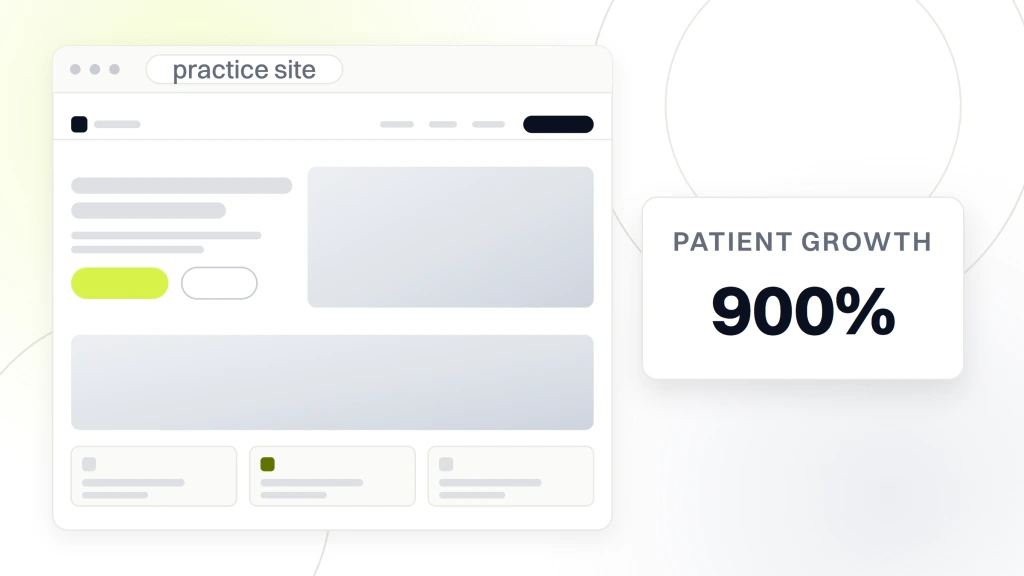
The engagement covered a secure HTTPS rebuild, specialized service-page content for sedation and periodontal care, NAP citation cleanup, Google Ads, custom video, and GMB review generation. In 6 months, the practice ranked on page one for 75 keywords. Patient growth hit 900%, scaling from 1 to 2 new patients per month to 12 to 14 consistently. Organic traffic grew 800%. Marketing ROI landed at 500%. Every number came from a rebuild that treated design, speed, SEO, compliance, and content as one integrated program.
Outcome measured across the engagement
Patient growth 900%. Organic traffic 800%. Marketing ROI 500%. 75 page-one keywords in 6 months. Compounding effect is what matters most. The rebuilt site converted the traffic. Better SEO grew the traffic. Video content added trust. Paid ads on the same site earned better efficiency because landing pages matched search intent. Every piece supported every other piece because the rebuild had a plan and a reporting cadence to hold each channel accountable.
Lessons for other practices
Two lessons carry over. First, treat the rebuild as one part of an integrated marketing plan, not a standalone project. iSmile rebuilt the site, restructured SEO, launched Google Ads, and produced treatment videos in a coordinated sequence. Second, video on treatment pages punches above its weight. A 60-second doctor video on the homepage and top three treatment pages typically drives 20 to 35% higher booking rate. A $1,500 to $3,000 production shoot pays back in one month.
Migration sequence for the launch
Migration for a healthcare website redesign runs in a specific sequence. Two weeks before launch, lower DNS TTL to 300 seconds. Set up the new site on the new host in parallel with the old site live. Complete the redirect map from old URLs to new URLs. Test every form with real submissions. Test the phone number, the booking flow, and the mobile menu on a real Android phone. Run a WAVE scan. Validate schema. Only after every check passes do you flip DNS.
Launch happens at 2 AM local time on a Tuesday, not Friday afternoon. The team is available for four hours after the switch. First 48 hours involve monitoring 404 patterns in Search Console, watching form submissions live, and confirming GA4 events fire. Friday launches usually discover a broken form on Monday morning after 72 hours of failed bookings. Boring launches on Tuesday mornings are the goal.
First 90 days after launch
The first 90 days tell you whether the healthcare website redesign benefits are real. Booking rate typically settles 15 to 30% higher than the old site. Organic traffic dips 10 to 20% for two to four weeks during reindexing, then recovers and grows. Cost per booked patient from paid ads drops 20 to 40% as landing pages convert better. Any deviation from these ranges deserves investigation. Both a better-than-expected rebuild and a broken redirect need someone paying attention.
Six-month review with the vendor
Book a six-month review with the vendor on the day the site launches. Put it on the calendar. Review the three success metrics from discovery. Check Search Console for keyword movement, GA4 for booking rate, and Google Business Profile for review growth. Talk about what worked, what did not, and what to change next quarter. Skip the six-month review and you coast on the launch honeymoon and miss drift that would be easy to fix at month six.
Vendor selection for a healthcare website redesign
Look at three specific things when comparing vendors. Two live healthcare sites they built in the last 18 months. The mobile PageSpeed score of those sites (should be 85 or higher). A written scope with a fixed feature list. That filters half the market in an afternoon. Design shops without a live-site portfolio outsource the actual development. Vendors that show live sites at 40-score mobile PageSpeed built the sites without regard for the ranking and booking benefits you want.
Ask five questions on the sales call. What is your typical launch timeline for a practice our size. Show me two case studies with real numbers. What does redirect mapping cost as a line item. How do you handle HIPAA for intake forms. What is your post-launch support policy. Written answers to those five questions separate real healthcare specialists from generalists that miss the compliance specifics.
Post-launch maintenance that preserves the rebuild benefits
A rebuild is a moment. Maintenance is a habit. Every healthcare website redesign benefit you gained at launch will drift within six to twelve months without monthly maintenance. Plugin updates. Speed monitoring. Security patching. Content freshness. Analytics reviews. Practices that skip maintenance rebuild again in 18 months because the vitals fell apart and the intake flow drifted out of tune.
The maintenance scope covers monthly plugin updates on staging first, security patching within 48 hours of disclosure, uptime monitoring with real inbox alerts, monthly speed audits, quarterly content refresh on the top ten pages, and semi-annual reviews of Core Web Vitals against baseline. Retainers that cover this stack run $199 to $499 per month. Our Healthcare Website Maintenance Services guide covers what the full stack looks like end to end.
Quarterly review with the team
Set a recurring quarterly review with the maintenance team and marketing lead. Twenty minutes. Review the three success metrics from discovery, the plugin update log, and the speed monitoring log. Ask three questions. What drifted. What worked. What to change next quarter. Skip it and the site drifts back to the pre-rebuild state within a year.
Content freshness on the top pages
Refresh the top ten pages of your site every quarter. Update statistics, add recent case work, refresh photos, and rewrite the intro if the wording feels tired. See the web.dev content strategy notes for the pattern that keeps pages ranking on freshness. Google rewards content freshness on healthcare topics because health information changes over time. Practices that leave the site static for a year usually see 10 to 20% ranking drift on the pages that matter most.
Where to start with your healthcare website redesign benefits
Start with the triage sheet to map the actual benefits against your baseline. Run PageSpeed Insights on the top ten URLs. Run WAVE. Categorize every issue as fix-first or rebuild-required. That sheet tells you whether the rebuild is truly needed or whether a targeted sprint would move the same numbers cheaper. Do the sheet first.
Once you are ready to scope the rebuild, look at three specific things. Baseline booking rate. Baseline mobile PageSpeed. Baseline ranking positions for your top ten keywords. Those three numbers become the success metrics you measure against 90 days after launch. For deeper reading, our Healthcare Website Design Services guide covers the rebuild engagement, our Healthcare Web Design (Pillar) covers UX and trust principles, our Core Web Vitals for Healthcare Websites covers speed targets, and our Healthcare Marketing Hub covers the full engagement. Ready to scope maintenance that preserves the benefits, our Healthcare Website Maintenance plans start at $199 per month. See our post on healthcare website classification criteria for the six-bucket framework that decides which reviewer chain and SEO priority each page runs through.