
Home Services Marketing Ideas That Book More Jobs
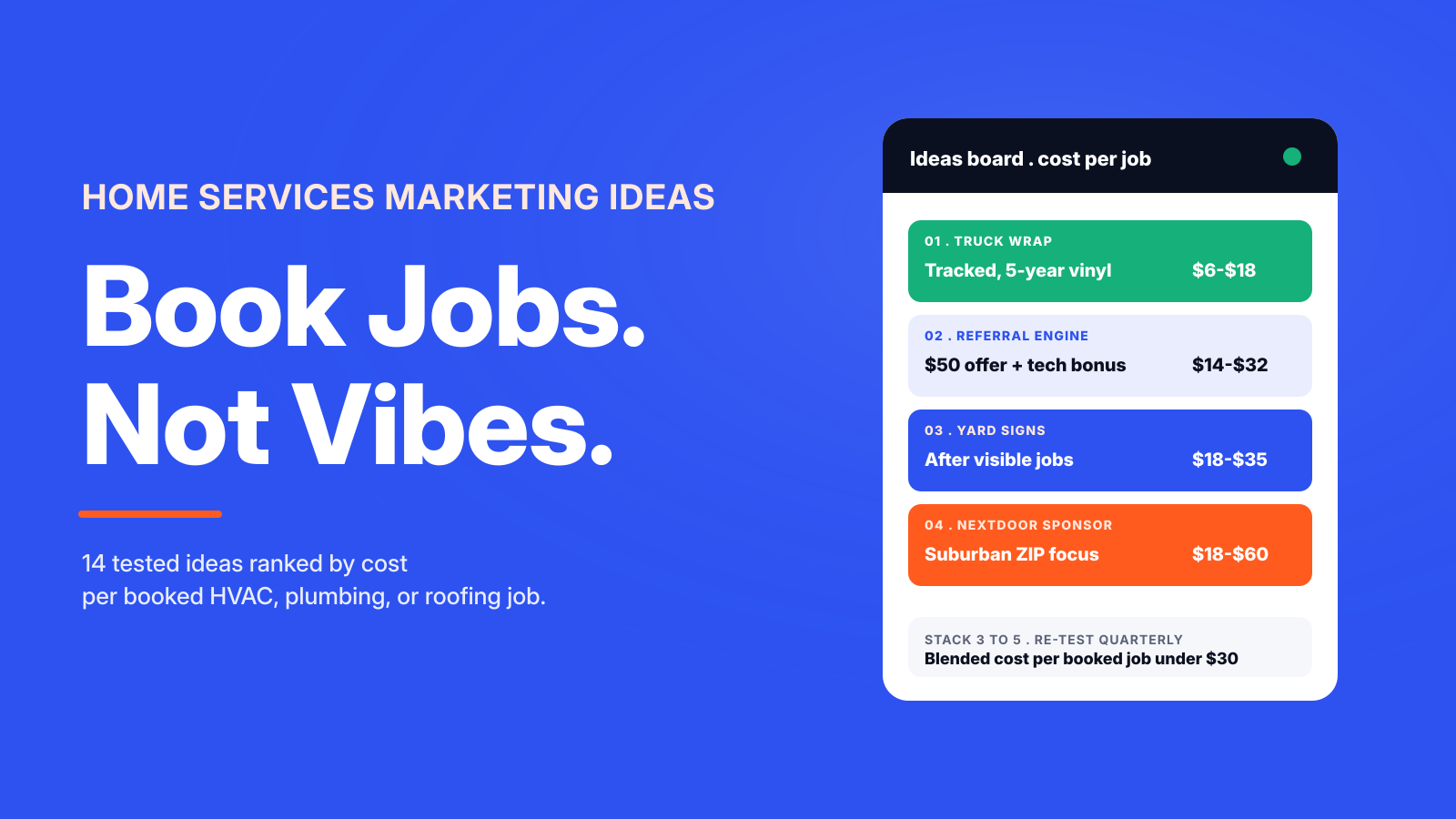
- Home services marketing ideas work in stacks of 3 to 5, not one at a time. Truck wraps tracked to a dedicated CallRail number, a referral engine paying homeowners $50 and techs $25 to $75 per completed referral, and yard signs planted after every visible job together produce 18 to 48 booked jobs a month at $14 to $35 per booked job.
- The 14 ideas in this playbook rank from cheapest to most expensive by blended cost per booked job. Truck wraps land at $6 to $18, referrals at $14 to $32, yard signs at $18 to $35, Nextdoor sponsorships at $18 to $60, and Google Ads on high-intent search at $45 to $110.
- Parker Heating and Cooling cut cost per lead from $83 to $15, an 82 percent drop, by tightening Google Ads into service-specific campaigns, adding matched landing pages, and running call-tracking pixels on every inbound call. Result: 125-plus qualified leads a month at 18x return on ad spend across a 24-month engagement.
- Run a 90-day cycle. Pick 3 to 5 ideas. Assign a tracking number to each. Report cost per booked job at the end of the quarter. Kill the two worst performers. Add two new ideas. Over 4 quarters the shop knows exactly which 4 to 6 ideas deserve permanent budget.
- Market density and demographic dictate which ideas fit. Nextdoor and yard signs win in suburban single-family neighborhoods. Direct mail EDDM wins in older-demographic high-ownership ZIPs. Google Ads and LSA work in every market with bids running 30 to 90 percent higher in top-25 metros.
Home services marketing ideas are a dime a dozen once you open a browser. Half the lists tell you to post more on Facebook. The other half tell you to buy billboards on the freeway. Neither answers the question every HVAC owner, plumber, and roofer wakes up asking on a Monday: what specific move puts three more booked jobs on the calendar by Friday. This piece walks through the 14 ideas that have moved the schedule inside real client accounts, with the dollar figure or booking gain attached to each one.
Every idea below has been run inside HVAC, plumbing, roofing, moving, or cleaning shops we work with across the US, Canada, Ireland, and the UK. None of them are theoretical. Where an idea does not fit a trade, that is called out. Where the numbers vary by metro competition, the ranges are honest.

Wrap the truck like a rolling billboard
A full vinyl wrap on a service van runs $2,800 to $4,500 and stays on the road 5 to 7 years before the vinyl fades. Divide the cost by 60 months and the truck advertises for $47 to $75 a month. A tracked wrap that ties phone calls back to visible impressions produces 4 to 11 booked jobs per month in a metro with heavy suburban routing. That works out to $6 to $18 per booked job, which is cheaper than every paid channel a home services shop runs. The wrap has to be legible at 40 feet: a huge phone number, a service list of three items, a service-area line, and the Google review star count. Skip the stock image of a smiling actor holding a wrench.
Tracking the wrap is the part most shops skip. Assign a dedicated phone number (CallRail sets one up for $30 a month) that appears only on the truck. Log every inbound call to that number as a wrap lead. After 90 days the shop has a real cost per booked job number to compare against Google Ads and LSA, instead of a vague “the trucks help.” Owners who track the wrap number typically double the vinyl budget in year two once the math shows up on paper.
Plant a yard sign on every completed job
A 24-by-18 corrugated plastic yard sign costs $8 to $14 in bulk. Every completed HVAC install, water heater swap, or roof replacement gets a sign staked at the curb for 5 to 10 days after the crew leaves. The homeowner gets a $25 credit toward next service for keeping it up. The sign carries three lines: the trade, a giant phone number, and a QR code to the booking page. In a single-family neighborhood of 200 to 400 homes, one visible sign produces 1 to 3 inbound calls from neighbors over the two weeks it stays up. At $8 per sign plus a $25 credit that most homeowners never redeem, blended cost per booked job runs $18 to $35.
Yard signs work best after high-visibility jobs. A roof replacement, a new HVAC condenser on a driveway, a shrub trim, a driveway seal-coat. They work poorly for indoor jobs no neighbor sees, like a drain cleaning or a bathroom fixture swap. Roofing shops that plant a sign on every completed job in a 6-house radius typically book 2 to 4 neighbor jobs from that same street inside 30 days. The math on the second and third job compounds fast.
Post Nextdoor recommendations without spamming the feed
Nextdoor is the most underrated channel for residential HVAC, plumbing, cleaning, and handyman work in suburban markets. The trap is treating it like Facebook. Nextdoor punishes overt sales posts with a shadow-ban that hides the post from neighborhood feeds. What works is asking every completed customer to write a real recommendation on their neighborhood feed, tagging the business. Response rate on the ask runs 4 to 9 percent, which is low, but each recommendation persists on the platform and produces 2 to 6 booked jobs over the following 12 months from neighbors who scroll it.
The paid side of Nextdoor is worth 8 to 15 percent of the marketing budget for suburban residential shops. Business Sponsorships cost $200 to $700 a month depending on ZIP density. They produce 6 to 15 booked jobs a month in the right metro, which puts blended cost per booked job at $18 to $60. Nextdoor does not work well in rural markets or dense urban ones. It works best in suburban single-family-home neighborhoods where the same 400 to 1,200 households see every post.
Shoot a 90-second tech-in-truck video every week
Every week, one of the field techs films a 90-second phone video from inside the truck showing the fix they just made. The camera stays on the tech, the tool, or the part. No editing, no music, no captions, just a real explanation of what broke and what fixed it. Post the clip to Facebook, Instagram Reels, TikTok, and Nextdoor the same day. Cost is one hour of tech time per week ($40 to $70 loaded) plus $0 in production.
Shops that keep the weekly rhythm for 6 months typically build a following of 2,000 to 8,000 local viewers and produce 3 to 9 booked jobs per month traced back to the video posts. The videos feed the site’s blog, the Google Business Profile posts, and the email list on top of the direct social reach. Never over-produce them. The value is that the tech looks like a person, not a spokesperson. Roofing and HVAC do best on this format since the fixes are visible. Cleaning and moving companies use the same format for before-and-after clips of an actual job.
Run a same-week emergency offer that carries the shoulder season
Home services demand dips in spring and fall for HVAC, summer for heating, and winter for cooling. Shoulder season is the ideal window for a same-week emergency offer that pulls forward jobs a homeowner would have delayed. The offer: any diagnostic call booked and completed inside the same calendar week gets 15 percent off the repair, capped at $150. The offer runs on Google Ads and LSA landing pages during the two shoulder months, then gets pulled during peak.
Shops that run the same-week offer during 8 shoulder weeks a year typically book 40 to 90 extra jobs across the two windows at an average discount of $85 to $120 per job. The math nets $65 to $180 in incremental margin per pulled-forward job after the discount. Roofing shops run a variant tied to the pre-storm inspection window, offering a free roof inspection for any appointment booked before the March 15 storm season kicks off. Same shape, different trigger.
Launch a Google Screened profile alongside LSA
Google Screened is the sibling product to Local Services Ads for professional services like electricians and pest control, and it applies to home services in most markets too. The Google Guaranteed badge on the LSA listing costs the shop $0 extra beyond the LSA lead fee. What it adds is a background check on every listed employee that turns into a green shield next to the business name. Click-through rate on shielded LSA listings runs 22 to 41 percent higher than un-shielded ones for the same query.
Getting the shield takes 3 to 6 weeks: proof of license, general liability insurance, and background checks on every employee listed in the profile. For a 4-person shop the paperwork is a Saturday afternoon. For a 40-person shop the paperwork is a 2-week project. Roofing and moving shops need bond documentation on top, which stretches the timeline to 6 to 10 weeks. The click-through gain is worth every day of it. Our home services PPC team runs the shield application inside every new LSA account setup.
Send a $2 direct mail card with a QR code to booking
Direct mail is dead in most industries. It is alive and profitable in home services. A postcard (6-by-11 EDDM format) costs $0.42 to print and $0.42 to mail through USPS Every Door Direct Mail, all-in $0.84 per household. Send 4,000 postcards to two adjacent ZIP codes in the shoulder season for $3,360 total. The postcard carries a QR code to a same-week booking page, a trade-specific offer (spring AC tune-up for $89, or fall furnace inspection for $79), and a giant phone number.
Response rate on a well-targeted EDDM run is 0.8 to 2.4 percent, which produces 32 to 96 inbound calls from a 4,000-piece send. Close rate on those calls runs 55 to 75 percent since the offer is trade-specific and the homeowner already picked up the phone. Blended cost per booked job runs $35 to $105 depending on trade and metro. That is competitive with Google Ads and beats Facebook by a factor of 3 to 6 for older homeowners in single-family neighborhoods. The channel does not scale infinitely, but for a shop with a 15-mile service radius, direct mail pulls consistent volume that paid digital cannot replicate.
Stack marketing ideas by cost per booked job
The 14 ideas in this playbook do not all cost the same or produce the same volume. The table below ranks the most-used ones by blended cost per booked job for a typical single-shop HVAC or plumbing operation in a mid-sized US metro. Ranges reflect the honest variance across trades and cities.
| Marketing idea | Setup cost | Ongoing monthly | Booked jobs / month | Cost per booked job |
|---|---|---|---|---|
| Referral engine (homeowner + tech bonus) | $0 | $400 to $900 | 10 to 28 | $14 to $32 |
| Yard signs after visible jobs | $140 for 20 signs | $120 to $260 | 4 to 9 | $18 to $35 |
| Truck wrap (per truck, tracked) | $3,200 | $47 amortized + $30 tracking | 4 to 11 | $6 to $18 |
| Tech-in-truck weekly video | $0 | $180 to $320 | 3 to 9 | $20 to $95 |
| Nextdoor Business Sponsorship | $0 | $200 to $700 | 6 to 15 | $18 to $60 |
| Same-week emergency offer | $0 | $85 to $120 avg discount | 5 to 12 shoulder weeks | $25 to $70 |
| Direct mail EDDM (4,000 pieces) | $3,360 per send | 2 to 3 sends a year | 18 to 42 per send | $35 to $105 |
| Google Local Services Ads | $0 (verification) | Variable, per lead | 25 to 80 | $32 to $85 |
| Google Ads on high-intent search | $0 | $1,800 to $6,500 | 18 to 60 | $45 to $110 |
| Facebook + Instagram retargeting | $0 | $400 to $1,200 | 3 to 8 | $85 to $210 |
Sponsor a youth sports team the shop actually watches
A single-team youth soccer or Little League sponsorship costs $500 to $1,800 a season for a jersey logo, a banner at the field, and a mention in the season program. Direct return on the sponsorship is low in the first year: maybe 2 to 5 booked jobs traced back to the banner. Community trust return is high in year three. A shop that sponsors the same team for 4 seasons gets recognized at the grocery store, gets referred inside the parents’ Facebook group, and gets a 3 to 8 percent gain in unaided brand recall inside the ZIP code.
Sponsorship works for shops that stay in one market for 10-plus years. It does not work for shops that plan to sell or move in 24 months. Pick a team the owner or a tech’s kid actually plays on. Show up to games. Wear the shirt. The sponsorship is real when the shop is present, not when the check clears.
Answer every review inside 48 hours with a real reply
Every Google review, positive or negative, gets a hand-typed reply from the owner or the office manager inside 48 hours. Not a canned template. A real reply that names the tech, references the specific job, and thanks the homeowner. Google reads reply velocity as a ranking signal for the map pack. Shops that reply to 95 percent of reviews within 48 hours outrank shops that reply to 40 percent, holding review count and rating equal.
Negative reviews get a longer reply that acknowledges the complaint, offers a phone number to fix it, and never argues in public. Homeowners scrolling reviews read the response as much as the original complaint. A shop with 12 negative reviews all replied to professionally reads better than a shop with 2 negative reviews left unanswered. Our home services SEO team runs a monthly review-response audit inside every retainer account.
Add financing to every quote over $2,500
Every quote for a job over $2,500 gets a monthly-payment line printed next to the total. A $9,000 heat pump reads as “$9,000 total, or $139 a month for 84 months at 9.9 percent APR through Wisetack.” Close rate on the same job jumps from 22 to 34 percent (up-front only) to 46 to 61 percent (payment shown). The marketing move is the payment appearing on the ad, the landing page, and the quote at the same time.
Wisetack, GreenSky, and Synchrony are the three financing partners home services shops standardize on. Wisetack is the easiest integration since ServiceTitan, Housecall Pro, and Jobber all have native connectors. GreenSky handles 84 to 120-month terms for large jobs. Synchrony is the legacy standard tied to manufacturer programs (Carrier, Trane, Lennox). The paperwork on the shop side is a merchant application, a bank account for payouts, and a compliance disclosure printed on every quote. Setup takes 5 to 12 business days.
Run a $50 first-service coupon in the local family calendar
Every metro has a print or digital family calendar (Macaroni Kid, the local community magazine, the school district newsletter) that sells full-page ads for $200 to $700 a month. Buy the back page. Print a $50 coupon toward first service with a redemption code the CRM can track. The coupon runs 12 months. Response rate is low (0.4 to 1.1 percent) but the homeowner who clips a $50 coupon is a self-selected buyer and closes at 55 to 70 percent. Blended cost per booked job runs $60 to $140. Not the cheapest channel, but the audience is a school-district homeowner who owns a house and will need HVAC service for 20 years.
Digital family calendars (Macaroni Kid email newsletter, local Patch) work the same shape at lower volume. Cost per placement runs $150 to $400 a month, response rate 0.3 to 0.8 percent, and the retention side pays back. Track the coupon code so the shop knows the channel is producing, and rotate the offer twice a year to keep the code from going stale.
How Parker Heating and Cooling cut cost per lead from $83 to $15
The best working example of the paid-side ideas on this list running together is Parker Heating and Cooling, a family-owned HVAC company in Colorado. Before the rebuild, Parker was paying $83 per lead through self-managed Google Ads with no structure, no landing page match, and no keyword targeting. Referrals kept the trucks moving, but scaling the crew meant scaling paid volume, and paid volume at $83 a lead was underwater on every install ticket under $6,500.
The engagement ran 24 months. Google Ads got restructured from scratch into service-specific campaigns (furnace repair, AC install, water heater swap, heat pump replacement), each with a matched landing page carrying the offer, the trust signals, and a click-to-call number in the mobile header. Keywords got tightened to high-intent local terms with negatives filtering out DIY searchers, real-estate agents, and out-of-service-area clicks. Call tracking pixels tied every inbound call back to the ad group and keyword that produced it, so the shop could kill the losers and double the winners on a weekly cadence.
Cost per lead moved from $83 to $15, an 82 percent drop. Monthly qualified leads scaled from under 25 to 125-plus. Return on ad spend hit 18x, or $18 back for every $1 spent, verified against tracked closed revenue on install jobs. The same paid-plus-tracking discipline produced parallel results for Gwinnett Area Plumbers, a Gwinnett County plumbing shop that ran a fresh PPC build with service-segmented ad groups, appointment-focused landing pages, and full call tracking. Result: 141 new qualified leads in 4 months, 968 targeted ad clicks, and a 14.6 percent conversion rate on the landing pages.
Pick 3 to 5 ideas and stack them for 90 days
The 14 ideas above do not all need to run at once. Most single-shop operations that grow past 100 booked jobs a month run 3 to 5 of them in parallel: the paid stack (LSA + Google Ads), a review engine, a referral engine, and one field-visible idea (truck wrap or yard signs). Everything else is a layer added once the first four are stable. Running 10 ideas half-heartedly produces worse results than running 4 ideas hard.
The 90-day cycle is the working cadence. Pick 3 to 5 ideas at the start of a quarter. Assign a tracking number to each. Report the cost per booked job for each at the end of the 90 days. Kill the two worst performers. Add two new ideas. Repeat. Over 4 quarters the shop has run 12 to 20 ideas and knows exactly which 4 to 6 deserve permanent budget. That is how a $22 blended cost per booked job gets built, one 90-day test at a time. For a deeper look at the seasonal budget shifts that plug into this cycle, see the home services marketing playbook or the earlier piece on digital marketing for home services.
Frequently asked questions about home services marketing ideas
What are the best home services marketing ideas for a small shop with a tight budget?
The cheapest home services marketing ideas that consistently produce booked jobs are a referral engine paying homeowners $50 and technicians $25 to $75 per completed referral, yard signs planted on every visible completed job, and truck wraps tracked to a dedicated CallRail number. All three run at a blended cost per booked job of $14 to $35, which is 3 to 6 times cheaper than paid channels. Together they typically produce 18 to 48 booked jobs a month for a single-shop operation without a Google Ads budget.
A shop under $500,000 in annual revenue can run those three plus a fully optimized Google Business Profile and a review request text after every completed job. That five-idea stack costs under $600 a month in tools plus the referral offers, and it books 30 to 70 jobs a month once the review base crosses 60 to 100 five-star reviews.
How do home services marketing ideas compare to just running Google Ads?
Google Ads is one of 14 home services marketing ideas, not the only one worth running. Ads produce 18 to 60 booked jobs a month at $45 to $110 per booked job for a well-tuned single-shop account. Referrals produce 10 to 28 booked jobs at $14 to $32. Nextdoor sponsorships produce 6 to 15 at $18 to $60. Truck wraps produce 4 to 11 at $6 to $18. A shop that runs only Google Ads pays 2 to 5 times more per booked job than a shop that stacks 4 to 5 ideas.
The right way to think about it is the marketing stack, not the single channel. Google Ads is a floor of consistent volume. The other 13 ideas layer on top to drop the blended cost per booked job. Parker Heating and Cooling cut cost per lead from $83 to $15 by tightening Google Ads plus adding landing page conversion work and call tracking. That is three ideas stacked, not one channel optimized.
Which home services marketing ideas work best for roofing companies?
Roofing benefits most from four ideas working together: yard signs planted after every visible roof replacement, Google Ads tied to storm-response landing pages with a same-week free-inspection offer, Google Local Services Ads with the Google Guaranteed shield, and door-to-door canvassing after a hail event. Roofing is the trade where a single storm day produces a full month of inspection appointments, so the standby budget matters more than the flat monthly plan.
HP Roofing in Dublin ran a variant of this stack (positioning, SEO, GMB, Google Ads, and lead tracking) and won a €120,000 commercial project in the first week of their new site going live, followed by 20 to 30 monthly leads and 10x return on marketing spend. The roofing side of the playbook rewards fast response to weather events and slow compounding on local SEO in the storm-adjacent months.
How long do home services marketing ideas take to produce booked jobs?
Paid ideas (Google Ads, LSA, Nextdoor sponsorships, direct mail) produce booked jobs inside 7 to 30 days of launch. Field-visible ideas (truck wraps, yard signs) produce inbound calls inside 30 to 60 days as neighbors start noticing the vehicles and signs. Reputation ideas (review engine, Nextdoor recommendations, review reply cadence) compound over 3 to 9 months and produce a steady base of inbound calls after that. Community ideas (youth sports sponsorships, local calendar coupons) take 12 to 24 months to produce measurable return.
The mix is the point. A shop running only fast-return ideas burns cash on rising ad costs. A shop running only slow-compounding ideas starves for jobs in the first 6 months. The 3-to-5-ideas-per-quarter cycle keeps both timelines running at once, so the compounding ideas start paying back around the time the paid ideas plateau.
Do home services marketing ideas work the same in urban and rural markets?
No. Nextdoor works well in suburban single-family neighborhoods and poorly in dense urban or rural markets. Direct mail EDDM works well in older-demographic ZIPs with high home ownership and poorly in transient renter neighborhoods. Google Ads works everywhere but bids run 30 to 90 percent higher in top-25 metros than in mid-sized markets. Referrals work in every market once the base of completed jobs crosses 200 to 400 per year. Yard signs work in single-family neighborhoods and poorly in apartment corridors.
Rural shops (service area over 25 miles) lean heavier on Google Ads, radio, and direct mail since the density does not support Nextdoor or yard-sign visibility. Urban shops in Chicago, Boston, or Brooklyn lean heavier on Google Ads, LSA, and review velocity since the map pack is the primary discovery surface. Suburban shops run every idea on this list. Pick the ideas that match the density and demographic of the service area, and drop the ones that do not.
See the full stack of 14 home services marketing ideas running inside HVAC, plumbing, roofing, moving, and cleaning accounts at home services marketing, or start with the home services marketing retainer that bundles the paid, SEO, web, and tracking sides under one monthly plan starting at $599 a month.
Book your free 30-minute strategy call.
No spam, no sales rep. We use your email to schedule your call with a senior strategist. That is it.
More from the blog
View all articles → Marketing Strategy
 How Dental DSOs Grow Through Marketing. Tactics That Scale
Read article Marketing Strategy
 Dental DSO Marketing Services. What to Expect From an Agency Partner
Read article Marketing Strategy