
How to Market a Med Spa. Proven Tactics That Work
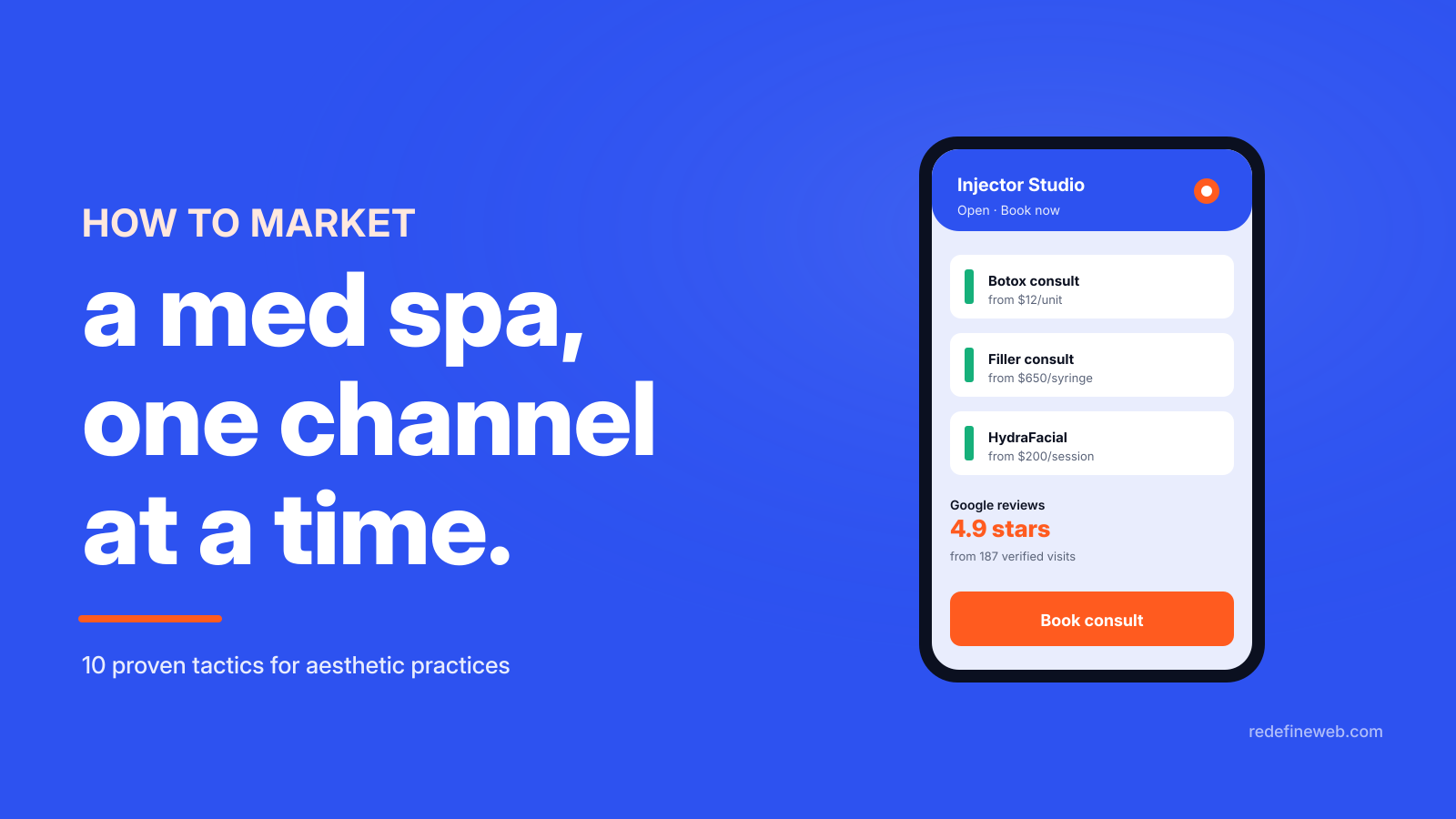
- The first move to market a med spa is fixing the Google Business Profile: primary category set to Medical spa, treatments listed the way patients search, weekly Posts, and a review flow through the booking app.
- Rebuild the site around three or four hero treatments (Botox, filler, laser, HydraFacial, CoolSculpting), each with its own page carrying transparent pricing above the fold.
- Google Ads on treatment-plus-city terms convert 3 to 5 times better than practice-brand or generic near-me terms when the landing page matches the ad copy exactly.
- SMS reminders and rebook links tied to Boulevard, Vagaro, or Zenoti are the highest-ROI channel for a mature practice because the infrastructure already exists.
- Measure every channel against booked, completed treatments and revenue, not consult requests or clicks.
How to Market a Med Spa. Proven Tactics That Work
If you own a med spa and you’re asking “how do I actually get more patients?”, this guide is for you. Not strategy theory. Not channel overviews. A concrete, step-by-step process for building a marketing system that generates patient bookings consistently. Each step is ordered by priority, starting with the foundation and building toward advanced patient acquisition.
Step 1. Get Your Digital Foundation Right
Before spending on advertising, your website needs to meet a baseline standard. Sending paid traffic to a slow, confusing, or outdated website wastes your entire ad budget. Every potential patient who clicks an ad and bounces because your site takes 8 seconds to load is a lost booking you paid for.
Your med spa website needs to load in under 3 seconds on mobile (the majority of your traffic comes from phones). It needs a prominent before/after gallery showing real patient results for your core treatments. Provider credentials should be visible on the homepage and on treatment pages. The booking or consultation request button needs to be obvious, not buried. The site should be mobile-first in its design, meaning it was built for small screens first.
If your site doesn’t meet these standards, fix it before running any advertising. A $500/month website improvement investment that improves conversion rates by 20% does more for patient acquisition than adding $2,000/month to your ad budget on a broken funnel.
For med spa website standards and what separates high-converting sites from low-converting ones, our med spa web design guide covers the specific elements that drive consultation requests.
Step 2. Claim and Fully Optimize Your Google Business Profile
Your Google Business Profile is free and has the highest local visibility return of any single digital asset you can optimize. When a patient searches “Botox near me” or “laser hair removal [your city],” the results they see first are a map with three local listings. That map comes from Google Business Profile. If your profile is incomplete, unclaimed, or poorly configured, you’re invisible to patients at their highest point of purchase intent.
Complete optimization means: verify your listing, set your primary category to “Medical Spa” (not a generic healthcare category), add all the treatments you offer as services with descriptions, upload at least 20 photos including your interior, your team, and before/after results (with patient consent), fill in every available attribute. The attributes section includes things like “accepts new patients,” “appointment required,” and “online appointments available.” Fill all of them.
Post to your GBP regularly, at least twice per month. Respond to every review, positive and negative. Use the Q&A section to proactively answer the most common patient questions about your practice. A fully optimized GBP outranks a half-completed one even when the half-completed practice is physically closer to the searcher.
Step 3. Build Your Review Base Before Heavy Advertising
Aim for 50 or more Google reviews before investing heavily in paid advertising. Here’s the math: you spend $2,000 on Google Ads, drive 300 visitors to your website, and 15 of them click through to your GBP to check your reviews before booking. Your GBP shows 8 reviews. Seven of those 15 potential patients decide to look at the competing practice with 90 reviews. You’ve effectively paid to send patients to your competitor.
Review count matters because patients booking aesthetic procedures treat it as a proxy for experience and trust. A brand-new injector with 8 reviews looks less established than an injector with 80 reviews, regardless of actual skill. Build the review count first by making review requests a standard part of every checkout.
At checkout: “If you enjoyed your visit today, we’d really appreciate a Google review. It only takes a minute and helps other patients find us.” Send a follow-up text or email with a direct link to your Google review page within 24 hours of the appointment. The response rate on a timely, specific review request with a direct link is significantly higher than a general “please leave us a review” at the end of a monthly email newsletter.
Step 4. Set Up Treatment Recall Emails
Your most valuable patients are the ones you already have. Most med spas focus so much energy on new patient acquisition that they under-manage the patients they’ve already spent money to acquire. Treatment recall emails solve this by automatically prompting patients to rebook when their treatment is ready for maintenance.
Set up automated emails for every core treatment based on its typical maintenance schedule. Botox: send at 10-12 weeks post-treatment. Lip filler: send at 5-6 months. Chemical peels: send at 4-6 weeks depending on the peel type. Body contouring: send 4-6 weeks after their last session to discuss maintenance or next steps. The email doesn’t need to be elaborate. A clean, direct message with the patient’s first name, the specific treatment they had, and a booking link is all it takes.
A med spa with 500 active patients, a recall email system, and a 25% open rate on recall messages generates approximately 125 potential re-booking touchpoints per campaign cycle. At a conservative 30% conversion rate, that’s 37 appointments generated per cycle from emails alone, at near-zero cost per booking compared to paid advertising. This is typically the highest-ROI marketing investment an established med spa can make.
Step 5. Launch Google Ads for Your Top Treatments
With your foundation set (website, GBP, reviews, recall emails), Google Ads generates immediate new patient pipeline. Identify your top 2-3 treatments by margin and by local search demand. These are the treatments you want Google Ads running for first.
Set up separate campaigns for each treatment. Use exact-match keywords targeting appointment-intent searches (“Botox [your city]”, “lip filler consultation [your city]”). Write ad copy that’s specific to the treatment, mentions your practice location, and includes a clear call to action. Send every ad click to a dedicated landing page built around that treatment, not your homepage. A patient who clicks an ad for lip filler and lands on your homepage has to navigate to find the relevant information. Most won’t. They’ll bounce.
Set up call tracking so you can attribute phone-based bookings to specific campaigns. Without call tracking, you’re missing most of your PPC conversions. Many med spa patients still prefer to book over the phone after clicking an ad. A tracking number tied to each campaign shows you exactly how many phone bookings each dollar of ad spend generates.
Step 6. Publish One Treatment Guide per Month
Content marketing builds the organic patient pipeline that reduces your long-term dependence on paid ads. One comprehensive treatment guide per month is a sustainable pace that generates compounding search traffic over time.
Pick the treatment patients ask the most questions about or search for most frequently in your market. Write a guide that covers: what the treatment is, who it’s right for, what happens during the procedure, what results look like and how long they last, cost range, how to prepare, and what recovery involves. Include real before/after images from your practice. Answer the specific questions patients type into Google, because those questions are the exact keyword phrases the guide will rank for.
A well-written 1,500 to 2,000 word treatment guide can rank on the first page of Google within 3 to 6 months for long-tail search queries with real patient intent. Twelve guides over a year build a content asset base that generates organic traffic indefinitely. The first guide you publish today will still be generating bookings two years from now.
For the SEO mechanics behind how these guides rank, our med spa SEO guide covers keyword strategy, on-page optimization, and what actually moves your organic rankings.
Step 7. Plan Seasonal Promotions in Advance
Med spas have predictable high-intent seasons. January is the biggest (new year aesthetics resolutions). Valentine’s Day drives lip filler, skincare, and pampering-adjacent treatments. Mother’s Day drives gifting and self-care bookings. Summer drives body treatments, hair removal, and sweat-reduction treatments. December holidays drive gift cards and last-minute aesthetics appointments before family gatherings.
Each season should have a coordinated campaign: a specific offer tied to the season (not a generic discount, but a seasonally relevant treatment or bundle), an email campaign to your patient list, a social media series, and a temporary Google Ads budget increase. Plan these campaigns at least 6 weeks in advance so the creative is ready, the landing page is built, and the email sequence is written before the season starts.
Practices that plan seasonal campaigns in advance consistently outperform practices that run ad-hoc promotions reactively. Reactive promotions are created in a rush, go out late, and miss the peak decision window. A January campaign launched on December 28th catches patients making decisions before they’ve already booked with someone else. The same campaign launched January 10th catches the stragglers.
Step 8. Measure and Optimize Consistently
Marketing without measurement is guessing. Set up the tracking infrastructure to know what’s working before you spend more money. Google Analytics 4 with appointment form conversion tracking shows you which channels drive actual consultation requests, not just traffic. Call tracking software (CallRail, WhatConverts, or similar) attributes phone bookings to specific campaigns. Google Business Profile Insights shows you how many patients found your practice through local search and what actions they took.
Check these numbers monthly. Ask three questions: which channel generated the most booked appointments last month? Which channel had the lowest cost per booked appointment? Which channel underperformed relative to its budget? Shift budget toward what’s working. Cut or restructure what isn’t. Marketing optimization is an ongoing process, not a one-time setup.
The key metric to track isn’t impressions, clicks, or even website visitors. It’s booked appointments per channel. Everything else is a proxy. Connect your marketing tracking to your patient management system so you can verify that the booked appointments attributed to marketing actually showed up. No-show rate varies by channel and matters for true cost-per-acquisition calculations.
What to Prioritize If Your Budget Is Limited
If you can’t run all 8 steps simultaneously, start with steps 1 through 4. These four steps cost time more than money and produce compounding returns.
A fast, well-designed website (step 1) improves the conversion rate of every other channel. A fully optimized GBP (step 2) is free and generates local search visibility with no ongoing ad spend. Reviews (step 3) build the trust that converts traffic into consultations. Recall emails (step 4) generate bookings from patients you already have, at near-zero cost per booking.
Once these foundations are in place, add Google Ads (step 5) to accelerate new patient acquisition. Add content marketing (step 6) to build long-term organic traffic. Then layer in seasonal promotions (step 7) and full measurement infrastructure (step 8) as the program matures.
This sequencing matters. A practice that skips the foundation and goes straight to paid advertising gets expensive lessons in conversion rate optimization. A practice that builds the foundation first gets more from every subsequent investment.
For a complete view of what a structured marketing program looks like across all these steps, our med spa marketing plan guide walks through how to build the full program and prioritize by growth stage.
How Redefine Web Helps Med Spas Get More Patients
At Redefine Web, we build med spa marketing programs around what actually generates patient bookings, not what generates the most impressive-looking monthly reports. We start with where your practice is today: current website performance, GBP status, review count, existing traffic, and what’s already converting. Then we build the program from the foundation up, prioritizing the steps that produce the fastest return given your specific baseline.
We work with med spas across practice sizes and growth stages. Whether you’re a new practice building from zero or an established practice that’s hit a growth plateau, the approach is diagnostic first, executional second. We identify the gaps, build the plan, and run the program. You focus on delivering exceptional patient results. We focus on putting more patients in front of you.
Frequently Asked Questions About Marketing a Med Spa
Book your free 30-minute strategy call.
No spam, no sales rep. We use your email to schedule your call with a senior strategist. That is it.
More from the blog
View all articles → Marketing Strategy
 How Dental DSOs Grow Through Marketing. Tactics That Scale
Read article Marketing Strategy
 Dental DSO Marketing Services. What to Expect From an Agency Partner
Read article Marketing Strategy