
Improve Lead Quality Dental Marketing Programs Produce
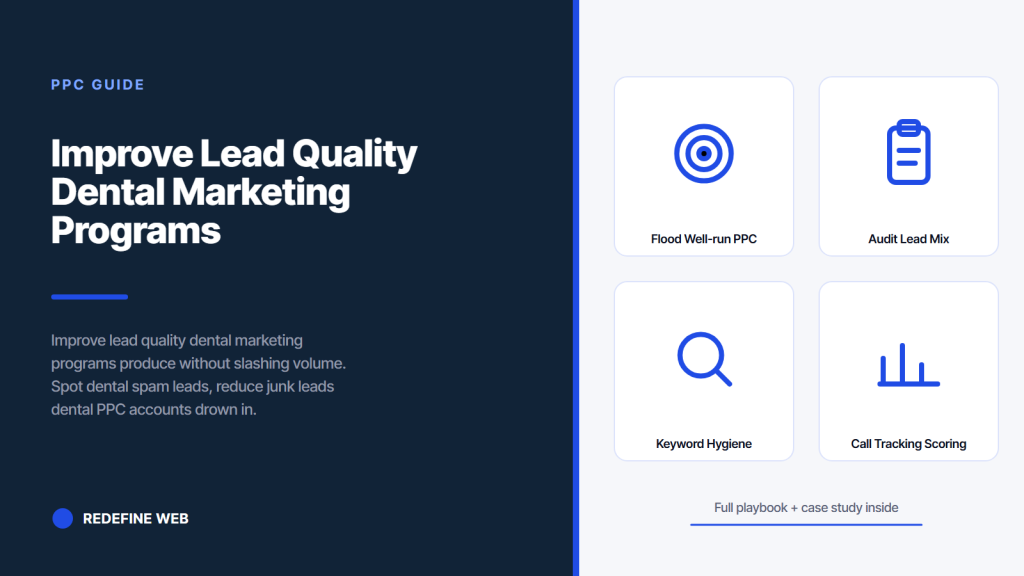
- Push booked patients back to Google and Meta, not form fills.
- Meta review step drops junk by 60 to 80 percent, worth the volume trade.
- One campaign per service line, always, before any bidding tune.
- Front desk tags every call with a five-tag rubric or the data lies.
- Weekly negative keyword sweep prevents 90-day quality drift.
- Why dental spam leads flood a well-run PPC account
- Audit lead mix to improve lead quality dental marketing baselines
- Keyword hygiene and matching search intent to service line
- Call tracking, scoring, and the disposition workflow front desks actually use
- How Smile Design Dentistry improved lead quality across 50 offices
- Budget shifts and quality benchmarks to expect
- Running the quality program as a retainer versus in-house
- Common pitfalls that quietly kill your quality gains
- Putting it all together to improve lead quality dental marketing produces
You cannot improve lead quality dental marketing programs produce by piling more filters at the top of the funnel. You improve it by teaching the ad platforms which patients are worth chair time and which are wasting the front desk. This guide covers the exact audit that separates dental spam leads from qualified consults, the negative keyword lists that stop reducing junk leads dental PPC accounts drown in, and the offline conversion loop that gets Google and Meta bidding toward booked patients instead of raw form fills. Every example runs from real dental client work, and the numbers are pulled from patient rosters, not vanity dashboards.
Smile Design Dentistry, a 50-plus location DSO on our roster, cut cost per call by 30 percent and grew PPC conversion rate by 20 percent after we rebuilt the quality layer across their network. The volume did not collapse. The junk did. That is the honest goal of every fix in this playbook, and it is the frame every section below returns to.
Why dental spam leads flood a well-run PPC account
Dental spam leads flood a well-run PPC account because the account is doing exactly what you told it to do, which is bid on cheap conversions. If a conversion is a form fill, the platform will find the cheapest form fillers on the internet. Almost none will book an implant.
Every Smart Bidding strategy chases the definition of conversion you handed it during setup. Some responders will be bots. Most will be lead-gen aggregators, price shoppers, and people confused about which practice they contacted. Google’s official Smart Bidding documentation is explicit about this: the algorithm optimizes toward the conversion action you name and nothing else.
The pattern is worst on Meta lead forms because the pre-filled fields ask nothing of the visitor. A tap and a slide and the lead is submitted. Google Search stays cleaner because the query itself filters intent, but broad match plus Performance Max plus a form-fill conversion action reproduces the same pattern in three months if you leave it alone. You are not fighting bad luck. You are fighting an incentive structure that rewards volume over outcome. Fix the incentive and the quality follows.
The three sources of junk in a dental funnel
- Bots and automated form fillers hitting exposed forms without honeypots
- Real humans with no intent to book (price shoppers, contest hunters, competitor snooping)
- Real prospects who called the wrong practice because your ad copy did not qualify them
You handle each source with a different tool. Bots die on hCaptcha or Cloudflare Turnstile plus a honeypot field. Real-human low-intent gets filtered with disqualifying copy on the ad and the landing page. Wrong-practice callers get filtered with a call-tracking disposition rubric that the front desk actually uses. Skip any of these and one bucket keeps quietly filling your CRM with junk.
Audit lead mix to improve lead quality dental marketing baselines
You cannot fix what you have not measured. The audit takes an afternoon and produces the baseline every downstream decision depends on. Pull the last 90 days of leads from every source: Google Ads, Meta Ads, organic forms, GBP calls, and email. Score each one against a five-tag rubric and see what percentage of your reported leads actually books a first visit. This is the first move to improve lead quality dental marketing dashboards claim to already deliver.
The five-tag disposition rubric
- Booked New Patient: called or filled, scheduled, appointment held
- Qualified No-Book: real prospect, right service, chose not to schedule
- Unqualified: wrong service, out of area, existing patient
- Spam: bot, obvious junk, empty form
- Duplicate: same person, second lead within 30 days
Most audited dental accounts show a ratio around 20 to 30 percent Booked New Patient, 15 to 20 percent Qualified No-Book, 20 to 30 percent Unqualified, 10 to 25 percent Spam, and 5 to 10 percent Duplicate. If your booked-patient share is under 15 percent, the platform is optimizing toward the wrong signal. If your spam share is over 30 percent, your forms are unprotected. Either way the fix belongs in the campaign, not in a front-desk playbook.
Do the audit yourself in a spreadsheet or ask your agency to send you the raw disposition log for the last 90 days. Practices that outsource this step to a monthly report tend to get sanitized numbers. Raw logs tell the truth. Ask for the raw log every quarter and you will spot the drift patterns weeks before they show up in dashboards. That habit alone changes the tone of every marketing conversation with leadership.
Keyword hygiene and matching search intent to service line
Bad keyword-to-service alignment is the second-largest source of dental spam leads on Google Search. A campaign bidding on cheap dental cleaning and landing traffic on an implant page will produce lots of calls and few implants. The fix is separating keywords by service line and building landing pages that match the exact intent the keyword implies. The dental google ads keywords guide covers the starter list and the negatives that pair with each service line.
One campaign per service line, always
Implants, Invisalign, veneers, general cleaning, emergency, and pediatric each deserve their own campaign. The bids are different. The audiences are different. The landing pages are different. The negative keyword lists are different. Practices running one blended campaign for everything are handing every service line the average CPC of the lowest-value one. You will pay implant-visit prices for cleaning-visit outcomes. Split the campaigns before you tune anything else.
Match landing page to campaign to keyword
Every campaign points to a landing page written for that service. Every ad group inside the campaign points to a variant of that page speaking to the exact keyword theme. Message match is not decorative. It is the mechanism that raises Quality Score, drops CPC, and pushes booked-patient rate. Practices that skip message match pay more per click and convert fewer of those clicks. The dental ppc landing pages playbook covers the layout patterns.
The account bids on whatever you told it a conversion is. Swap the conversion action from form fill to booked appointment and junk drops 40 percent in 3 weeks.
Call tracking, scoring, and the disposition workflow front desks actually use
Call quality is where every quality program lives or dies. A dental practice runs on the phone. If the front desk is not tagging every call with a disposition, the marketing team is blind to which channel is booking patients. That blindness is the reason so many dental accounts spend six figures a year without moving the needle on lead quality. Fix the tagging and everything else in this guide compounds. Skip it and everything else is theoretical.
Making tagging effortless for the front desk
Front desks do not have time for a 12-field disposition form. They have time for 5 buttons. That is why the five-tag rubric earlier in this guide works. Print it on a card and tape it to the monitor. Add auto-tagging on top through CallRail Conversation Intelligence or an equivalent, so 80 percent of calls are pre-tagged by the LLM and the front desk only corrects the edge cases. Ten minutes per day per office keeps the data clean. The call tracking for dentists guide covers the platform setup end to end.
Push tagged calls back into the ad platforms
Tagged calls that stay in CallRail are half the fix. Tagged calls that flow back into Google Ads and Meta as offline conversion events are the whole fix. Every reputable call-tracking platform ships this integration. Turn it on. Set the Booked New Patient tag to fire as the primary conversion action. Watch Smart Bidding start optimizing away from campaigns that produce lots of Unqualified calls toward campaigns that produce actual patients. That shift is the whole point of the tracking stack. Search Engine Journal’s PPC coverage documents this workflow across many verticals.
How Smile Design Dentistry improved lead quality across 50 offices
Smile Design Dentistry improved lead quality across 50 offices by running this exact six-week rebuild: audit, negative keywords, Meta form fixes, offline conversions, front-desk training, and a new leadership dashboard. Ninety days later, PPC conversion rate climbed 20 percent and cost per call dropped 30 percent.
The DSO came to us in 2022 with a broken tracking layer and a lead report leadership had stopped trusting. Cost per call looked reasonable at $110 blended, but the front desk was reporting new-patient booking rates under 20 percent. The gap between the marketing dashboard and the chair count was killing the CFO’s willingness to fund growth. We ran the exact playbook in this guide to improve lead quality dental marketing dollars were producing across the group.
The rebuild in six weeks
- Week 1: Audit of every campaign, tracking layer, and form across 50 offices
- Week 2: Negative keyword rebuild and match-type discipline installed at account level
- Week 3: Meta lead forms rebuilt with review step and qualifying questions
- Week 4: Offline conversion loop wired from Dentrix and Open Dental into Google and Meta
- Week 5: Front-desk training on the five-tag rubric across all 50 offices
- Week 6: New reporting dashboard rolled up to leadership, one number per office
Results at 90 days: PPC conversion rate up 20 percent, cost per call down 30 percent, and (the number leadership cared about) Booked New Patient share of tagged calls climbed from 22 percent to 41 percent. The volume of leads dropped by roughly 25 percent. The number of actual patients climbed by 55 percent. The dental marketing agency hub links out to the full write-up on our case studies page.
Budget shifts and quality benchmarks to expect
A quality rebuild changes what your dashboard shows. Expect volume to drop 15 to 30 percent in the first 60 days. Expect Booked New Patient rate to climb 40 to 100 percent. Expect blended cost per new patient to drop 25 to 45 percent. If none of these move, one of the fixes was skipped or half-installed. Audit which step was skipped and rerun it. The pattern is consistent across every practice we have taken through this workflow.
Benchmark table for common service lines
| Service line | Cost per call (target) | Booked share (target) | Cost per booked patient (target) |
|---|---|---|---|
| General cleaning / new patient | $40 to $70 | 35 to 50 percent | $120 to $200 |
| Emergency dental | $25 to $50 | 50 to 70 percent | $50 to $100 |
| Invisalign / clear aligners | $80 to $150 | 15 to 25 percent | $400 to $800 |
| Dental implants | $120 to $250 | 10 to 20 percent | $800 to $1,500 |
| Cosmetic / veneers | $100 to $200 | 12 to 20 percent | $700 to $1,200 |
Practices consistently outside these benchmarks have a quality problem, a tracking problem, or both. Practices consistently inside the benchmarks have both fixed. Where a practice lands on this table is a better health check than any vanity metric. Track it monthly, per campaign, per office, and adjust budget toward the campaigns that hit the targets. The dental marketing roi guide covers how these numbers roll up to a return calculation leadership actually reads.
Benchmarks shift with market. Manhattan dental implants cost more per lead than Tulsa dental implants because the auction is different. Adjust for local CPC baselines before you declare a campaign broken. A campaign at $180 cost per call in a competitive market may be doing better than a campaign at $80 in a low-cost market if the booked share is higher. That nuance is why raw cost per call, without a booked-share number attached, is a misleading metric.
Running the quality program as a retainer versus in-house
The initial rebuild takes 40 to 100 hours depending on practice size. The ongoing maintenance takes 6 to 12 hours per month per office. Practices with a marketing lead can run it in-house after we do the rebuild. Groups with 10 or more offices almost always outsource the maintenance because the coordination cost across offices exceeds the platform cost. Neither answer is wrong. Both beat leaving the quality problem alone.
What monthly maintenance looks like
Weekly negative keyword sweep. Monthly Meta form audit for qualifying questions and review-step compliance. Monthly offline conversion loop health check. Quarterly landing page CRO audit. Ongoing front-desk coaching on tagging. This is the maintenance program a Redefine Web dental marketing retainer covers from $599 per month. The dental marketing hub goes deeper on the full program.
Whichever path you pick, calendar the work. The number one predictor of quality decay is a marketing team that says yes to the rebuild and then does not put maintenance blocks on the shared calendar. A recurring Tuesday morning slot for search terms review, a Wednesday for Meta form audit, a Friday for the conversion loop health check. Treat these like patient appointments. Miss one and the account starts drifting.
A retainer team beats an in-house team on maintenance discipline in most groups because the retainer team’s whole job is to improve lead quality dental marketing systems produce week after week. The in-house lead has 20 competing priorities and quality drift is invisible until leadership complains. Both structures work when the calendar is real. Neither works when the calendar is aspirational.
Common pitfalls that quietly kill your quality gains
You will invest 40 hours in the rebuild and get to a great baseline. Then, over the next 90 days, without maintenance, the account will drift back toward junk. These are the top drift sources we see on client accounts and how to catch them early. Every one of these erodes the improve lead quality dental marketing gains you spent weeks building.
The top eight quality drift patterns
- Broad match sneaks back in after a Google Ads recommendation is auto-applied
- Meta lead form loses the qualifying question when a new campaign is duplicated from an old one
- Offline conversion pipeline breaks when the CRM webhook silently fails and no one is watching
- Front desk stops tagging because a new hire was not trained on the rubric
- Landing page loses its qualifying copy after a design refresh
- Search terms report reveals new junk queries no one added to the shared negative list
- Meta Advantage+ audience expands into low-intent lookalikes without checking booked outcomes
- Google Ads auto-applies recommendations that undo negative keyword discipline
Every one of these is fixable in under an hour once you notice it. The trick is the noticing. Weekly account hygiene beats monthly, and monthly beats quarterly. Practices that treat quality as a quarterly project accept 90 days of drift between fixes. Practices that treat it as a weekly habit stay at the top of the benchmark table.
Putting it all together to improve lead quality dental marketing produces
You do not need every trick in this guide to see meaningful gains. You need the offline conversion loop, the negative keyword discipline, the Meta qualifying question, the bot protection at the form layer, and the front-desk tagging habit. Those five together push most dental accounts from 20 percent Booked New Patient share into the 40 to 50 percent range inside 90 days. Add the landing page qualification and the campaign-per-service-line pattern and you are running a program that leadership will fund at 2x the previous budget because the returns finally read honestly.
Where the program pairs with the rest of your dental stack
Quality work pairs with everything upstream and downstream of the ad account. Cleaner tracking makes SEO reports honest. Better booked-patient signals make the retention program measurable. Higher-quality traffic makes the landing page CRO tests conclusive faster. Pair this playbook with the tracking guide, the audience work from meta ads lead generation for dental practices, and the return calculation from dental marketing. That combination is the quiet advantage most competitors will not build.
Frequently asked questions
How do I improve lead quality dental marketing programs produce without tanking volume?
You improve lead quality dental marketing programs produce by rewiring the conversion signal instead of adding filters at the top. Push booked-appointment events back to Google Ads and Meta as the primary conversion action, install the negative keyword shared list, add a review step and qualifying question to Meta lead forms, and train the front desk on a five-tag disposition rubric. Volume typically dips 15 to 30 percent inside 60 days while booked new patient share climbs 40 to 100 percent. The net is more patients at a lower cost, which is what leadership actually funds.
Why are Meta lead forms producing so many dental spam leads?
Meta lead forms produce dental spam leads because the default pre-fill behavior costs the visitor nothing to submit. A tap and a slide and the lead is in your CRM. Fix it by switching to the higher-intent form template with a review step, adding one qualifying question above the contact fields, and pushing booked-appointment events back to Meta as the primary conversion. The review step alone drops junk by 60 to 80 percent, and the qualifying question filters out the wrong prospect without offending the right one. Meta then starts optimizing toward audiences that produce actual patients.
What is the fastest way to reduce junk leads dental PPC accounts produce on Google Search?
The fastest way to reduce junk leads dental PPC accounts produce on Google Search is a shared negative keyword list at the account level. Load in free-searches, insurance mismatches, job searches, charity queries, wrong-service terms, and out-of-area cities. Review the search terms report weekly and promote any junk term into the shared list. This one workflow, run consistently, cuts junk leads by 30 to 50 percent inside 90 days. Pair it with match-type discipline (exact and phrase as default, broad match only with offline conversion feedback) and the account cleans up fast.
How does the offline conversion loop change lead quality?
The offline conversion loop pushes booked-appointment events (not form fills, not raw calls) back into Google Ads and Meta as the primary conversion action. Smart Bidding and Advantage+ then optimize toward the keywords, audiences, and creatives that produce booked patients instead of the ones that produce cheap form fills. Setup runs about two hours from Dentrix, Open Dental, or Weave through Zapier or a webhook. The algorithm retrains against the higher-quality signal within 2 to 4 weeks. Every dental account we take over has this missing on day one, and it is the highest-return fix in the whole quality program.
How much volume will I lose when I improve lead quality?
Expect volume to drop 15 to 30 percent in the first 60 days after the rebuild. The volume you lose is the volume that was never booking. Booked New Patient rate typically climbs 40 to 100 percent, and blended cost per new patient drops 25 to 45 percent. Smile Design Dentistry saw lead volume drop about 25 percent while actual patients booked climbed 55 percent. If none of your quality numbers move after a rebuild, one of the fixes was skipped or half-installed. Audit which step was skipped and rerun it before touching anything else.
Do I need to run this as a retainer or can we do it in-house?
You can run the ongoing quality program in-house if you have a marketing lead with 6 to 12 hours per month per office to give it. Groups with 10 or more offices almost always outsource the maintenance because the coordination cost across offices exceeds the platform cost. Neither answer is wrong. Both beat leaving the quality problem alone. A Redefine Web dental marketing retainer starts at $599 per month and covers the weekly negative sweep, monthly form audit, monthly conversion loop health check, quarterly landing page CRO, and ongoing front-desk coaching.
Book your free 30-minute strategy call.
No spam, no sales rep. We use your email to schedule your call with a senior strategist. That is it.
More from the blog
View all articles → PPC
PPC Healthcare PPC Advertising Channels Compliance and Targeting
Read article PPC
PPC Dental Facebook Ads Guide for Practices That Book Patients
Read article PPC
PPC