
Dental Office SEO That Ranks Service Pages Fast
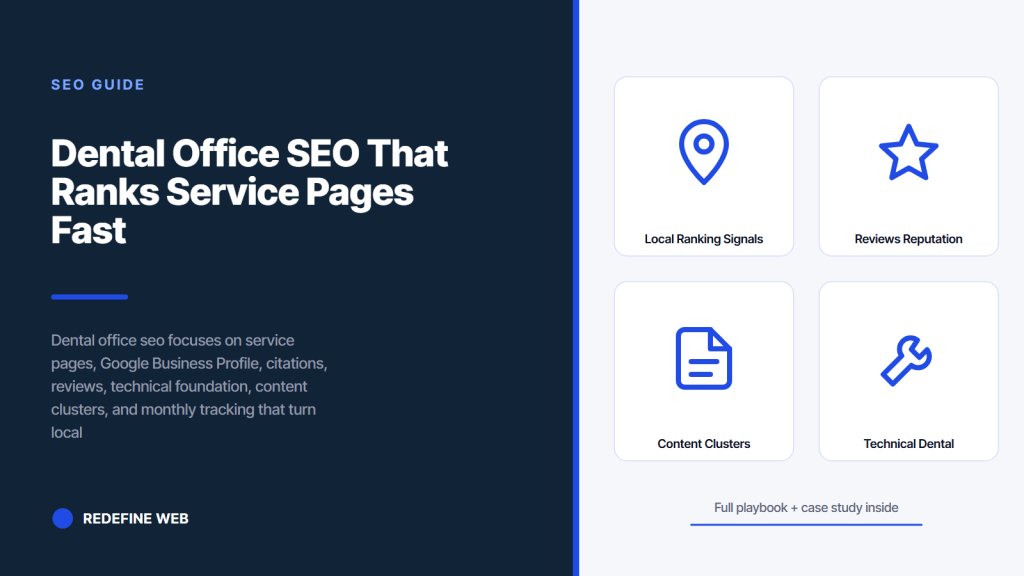
- Dental office seo covers eight distinct moves that all matter.
- Service pages are the backbone of every ranking practice site.
- Google Business Profile and citations drive the local pack.
- Reviews are a top-3 ranking factor when acquired steadily.
- Monthly tracking ties rankings to booked patients and revenue.
- Local ranking signals for seo for dental offices
- Reviews and reputation for dental office seo
- Content clusters for dental clinic seo authority
- Technical dental office seo the whole site depends on
- Tracking dental office seo results monthly
- Case study, iSmile Dental Spa’s 900 percent patient growth
- Dental office seo budget and monthly retainer options
- Common dental office seo mistakes to skip
Dental office seo is the specific SEO discipline aimed at ranking a single practice, or a small group, on the local searches that book new patients. It looks nothing like generic SEO advice you read on marketing blogs. It focuses on the office, the neighborhood, the services, the reviews, and the practice management pages that actually convert searchers into calls. Get it right and your phone rings weekly from Google. Get it wrong and you rank for nothing while the practice down the street books your patients.
This guide walks through the on-page moves, the local ranking factors, the service page structure, the review workflow, and the tracking stack that dental office seo depends on to book patients. You will get the exact page shape we build for every service page inside our practice retainers, the citation cleanup process, and the mistakes that quietly cost practices six months of ranking growth. Read once, then work the list.
Local ranking signals for seo for dental offices
Local ranking signals are the second-biggest lever in seo for dental offices, behind service pages. Google’s local pack ranks practices based on three main factors, relevance (do your pages match the query), distance (how far the searcher is from the office), and prominence (how well-known the practice reads to Google through reviews, citations, and links). You cannot change distance, but you can move relevance and prominence with disciplined work.
Google Business Profile is where prominence lives. Fill every field, primary category Dentist plus every relevant secondary (Cosmetic Dentist, Emergency Dental Service, Pediatric Dentist as applicable), 20+ photos of the office, staff, and results, weekly posts (updates, offers where allowed, patient education), Q&A section seeded with the questions patients most commonly ask, and services with descriptions for each treatment. Complete profiles rank 2 to 4 positions higher on average than half-filled ones.
Citations extend prominence off Google. NAP consistency across 40+ core directories, Yelp, HealthGrades, Zocdoc, Facebook, BBB, plus dental-specific listings (Dentist.com, WebMD, Vitals). Every inconsistency (wrong suite number, different phone) chips rankings. Use BrightLocal or Whitespark for a one-time cleanup at 400 to 800 dollars, then 30 to 60 dollars per month for ongoing maintenance. See our local seo for dentists for the full map pack playbook.
GBP post cadence for dental offices
Practices posting on Google Business Profile every week see 15 to 25 percent higher click-through rates on their map pack listings than practices posting monthly or quarterly. Post structure works best as one weekly update covering a service, a patient tip, or an event. Do not post promotional discounts too aggressively, Google can flag those. Keep tone helpful, informative, and community-oriented.
Reviews and reputation for dental office seo
Reviews are a top-3 local ranking factor for dental office seo. Practices with 100+ Google reviews at 4.7+ stars rank consistently higher than practices with 20 reviews at 4.9, because volume compounds with velocity. Google rewards steady review acquisition more than a big burst of reviews all at once. The review workflow should produce 3 to 5 new Google reviews per month, every month, without interruption.
The workflow, send an SMS review request 2 hours after every appointment through CallRail, Podium, or your practice management system. Keep the message short and specific to the visit. Do not incentivize reviews with discounts, this violates Google’s policies and can get the profile suspended. Ask specifically for “Google review” and link directly to your Google review form.
Respond to every review within 48 hours. Positive reviews get a warm thank-you referencing the specific service. Negative reviews get a professional, HIPAA-safe response acknowledging concern without confirming or denying the patient relationship, then moving the conversation offline. Practices that respond to every review see 8 to 15 percent higher review acquisition rates because patients feel heard.
Reviews on secondary platforms (Yelp, HealthGrades, Zocdoc) matter for citation prominence but do not affect Google local pack the way Google reviews do. Focus 80 percent of the review effort on Google, 20 percent on the top secondary platforms.
Content clusters for dental clinic seo authority
Content clusters build the topical authority Google uses to decide which practice site to trust. Dental clinic seo pulls forward when the site publishes deeply on the services it offers, not shallowly on everything. A pillar page (“dental implants”) plus 8 to 12 supporting posts (implant types, cost, aftercare, mini implants, all-on-4) tells Google this practice knows implants better than a generic site with one thin implants page.
Sequence the clusters by revenue. Rank order your services by lifetime value, and build the highest-LTV cluster first. Dental implants (12,000 to 40,000 dollars per case) usually wins the top slot. Cosmetic dentistry, orthodontics, and full-mouth rehabilitations come next. General preventive care and cleanings get clusters last because volume alone does not justify the content investment when higher-value services need coverage.
Every post should be attributed to a real dentist, ideally the practice owner or a specialist on staff. Byline, credentials, state license number, and a photo. Google’s E-E-A-T guidelines specifically reward first-hand practitioner content in the medical vertical. Ghostwritten posts under a “Team” byline underperform every time in dental clinic seo. Our dental website content guide covers the E-E-A-T pattern.
Refresh cadence matters too. Every cluster pillar page should get a quarterly update, new stats, new patient FAQs, a fresh photo or two. Google reads content freshness as a trust signal in the medical vertical. Stale pillar pages slip a rank position or two per quarter, so setting a recurring calendar reminder is cheaper than trying to fix a slide 18 months later.
Open your Google Business Profile. If primary category isn't the exact service you want to rank for (implants, invisalign), fix that today. On-page work waits.
Technical dental office seo the whole site depends on
Technical dental office seo is the plumbing beneath every ranking. Core Web Vitals, HTTPS, mobile-first design, schema, crawlability, and internal linking. Skip technical and every content investment underperforms because the base is broken. Nail technical and everything above compounds. Two-week sprint at the start of any engagement, then quarterly audits after that.
Core Web Vitals targets, Largest Contentful Paint under 2.5 seconds, Interaction to Next Paint under 200 milliseconds, Cumulative Layout Shift under 0.1. Most practice sites fail LCP because the hero is a giant PNG. Convert to WebP, set width and height attributes, add fetchpriority high on the hero. That single change usually moves LCP from 5 seconds to 2 seconds and picks up mobile ranking positions immediately.
Schema markup adds machine-readable context. Dentist LocalBusiness schema on the homepage and every location page. FAQPage schema on service pages with a real FAQ block. Service schema on each service page. Validate with the Rich Results Test before pushing live. Broken schema hurts more than no schema, so treat validation as a launch gate.
Internal linking spreads authority. Every service page links to related services (implants links to crowns links to bone grafts). Every blog post in a cluster links to the pillar page. Every location page links to the services offered at that office. This linking pattern is invisible to most patients but visible to Google, and it shifts rankings inside 4 to 8 weeks.
Tracking dental office seo results monthly
Tracking dental office seo closes the loop between rankings and revenue. Rankings alone are vanity. Rankings paired with organic traffic, form submits, and phone calls booked from organic are the numbers that answer whether the work paid off. Every practice should wire the tracking stack in the first 30 days.
The stack, Google Search Central guidance for LocalBusiness schema first, then Google Search Console for every property, Semrush or Ahrefs rank tracking for the top 60 keywords, Google Analytics 4 with conversion events on form submits and phone-click events, and CallRail (or WhatConverts) for call tracking that swaps a phone number by traffic source. This costs 200 to 500 dollars per month in tools and takes about 4 hours to configure once.
Report monthly against a fixed template, top 20 keywords with rank change month over month, organic traffic total and by top-10 landing pages, conversions from organic (calls + forms), estimated new-patient revenue attributed to organic. The report should take 45 minutes if the tracking is clean and 3 hours if it is not, which is why day-30 setup matters.
Close the loop with the practice management system. Every new patient gets an origin field auto-tagged by landing page and referrer, “how did you hear about us.” Aggregate monthly and you get keyword-to-patient attribution that answers the only question the practice owner actually cares about, which keywords booked how many patients this month, at what cost per patient.
Case study, iSmile Dental Spa’s 900 percent patient growth
iSmile Dental Spa in Carmichael, California came to the engagement with a strong offline reputation and a nearly invisible online presence. Non-responsive site, no HTTPS, minimal citations, weak GBP, and 1 to 2 new patients per month from digital. The practice offered sedation dentistry and periodontal treatment but had no service pages targeting those terms, so nothing ranked.
We rebuilt on secure HTTPS with a mobile-first design, then built specialized service pages for sedation dentistry, periodontal disease treatment, cosmetic dentistry, and family dentistry, each targeting a specific keyword cluster with local modifiers. NAP consistency across 40+ directories, GBP category optimization with 20+ photos, and monthly review generation stacked local signals on top. Google Ads ran in parallel to fill the funnel while organic ramped up.
Six months in, iSmile ranked on page 1 for 75 keywords across service, location, and long-tail terms. Organic traffic climbed 800 percent. Patient acquisition rose 900 percent. The practice averaged 12 to 14 new digital patients per month. The 500 percent ROI on the total program held for the next three years without needing to double content spend.
The takeaway is the same one every dental office seo engagement teaches. Right keywords, mapped to right pages, backed by clean technical SEO and stacked local signals. See dental website seo for the technical side and custom dental website design packages for the build.
Dental office seo budget and monthly retainer options
Dental office seo budgets fall into three tiers. DIY practices spend 200 to 500 dollars per month on tools (Semrush, Ahrefs, BrightLocal, CallRail) plus 15 to 20 hours per month of practice-owner or office-manager time. Freelancer partnerships run 1,200 to 2,500 dollars per month for a solo consultant covering on-page and content while the practice handles GBP. Agency retainers run 1,500 to 4,500 dollars per month for full-stack scope.
Redefine Web practice retainers start at 599 dollars per month for single-office scope and scale to 2,400 dollars per month for multi-office groups. The starter scope includes GBP maintenance, monthly rank tracking, 2 published posts, on-page fixes, monthly reporting, and a quarterly strategy review. Multi-office adds per-location content, citation management per office, and cross-office internal linking.
| Tier | Monthly cost | Owner hours/mo | Best for |
|---|---|---|---|
| DIY | $200-$500 tools | 15-20 hrs | Solo practice, comfortable with tech |
| Freelancer | $1,200-$2,500 | 5-8 hrs | Small practice, hybrid model |
| Agency starter | $599-$1,200 | 2-4 hrs | Single-office growth stage |
| Agency multi-loc | $1,500-$4,500 | 3-6 hrs | 3+ office group or DSO |
ROI math is direct. If a new patient is worth 900 dollars lifetime value and the retainer brings 8 to 12 new patients per month at month 6, the retainer pays back 5 to 15 times monthly. Practices that measure ROI on month 2 call volume without lifetime value adjust often drop the retainer too early. Give it 6 months. See dental marketing plan for how to structure the milestone gates.
Common dental office seo mistakes to skip
The biggest dental office seo mistake is treating it like generic small-business SEO. Dental has unique constraints, HIPAA, ADA, medical E-E-A-T, and specific search behavior around insurance and near me qualifiers. A vendor pitching generic SEO to a dental practice usually delivers generic results, which is another way of saying no ranking movement for six months.
Second mistake, chasing generic terms like “dentist” without a location modifier. Even a strong practice site will not outrank Aspen Dental for the ungeographic term. Target city plus service (“dental implants Austin”), neighborhood plus service (“family dentist Park Slope”), and insurance plus dentist (“dentist that accepts Aetna Austin”). These convert 3 to 5 times better anyway.
Third mistake, publishing thin service pages. A 400-word implants page will never rank against a 1,600-word competitor with proper structure. Every service page needs depth (benefits, procedure, cost, aftercare, FAQ), not word count for its own sake. Read the top 3 competitors and cover every subtopic they cover, plus 2 they missed. Then stop.
Fourth mistake, and one that came up during a real audit call, was a practice owner proudly showing us a beautifully designed homepage that scored a 12 on mobile PageSpeed. Twelve. Out of 100. Google was crawling the site at 4 pages per minute. Nothing could rank until the site finished loading, which is a hard bar to clear when it never really did.
- Treating dental office seo like generic small-business SEO
- Chasing “dentist” without a location modifier
- Publishing thin service pages that lack depth
- Skipping technical foundation before content
- Not tracking rankings against booked patients
Frequently asked questions
What is dental office seo and how does it differ from generic small-business SEO?
Dental office seo is the specialized SEO discipline for ranking a dental practice on local searches that book new patients. It differs from generic small-business SEO in five ways, HIPAA-safe conversion tracking and forms, ADA compliance on the site (mandatory for healthcare), medical E-E-A-T standards on content (bylines, credentials, license numbers), specific patient search behavior (near me plus insurance plus service), and the local pack behavior for medical categories in Google. A vendor pitching generic SEO to a dental practice usually delivers generic results, meaning no meaningful ranking movement for six months.
How long does dental office seo take to produce results?
Dental office seo produces meaningful results in 4 to 6 months for established practice sites with clean technical foundations. Local and long-tail terms rank first, in weeks. City-plus-service terms land page 1 by month 4 to 6. Highly competitive service terms take 12 to 18 months, especially in metros with heavy DSO competition. Brand new practice sites add 6 to 8 months to every timeline because Google has not accumulated trust signals yet. Practices asking for 30-day rankings from an agency should hang up the phone and find a different partner.
How many service pages does a dental office seo plan need?
A dental office seo plan needs one service page per service the practice actually performs. For most general practices that means 12 to 20 pages covering preventive care, restorative (fillings, crowns, bridges), cosmetic (veneers, whitening, bonding), implants, orthodontics if offered, endodontics if offered, periodontics, oral surgery, pediatric if offered, and emergency dental care. Multi-location groups add per-office variants of each page. Skimping to 4 or 5 pages leaves 8 to 15 ranking assets on the table and cuts organic traffic capacity by 60 percent or more.
How much does dental office seo cost per month?
Dental office seo costs 200 to 500 dollars per month in DIY tool subscriptions plus 15 to 20 owner hours, 1,200 to 2,500 dollars per month for a freelancer partnership, and 1,500 to 4,500 dollars per month for a full-stack agency retainer covering technical, on-page, local, content, and reporting. Multi-location DSOs pay 3,500 to 8,000 dollars per month because scope scales with locations. Redefine Web practice retainers start at 599 dollars per month for single-office scope. Payback usually lands between month 4 and month 8 measured against new-patient lifetime value.
Does dental office seo work in the age of Google AI Overviews?
Yes. AI Overviews summarize answers from the pages that rank in the top 10 organic results, so dental office seo work is exactly the input Google's AI reads. Practices with strong service pages, FAQ schema, and answer-first paragraphs under question H2s get cited in AI Overviews and picked up as brand mentions even when the click drops. The moves themselves have not changed. The reward has extended to a new SERP surface, and practices that skipped SEO before because they thought AI would replace search have fallen further behind, not less.
Can a solo dentist run dental office seo without an agency?
A solo dentist can run dental office seo without an agency if they have 15 to 20 hours per month of consistent bandwidth and comfort with Semrush or Ahrefs, Google Search Console, and Google Business Profile. DIY works best for technical fixes, GBP maintenance, on-page updates, and citation cleanup. It stops working when the practice needs 4+ posts per month, cross-office coordination, or link-building outreach at scale, which usually needs a dedicated hire or an agency partner. Most practices hit that wall around 30 published pages and switch to a hybrid model with a freelancer or agency.
Book your free 30-minute strategy call.
No spam, no sales rep. We use your email to schedule your call with a senior strategist. That is it.
More from the blog
View all articles → SEO
SEO Organic Search Engine Optimization Services That Grow Real Traffic
Read article SEO
SEO SEO for Pet Groomers That Fills the Appointment Book Weekly
Read article SEO
SEO