
Marketing Plan for Ecommerce Template and Launch Checklist
- Ship the plan on one page before spending a dollar.
- Tie every channel line to a revenue target.
- Lock a 30-day launch checklist for week zero.
- Budget splits shift by DTC brand stage.
- Review the plan monthly, not quarterly.
- Building the Ecommerce Marketing Checklist by Channel
- How to Write an Ecommerce Marketing Plan Without Overengineering
- Paid Media Budget Split Across Meta Google and Retargeting
- Email and SMS Lifecycle Playbook for Launch and Retention
- SEO and Content Cadence for the Marketing Plan for Ecommerce
- Measuring the Marketing Plan Against Revenue and CAC
- Real Work Behind the Marketing Plan for Ecommerce
- Where the Marketing Plan for Ecommerce Fits Your Stack
You’re about to spend $30,000 to $180,000 on ecommerce marketing in the next twelve months and the plan for how each dollar earns revenue sits in your head, not on paper. That’s the problem this guide fixes. A working marketing plan for ecommerce is one page long, ships in a week, and tells your team exactly which channel spends what, which KPI it moves, and which day the review meeting happens. The 100-page brand strategy deck a consultancy sold you last spring is not a marketing plan. It’s a doorstop.
This guide walks the template, the 30-day launch checklist, and the channel-by-channel budget math we use with real DTC clients from starter Shopify stores at $200K yearly revenue up to scale brands past $20M. Every retainer number, checklist item, and cadence rule below runs against a live account. Read straight through in twelve minutes and finish with a page you can hand to your team on Monday.
Building the Ecommerce Marketing Checklist by Channel
The ecommerce marketing checklist splits by channel because each channel has its own setup depth. A single flat list of 200 tasks intimidates the team and hides the sequencing. Four to six checklists, one per channel, run faster because each owner sees only the block they run.
Paid Media Checklist Runs 22 Items
The paid media checklist covers pixel and tag setup, catalog feed integrity, campaign structure for Meta Advantage Plus plus manual campaigns, audience seeding for lookalikes and interests, five to eight creative variants per campaign, bid strategy pick between ROAS and CPA, dayparting decisions, negative keyword lists on Google Shopping, and offline conversion upload for Klaviyo revenue attribution. Deep guides from Think with Google’s ecommerce search coverage walk the campaign structure math a founder can copy against. Our take on the full retention program lives inside the email marketing for ecommerce deep read.
Email SMS SEO and Creative Round Out the Checklist
Email plus SMS checklist covers 14 items including welcome flow, abandoned cart, browse abandonment, post-purchase, winback, replenishment, and a monthly campaign calendar. Ecommerce SEO checklist runs 18 items covering technical crawl, category page schema, product page schema, blog cadence at two to four posts monthly, internal linking hygiene, and Google Search Console monitoring. Creative production checklist runs eight items covering photo shoot cadence, UGC sourcing, video ad templates, and iteration rhythm. Every checklist gets a named owner and a due date. For a fuller channel play mapping walk our ecommerce digital marketing strategy deep read.
How to Write an Ecommerce Marketing Plan Without Overengineering
Draft the whole plan in 90 minutes on the first pass. Open a blank doc. Write the yearly revenue number. Split it into twelve months. Pick two to four channels based on stage. Assign a monthly budget per channel. List the top 15 checklist items for the next 30 days. Assign an owner per item. Ship version one. Iterate weekly.
Overengineering kills more marketing plans than underengineering. Founders that spend six weeks on a beautiful plan lose the first quarter of execution. Founders that ship an ugly one-page plan on Wednesday and start running Meta ads on Thursday earn a full quarter of data by the time the beautiful-plan founder finishes drafting. The plan gets rewritten monthly anyway. Version one exists to unblock action, not to win awards.
The 90-minute draft covers four sections: revenue math, channel picks with budget, top 15 tasks with owners, and reporting rhythm. Skip brand positioning, competitive analysis, SWOT, and TAM SAM SOM sizing. Those live in a strategy doc that gets reviewed twice a year. The marketing plan is the operational sibling of the strategy doc. Two different documents with different jobs. Marketing plans that try to double as brand strategy documents fail at both because the audiences read them differently. Reference the HubSpot marketing plan framework for a plain outline that fits an ecommerce brand’s needs on the first pass.
Paid Media Budget Split Across Meta Google and Retargeting
Paid media eats the biggest budget line in almost every ecommerce plan and the split across Meta, Google, and retargeting drives whether the spend earns. The rough starting split for a DTC brand under $2M yearly revenue: 55 to 65 percent Meta prospecting, 20 to 25 percent Google Shopping plus branded search, 10 to 15 percent retargeting across Meta and Google display, 5 percent video marketing for ecommerce test budget.
Prospecting Carries the Growth Number
Meta prospecting on Advantage Plus Shopping campaigns handles cold audience acquisition for most DTC brands at growth stage. The campaign runs against a lookalike seed from the top 25 percent value customers plus interest layers relevant to the product category. Creative rotation of three to five new variants weekly keeps fatigue under control past the first 90 days. Prospecting spend that flattens ROAS by month two usually points to weak creative rather than a broken audience. Our ecommerce PPC management deep read walks the account structure decisions per brand stage.
Retargeting Runs on a Smaller Slice
Retargeting works as a supporting slice at 10 to 15 percent of paid budget, not the headliner. Founders that over-invest retargeting past 25 percent of budget cannibalize returning customer revenue that would have converted through email flows anyway. The right retargeting split runs a sequenced funnel: browse abandonment at day one to three, cart abandonment at day one to seven, category interest at day seven to 30. Retargeting past day 30 rarely earns positive incremental ROAS on a DTC brand under $10M yearly revenue. Turn off long-window retargeting after the first month of data proves it out.
40-slide strategy decks aren't marketing plans. Open a blank doc. Write revenue target, channel budget, launch list, review cadence. Done in 15 minutes.
Email and SMS Lifecycle Playbook for Launch and Retention
Email plus SMS handles 20 to 40 percent of ecommerce revenue at healthy DTC brands. The lifecycle playbook opens with four flows on day one, adds three flows by month three, and runs a monthly campaign calendar in parallel. The playbook holds regardless of whether the brand runs Klaviyo, Mailchimp, or Attentive because the flow structure matches how buyers actually behave, not how the tool draws diagrams.
Four Flows on Day One
The four launch-day flows: welcome series across three to five emails, abandoned cart across three emails plus two SMS, browse abandonment across two emails, and post-purchase across two emails. The welcome flow captures 30 to 50 percent of first-week email revenue at a starter brand. Abandoned cart recovers 8 to 15 percent of abandoned sessions when the SMS layer runs alongside email. Browse abandonment recovers 3 to 7 percent. Post-purchase drives review requests and second-order flows. Skipping any of the four leaves 10 to 25 percent of revenue on the table inside the first 90 days.
Three More Flows by Month Three
Winback flow triggers at day 90 without a purchase and runs three emails plus one SMS. Replenishment flow triggers at the expected reorder window for consumable products, usually 25 to 45 days after purchase. VIP flow triggers at the top 5 percent value tier and runs a monthly touchpoint. Add these three by month three once the first four flows produce baseline numbers. Our ecommerce digital marketing services retainer scope walks the flow sequencing per brand tier.
SEO and Content Cadence for the Marketing Plan for Ecommerce
Ecommerce SEO under the marketing plan for ecommerce runs on a monthly cadence covering category page rewrites, product page schema audits, and buyer-intent blog content. The cadence holds constant across brand stages. What shifts is the total volume per month. Starter brands publish two blog posts monthly plus one category rewrite. Growth brands publish four blogs and three category rewrites. Mid-market brands push eight to twelve blog posts and monthly category refreshes. Scale brands past $10M add author bylines with real author bios, expert-review workflows, and structured product schema audits every quarter to keep pace with Google core update cycles that hit ecommerce categories the hardest each spring and fall.
Category Pages Carry Commercial Intent
Category pages rank for the highest intent commercial searches. A DTC skincare brand’s category pages target queries like “vitamin c serum” or “retinol cream” that pull buyers with wallet out. Category page rewrites focus on above-the-fold copy, filter and sort logic, review integration, related product blocks, and a rich results eligibility check on Product schema. Category page work returns organic revenue faster than blog content at any brand stage because the intent already exists in the searcher. The full technical set lives in our ecommerce SEO services walkthrough.
Blog Content Warms Early Funnel
Blog content catches early funnel readers researching the product category two to twelve weeks before buying. A candle brand publishing a guide on soy versus paraffin wax earns readers today and converts them at week eight when they bookmark the brand and return during a promo cycle. Blog content compounds slower than paid but produces a lower cost per acquired customer past month nine. Founders that skip blog content in the first year plan usually reintroduce it around month fourteen when paid ROAS drift proves the need for organic acquisition upside.
Measuring the Marketing Plan Against Revenue and CAC
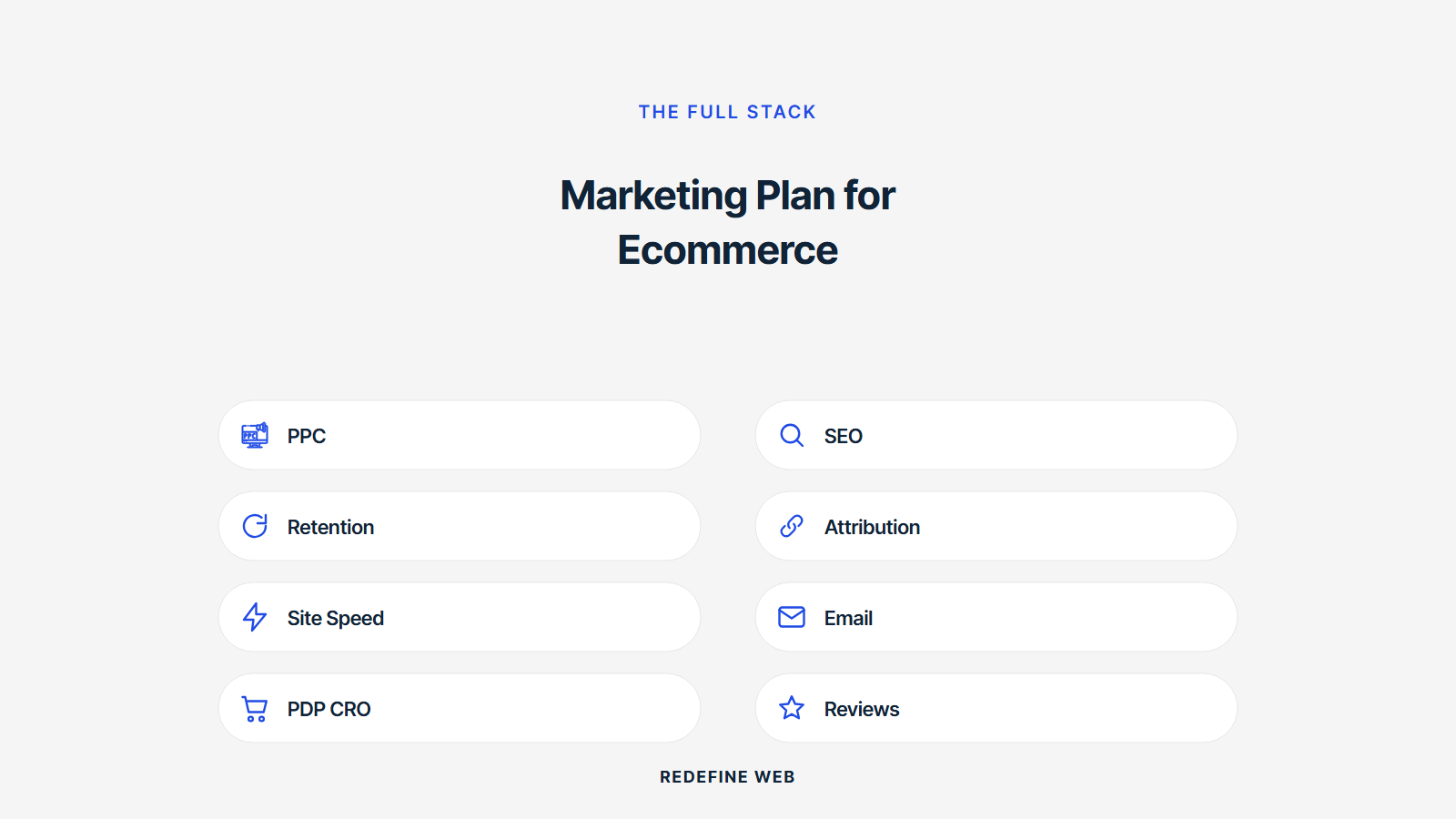
Measurement closes the loop on the whole plan. The right dashboard tracks eight KPIs at the brand level plus four KPIs per channel. Track weekly at the channel level. Track monthly at the brand level. Track quarterly at the LTV level. Dashboards that mix cadences confuse the team and mask which number is actually behind plan.
| Brand stage | Yearly revenue | Total monthly spend | Retainer floor | Media spend | Priority KPI |
|---|---|---|---|---|---|
| Starter | Under $500K | $3,000 to $8,000 | $599 | $2,000 to $6,500 | New customer count |
| Growth | $500K to $2M | $10,000 to $30,000 | $3,500 to $6,500 | $6,500 to $23,500 | New customer revenue |
| Mid-market | $2M to $10M | $30,000 to $150,000 | $6,500 to $12,000 | $23,500 to $138,000 | Blended ROAS |
| Scale | $10M to $30M | $150,000 to $400,000 | $12,000 to $20,000 | $138,000 to $380,000 | Marketing efficiency ratio |
| Enterprise | $30M plus | $400,000 plus | $20,000 plus | $380,000 plus | Contribution margin after ads |
The table lines up spend against revenue tier so the founder can spot whether the current spend matches brand stage. Overspend past tier usually points to premature scaling. Underspend below tier caps growth against a real market opportunity. Adjust the plan monthly to keep spend aligned with actual revenue trend, not the yearly target set in January.
Every founder writing a first marketing plan opens a Notion doc, spends 45 minutes picking a template with three colored tabs, moves one bullet from column A to column B, changes the header font twice, and then closes the laptop because the actual plan writing feels harder than the template design. Somewhere in a shared drive at 2 million DTC brands, an untouched marketing plan template with a blue accent border sits waiting for its second paragraph.
Real Work Behind the Marketing Plan for Ecommerce
Abigail Ahern, a luxury home decor brand out of London, engaged Redefine Web in August 2020 to unify a marketing plan for ecommerce that had drifted into heavy discount reliance and branded search dependency. The brief centered on cutting discount messaging that had trained buyers to wait for promotions, rebuilding Google Shopping campaign structure around non-branded intent, and restoring category page SEO for high-intent design queries. Paid media and SEO ran under one retainer with one account team.
The rebuild results across a 12-month window on a unified plan. Ecommerce revenue grew 179 percent year over year. Paid search return on ad spend climbed from around 700 percent to 1,588 percent, more than doubling the previous cycle’s efficiency. Paid social return on ad spend reached 3,000 percent through disciplined retargeting and prospecting audience work. Conversion rate roughly doubled from the pre-partnership baseline. Non-branded search demand that had been going to Neotimber and other competitors flipped back to Abigail Ahern category pages inside six months.
What made the Abigail Ahern engagement work under one plan was scope alignment. Paid and SEO shared a single account team who pulled organic keyword data into paid targeting and paid audience learnings into SEO content planning. That cross-channel loop rarely happens when a brand runs three specialist agencies against three separate plans. This is why our ecommerce marketing agency hub sells full-stack scope over deep-single-channel work at the growth and mid-market tiers.
Where the Marketing Plan for Ecommerce Fits Your Stack
The marketing plan for ecommerce sits at the operational layer between the brand strategy doc and the weekly channel reports. Strategy tells the team why the brand exists. The plan tells the team what to do this month. The channel reports tell the team whether the plan is working. All three documents matter. All three run on different cadences and different levels of detail.
Founders that collapse the three into a single doc usually end up updating none of them. Founders that run the three separately with named owners keep the operational discipline that compounds into real revenue outcomes across 12 to 24 months. The plan-first pattern earns compounding gains from month six onward because the team stops rewriting foundational decisions every Monday and starts iterating on real campaign data. Founders that skip the plan spend the first year making the same three tactical decisions repeatedly across every channel review. Reference reads like Content Marketing Institute’s plan framework confirm the split between content strategy and content plan, which the same discipline applies to a full marketing plan.
Founders ready to run the template against real brand numbers can start with a free audit of the current channel mix, spend, and reporting rhythm. That audit produces a written fix map and a channel-priority order before any retainer conversation begins. Read our ecommerce marketing definition deep read for the channel-by-channel primer that complements this plan-focused guide. Whether the brand is a starter Shopify store at $200,000 yearly revenue or a scale brand pushing past $20M, the plan-first pattern beats the tactic-first pattern every quarter.
Founders planning the next twelve months against the ecommerce marketing trends 2026 should treat this plan template as the operational sibling of the trend read.
Related read: ecommerce marketing metrics benchmarks.
Frequently asked questions
What should a marketing plan for ecommerce include at minimum?
A working marketing plan for ecommerce lists four things on one page. A revenue target with a monthly split. A channel budget covering paid media, ecommerce SEO, email plus SMS, and creative. A 30-day launch checklist for pre-launch and week one. A reporting rhythm with named owners for weekly and monthly reviews. Everything else is optional. Skip any of the four and the plan drifts inside 45 days because nobody knows which channel is behind and who fixes it. Practice owners often overbuild the plan to 20 pages then never open it after week two.
How do you write an ecommerce marketing plan for a store under 500K yearly revenue?
Start with a one-page plan for a store under $500K yearly revenue. Pick two channels rather than five. Paid social on Meta and lifecycle email through Klaviyo cover 80 percent of what a starter store needs. Set a monthly retainer floor at $599 with $3,000 to $8,000 in ad spend. Write a 30-day launch checklist that ships a welcome flow, an abandoned cart flow, five Meta ad creatives, and a homepage rewrite. Track new customer revenue, cost per acquired customer, and email revenue share weekly. Add channels only after month three when the first two hit their numbers.
What goes on an ecommerce marketing checklist for a Shopify launch?
An ecommerce marketing checklist for a Shopify launch covers eight blocks in the first 30 days. Google Analytics 4 and Meta Pixel installed with a Shopify tag manager. Klaviyo connected with welcome, browse abandonment, cart abandonment, and post-purchase flows drafted. Google Merchant Center feed live for Shopping ads. Meta and Google campaigns structured with two audiences each. Homepage, three category pages, and top ten product pages rewritten for conversion. Review request emails set up through Judge.me or Loox. A weekly reporting dashboard in Looker Studio. SMS keyword and welcome message live through Postscript or Attentive.
How much should a DTC brand budget against a marketing plan for ecommerce?
A DTC brand budgets against a marketing plan for ecommerce in three lines. Media spend on Meta, Google, and TikTok. Agency retainer or in-house salary. Software stack across Klaviyo, Postscript, Judge.me, and analytics. Starter brands run $3,000 to $8,000 monthly total spend. Growth stage brands at $500K to $2M yearly revenue run $10,000 to $30,000 monthly. Mid-market brands at $2M to $10M run $30,000 to $150,000 monthly. Retainer floors sit at $599 for starter, $3,500 to $6,500 for growth, and $6,500 to $12,000 for mid-market. Media spend runs three to ten times the retainer at healthy brands.
How often should you update the ecommerce marketing plan template?
Update the ecommerce marketing plan template monthly for the first quarter, then quarterly once the numbers stabilize. Month one revisits channel-level budget split against the first data. Month two adjusts campaign creative and audience mix. Month three locks the retainer scope and reporting cadence. From month four onward, review the plan on the last Friday of each quarter. Rewrite the whole template once yearly around the peak season prep window. Founders that leave the plan static for six months end up running channels against last quarter's data rather than the current buying cycle, which shows up in wasted spend by month five.
Book your free 30-minute strategy call.
No spam, no sales rep. We use your email to schedule your call with a senior strategist. That is it.
More from the blog
View all articles → Digital Marketing
 Dental Marketing Tips That Compound Into New Patients
Read article Digital Marketing
 Ecommerce Marketing Strategies That Drive Real DTC Revenue
Read article Digital Marketing